Equipment for Leg Exercises: Gym Machines and Home Gear Explained for Beginners
Equipment for leg exercises can be confusing when you first see it. Walk into a gym and there is a row of machines with seats, pads and pins, and none of them come with clear instructions. Look online for home gear, and you will find everything from cheap resistance bands to expensive machines that promise to tone your legs in minutes a day.
Here is what I would want a friend to know before spending money or feeling lost in a gym. You do not need much. Your legs respond to being worked hard and progressively, and that can happen on a leg press, with a pair of dumbbells or with a single resistance band. The best equipment is the kind that suits your body, your space and your budget, and that you will actually keep using.
This guide explains what each leg exercise machine does and how to use it, the most useful home gear, what research says about machines and free weights, and three simple workouts. There is also advice for older adults and for anyone with sore knees.
At a glance
- Your legs have four main muscle groups: quads, hamstrings, glutes and calves
- The most useful gym machines are the leg press, leg curl, leg extension and calf raise
- The most useful home gear is a pair of dumbbells or a kettlebell, resistance bands and a sturdy step
- A review of 13 studies found no clear overall winner between machines and free weights for strength or muscle size
- Machines are easier to learn. Free weights also train balance and transfer better to free-weight strength tests
- Older adults can do well on machines, and strength training improves everyday tasks such as rising from a chair
- There are no affiliate links on this page, and this is general advice, not product reviews
What your leg muscles need
Good equipment for leg exercises lets you work all of the main muscle groups, and add resistance over time. Here is what each one does and the type of equipment that trains it.
| Muscle group | Where it is | What it does | Equipment that trains it |
|---|---|---|---|
| Quadriceps | Front of the thigh | Straightens the knee | Leg press, leg extension, hack squat, dumbbells |
| Hamstrings | Back of the thigh | Bends the knee and extends the hip | Leg curl, dumbbells, kettlebell, bands |
| Glutes | Buttocks | Extends and stabilises the hip | Leg press, hip thrust machine, bands, dumbbells |
| Calves | Back of the lower leg | Lifts the heel | Calf raise machine, step, dumbbells |
| Inner and outer thighs | Sides of the thigh and hip | Move the leg in and out | Hip machine, cables, bands |
So a well-rounded setup does not need ten different machines. It just needs something that lets you push, bend the knee and hinge at the hips, with enough resistance to make the last few reps hard. Our guide to what muscles squats work explains how these muscles work together.
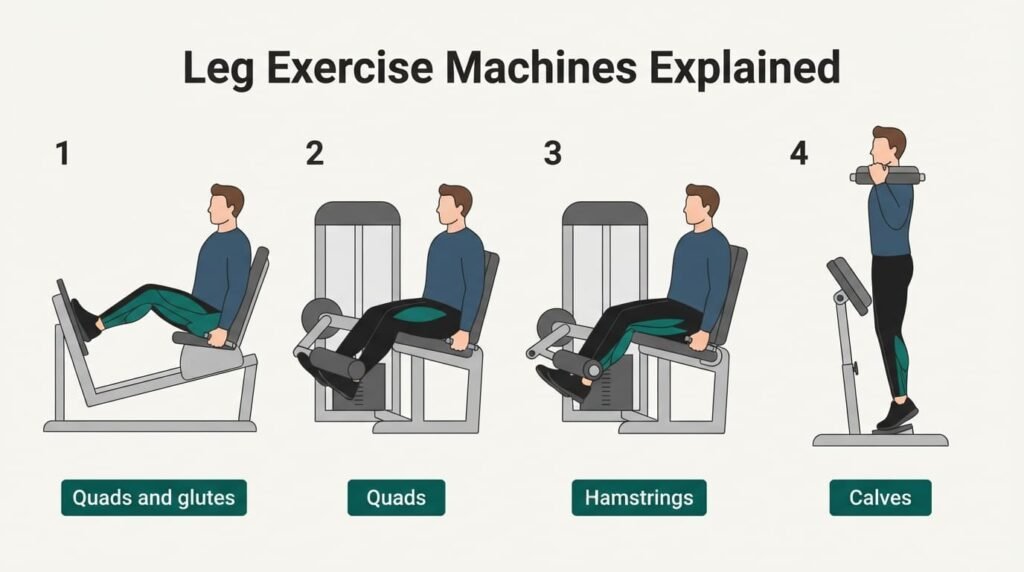
Gym machines: what each leg exercise machine does
If you are new to the gym, this is the equipment for leg exercises you will usually find. Most machines have a picture and instructions on the frame, and the staff will happily show you how to set one up.
Our guide to cable leg exercises shows 10 beginner moves on the cable machine, plus Smith machine options.
| Machine | Main muscles | Best for | Beginner tips |
|---|---|---|---|
| Leg press | Quads, glutes, hamstrings | Heavy leg work with back support | Keep your lower back on the pad and do not lock your knees hard |
| Leg extension | Quads | Isolating the front of the thigh | Use a moderate weight and move smoothly |
| Seated or lying leg curl | Hamstrings | Isolating the back of the thigh | Line up your knee with the machine’s pivot |
| Calf raise machine | Calves | Full range of calf work | Pause at the bottom and top |
| Hip abductor and adductor | Outer and inner thighs | Hip and thigh strength | Use a slow, controlled movement |
| Hack squat | Quads, glutes | A guided squat with support | Start with low weight and short range |
| Smith machine | Quads, glutes | A squat or lunge on a fixed path | Fine for beginners, but learn how to set the safety stops |
| Cable machine | Glutes, hamstrings, hips | Kickbacks, pull-throughs and hip work | Ask staff how to use the ankle strap |
The leg press
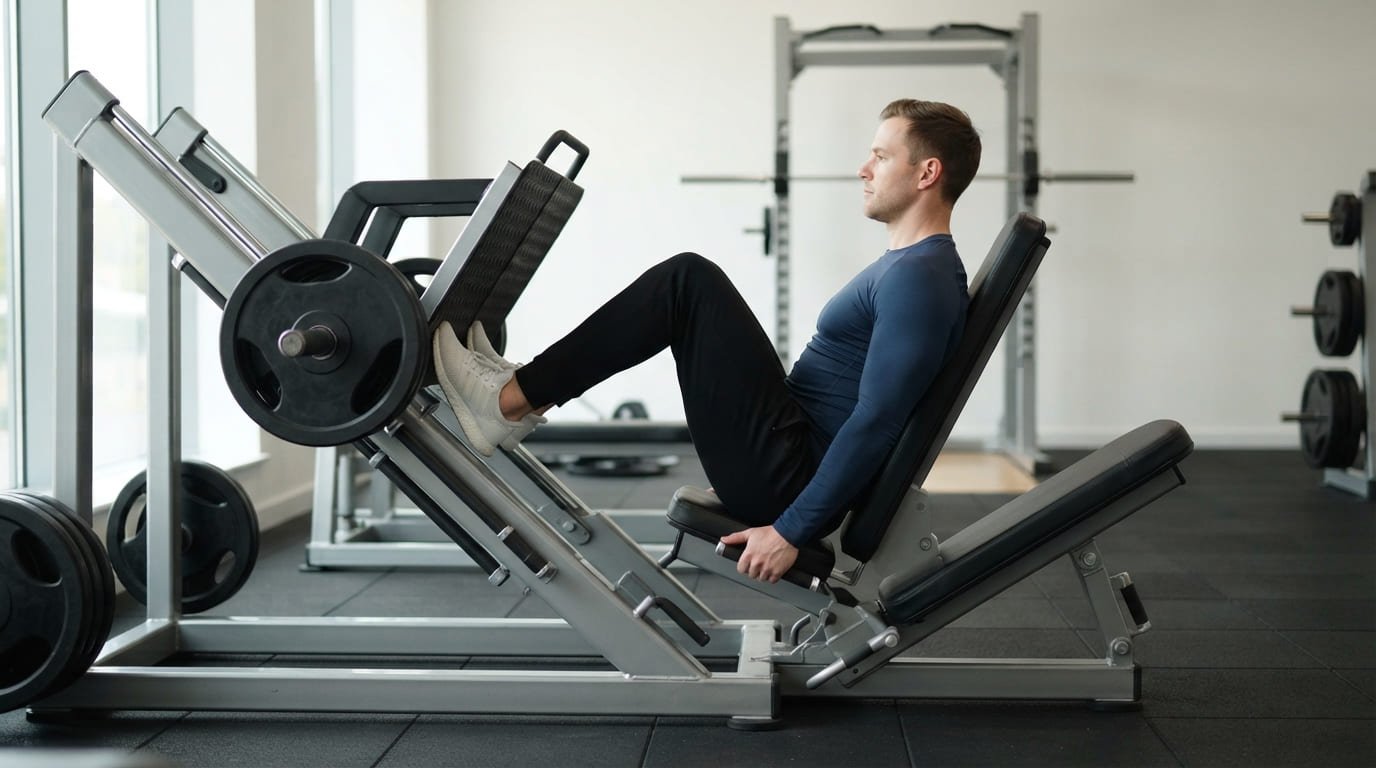
If you only use one leg exercise machine, make it this one. It trains the quads, glutes and hamstrings together, and your back is supported.
- Sit with your back and head flat against the pad
- Put your feet flat on the plate, about hip-width apart
- Release the safety handles and lower the plate slowly until your knees are bent to about 90 degrees
- Press through your whole foot to return, stopping just before your knees lock
- Re-engage the safety handles when you finish
Dose: 3 sets of 10 to 12. Do not let your lower back lift off the pad at the bottom.
Leg extension and leg curl
These two work as a pair. The leg extension trains the front of the thigh, while the leg curl trains the back. Set the pad so it sits just above your ankle, and line your knee up with the machine’s pivot point, usually marked in a bright colour. Do 2 to 3 sets of 10 to 15 with a smooth, controlled movement. If the leg extension irritates your knees, reduce the range or skip it, and use the leg press instead.
Hip abductor and adductor machines
These train the muscles on the outside and inside of your thighs. They are useful for hip strength, but they will not burn fat from your thighs, whatever the marketing says. Do 2 sets of 12 to 15 slowly. You can train the same muscles at home with our outer thigh exercises and inner thigh exercises.
Cardio machines that also work your legs
Stationary bikes, rowers, stair climbers and treadmills all work your legs too, mostly for endurance rather than strength. They are excellent for your heart and stamina, but you still need something heavier to build real strength. Our guides to the exercise bike and rowing machine workouts explain how to use them.
The best leg exercise equipment for home
You do not need a gym to have good equipment for leg exercises. You can build strong legs at home with very little. Here is the leg exercise equipment for home that I think gives the most value, in the order I would buy it.
| Equipment | What it trains | Approximate cost level | Why it earns its place |
|---|---|---|---|
| Your bodyweight and a chair | Squats, lunges, step-ups | Free | Start here if you are new |
| Resistance bands | Glutes, hips, hamstrings | Low | Cheap, portable and very versatile |
| A sturdy step or low box | Step-ups, calf raises | Low | Great for strength and balance |
| Dumbbells or an adjustable pair | Whole lower body | Medium | Easy to add load in small steps |
| A kettlebell | Swings, goblet squats, deadlifts | Medium | One bell covers a lot |
| A stationary bike | Cardio and leg endurance | Medium to high | Useful if you want low-impact cardio at home |
| A squat rack and barbell | Heavy strength work | High | Only worthwhile if you are committed and have the space |
For most people, resistance bands plus a pair of dumbbells or a single kettlebell will take you a very long way. Our guides to the dumbbell leg workout at home, kettlebell leg exercises and resistance band leg workout show you exactly how to use them.
Home gear I would think twice about
- Thigh toners and squeeze gadgets. They offer very little resistance, and they cannot burn fat from your thighs
- Vibration machines as your only exercise. They can have a place, but they do not replace strength training. See our guide to vibration plate exercises
- All-in-one machines you have not tried. They are bulky and often poorly made. Try before you buy, if you can
- Anything sold with a promise of fast, effortless results. If it sounds too good to be true, it probably is
Under-desk pedal exercisers
Portable pedal exercisers have become popular, especially among older adults. They offer gentle leg movement while you sit, which can be a good way to keep your legs moving if walking is difficult. Just remember the resistance is usually light, so they are for gentle activity rather than for building strength.
Machines or free weights: what does the research say?
People love to argue about which equipment for leg exercises is better, so I looked for a proper answer. A review of 13 studies with over 1,000 participants compared free-weight training with machine training. In a direct comparison, it found no differences between the two for strength, jump performance or muscle size.
There was one interesting detail. You tend to get better at the type of test you train for. People who trained with free weights improved more in free-weight strength tests, while machine users tended to do better on machine tests. So train the way you want to get strong.
| Point | Machines | Free weights |
|---|---|---|
| Learning curve | Easy | Takes more practice |
| Balance and coordination | Less needed | Trains them too |
| Safety when you train alone | Generally easier | Needs more care with heavy loads |
| Space and cost at home | Large and expensive | Small and cheaper |
| Isolating one muscle | Excellent | Possible, but harder |
| Carry-over to daily movement | Good for strength | Often closer to real-life movement |
My view is that you should use what you have and enjoy. If machines get you into the gym and make you feel confident, that is a very good reason to use them. Many people end up using a mix of both.
Leg equipment for older adults
Strong legs are one of the best things you can have as you get older. A Cochrane review of 121 trials with 6,700 older adults found that progressive resistance training had a large positive effect on muscle strength, a moderate to large effect on getting out of a chair and a modest improvement in walking speed.
The best equipment for leg exercises can change a little as we age. If you are older, or returning after a long break, these tend to be good options:
| Equipment | Why it suits older adults | Tip |
|---|---|---|
| Seated leg press | Supported back, easy to adjust | Start with very low weight |
| Seated leg curl and extension | Stable and controlled | Keep movements smooth |
| Recumbent bike | Low-impact cardio with back support | Good for sensitive knees |
| Sturdy chair | Sit-to-stands train daily strength | Use your arms if you need to at first |
| Light resistance bands | Gentle and portable | Good for hip and thigh work |
| Pedal exerciser | Keeps legs moving while seated | Good for movement, not strength |
A leg exercise machine for the elderly should be easy to get on and off, with a stable seat and handles. Ask a trainer or physiotherapist to help you with your first sessions. Our guide to leg exercises for seniors has many routines that need only a chair.
How to choose equipment for leg exercises
Ask yourself these questions before you spend any money.
- What is your goal? Strength, muscle size, general fitness or staying independent all need slightly different tools
- Where will you train? A gym already has the machines. At home, think about space and noise
- What can your joints tolerate? Supported machines and low-impact cardio may suit sore knees or hips
- Will you actually use it? The best equipment is the one you enjoy and can reach easily
- Can you make it harder later? Your legs will get stronger quickly. Choose equipment that lets you add resistance
| Your situation | What I would choose |
|---|---|
| Complete beginner at home, small budget | Bodyweight, a chair and resistance bands |
| Beginner at home, wanting to build strength | Add adjustable dumbbells or a kettlebell |
| Gym member, nervous about free weights | Leg press, leg curl, leg extension and calf raise |
| Gym member, wanting strength and balance | Goblet squats and dumbbell lunges, plus the leg press |
| Older adult or returning after a long break | Seated machines, a chair and a recumbent bike |
| Very small flat | Bands and a kettlebell that lives under the bed |
There are no affiliate links on this page, and I do not earn anything from any equipment you buy. I also have not tested specific brands, so this is general guidance rather than a product review. For more on low-cost gear, see our guide to the best home gym equipment for beginners.
3 simple leg workouts
Each workout below uses different equipment for leg exercises, so choose the one that matches what you have. Warm up first with 5 minutes of walking or easy cycling, plus 10 bodyweight squats. Our guide to warming up before a workout has a full routine.
Workout 1: machine leg workout at the gym
| Exercise | Sets and reps | Rest |
|---|---|---|
| Leg press | 3 x 10 to 12 | 90 seconds |
| Seated leg curl | 3 x 10 to 12 | 60 seconds |
| Leg extension | 2 x 12 to 15 | 60 seconds |
| Calf raise machine | 3 x 12 to 15 | 45 seconds |
| Hip abductor machine | 2 x 15 | 45 seconds |
Workout 2: home workout with bands and dumbbells
| Exercise | Sets and reps | Rest |
|---|---|---|
| Goblet squat | 3 x 10 to 12 | 60 to 90 seconds |
| Dumbbell Romanian deadlift | 3 x 10 | 60 to 90 seconds |
| Reverse lunge | 2 x 8 per leg | 60 seconds |
| Banded side steps | 2 x 12 per side | 45 seconds |
| Calf raises on a step | 3 x 15 | 45 seconds |
Workout 3: a chair and a band
| Exercise | Sets and reps | Rest |
|---|---|---|
| Sit-to-stand from a chair | 3 x 10 | 60 seconds |
| Step-ups on a low step | 2 x 8 per leg | 60 seconds |
| Glute bridge | 3 x 12 | 45 seconds |
| Banded clamshell | 2 x 12 per side | 45 seconds |
| Standing calf raise | 2 x 15 | 45 seconds |
Train your legs 2 times a week as a beginner, with at least one rest day between sessions. Our glute bridges guide and next-step resistance calculator will help you progress.
How to get results from any leg equipment
It does not matter whether you use a leg press or a resistance band. These rules apply to all equipment for leg exercises.
- Add a little over time. When you can do all your sets at the top of the rep range, add a small amount of weight or a stronger band
- Control the way down. Take 2 to 3 seconds to lower. It makes any exercise more effective
- Train the front and back of your legs. Do not skip your hamstrings and glutes
- Use a full, comfortable range. A range you can control is better than a heavy half rep
- Keep a simple log. Write down your weights and reps, so you know when to progress
- Be patient. Most beginners feel stronger within a few weeks, while visible changes take a couple of months or more
Common mistakes
| Mistake | Why it matters | Fix |
|---|---|---|
| Going heavy too soon | Poor form and sore joints | Start light and add weight slowly |
| Lifting your lower back on the leg press | Puts stress on your spine | Reduce the range and keep your back on the pad |
| Locking your knees hard | Puts unwanted stress on the joint | Stop just short of full lockout |
| Machine not set up for your body | Awkward angles and discomfort | Line up joints with the pivot point |
| Only using leg extensions | The back of your legs gets neglected | Add leg curls or Romanian deadlifts |
| Buying gadgets for thigh fat | Fat loss cannot be targeted | Spend your money on bands or dumbbells |
Safety and sore knees
Most equipment for leg exercises is safe when you start light and move with control. Check with a doctor or physiotherapist first if you have had a recent injury or joint surgery. If your knees are sore, try a shorter range on the leg press, swap leg extensions for glute bridges, and use a recumbent bike for cardio. Our guide to exercises for knee pain has more options. Stop an exercise if it causes sharp pain.
This article is general information, not medical advice. See our medical disclaimer.
The bottom line
The best equipment for leg exercises is whatever you will use consistently and can make harder over time. At the gym, the leg press, leg curl, leg extension and calf raise cover the basics. At home, resistance bands, a sturdy step and a pair of dumbbells or a kettlebell will take you a long way.
Research suggests neither machines nor free weights are clearly better overall, so choose what suits you. Older adults can do very well on supported machines and simple chair exercises. Whatever you pick, train your legs twice a week, add resistance slowly, and skip the gadgets that promise effortless results.
Frequently asked questions
What is the best equipment for leg exercises?
At the gym, the leg press is the most useful single machine. At home, a pair of dumbbells or a kettlebell plus resistance bands gives you the most options for the money. The best choice is what suits your space and your goals.
What is the best leg exercise machine for beginners?
The leg press is usually the easiest place to start because your back is supported and it works several muscles at once. Add the leg curl and leg extension machines when you feel comfortable.
What leg exercise equipment for home is worth buying?
Start with resistance bands and a sturdy step, then add adjustable dumbbells or a kettlebell. A stationary bike is useful if you want low-impact cardio. Avoid thigh gadgets that promise fat loss.
Are machines or free weights better for legs?
A review of 13 studies found no clear difference for overall strength or muscle size. Machines are easier to learn, while free weights also train balance. Use whichever you enjoy and can do safely.
What is the best leg exercise machine for the elderly?
Seated leg presses, seated leg curls and recumbent bikes tend to suit older adults, because they are supported and easy to control. A sturdy chair for sit-to-stands is also excellent. Ask a physiotherapist or trainer for help at first.
Can I build strong legs without any machines?
Yes. Squats, lunges, step-ups and hip hinges with bodyweight, dumbbells or bands can build strong legs. You just need to keep making them harder over time.
Do thigh machines burn thigh fat?
No. Exercise strengthens the muscles but does not burn fat from one chosen area. Overall fat loss depends on your diet and your total activity, while strength training helps shape the muscle underneath.
How often should I use leg exercise equipment?
Twice a week is a good target for beginners, with at least one rest day between sessions. You can add a third session once your recovery is good.
Are pedal exercisers good for your legs?
They are good for gentle movement, especially if you sit for long periods or find walking difficult. The resistance is usually light, so they will not build much strength by themselves.
Is the leg press bad for your knees?
Not usually, when done with a sensible weight and range. Keep your feet flat, do not lock your knees hard and stop if you feel sharp pain. If your knees are sensitive, reduce how deep you lower the plate.
What’s next?
Reading is the easy part. Pick one of these and do it today.