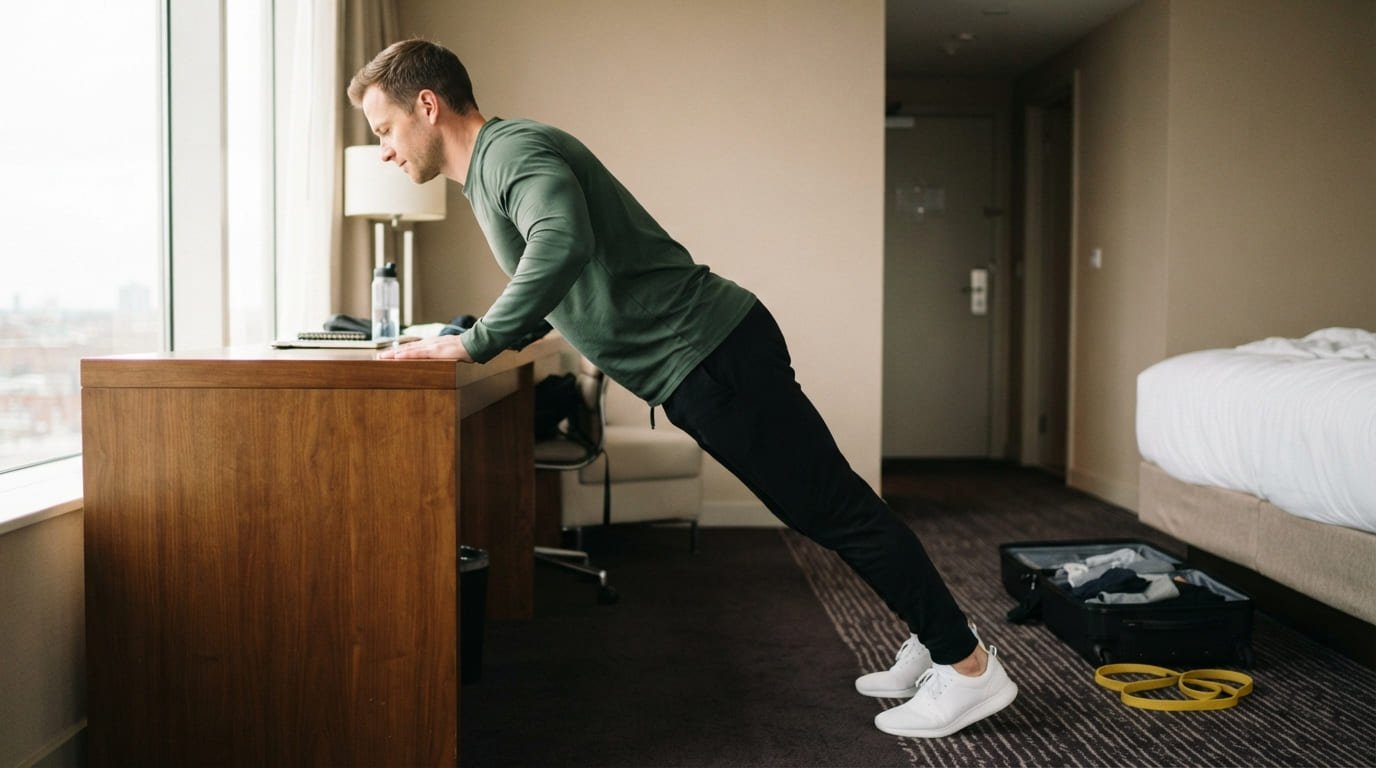
Travel Exercises: Portable Moves for Flights, Hotels and Exercising on Holiday
Travel exercises do not need to be complicated. You do not have to find a hotel gym, pack a suitcase full of kit or feel guilty about skipping your usual routine. A few simple moves in your seat, a short workout in your room and plenty of walking are often all you need to feel good while you are away.
Trips have a way of knocking routines over. You sit for hours, sleep badly, eat differently and lose your normal rhythm. That is fine, and it does not undo your progress. What I would aim for while travelling is not a perfect training week. It is just to keep moving, ease stiffness and come home without feeling as though you have to start all over again.
This guide covers the best travel exercises portable enough to fit into a carry-on, what to do on planes, trains and in cars, three short workouts, what to pack and how to approach exercising on holiday without spoiling your holiday.
At a glance
- The goal when you travel is to keep moving, not to train perfectly
- On long journeys, stand up, walk and move your ankles and legs regularly
- On flights of more than 5 hours, compression stockings reduced symptomless clots in a large Cochrane review
- Short bursts count. Three brief stair climbs a day improved fitness in one small trial
- Resistance bands, a skipping rope and a travel towel are the most useful portable kit
- A 10-minute workout in your room is enough to keep your habit going
- Know the warning signs of a blood clot, and get urgent help if you notice them
Why travel exercises are worth it
- Less stiffness. Long periods of sitting leave your hips, back and neck feeling tight
- Better energy. Short movement breaks can help you feel more awake after a long journey
- Better sleep and mood. Daylight and activity may help when your routine has been disrupted
- A habit that survives the trip. It is much easier to return to your routine if you never stopped completely
And here is the reassuring part. A week or two with less training will not ruin your fitness. You can miss your usual sessions and still come back without much trouble. Just keep moving when you can.
Sitting for hours: blood clots and what helps
Long-distance travel can slightly raise your risk of a blood clot in the leg, known as deep vein thrombosis or DVT. For most healthy people, the risk is low, but it is higher if you have had a clot before, are pregnant, have had recent surgery, have cancer or take certain hormone medicines.
A Cochrane review of 12 trials looked at compression stockings on flights lasting more than five hours. Among 2,637 passengers, 50 had a symptomless clot: 3 of those wearing stockings and 47 of those not wearing them. Stockings also reduced leg swelling. No deaths, lung clots or symptomatic clots were reported in the trials.
So if you are at higher risk, or you are planning a long flight, ask your doctor before you travel about stockings or other measures. In-seat movement and walking are sensible for everyone, though I could not find strong trials showing exactly how much they reduce the risk of a clot.
Get urgent medical help if you notice pain, swelling, warmth or redness in one leg, or sudden shortness of breath, chest pain or coughing up blood, during or after travel. These can be signs of a blood clot. This article is general information, not medical advice. See our medical disclaimer.

Travel exercises you can do in your seat
These travel exercises work on planes, trains, coaches and as a passenger in a car. They take a few minutes and do not disturb anyone. Repeat them about once an hour.
| Exercise | How to do it | Reps |
|---|---|---|
| Ankle pumps | Lift your toes, then press your heels up, like pressing a pedal | 20 |
| Ankle circles | Lift one foot and circle it each way | 10 each way, per foot |
| Seated march | Lift one knee a little, then the other | 20 total |
| Glute squeezes | Squeeze your buttocks, hold for 5 seconds and relax | 10 |
| Shoulder rolls | Roll your shoulders slowly back | 10 |
| Seated twist | Sit tall and gently turn to each side | 3 per side |
| Chin tucks | Glide your head straight back, keeping your eyes level | 8 |
| Seated cat-cow | Hands on knees, round then gently arch your back | 8 |
Our guide to desk exercises has more seated options, and the chin tuck exercise guide is useful for a stiff neck after sleeping upright.
Moving around on long journeys
- On a plane: walk the aisle about every hour or two when it is safe to do so, and do some calf raises while waiting for the toilet
- On a train: walk to the buffet car or the far end of the carriage
- In a car: stop every couple of hours for a 5-minute walk
- At the airport: walk instead of sitting at the gate. Take the stairs and skip the moving walkway
- Between connections: stretch your hips and calves
Keep drinking water throughout your journey, and do not overdo the alcohol on a flight. Choose an aisle seat if you can, because it makes getting up much easier and you are more likely to do it.
The best travel exercises portable enough to do anywhere
Here are some of the best travel exercises portable enough to do in a hotel room, an Airbnb, a park or a beach, with no equipment at all.
| Exercise | What it trains | Beginner version |
|---|---|---|
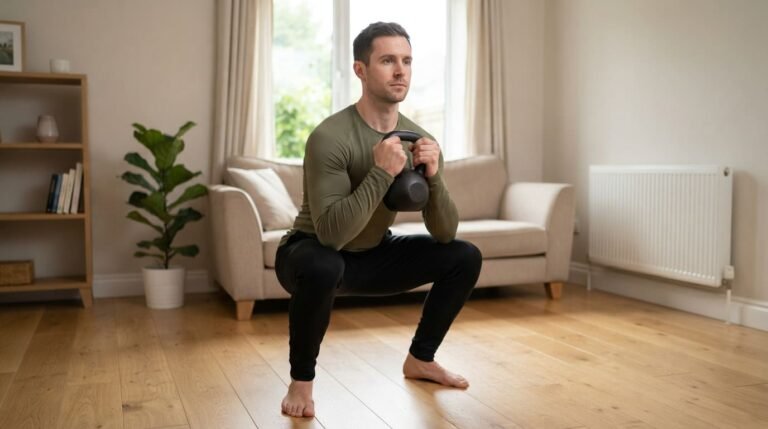
| Squats | Legs and glutes | Sit down to the edge of the bed and stand up |
| Reverse lunges | Legs and balance | Hold a wall |
| Push-ups | Chest, shoulders and arms | Hands on the bed or a desk |
| Glute bridges | Glutes and lower back | Both feet on the floor |
| Plank | Core | From your knees |
| Bird dog | Back and core | Move one limb at a time |
| Calf raises | Lower legs | Hold a wall |
| Marching on the spot | Heart rate | Low knees, quiet feet |
For harder options, our guides to the hotel room workout, no equipment home workout and 15-minute full-body workout all work well on the road.
Why short bursts count
If a full workout feels impossible, try short bursts. In one small trial, inactive young adults climbed a three-flight stairwell briskly, 3 times a day, 3 days a week, for 6 weeks. Their fitness improved modestly compared with a group that did no training.
So hotel stairs are a gift. Use them whenever you can. If you have a lift to your room, try walking up a few flights instead.
3 travel workouts
Workout 1: the 10-minute wake-up
Do each move for 40 seconds, rest for 20 seconds, and repeat the circuit twice. No equipment is needed.
- Marching on the spot
- Squats
- Push-ups against the bed or desk
- Reverse lunges
- Plank
Workout 2: the quiet room workout (15 minutes)
No jumping, so nobody below you will complain. Do 3 rounds.
| Exercise | Reps |
|---|---|
| Slow squats | 12 |
| Glute bridges | 15 |
| Incline push-ups | 8 to 10 |
| Bird dog | 6 per side |
| Side plank from the knees | 20 seconds per side |
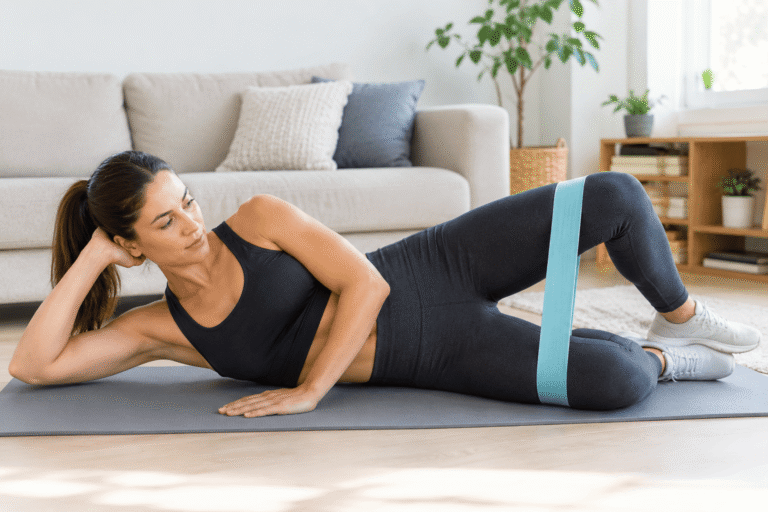
Workout 3: the travel band workout (20 minutes)
Pack one resistance band, and do 3 rounds with 45 seconds of rest between exercises.
| Exercise | Reps |
|---|---|
| Banded squat | 12 |
| Band row, with the band around a door handle or your feet | 12 |
| Band chest press | 10 |
| Band pull-apart | 15 |
| Banded glute bridge | 15 |
Our guide to the best resistance bands for beginners explains which bands to choose and how to anchor them safely.
Portable exercise equipment worth packing
The best travel exercises portable enough for hand luggage need no kit at all. But if you want some, this portable exercise equipment takes up very little room.
| Item | Weight and size | What it adds | Worth packing? |
|---|---|---|---|
| Resistance loop or tube band | Very light, fits a pocket | Strength work for your whole body | Yes |
| Jump rope | Light, fits a shoe | Fast cardio | Yes, if you have space and a suitable floor |
| Suspension straps | Small pouch | Rows and presses using a door | Maybe, if you already use them |
| Travel yoga mat or towel | Light | A clean floor space | A towel usually does the job |
| Massage ball | Small | Eases stiff feet, hips and shoulders | Yes, for long journeys |
| Walking or running shoes | Bulkier, but useful | Lets you explore on foot | Yes |
Water bottles, a backpack filled with clothes and a sturdy chair also make good free equipment. A filled backpack makes a surprisingly good weight for squats and rows, and it costs nothing because you are already carrying it.
I have not tested specific brands of travel gear, and there are no affiliate links on this page. Our guides to the jump rope workout and fascia release exercises show you how to use two of these items. Be aware that airline rules vary, so check before you pack anything unusual.
Travel exercises for work trips
Business trips are often harder than holidays, because you have long days, restaurant meals and little free time. These travel exercises fit around meetings:
- Before breakfast: the 10-minute wake-up in your room, while the day is still yours
- Between meetings: 10 calf raises and a walk around the block, or a few flights of stairs
- On calls: stand up and walk, if the call allows it
- After dinner: a 15-minute walk instead of going straight to your room
- Before bed: gentle stretches for your hips, chest and upper back
Keep your kit in your bag, so you never have to remember it. A band, a pair of trainers and a plan you can do in 10 minutes will cover almost any trip.
Travel exercises for road trips
Driving is different from flying, because you are the one who decides when to stop. If you are the driver, stay focused on the road and save your exercises for your breaks. Stop about every two hours, which is also good for your concentration. In a car park or lay-by, try this simple 5-minute routine:
- Walk briskly for 2 minutes
- Do 10 squats, holding the car door if you need to
- Do 10 incline push-ups against the side of the car, if it is safe and stable
- Stretch your calves and hip flexors for 20 seconds per side
- Roll your shoulders and turn your head slowly from side to side
If you are a passenger, you can use the in-seat travel exercises above as often as you like.
Exercising on holiday without spoiling it
Exercising on holiday should add to your trip, not get in the way of it. Here is how I would think about it.
- Walk everywhere you can. Exploring on foot often adds up to more activity than your usual workout
- Choose active fun. Swimming, hiking, cycling, kayaking and dancing all count
- Do it early. A short session before breakfast is done before the day gets busy
- Set a low bar. Aim for 10 minutes on most days, and treat anything extra as a bonus
- Book a hotel with a pool or a good place to walk, if that matters to you
- Let go of guilt. A holiday is meant to be a rest. Enjoy your food, and return to your routine afterwards
| Type of holiday | Easy ways to stay active |
|---|---|
| Beach | Swimming, beach walks, a bodyweight session on the sand |
| City break | Walking tours, climbing stairs, renting a bike |
| All-inclusive resort | Pool lengths, morning walks, the resort gym or classes |
| Countryside | Hiking and cycling. See our guide to strength training for hiking |
| Skiing or an active trip | Focus on rest, stretching and sleep instead of extra workouts |
| Family holiday | Games on the beach, swimming with children, active days out |
Our guide to staying consistent with working out has more ideas for keeping your habit going when life gets in the way.
Jet lag, heat and hydration
Jet lag
Light exercise and daylight at your destination can help you feel more awake, though the evidence on exercise for jet lag is limited. Try a walk outdoors soon after you arrive, and keep the first couple of days easy. Hard sessions when you are badly short of sleep usually feel awful and are not worth forcing.
Heat and altitude
- Hot climates: exercise early or late, drink plenty of water and wear a hat. Our water intake calculator gives you a starting estimate
- Humidity: your usual pace may feel harder, so slow down
- Altitude: you may get breathless more easily. Take the first few days gently
- Sun: use sunscreen, and rest in the shade
Eating while you travel
There is no need for a strict plan on holiday. Enjoy local food. If you want a simple approach, have some protein and vegetables at most meals, carry a snack on long journeys and drink plenty of water, especially on flights.
A sample 7-day trip
| Day | Activity |
|---|---|
| Travel day | In-seat exercises hourly, a walk around the airport, a light walk on arrival |
| Day 2 | Walk 30 to 60 minutes while exploring, plus the 10-minute wake-up |
| Day 3 | Active day: swim, hike or cycle |
| Day 4 | Quiet room workout, then a relaxed day |
| Day 5 | Long walk, plus stairs wherever you find them |
| Day 6 | Rest or gentle stretching. Our stretching routine works well |
| Day 7 | 10-minute wake-up, then in-seat exercises on the way home |
If you only do half of this, you are still doing plenty. When you get home, start your normal routine again as soon as you have recovered from the journey, perhaps with slightly lighter weights in the first session.
Common mistakes
| Mistake | Why it matters | Fix |
|---|---|---|
| Sitting through the whole journey | Stiffness, and possibly a higher risk of clots | Move hourly, and walk when you can |
| Planning too much exercise | You miss it, feel guilty and stop | Aim for 10 minutes, and count everything else as a bonus |
| Packing a lot of kit | It takes up room and rarely gets used | One band and your walking shoes are enough |
| Training hard with jet lag | Feels awful and you may not recover well | Keep the first days light |
| Treating a trip as a failure | Guilt makes it harder to restart | Just get back to it when you return |
| Jumping in a thin-walled room | Annoys your neighbours | Use the quiet workout |
Safety notes
Check with your doctor before you travel if you have had a blood clot, recent surgery, a heart or lung condition, or if you are pregnant. If you have a health condition, carry your medication in your hand luggage. Take care with unfamiliar activities such as hiking and water sports, and do not try anything too risky for your experience level. If you get hurt, rest and seek local medical advice.
The bottom line
The best travel exercises are simple: ankle pumps and walks on long journeys, a few bodyweight moves in your room, and lots of walking when you get there. A resistance band and comfortable shoes are about all the portable exercise equipment you need. Short bursts count, so use the stairs and do not worry about perfect workouts.
Exercising on holiday should feel good, so set a low bar, enjoy your trip and get back to your normal routine when you get home. And on long journeys, keep moving and learn the warning signs of a blood clot. A couple of weeks away will not undo your progress, especially if you keep moving in small ways.
Frequently asked questions
What are the best travel exercises to do on a plane?
Ankle pumps, ankle circles, seated marches, glute squeezes, shoulder rolls and gentle seated twists work well. Do them about once an hour, and walk the aisle when it is safe. On long flights, ask your doctor about compression stockings if you are at higher risk of clots.
What portable exercise equipment is best for travel?
A resistance band is the most useful, because it is light and trains your whole body. A jump rope, a massage ball and comfortable walking shoes are also worth packing if you have room.
Should I exercise on holiday?
It is up to you, and a short break from training will not harm your progress. Exercising on holiday can boost your energy and mood, but walking, swimming and active days out count too. Set a low bar and enjoy your trip.
How do I stay fit when I travel a lot?
Keep a short, equipment-free workout you can do anywhere, use stairs and walk whenever you can, and pack a resistance band. Our hotel room workout gives you several routines. Consistency matters more than intensity.
Can I work out in a hotel room without disturbing anyone?
Yes. Avoid jumping and use slow squats, bridges, incline push-ups, bird dogs and side planks. Do them on a towel or mat, and choose reasonable hours if the walls are thin.
Will I lose fitness on a two-week holiday?
You may lose a little, but it comes back quickly. Walking and light exercise while you are away will help. Start again with slightly lighter sessions for your first week home.
How can I prevent blood clots when travelling?
Move your legs regularly, walk when you can and drink water. Compression stockings reduced symptomless clots on flights over 5 hours in a Cochrane review. If you have had a clot before, or have other risks, speak to your doctor before you travel.
What can I use as weights while travelling?
A backpack filled with clothes or books works well for squats, lunges and rows. Large water bottles and a sturdy chair also help. Resistance bands are another good option.
How long should a travel workout be?
Ten minutes is enough to keep your habit going and to wake up your body. If you have more time, 15 to 20 minutes gives you a good all-round workout.
What’s next?
Reading is the easy part. Pick one of these and do it today.