Jump Rope Workout for Beginners: 5 Routines, a 6-Week Plan and How to Stop Tripping
A jump rope workout is one of the cheapest, most portable and most effective ways to get fit at home. All you need is a rope that costs less than a takeaway pizza and a few square metres of space. The catch is that it is surprisingly hard at first. The first time I picked up a rope as an adult, I managed eleven skips before it caught my heel, and after two minutes of start-stop attempts I was more out of breath than after a 20-minute jog.
I almost gave up. Instead I followed a boxing coach’s advice: practise in tiny sets, jump lower than you think you need to, and let the wrists do the work. Three weeks later I could skip for a full minute without tripping. Two months later, a 15-minute skipping session had become my go-to workout on busy days.
This guide covers how to choose a rope, how to skip with good form, five beginner routines, a six-week jump rope workout plan, the calories you burn, the muscles you work, weighted jump rope benefits and how to keep your shins and calves happy.
At a glance
- Jump rope training improves cardiovascular fitness, coordination, leg power and body composition
- Start with short sets of 20 to 30 seconds and plenty of rest
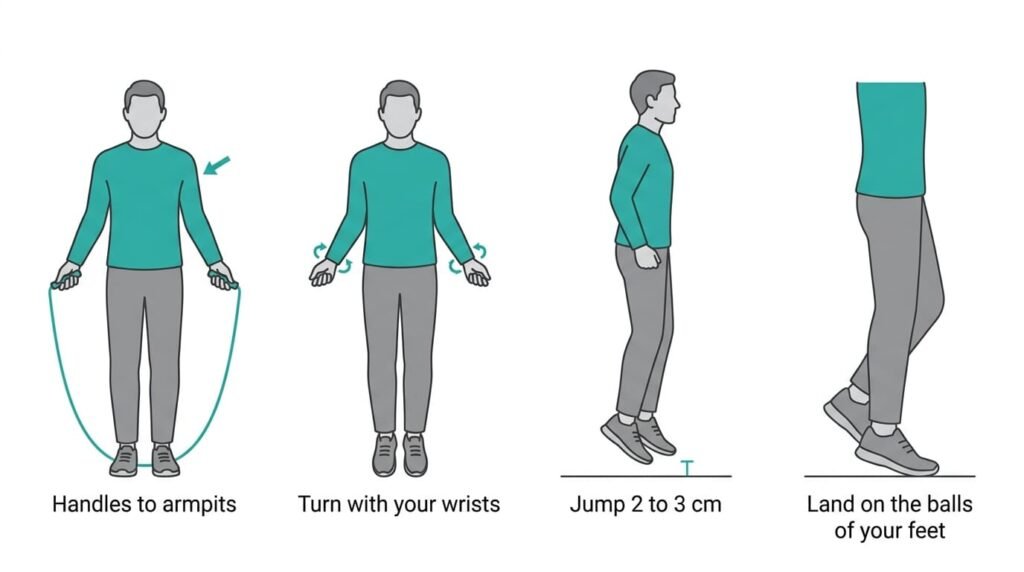
- Jump low, land softly on the balls of your feet and turn the rope with your wrists
- A good beginner rope reaches your armpits when you stand on the middle
- A 70 kg adult burns about 10 to 15 calories per minute of skipping, depending on speed
- Two or three sessions a week of 10 to 20 minutes is plenty for beginners
- Build up gradually to protect your calves, shins and Achilles tendons
Why a jump rope workout is worth it
| Benefit | What it means for you |
|---|---|
| Cardio fitness in little time | Skipping raises your heart rate quickly, so short sessions count |
| Coordination and timing | Your hands, feet and eyes learn to work together |
| Leg power and calf strength | Every jump trains the calves, ankles and feet |
| Cheap and portable | A rope fits in a bag and works almost anywhere |
| Bone loading | Light, repeated impact helps keep bones strong |
| Fun and measurable | Counting skips and learning tricks keeps it interesting |
What the research says
- Fitness benefits. A systematic review and meta-analysis of 21 studies with 1,021 participants found that jump rope training improved resting heart rate, body mass index, fat mass, cardiorespiratory endurance, lower and upper body strength, jumping, range of motion and sprinting compared with control groups. Most participants were under 18, so results in adults may differ
- Energy cost. The Compendium of Physical Activities, the standard reference for the energy cost of exercise, rates rope jumping between about 8.8 and 12.3 METs depending on speed. That is similar to running at a moderate to fast pace
Choosing a rope and a place to skip
Types of jump rope
| Rope type | Best for | Notes |
|---|---|---|
| Basic PVC or beaded rope | Beginners | Slightly slower, easier to time, cheap and durable |
| Speed rope (thin cable) | Faster skipping and double unders | Spins quickly, less forgiving when you trip |
| Weighted rope | Strength and slower, harder cardio | Heavier handles or cord. Builds shoulders and forearms |
| Ropeless rope | Small spaces, low ceilings, beginners who keep tripping | Handles with short weighted tails. You get the motion without the trips |
How to size your rope
Stand on the middle of the rope with both feet. Pull the handles up. For beginners, the tops of the handles should reach roughly your armpits. A slightly longer rope is more forgiving while you learn. As you improve, you can shorten it to chest height for faster skipping.
Where to skip
Choose a forgiving surface: a wooden floor, rubber gym flooring, an exercise mat or a sports court. Avoid concrete and carpet. Concrete is hard on your legs, and carpet grips the rope and your shoes. Check the ceiling height, and clear the area of furniture and pets. Wear supportive trainers rather than going barefoot.
How to skip properly
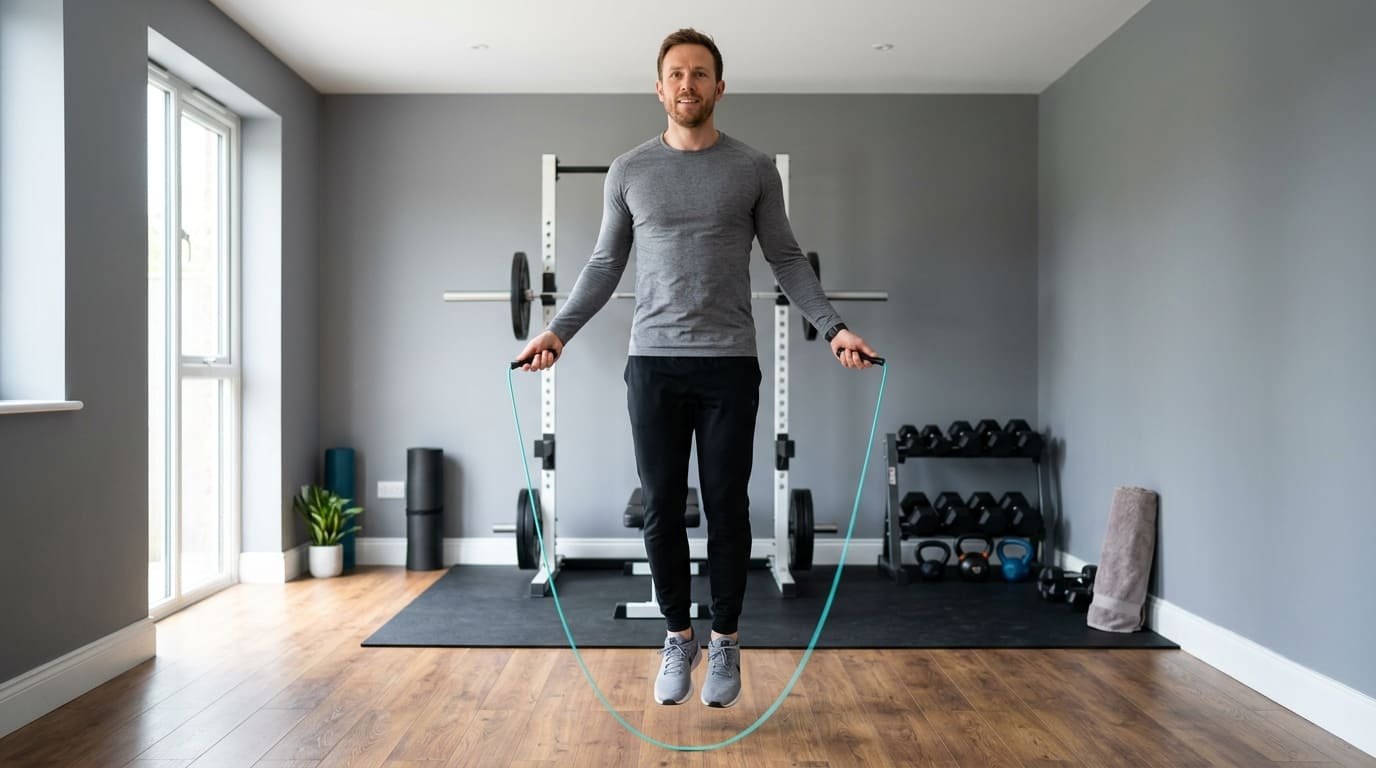
- Stand tall with your feet hip-width apart and your knees soft
- Hold the handles loosely at hip height, elbows close to your sides
- Turn the rope with your wrists, not your whole arms. Your elbows stay close to your body
- Jump just high enough for the rope to pass, about 2 to 3 cm off the floor
- Land softly on the balls of your feet, with your heels hovering just above the ground
- Keep your eyes forward and your chest up. Do not look at your feet
- Breathe steadily and keep a relaxed rhythm
| Common problem | Usual cause | Fix |
|---|---|---|
| Rope keeps hitting your feet | Jumping too early or arms too wide | Keep elbows in, wait to hear the rope tap the floor |
| Getting out of breath very quickly | Jumping too high | Jump lower. Just clear the rope |
| Sore calves the next day | Too much volume too soon | Shorter sessions, more rest, calf stretches |
| Shoulders ache | Turning the rope with whole arms | Small wrist circles only |
| Rope hits the ceiling | Rope too long or arms too high | Shorten the rope, keep hands at hip height |
Practise without a rope first
If you keep tripping, spend a few sessions doing the movement without a rope. Bounce lightly on the balls of your feet while turning your wrists in small circles. Then hold both handles in one hand and swing the rope at your side while you bounce. Once the rhythm feels natural, try again with the rope going over your head.
6 basic jump rope steps
1. Basic bounce
Both feet jump together, one jump for each turn of the rope. Master this before anything else.
2. Alternate foot step (boxer skip)
Shift your weight from one foot to the other as if jogging on the spot. It feels easier than the basic bounce once you have the rhythm and is the standard pattern for boxers.
3. Side to side
Jump a few centimetres left, then right, with each turn of the rope. Great for ankle stability.
4. Forward and back
Jump a few centimetres forward, then back, with each turn.
5. High knees
Alternate feet while lifting your knees toward hip height. This is a harder cardio variation. Our high knees exercise guide covers the technique without a rope too.
6. Double unders (advanced)
Jump slightly higher and spin the rope twice under your feet in one jump. Leave this until you can skip continuously for three minutes.
5 jump rope workout routines for beginners
Warm up for 3 to 5 minutes before each jump rope workout with marching, gentle jogging on the spot, ankle circles and arm circles. Cool down with a few minutes of walking and calf stretches.
Routine 1: First-week intervals (10 minutes)
| Round | Work | Rest |
|---|---|---|
| 1 to 10 | 20 seconds basic bounce | 40 seconds walking or marching |
Do not worry about trips. Just pick the rope up and restart.
Routine 2: Skip and strength circuit (15 minutes)
| Exercise | Time |
|---|---|
| Jump rope, basic bounce | 30 seconds |
| Bodyweight squats | 30 seconds |
| Jump rope, alternate foot step | 30 seconds |
| Push-ups or incline push-ups | 30 seconds |
| Jump rope, basic bounce | 30 seconds |
| Plank | 30 seconds |
| Rest | 1 minute |
Repeat 3 times. This skipping rope workout mixes cardio and strength, so the time flies.
Routine 3: Ladder (12 minutes)
Skip for 30 seconds, rest 30. Then 45 seconds, rest 30. Then 60 seconds, rest 45. Then 45, rest 30. Then 30 seconds. Repeat the whole ladder twice.
Routine 4: Footwork variety (15 minutes)
Skip for 1 minute using each of these in turn: basic bounce, alternate foot, side to side, forward and back, high knees. Rest 1 minute after each. Repeat twice.
Routine 5: Steady skip (20 minutes)
Once you can skip for several minutes without stopping, try a steady skip: 3 minutes skipping, 1 minute rest, repeated 5 times, at an easy, conversational rhythm. This builds aerobic fitness in the same way an easy run does. Our guide to aerobic vs anaerobic exercise explains why both easy and hard sessions matter.
| Routine | Length | Best for |
|---|---|---|
| First-week intervals | 10 minutes | Complete beginners learning the rhythm |
| Skip and strength circuit | 15 minutes | Full-body sessions at home |
| Ladder | 12 minutes | Building continuous skipping time |
| Footwork variety | 15 minutes | Coordination and agility |
| Steady skip | 20 minutes | Aerobic endurance |
A 6-week jump rope workout plan
Do three sessions a week, on non-consecutive days. On the days in between, walk, stretch or do strength training. This jump rope workout plan builds up slowly to protect your calves and shins.
| Week | Sessions | Main set |
|---|---|---|
| Week 1 | 3 x Routine 1 | 10 x 20 seconds on, 40 seconds off |
| Week 2 | 2 x Routine 1 plus 1 x Routine 2 | 10 x 30 seconds on, 30 seconds off |
| Week 3 | Routine 2, Routine 3, Routine 2 | Ladder and circuits |
| Week 4 | Routine 3, Routine 4, Routine 2 | Add footwork variations |
| Week 5 | Routine 4, Routine 5 (3 rounds), Routine 2 | First steady skip |
| Week 6 | Routine 5, Routine 4, Routine 5 | 5 x 3 minutes steady skip |
By the end of the plan, most beginners can skip continuously for three minutes or more. If your calves or shins are sore for more than a day or two, repeat a week before moving on.
How many calories does a jump rope workout burn?
The energy cost of skipping depends on how fast you go and how much you weigh. These estimates use MET values from the Compendium of Physical Activities.
| Pace | MET value | Calories per minute, 60 kg | Calories per minute, 70 kg | Calories per minute, 90 kg |
|---|---|---|---|---|
| Slow (under 100 skips per minute) | 8.8 | About 9 | About 11 | About 14 |
| Moderate (100 to 120 skips per minute) | 11.8 | About 12 | About 14 | About 19 |
| Fast (120 to 160 skips per minute) | 12.3 | About 13 | About 15 | About 19 |
In a real 15-minute session, you also rest between sets, so a beginner might burn roughly 100 to 150 calories. That is similar to a short run. Our calories burned calculator gives you a personal estimate.
Jump rope vs running
| Feature | Jump rope | Running |
|---|---|---|
| Calories per minute | High, similar to moderate or fast running | High, depends on pace |
| Space needed | A few square metres | A route or a treadmill |
| Coordination | High | Lower |
| Impact per step | Repeated small jumps on the balls of the feet | Larger landing forces with each stride |
| Learning curve | Steep for the first few weeks | Gentle |
| Best for | Short, intense sessions at home | Longer endurance sessions outdoors |
Neither is better. They complement each other. Many runners use a short jump rope workout to build foot and calf strength, and many boxers use running to build their aerobic base. If you want to build your running too, see our guide on how to increase running endurance.
Muscles worked by jumping rope
| Muscle group | Role |
|---|---|
| Calves and Achilles | Spring you off the floor with every jump |
| Quadriceps and glutes | Absorb landings and add power |
| Core | Keeps your body upright and stable |
| Shoulders and forearms | Turn and control the rope |
| Feet and ankles | Stabilise and absorb small impacts |
Weighted jump rope benefits
Weighted jump ropes have heavier handles or a heavier cord, usually from about 0.5 kg to 2.5 kg in total. The main weighted jump rope benefits are:
- More upper body work. Your shoulders, forearms and grip work much harder to turn the rope
- A slower, more controlled rhythm. Many beginners find the heavier rope easier to time
- Higher effort in less time. Each minute feels harder, so short sessions are challenging
- Good feedback. You feel the rope’s position, which helps your timing
The trade-offs are that weighted ropes are slower, put more strain on the shoulders and wrists, and are less suited to fast footwork or double unders. Start with a light weighted rope, keep sessions short, and stop if your shoulders or wrists ache. For most beginners, a standard rope is the best first choice, with a weighted rope as a later addition.
How to fit a jump rope workout into your week
One of the best things about skipping is how easily it slots into a busy life. These are the ways I use it:
| Use | How | Time |
|---|---|---|
| As a warm-up | 2 to 3 minutes of easy skipping before strength training | 3 minutes |
| As a finisher | 5 rounds of 30 seconds hard, 30 seconds easy after a workout | 5 minutes |
| On a busy day | A complete 15-minute skipping rope workout instead of a run | 15 minutes |
| On a travel day | A rope in your bag and a short session in a hotel car park or gym | 10 minutes |
| On a rest day | Nothing. Let your calves recover | 0 minutes |
Pairing skipping with other training
A jump rope workout pairs well with upper body strength training, core work and walking, because none of those load the calves heavily. It pairs less well with long runs or plyometric sessions on the same day, because they all hammer the same lower leg muscles. If you love boxing, skipping is the classic warm-up. Our boxing bag workout uses it exactly that way.
How to keep progressing
After the six-week jump rope workout plan, you have plenty of ways to keep it fresh:
- Lengthen the steady skip to 5-minute rounds
- Add speed intervals: 20 seconds as fast as you can, 40 seconds easy, 10 times
- Learn new footwork such as the criss-cross, the skier and the bell jump
- Try double unders once you can skip continuously for three minutes
- Add a weighted rope once a week for upper body work
- Combine with a HIIT workout or a plyometric workout for a tougher session, keeping the total jumping volume sensible
Change only one thing at a time, and give your calves a week to adapt to each step up.
Protecting your calves, shins and joints
- Build up gradually. Skipping loads the calves, shins and Achilles tendons in a way most adults are not used to
- Jump low and land softly. Higher jumps mean bigger landings
- Use a forgiving surface and supportive trainers
- Strengthen your lower legs with calf raises and toe raises. Our calf workout at home is ideal
- Stretch after each session. The wall calf stretch and soleus stretch from our shin splints stretches guide work well
Check with your doctor before starting if you have heart or blood pressure problems, are pregnant, have significant knee, ankle or back pain, have osteoporosis, or have pelvic floor symptoms such as leaking when you jump. Low-impact options such as the ropeless rope or marching on the spot can be better choices.
This article is general information, not medical advice. Stop exercising and seek urgent help if you have chest pain, severe breathlessness, dizziness or fainting. See our medical disclaimer.
Common mistakes
- Jumping too high, which wastes energy and increases impact
- Turning the rope with your arms instead of your wrists
- Looking at your feet
- Doing too much too soon, leading to sore calves and shins
- Skipping on concrete in thin shoes
- Using the wrong rope length
- Giving up in week one. Everyone trips constantly at first
The bottom line
A jump rope workout is a cheap, fun and powerful way to build fitness at home. Start with a rope that reaches your armpits, jump low, turn with your wrists, and begin with 20-second sets and plenty of rest. Follow the six-week plan, and add footwork variations and a weighted rope as you improve.
The first week is the hardest, because you trip so often. Stick with it. By the third week, the rhythm clicks, and a 15-minute skipping rope workout becomes one of the most efficient sessions in your week. Mine still is.
Frequently asked questions
Is a jump rope workout good for beginners?
Yes, as long as you start gently. Use short sets of 20 to 30 seconds with plenty of rest, jump low and build up over several weeks. Expect to trip a lot at first. That is normal.
How long should a beginner jump rope?
Start with about 10 minutes in total, including rest, made up of short intervals. Build up to 15 to 20 minutes over four to six weeks, three times a week.
How many calories does jumping rope burn?
About 9 to 15 calories per minute of continuous skipping for most adults, depending on speed and body weight. A beginner session of 15 minutes with rest breaks might burn roughly 100 to 150 calories.
Is jumping rope better than running?
Neither is better. Jumping rope burns similar calories per minute, needs less space and builds coordination. Running is easier to sustain for long sessions. Many people do both.
What muscles does jumping rope work?
Mainly the calves, quadriceps, glutes and core, with the shoulders and forearms turning the rope. A weighted rope adds more upper body work.
What are the benefits of a weighted jump rope?
Weighted jump rope benefits include more shoulder, forearm and grip work, a slower rhythm that is easier to time, and a harder workout in less time. They are less suited to fast footwork.
Can I do a skipping rope workout every day?
Beginners should stick to two or three sessions a week to let their calves and shins adapt. Experienced skippers can skip more often, with some easier days.
How do I stop tripping on the rope?
Keep your elbows close to your sides, turn the rope with your wrists, jump just high enough to clear it and keep your eyes forward. Check that the rope reaches your armpits when you stand on the middle.
What size jump rope should I buy?
Stand on the middle of the rope with both feet and pull the handles up. For beginners, the handles should reach roughly your armpits. A slightly longer rope is easier to learn with, and you can shorten it later for faster skipping.
Is jumping rope bad for your knees?
For most people with healthy knees it is fine, because you land softly on the balls of your feet with small jumps. Use a forgiving surface and supportive shoes, build up slowly, and choose a low-impact option such as a ropeless rope if your knees are sore.
What’s next?
Reading is the easy part. Pick one of these and do it today.