Shoulder Impingement Exercises: 10 Moves to Ease Pain and Rebuild Strength
Shoulder impingement exercises are usually the first thing a physiotherapist hands you when lifting your arm starts to hurt. I know, because I was handed a sheet of them at 34, after months of a sharp pinch every time I reached for a high shelf or pulled on a jacket. I had assumed something was torn and would need an operation. The physiotherapist smiled and said most shoulders like mine get better with the right exercise and a bit of patience.
She was right. Twelve weeks later I could reach overhead without the pinch, and I could do push-ups again. What surprised me most was how gentle the early exercises were. There was no heavy lifting and no pushing through pain. It was slow, controlled work for the small muscles that keep the shoulder joint centred.
This guide shares the ten shoulder impingement exercises that helped me, arranged in three stages, with a six-week plan. It also covers the research, what happens with rotator cuff tears that are treated without surgery, exercises for shoulder mobility and the signs that mean you need a professional assessment.
At a glance
- Shoulder impingement usually means pain when you lift your arm, often between shoulder and head height
- Exercise is the main first treatment. Research shows it reduces pain better than no exercise
- Specific exercises for the rotator cuff and shoulder blade muscles seem to work better than general exercise
- Start with pain-free range and isometric holds, then progress to bands and light weights
- Expect improvement over 6 to 12 weeks, not days
- Avoid painful overhead lifting for now, but keep the arm moving
- See a doctor for sudden weakness, a shoulder injury, night pain that will not settle or numbness in the arm
What shoulder impingement actually is
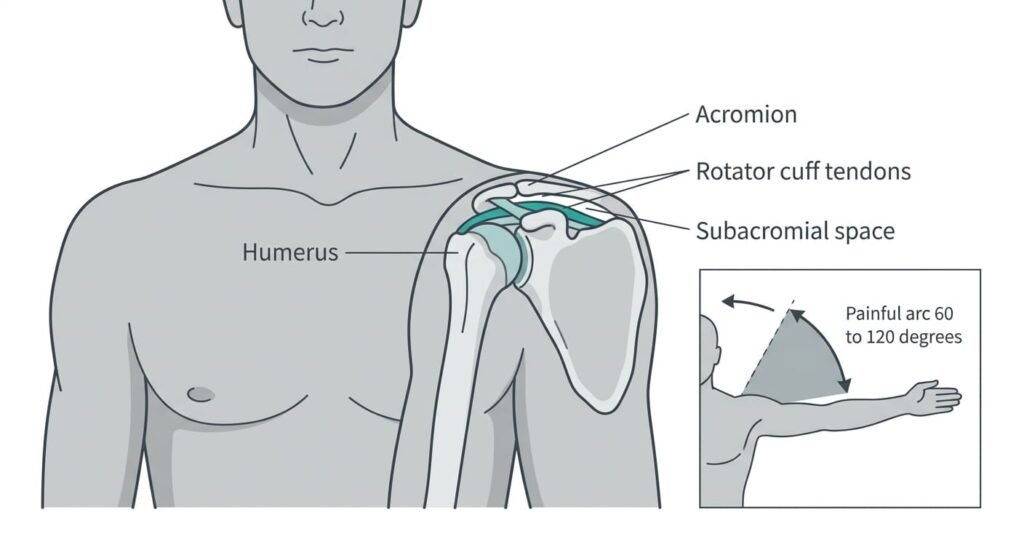
Your shoulder is a ball and a very shallow socket, a bit like a golf ball sitting on a tee. Four small muscles, together called the rotator cuff, wrap around the ball and keep it centred in the socket while the larger muscles move the arm. Above the ball sits a bony shelf called the acromion, part of the shoulder blade.
When you lift your arm, the rotator cuff tendons glide through the space under that shelf. If those tendons are irritated, or if the ball rides slightly upward because the cuff and shoulder blade muscles are not controlling it well, lifting the arm becomes painful. That is the classic picture of shoulder impingement.
Many clinicians now prefer the term subacromial pain or rotator cuff related shoulder pain, because the tendons are usually irritated by load rather than literally being squashed. The name matters less than the treatment, and for most people the treatment is the same: well-chosen impingement exercises.
| Common sign | What it often feels like |
|---|---|
| Painful arc | Pain when lifting the arm out to the side, mainly between about 60 and 120 degrees |
| Overhead pain | Pinching when reaching up to a shelf or washing your hair |
| Sleeping pain | Ache when lying on the affected side |
| Reaching behind | Pain putting on a coat or tucking in a shirt |
| Weakness from pain | The arm feels weak because it hurts, not because it is broken |
What the research says
- Exercise works. A systematic review and meta-analysis of randomised trials found exercise was better than non-exercise control treatments for pain in shoulder impingement, and that specific exercises were better than generic ones. The authors noted the evidence quality was low, but concluded exercise should be considered for people with these symptoms
- Specific exercise can reduce the need for surgery. A randomised trial of people with long-standing impingement who were on a surgical waiting list found that a specific programme for the rotator cuff and shoulder blade muscles improved pain and function, and fewer people in the specific exercise group chose to have surgery than in the control exercise group
- Surgery is not a magic fix. A large placebo-controlled trial found that decompression surgery was no better in a clinically important way than a placebo operation in which the surgeon only looked inside the joint
Ground rules for shoulder impingement exercises
Use a pain limit
Aim to keep pain during exercise at or below 3 to 4 out of 10, where 0 is none and 10 is the worst imaginable. A little discomfort is fine. A sharp pinch is not. The shoulder should feel no worse the next morning than it did before the session.
Stay below the pinch
Work in the range that does not pinch. For many people, that means keeping the arm below shoulder height at first, and moving into higher ranges over the weeks.
Set the shoulder blade first
Before each exercise, gently draw your shoulder blades slightly back and down, as if putting them into your back pockets. Do not squeeze hard. Think of it as setting a good base for the arm to move on.
Go slow and controlled
Take three seconds to lower on every strengthening exercise. Slow lowering, known as eccentric work, was a key part of the programme in the trial that reduced the need for surgery.
10 shoulder impingement exercises in three stages
Work through the stages in order. Move on when the exercises in your current stage feel easy and pain-free for a week.
Stage 1: Calm it down and keep it moving
These first impingement exercises focus on gentle movement and holding muscle contractions without moving the joint, which can ease pain.
1. Pendulum swing
- Lean forward with your good hand on a table, letting the sore arm hang straight down
- Gently rock your body so the arm swings in small circles, like a pendulum
- Keep the shoulder muscles relaxed. The movement comes from your body, not the arm
Dose: 30 seconds each direction, two or three times a day. A good warm-up and a way to ease stiffness.
2. Table slide
- Sit beside a table with your forearm resting on a towel on the table
- Slide the towel forward, letting your body lean forward too, until you feel a gentle stretch
- Slide back
Dose: 10 slow reps. One of the gentlest exercises for shoulder mobility, because the table supports the arm’s weight.
3. Isometric external rotation
- Stand side-on to a wall with the sore arm nearest the wall, elbow bent to 90 degrees and tucked at your side
- Press the back of your wrist gently into the wall, as if rotating the forearm outward. Nothing should move
- Hold for 20 to 30 seconds at a moderate effort
Dose: 5 holds. Isometric holds often reduce pain for a while afterwards, which makes them a useful first step.
4. Isometric abduction
- Stand side-on to the wall with the sore arm nearest the wall, elbow bent, arm at your side
- Press the outside of your elbow into the wall, as if lifting the arm out to the side
- Hold for 20 to 30 seconds at moderate effort
Dose: 5 holds.
Stage 2: Strengthen the rotator cuff and shoulder blade
These shoulder impingement exercises use a light resistance band or a small weight. Choose a resistance you can control for 12 to 15 slow reps.
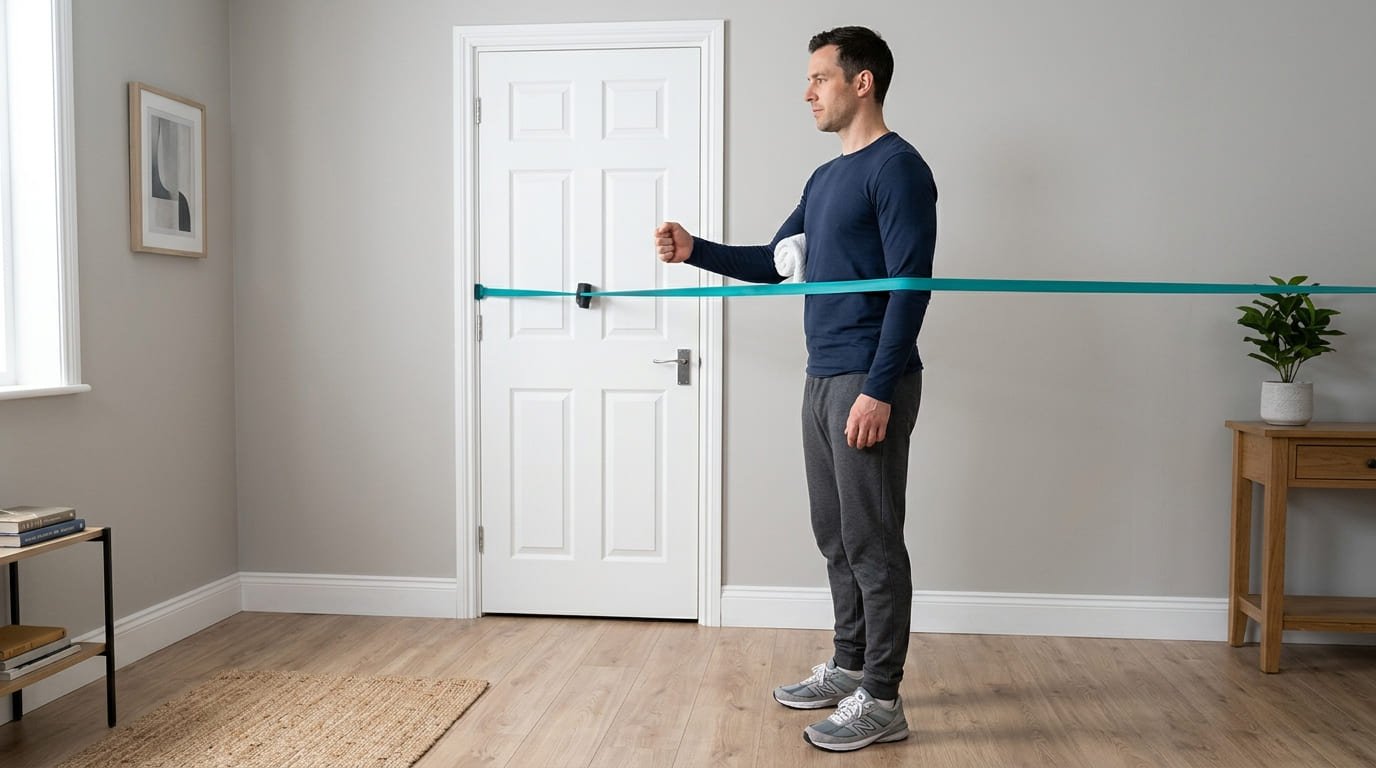
5. Band external rotation
- Tie a light band to a door handle at elbow height and stand side-on to the door, sore arm farthest from it
- Hold the band with the elbow bent to 90 degrees and tucked at your side. A rolled towel between elbow and ribs helps
- Rotate the forearm outward, away from your body, keeping the elbow at your side
- Return slowly over three seconds
Dose: 3 sets of 12 to 15. This is the core rotator cuff exercise in almost every programme.
6. Band internal rotation
- Stand with the sore arm nearest the door, holding the band with the elbow tucked at your side
- Rotate the forearm in toward your stomach
- Return slowly
Dose: 3 sets of 12 to 15. This trains the subscapularis, the front part of the rotator cuff.
7. Side-lying external rotation
- Lie on your good side with a rolled towel under the elbow of the top arm, elbow bent to 90 degrees
- Holding a very light weight, such as a water bottle, rotate the forearm up toward the ceiling
- Lower over three seconds
Dose: 3 sets of 10 to 15. Research on shoulder blade muscle balance has found side-lying external rotation recruits the cuff and lower trapezius well with little upper trapezius.
8. Band row
- Anchor a band at chest height and hold an end in each hand, arms straight in front of you
- Draw your elbows back past your sides, gently bringing your shoulder blades together
- Return slowly
Dose: 3 sets of 12. Rows strengthen the muscles that move the shoulder blade back and down, which helps the arm move in a better position. Our scapular retraction exercises guide has more on this.
Stage 3: Rebuild overhead strength
Only start these impingement exercises when stages 1 and 2 are pain-free.
9. Scaption (thumbs-up raise)
- Stand holding very light weights, thumbs pointing up
- Raise your arms forward and slightly out, in a V shape, to shoulder height
- Lower slowly over three seconds
Dose: 3 sets of 10. Raising the arm in this plane, with the thumb up, is usually more comfortable than lifting straight out to the side. Go higher than shoulder height only when it is pain-free.
10. Wall slide with lift-off
- Stand facing a wall with your forearms on the wall, elbows at shoulder height
- Slide your forearms up the wall as far as is comfortable, keeping the shoulders down
- At the top, lift your hands a centimetre off the wall and hold for 2 seconds
- Slide back down
Dose: 2 sets of 10. This combines shoulder mobility with serratus anterior and lower trapezius work, the muscles that rotate the shoulder blade upward as you reach overhead.
| Exercise | Stage | Main target | Equipment |
|---|---|---|---|
| Pendulum swing | 1 | Gentle movement | None |
| Table slide | 1 | Mobility | Table and towel |
| Isometric external rotation | 1 | Rotator cuff | Wall |
| Isometric abduction | 1 | Deltoid and cuff | Wall |
| Band external rotation | 2 | Rotator cuff (back) | Band |
| Band internal rotation | 2 | Subscapularis | Band |
| Side-lying external rotation | 2 | Rotator cuff, lower trapezius | Light weight |
| Band row | 2 | Shoulder blade retractors | Band |
| Scaption | 3 | Cuff and deltoid together | Light weights |
| Wall slide with lift-off | 3 | Serratus, lower trapezius | Wall |
Exercises for shoulder mobility
Pain often makes the shoulder stiff, and stiffness makes the pain worse. These exercises for shoulder mobility work well alongside the strengthening.
- Cross-body stretch. Bring the sore arm across your chest and gently hold it with the other arm. Hold for 30 seconds. Stop if it pinches at the front of the shoulder
- Sleeper stretch, gentle version. Lie on your sore side with the arm out in front at shoulder height and the elbow bent to 90 degrees. Use the other hand to ease the forearm toward the floor. Hold for 30 seconds, and stop well short of pain
- Doorway chest stretch. Place your forearms on a door frame below shoulder height and step gently through. Hold for 30 seconds
- Thoracic extension. Sit on a chair with your hands behind your head and gently arch your upper back over the backrest. A stiff upper back makes it harder to lift the arm. Our thoracic mobility exercises go further
| Mobility exercise | Area | Hold or reps |
|---|---|---|
| Table slide | Shoulder lift | 10 reps |
| Cross-body stretch | Back of the shoulder | 30 seconds x 2 |
| Gentle sleeper stretch | Back of the shoulder | 30 seconds x 2 |
| Doorway chest stretch | Front of the chest | 30 seconds x 2 |
| Thoracic extension | Upper back | 10 reps |
Do these exercises for shoulder mobility daily, ideally after a warm shower or a walk, and keep each one comfortable.
Exercises for torn rotator cuff without surgery
Many people with shoulder pain are told a scan shows a rotator cuff tear, and assume that means surgery. That is often not the case. Partial tears, and many full tears that come on gradually with age, are commonly managed first with exercise, and scans regularly show tears in people with no pain at all.
The exercises for torn rotator cuff without surgery are very similar to the shoulder impingement exercises above. The difference is that progress is often slower, and the focus is on the muscles that are still working well:
- Start with isometrics, exercises 3 and 4, for a couple of weeks
- Train the front of the shoulder too. The deltoid at the front can take over some of the lifting work. A lying front raise, done on your back with a light weight and the elbow straight, is a common starting point
- Move to band rotations and rows as pain allows
- Work toward overhead very gradually, starting lying on your back, then reclined, then sitting
Your surgeon or physiotherapist should guide exercises for torn rotator cuff without surgery, especially after a sudden injury. A sudden tear in a younger person, with a clear loss of strength after a fall or lift, is often assessed for surgery quickly, so get that checked straight away.
A 6-week shoulder impingement exercises plan
Do the strengthening sessions three or four times a week. Do the mobility work on most days.
| Week | Exercises | Sets and reps |
|---|---|---|
| Weeks 1 to 2 | Pendulum, table slide, isometric external rotation, isometric abduction | Daily. 5 x 20 to 30 second holds |
| Weeks 3 to 4 | Band external rotation, band internal rotation, side-lying external rotation, band row | 3 x 12 to 15, three times a week |
| Weeks 5 to 6 | Week 3 to 4 exercises plus scaption and wall slide with lift-off | 3 x 10 to 12, three times a week |
Keep the isometric holds as a warm-up throughout. If the pain flares, go back to the previous stage for a week. Most people need 6 to 12 weeks of these shoulder impingement exercises to see a clear change, and strength keeps improving for months after that.
What to avoid for now
- Heavy overhead pressing and behind-the-neck exercises
- Upright rows, which lift the arm in a position that often provokes pain
- Wide-grip dips and deep bench presses until the shoulder settles
- Sleeping on the sore side, if it hurts. Hug a pillow when lying on the other side
- Complete rest. A sling or keeping the arm still for weeks usually makes stiffness worse
When you return to the gym, start with lighter weights and a narrower range. Our bodyweight shoulder workout and resistance band guide are good bridges back to normal training.
Common mistakes
- Pushing through a sharp pinch in the hope it will loosen up
- Using a band that is too strong, which turns a rotator cuff exercise into a whole-body heave
- Shrugging during exercises. Keep the shoulder down and away from the ear
- Doing the exercises for a week and stopping. Tendons adapt slowly
- Only stretching without strengthening
- Ignoring the upper back, which affects how the shoulder blade sits
When to see a doctor or physiotherapist
Get a professional assessment before starting shoulder impingement exercises, or stop and get checked, if:
- The pain started after a fall, dislocation or sudden heavy lift
- You suddenly cannot lift your arm, or it is clearly weaker than before
- Pain spreads down the arm, or you have numbness, tingling or pins and needles
- You have night pain that does not ease with changing position, or pain with fever or feeling unwell
- The shoulder is becoming stiffer in every direction, which can suggest frozen shoulder
- Nothing has improved after six to eight weeks of consistent exercise
This article is general information, not medical advice. Left shoulder or arm pain with chest pain, breathlessness or sweating can be a sign of a heart problem and needs emergency help. See our medical disclaimer.
The bottom line
Shoulder impingement exercises work by calming the irritated tendons, then rebuilding the rotator cuff and shoulder blade muscles so the arm can lift without the pinch. Start with gentle movement and isometric holds, progress to band rotations and rows, and finish with overhead strength work. Keep pain low, lower every rep slowly, and stay patient for six to twelve weeks.
For me, the turning point was week four, when band external rotations stopped feeling awkward and I realised I had reached for a cup on the top shelf without thinking. I still do a short version of these impingement exercises twice a week before training. It takes ten minutes, and my shoulder has not complained since.
If your physiotherapist gives you a band with printed force markers, my guide to the CanDo AccuForce exercise band shows how to use the indicators to progress your rotator cuff exercises in small, measurable steps.
Frequently asked questions
What are the best shoulder impingement exercises?
Isometric rotation holds, band external and internal rotation, side-lying external rotation, band rows, scaption and wall slides are among the most useful. They strengthen the rotator cuff and shoulder blade muscles. Start with the gentlest and progress in stages.
How long does shoulder impingement take to heal with exercise?
Many people notice improvement within four to six weeks, with clearer changes over six to twelve weeks of regular shoulder impingement exercises. Long-standing problems can take longer.
Should I stop exercising with shoulder impingement?
Usually not. Stop the painful movements, especially heavy overhead lifting, but keep doing gentle impingement exercises within a comfortable range. Complete rest tends to make the shoulder stiff and weak.
Can a torn rotator cuff heal without surgery?
Many partial tears and many gradual-onset full tears are managed well without surgery. The tear may not heal completely, but exercise can restore strength and reduce pain. Sudden tears after an injury need prompt assessment.
What are good exercises for torn rotator cuff without surgery?
Isometric holds, lying front raises, band rotations, rows and a slow progression toward overhead movement are common. Your physiotherapist or surgeon should tailor exercises for torn rotator cuff without surgery to your tear.
What exercises should I avoid with shoulder impingement?
Avoid heavy overhead pressing, behind-the-neck presses, upright rows, deep dips and any exercise that causes a sharp pinch. Reintroduce them gradually once you can lift your arm without pain.
What are the best exercises for shoulder mobility?
Table slides, pendulum swings, cross-body stretches, gentle sleeper stretches, doorway chest stretches and thoracic extensions are good options. Do them daily within a comfortable range.
Is shoulder impingement serious?
It is common and usually responds well to exercise. It becomes more concerning if you have sudden weakness, an injury, numbness in the arm or pain that does not improve after a couple of months, so get those checked.
What’s next?
Reading is the easy part. Pick one of these and do it today.