Male Body Types: The 3 Types, the 5 Shapes and What They Mean
Search for male body types and you will find the same three words everywhere: ectomorph, mesomorph, endomorph. Thin, muscular, round. Each comes with a diet, a training plan and often a verdict on what you can and cannot achieve.
I once took one of those online quizzes, got told I was an ectomorph, and spent months believing I could not gain muscle. The real problem was that I was not eating enough or training consistently. The label gave me an excuse that sounded like science.
So this guide does two things. It explains the body type and body shape systems clearly, because they are useful as descriptions. And it is honest about where they stop being useful, which is the moment they are treated as a fixed destiny.
At a glance
- The three classic body types are ectomorph (lean and narrow), mesomorph (broad and muscular) and endomorph (wider and rounder)
- They began in the 1940s as part of a theory linking physique to personality, which has been discredited
- Most men are a mix, and your type changes as you gain muscle or lose fat
- Body shapes describe proportions: rectangle, triangle, inverted triangle, trapezoid and oval
- Bone structure is fixed. Muscle and body fat are not
- The same basics work for every build: strength training, enough protein, and calories matched to your goal
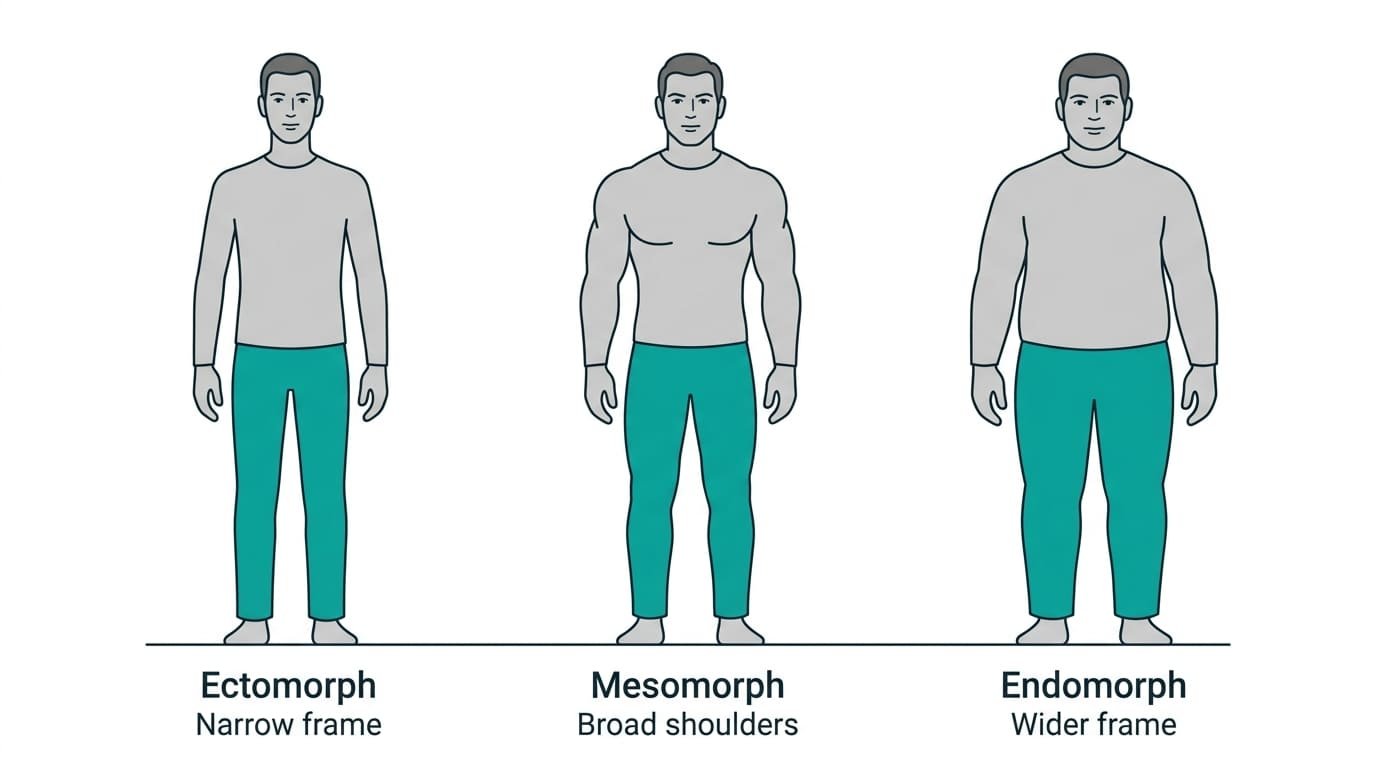
The three male body types
These are the somatotypes, the system most charts are based on.
| Type | Typical build | Often described as | Common strengths | Common challenges |
|---|---|---|---|---|
| Ectomorph | Narrow shoulders and hips, long limbs, small joints, little fat or muscle | Lean, slim, lanky | Stays lean easily, good at endurance | Finds it hard to gain weight and muscle |
| Mesomorph | Broad shoulders, narrower waist, medium frame, visibly muscular | Athletic | Gains muscle readily, loses fat reasonably easily | Can gain fat when inactive |
| Endomorph | Wider waist and hips, thicker joints, shorter limbs, more body fat | Stocky, solid | Often naturally strong, gains muscle well | Gains fat easily, loses it slowly |
Ectomorph
The classic picture is the tall, thin man with narrow shoulders, a flat chest, slim wrists and ankles, and long arms and legs. He eats what he likes without gaining much, and struggles to fill out a shirt.
Men who fit this description often have smaller appetites and are more active through the day than they realise, so their real intake is lower than they think.
Mesomorph
The athletic build: shoulders wider than hips, a defined chest and arms, and a medium bone structure. He looks as if he trains even when he does not, and responds visibly within weeks when he does.
Endomorph
A wider, more solid frame, with a thicker waist, broader hips and a tendency to carry more body fat, especially around the middle. Many strong men and heavyweight athletes have this build. Fat loss is slower, but strength often comes easily.
Where body types came from
The three types were created by the American psychologist William Sheldon in the 1940s. He photographed thousands of people and rated their physiques on three scales. His real aim was to show that body shape predicted temperament and character: that round people were sociable, muscular people were assertive and thin people were anxious.
That part of his work did not survive testing and is now regarded as pseudoscience. The link between physique and personality was never demonstrated reliably, and his methods were deeply flawed.
What did survive is the descriptive side. Sport scientists later developed a measurement method, known as the Heath-Carter somatotype, that scores a person on three scales at once using skinfolds, bone widths and limb girths. Two things about it matter:
- Nobody is one type. Everyone gets a score for all three components, such as low fatness, high muscularity and moderate linearity
- The score describes your body now. It changes when you gain muscle or lose fat. It is a snapshot, not a genetic verdict
So the words are fine as shorthand for how someone is currently built. They are not categories you are born into.
What is fixed and what is not
| Feature | Can you change it? | What decides it |
|---|---|---|
| Height and limb length | No | Genetics |
| Shoulder and hip bone width | No | Genetics |
| Wrist, ankle and joint size | No | Genetics |
| Where muscles attach and their shape | No | Genetics |
| Where you tend to store fat | Barely | Genetics, hormones, age |
| How much muscle you carry | Yes | Training, protein, total food, time |
| How much body fat you carry | Yes | Calorie balance, activity, sleep |
| Posture | Yes | Strength, habits, mobility |
The top half of that table is your frame. The bottom half is what sits on it, and it accounts for most of what people mean when they say body type. A thin man who trains and eats for two years is no longer an ectomorph by any measurement. A heavy man who loses 20 kg of fat and gains muscle looks like a different type altogether.
Genetics still matter
Being honest cuts both ways. People do respond differently to the same training. In one large study, 585 men and women followed an identical twelve-week arm training programme. Changes in muscle size ranged from a slight decrease to an increase of over 50 percent, and strength gains varied even more widely.
So your rate of progress and your eventual ceiling are partly inherited. What the research does not show is that anyone fails to improve at all with consistent training and enough food. The spread is in how much, not in whether.
The five male body shapes
Body shape is a separate idea from body type. It describes the outline made by your shoulders, chest, waist and hips, and it is mainly used for choosing clothes.
| Shape | Proportions | What creates it |
|---|---|---|
| Rectangle | Shoulders, waist and hips about the same width | A straight frame with little taper |
| Triangle | Waist and hips wider than shoulders | Narrower shoulders, or extra fat around the hips and waist |
| Inverted triangle | Shoulders and chest much wider than the waist and hips | Broad shoulders and a well-developed upper body |
| Trapezoid | Shoulders moderately wider than a slightly narrower waist | A balanced, lightly tapered build |
| Oval | Waist wider than both shoulders and hips | More fat carried around the middle |
Unlike your skeleton, your shape is largely adjustable. Building the shoulders and upper back while reducing waist size moves a rectangle or triangle toward a trapezoid. Our shoulder to waist ratio calculator puts a number on that taper.
How to work out your build
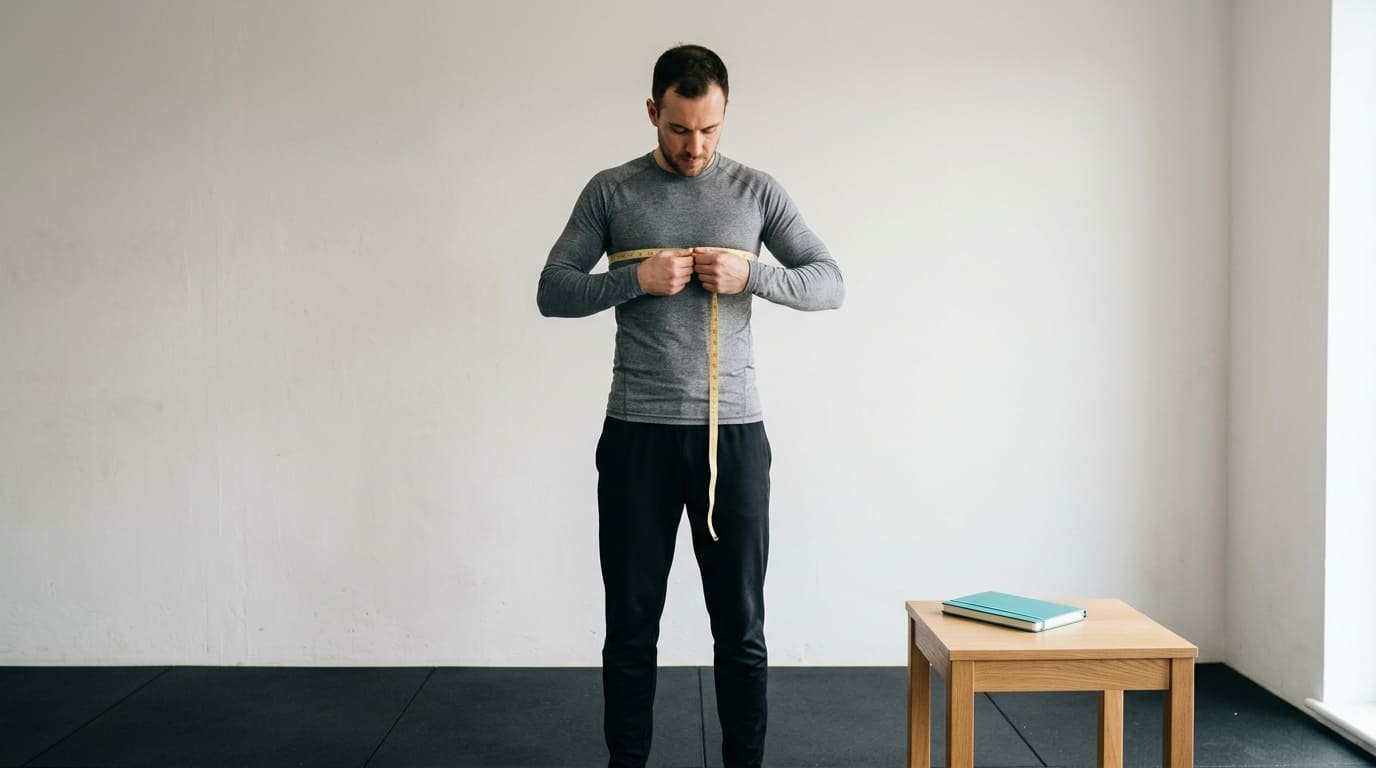
A quiz cannot tell you much. A tape measure and an honest look can.
- Measure your shoulders, chest, waist and hips with a soft tape. Our guide on how to measure your waist and hips shows where to place it
- Compare the numbers to the shape table above
- Check your frame size. Wrap your thumb and middle finger around the opposite wrist. If they overlap easily, your frame is smaller. If they do not meet, it is larger
- Estimate your body fat with our body fat calculator
- Think about your history. Have you always been slim, always solid, or somewhere between? How does your weight respond when you eat more or less?
| If this sounds like you | You lean toward | Your likely priority |
|---|---|---|
| Slim all your life, hard to gain weight, small wrists | Ectomorph | Eating enough and lifting consistently |
| Naturally athletic, shoulders wider than waist, gains muscle readily | Mesomorph | Staying consistent and keeping fat in check |
| Solid frame, gains weight easily, strong but soft around the middle | Endomorph | Managing calories while building muscle |
| Slim arms and legs with fat around the stomach | A mix, sometimes called skinny fat | Strength training first, with a small calorie deficit |
| Changed a lot with age or lifestyle | A mix | Whichever of the above matches where you are now |
Most men land between two types, and that is the expected result.
How to train for your build
The claim that each type needs a completely different programme is not supported by evidence. Muscles grow by the same process in everyone. What changes is emphasis.
| If you are lean and struggle to gain | If you are athletic and balanced | If you gain fat easily | |
|---|---|---|---|
| Strength training | 3 to 4 days a week, the top priority | 3 to 4 days a week | 3 to 4 days a week, to keep and build muscle |
| Main exercises | Squats, presses, rows, deadlifts, pull-ups | The same | The same |
| Sets and reps | 3 to 4 sets of 6 to 12, close to failure | The same | The same |
| Cardio | 1 to 2 easy sessions for health | 2 to 3 sessions | 3 to 4 sessions, plus daily walking |
| Daily steps | Normal activity | 7,000 to 10,000 | 8,000 to 12,000 |
| Main lever for results | Food intake | Consistency | Calorie balance |
Whatever your build, the foundation is progressive strength training: a small number of compound exercises, done regularly, with the weight or reps increasing over time. Our 3-day workout split is a sound starting plan for anyone, and compound exercises for beginners explains the main lifts.
How to eat for your build
The differences here are real, because they follow from your goal.
| Goal: gain muscle and weight | Goal: maintain and improve | Goal: lose fat | |
|---|---|---|---|
| Calories | About 250 to 500 above maintenance | Around maintenance | About 300 to 500 below maintenance |
| Protein | 1.6 to 2.2 g per kg of body weight | 1.6 to 2.2 g per kg | 1.8 to 2.4 g per kg |
| Carbohydrates | Generous, especially around training | Moderate | Moderate, mostly from whole foods |
| Fats | Enough to hit calories, about 25 to 35 percent | About 25 to 35 percent | About 20 to 30 percent |
| Helpful habits | Larger portions, extra snacks, calorie-dense foods, liquid calories | Regular meals, plenty of protein | High-fibre foods, lean protein, fewer liquid calories |
Our TDEE calculator estimates your maintenance calories, and the protein intake calculator gives a daily protein target.
If you are lean and cannot gain: track what you eat for a week. Almost every man who says he eats a lot and cannot gain weight discovers he eats less than he thought. Add 300 to 500 calories a day and weigh yourself weekly.
If you gain fat easily: a moderate deficit with high protein and regular lifting lets you lose fat while keeping, or even adding, muscle. Our guide to body recomposition explains how.
Dressing for your body shape
Shape charts are most useful when you are buying clothes. The aim is usually to suggest a gentle taper from shoulders to waist, whatever you are starting with.
| Shape | What tends to work | What to avoid |
|---|---|---|
| Rectangle | Structured shoulders, layers, horizontal detail across the chest | Shapeless, boxy cuts |
| Triangle | Structured jackets, darker colours below the chest, straight-leg trousers | Tight tops with slim-fit trousers |
| Inverted triangle | Well-fitted tops, straight or slightly tapered trousers with some weight to them | Heavily padded shoulders, very skinny trousers |
| Trapezoid | Most fitted styles | Clothes that are simply too big |
| Oval | Vertical lines, darker single colours, properly fitted shoulders | Tight waistbands, clingy fabrics, short jackets |
The most important rule applies to every shape: clothes that fit your shoulders properly look better than anything else you can change. A tailor can adjust the waist and sleeves cheaply.
Your first 12 weeks, by build
If you want a simple plan to start from, pick the column closest to you. All three use the same training. Only the eating and the amount of walking change.
| Lean, want to gain | Average, want to improve | Heavier, want to lose fat | |
|---|---|---|---|
| Strength training | Full body, 3 days a week | Full body, 3 days a week | Full body, 3 days a week |
| Daily calories | About 300 to 500 above maintenance | Around maintenance | About 400 below maintenance |
| Protein per day | About 2 g per kg | About 2 g per kg | About 2 g per kg of goal weight |
| Walking | Normal daily activity | 8,000 steps | 10,000 steps |
| Extra cardio | None needed | One or two 20-minute sessions | Two or three 20 to 30 minute sessions |
| Check every 2 weeks | Body weight rising by about 0.25 kg a week | Waist steady or shrinking, lifts rising | Waist shrinking, lifts steady or rising |
| If it is not working | Add 200 calories | Review protein and training effort | Remove 150 calories or add steps |
Stay with it for the full twelve weeks before deciding whether your body is responding. Most men who believe their body type is holding them back have never followed one plan for that long.
Body type myths
| Myth | Reality |
|---|---|
| Your body type is fixed for life | Your frame is fixed. Muscle and fat change with training, food and age |
| Ectomorphs cannot build muscle | They can. They need to eat more than feels natural and train consistently |
| Endomorphs are destined to be overweight | They gain fat more easily, but calorie balance still applies |
| Mesomorphs do not need to try | They respond faster, but lose condition like anyone else when inactive |
| Each type needs its own special diet | Protein and calorie needs depend on your size and goal, not a label |
| Endomorphs must avoid carbohydrates | Total calories matter far more than cutting one nutrient |
| A quiz can tell you your type | Proper somatotyping uses body measurements, and even then it only describes you today |
How body type changes with age
Many men notice their build shifting through their thirties and forties. The slim teenager becomes soft around the waist, and the athletic twenty-something loses definition.
This is rarely a change of type. It is usually three things happening together: less daily movement, a slow loss of muscle from not training, and a little more food than needed. Muscle mass tends to decline from around the age of 30 unless you train to keep it, and the lost muscle is often replaced by fat without much change on the scale.
The response is the same at any age: lift weights two or three times a week, keep protein up, and stay active day to day. Our guide on how to start exercising when out of shape is a good first step if it has been a while.
Better numbers than a label
If you want something to track, these are more useful than a type.
| Measure | What it tells you | Tool |
|---|---|---|
| Waist circumference | Changes in fat around the middle | Tape measure |
| Shoulder to waist ratio | Upper-body taper | Shoulder to waist ratio calculator |
| Body fat percentage | How lean you are | Body fat calculator |
| Fat-free mass index | How much muscle you carry for your height | FFMI calculator |
| Strength on key lifts | Whether training is working | A training log |
| Monthly photos | Visible change | Same light, same time of day |
Take these once a month. They show progress that a mirror and a label both miss. Our body measurement tracker keeps them in one place.
Body types in sport
Elite athletes cluster into recognisable builds because sport selects for them. Distance runners tend to be light and narrow. Sprinters and gymnasts are muscular with low body fat. Throwers and heavyweight lifters are large and solid. Swimmers often have long trunks and wide shoulders.
This is selection at the very top level, not a rule for the rest of us. You do not need a runner’s frame to enjoy running or a lifter’s frame to get strong. For general fitness, any build can do any activity well enough to benefit from it.
The bottom line
Ectomorph, mesomorph and endomorph are handy words for describing how a body looks today. They are not scientific categories, and they are not a forecast. The system they came from was built on a discredited idea, and the modern version treats everyone as a blend that shifts with training and diet.
Your bone structure is yours for life. The muscle and fat on it are not. Whatever build you are starting from, the plan is the same: lift progressively, eat enough protein, set your calories to match your goal, and give it months rather than weeks.
Measure your waist, your shoulders and your strength. Those numbers will tell you more than any chart.
Frequently asked questions
What are the three male body types?
Ectomorph, mesomorph and endomorph. Ectomorphs are lean with a narrow frame, mesomorphs are broad-shouldered and muscular, and endomorphs have a wider frame and carry more body fat. Most men are a mixture of two rather than a pure example of one.
Are body types scientifically real?
Only as descriptions. The theory behind them, which linked physique to personality in the 1940s, has been discredited. Sport scientists still use somatotype scores to describe a physique, but those scores change with training and diet. They are not fixed genetic categories.
Can you change your body type?
You cannot change your height, bone widths or where muscles attach. You can change how much muscle and fat you carry, which is most of what people mean by body type. Years of training and eating well can move someone from one description to another.
How do I know my body type?
Measure your shoulders, chest, waist and hips, check your wrist size, estimate your body fat and consider how your weight has behaved over your life. Slim with difficulty gaining suggests ectomorph, athletic suggests mesomorph, and solid with easy fat gain suggests endomorph.
What is the most common male body shape?
The rectangle, where shoulders, waist and hips are similar in width, is generally considered the most common. The trapezoid, with shoulders somewhat wider than the waist, is also very common and is the shape most ready-made clothing is cut for.
Should ectomorphs and endomorphs train differently?
The core training is the same: progressive strength work on compound exercises three or four days a week. The difference is emphasis. Leaner men should prioritise eating enough, while men who gain fat easily benefit from more walking and cardio and closer attention to calories.
What is a skinny fat body type?
It describes someone with slim arms and legs but noticeable fat around the stomach, usually from low muscle mass rather than high body weight. The best approach is strength training with plenty of protein and calories at or slightly below maintenance.
Does body type affect how fast you build muscle?
Genetics do affect the rate. Studies show a wide range of responses to identical training. However, nearly everyone gains muscle and strength with consistent training and enough food. Your build influences how quickly you progress, not whether you can.
What’s next?
Reading is the easy part. Pick one of these and do it today.