Brachialis Exercises: 10 Best Moves for Thicker, Stronger Arms
Most people who train their arms have never heard of the brachialis. It sits underneath the biceps where you cannot see it, it has no impressive peak, and it rarely gets a mention. Yet it is the strongest muscle you have for bending your elbow.
I came across it by accident. My biceps curls had stalled, and a friend suggested I spend a month doing hammer curls and slow reverse curls instead. My arms looked wider from the front within a few weeks, and my ordinary curls went up too. The muscle I had been ignoring was doing a good share of the work all along.
This guide explains what the brachialis is and what it does, why your grip decides how hard it works, the ten best exercises to train it, and three workouts for whatever equipment you have.
At a glance
- The brachialis lies beneath the biceps on the front of the upper arm
- It bends the elbow in every hand position and is the strongest elbow flexor
- Because it sits under the biceps, building it pushes the biceps up and makes the arm look thicker
- It works hardest when the biceps is at a disadvantage: with palms facing in or facing down
- Hammer curls and reverse curls are the two essential exercises
- Slow lowering and strict form matter more than heavy weight
- Add 4 to 8 direct sets a week to your normal arm or pulling training
What the brachialis is
The brachialis is a broad, flat muscle on the lower half of the front of your upper arm. It lies directly on the bone, underneath the biceps.
| Feature | Brachialis | Biceps brachii |
|---|---|---|
| Position | Deep, under the biceps | On the surface |
| Starts at | The lower half of the front of the upper arm bone | The shoulder blade, in two places |
| Attaches to | The ulna, the forearm bone on the little-finger side | The radius, the forearm bone on the thumb side |
| Crosses the shoulder joint? | No | Yes |
| Jobs | Bends the elbow, and nothing else | Bends the elbow, turns the palm up, helps raise the arm |
| Affected by hand position? | No | Yes, a great deal |
That last row is the key to training it. The brachialis attaches to the ulna, which does not rotate when you turn your hand. So it pulls with the same leverage whether your palm faces up, in or down. Anatomy texts describe it as the prime mover of elbow flexion for exactly this reason: it works in every position.
Source: Plantz and Bordoni, Anatomy, Shoulder and Upper Limb, Brachialis Muscle, StatPearls (2023)
The biceps is different. It attaches to the radius, which does rotate. With your palm up, the biceps is in its strongest position. Turn your palm to face inward or downward and the biceps tendon wraps partly around the bone and loses leverage.
The other elbow flexors
| Muscle | Where | Strongest when |
|---|---|---|
| Biceps brachii | Front of the upper arm, on the surface | Palm up |
| Brachialis | Front of the upper arm, deep | All positions equally |
| Brachioradialis | Top of the forearm, from just above the elbow to the wrist | Thumb up, the neutral grip |
All three work together in every curl. You cannot isolate one completely. What you can do is change which of them carries the larger share.
Why train the brachialis?
- Thicker arms. A larger brachialis adds width to the arm seen from the front and pushes the biceps upward, which improves its shape
- Stronger pulling. It contributes to every row, pull-up and chin-up. A stronger brachialis means stronger pulls
- Better curls. It is a major contributor to elbow flexion strength in any grip
- Balanced elbows. Training with different grips spreads the load across more tissue than palm-up curls alone
- Useful strength. Carrying shopping, lifting a child or a box, and climbing are all done with a neutral or palm-down grip, where the brachialis and brachioradialis do much of the work
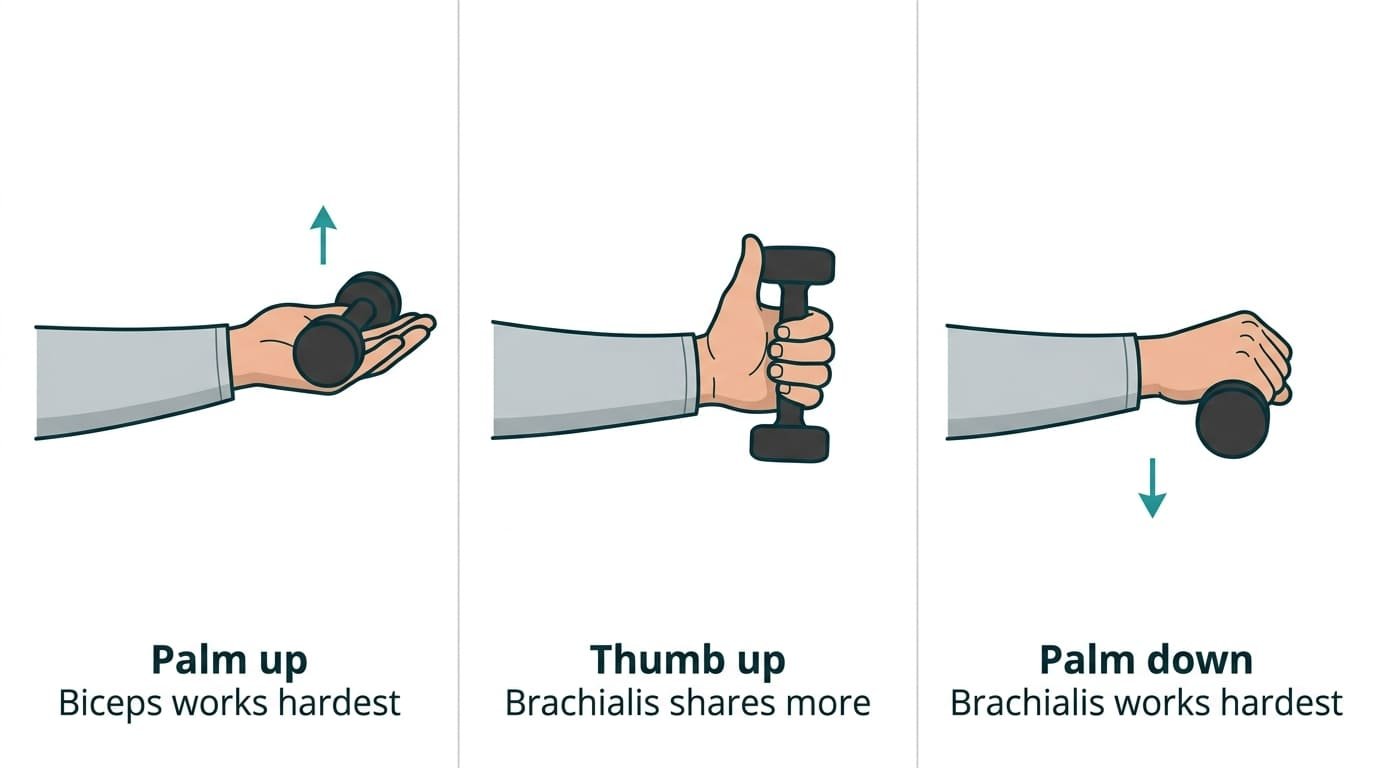
How grip changes which muscle works
This is the single most useful idea in the article.
| Grip | Hand position | Biceps | Brachialis | Brachioradialis | Example |
|---|---|---|---|---|---|
| Supinated | Palm up | Works hardest | Works | Works least | Standard curl |
| Neutral | Palms facing each other, thumbs up | Reduced | Takes a larger share | Works hardest | Hammer curl |
| Pronated | Palm down | At its weakest | Takes the largest share | Works hard | Reverse curl |
A note on honesty. The brachialis is a deep muscle, which makes it difficult to measure with the surface sensors normally used in muscle-activity studies, so direct evidence for exactly how much it works in each exercise is limited. The reasoning here comes from anatomy and mechanics: when the biceps is put in a weak position, the other elbow flexors must make up the difference. Studies comparing curl variations do show that changing the type of curl changes how active the biceps and brachioradialis are, which fits this picture.
Two other things shift work toward the brachialis:
- Slow lowering. Taking three to four seconds to lower the weight keeps tension on the elbow flexors for longer
- Elbows in front of the body. When your upper arm is raised forward, as in a preacher curl, the biceps is shortened at the shoulder and contributes a little less
The 10 best brachialis exercises
For all of them: keep your upper arms still, move only at the elbow, keep your wrists straight and lower the weight slowly.
1. Hammer curl
The foundation of brachialis training.
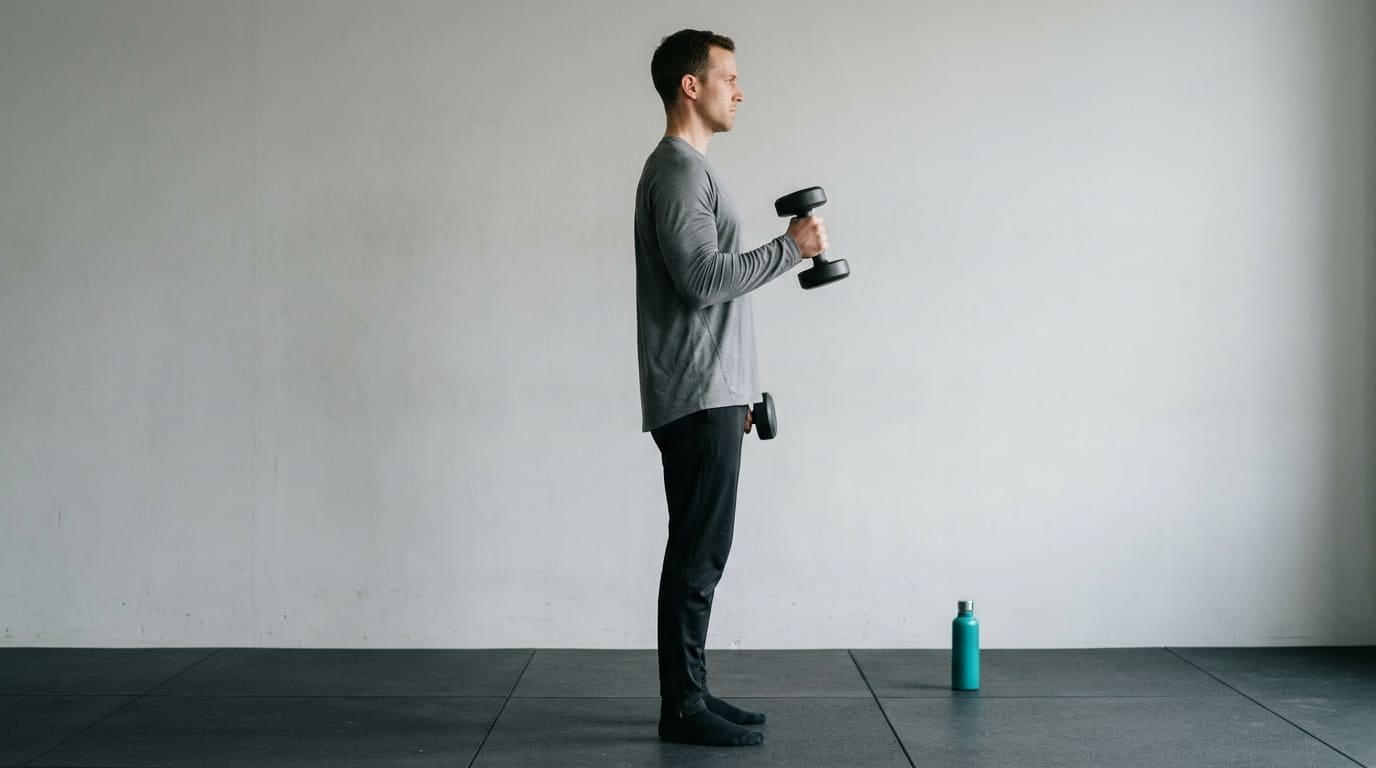
- Stand tall with a dumbbell in each hand, arms straight, palms facing your thighs
- Pin your elbows to your sides
- Curl the weights up, keeping your palms facing each other and your thumbs on top throughout
- Stop when your forearms are just past vertical
- Lower over three seconds until your arms are straight
Sets and reps: 3 sets of 8 to 12.
You will usually manage a little more weight than in a palm-up curl. Do not let that turn into swinging.
2. Cross-body hammer curl
- Stand tall with a dumbbell in each hand, palms facing your thighs
- Curl one dumbbell up and across your body toward the opposite shoulder
- Keep your elbow close to your ribs and your thumb on top
- Lower slowly and repeat on the other side
Sets and reps: 3 sets of 8 to 12 per arm.
Bringing the weight across the body shortens the range slightly and many people feel it more on the outside of the upper arm.
3. Reverse curl
- Hold a pair of dumbbells, a barbell or an angled EZ-bar with your palms facing down, hands shoulder-width apart
- Keep your elbows at your sides and your wrists straight, knuckles pointing forward
- Curl the weight up until your forearms are vertical
- Lower over three to four seconds
Sets and reps: 3 sets of 10 to 15.
Use about half to two thirds of the weight you would use for a standard curl. Your grip and forearms will limit you before your upper arms do, and that is expected. An EZ-bar is easier on the wrists than a straight bar.
4. Zottman curl
One exercise that covers two grips.
- Hold a dumbbell in each hand with your palms facing up
- Curl the weights up as in a standard curl
- At the top, rotate your hands so your palms face down
- Lower slowly, over three to four seconds, with palms down
- At the bottom, rotate back to palms up
Sets and reps: 2 to 3 sets of 8 to 10.
You lift with the biceps in its strong position, then lower with the brachialis and brachioradialis taking more of the load. Since you can lower more than you can lift, this works well.
5. Preacher hammer curl
- Sit at a preacher bench, or stand behind an incline bench set to about 60 degrees, and rest the back of one upper arm on the pad
- Hold a dumbbell with your thumb on top
- Curl it up without lifting your elbow from the pad
- Lower slowly until your arm is almost straight. Do not let it snap straight
Sets and reps: 2 to 3 sets of 10 to 12 per arm.
At home: kneel behind a sofa or armchair and rest your upper arm over the back of it.
6. Incline hammer curl
- Sit back on a bench set to about 60 degrees, with your arms hanging straight down, palms facing in
- Keeping your upper arms vertical, curl both dumbbells with thumbs on top
- Lower slowly to a full stretch
Sets and reps: 2 to 3 sets of 10 to 12.
7. Resistance band hammer curl
- Stand on the middle of a long band and hold an end in each hand with your thumbs on top. If your band has handles, turn them so your palms face each other
- Keep your elbows at your sides and curl your hands toward your shoulders
- Lower slowly, resisting the pull of the band
Sets and reps: 3 sets of 12 to 15.
For a band reverse curl, do the same with palms facing down.
8. Cable rope hammer curl
- Attach a rope to a low cable pulley
- Hold an end in each hand with thumbs on top, and step back so the cable is taut
- Keeping your elbows at your sides, curl the rope toward your shoulders
- Lower under control
Sets and reps: 3 sets of 10 to 15.
The cable keeps tension on the muscle through the whole range, including the bottom.
9. Neutral-grip chin-up
- Hang from a pair of parallel handles, or from rings, with your palms facing each other
- Pull yourself up until your chin is above your hands
- Lower slowly, taking three to five seconds, to a full hang
Sets and reps: 3 sets of 3 to 8.
If you cannot do one yet: jump or step to the top position and practise only the slow lowering, or use a band for assistance. Our pull-up alternatives guide explains the progression.
10. Towel hammer curl
No equipment at all.
- Sit on a chair and loop a towel under one foot
- Hold both ends in one hand, thumb on top, elbow at your side
- Curl upward while pressing down with your foot to provide resistance
- Resist on the way down for three to four seconds
Sets and reps: 3 sets of 10 to 12 per arm.
You control the difficulty with your leg, so you can make every rep as hard as you need. Our bicep workout without weights has more options.
Choosing exercises by equipment
| Equipment | Best brachialis exercises |
|---|---|
| Dumbbells | Hammer curl, cross-body hammer curl, reverse curl, Zottman curl |
| Dumbbells and a bench or sofa | Preacher hammer curl, incline hammer curl |
| Resistance bands | Band hammer curl, band reverse curl |
| Pull-up bar or rings | Neutral-grip chin-up, slow lowering |
| Gym cables and bars | Rope hammer curl, EZ-bar reverse curl |
| Nothing | Towel hammer curl, backpack hammer curl, held by the top loop |
Three brachialis workouts
Add one of these to the end of a pull day, an upper-body day or an arm session. Rest 60 to 90 seconds between sets.
Workout 1: dumbbells at home
| Exercise | Sets | Reps | Lowering time |
|---|---|---|---|
| Hammer curl | 3 | 8 to 12 | 3 seconds |
| Reverse curl | 3 | 10 to 15 | 3 seconds |
| Zottman curl | 2 | 8 to 10 | 4 seconds |
Workout 2: bands or no equipment
| Exercise | Sets | Reps | Lowering time |
|---|---|---|---|
| Band hammer curl, or towel hammer curl | 3 | 12 to 15 | 3 seconds |
| Band reverse curl | 3 | 12 to 15 | 3 seconds |
| Neutral-grip chin-up, slow lowering only if needed | 3 | 3 to 6 | 5 seconds |
Workout 3: gym
| Exercise | Sets | Reps | Lowering time |
|---|---|---|---|
| EZ-bar reverse curl | 3 | 8 to 12 | 3 seconds |
| Cable rope hammer curl | 3 | 10 to 15 | 3 seconds |
| Preacher hammer curl | 2 | 10 to 12 per arm | 4 seconds |
For a complete arm session, see our bicep and tricep workout, and for the palm-up side of things, short head bicep exercises.
Sets, reps and how often
| Question | Answer |
|---|---|
| How many direct sets per week? | 4 to 8 for most people, on top of rows, pull-ups and other curls |
| How many exercises? | 1 or 2 per session |
| How many reps? | 8 to 15 |
| How often? | Once or twice a week |
| How hard? | End each set with one or two good reps left |
| Tempo | About one second up, three to four seconds down |
| Where in the session? | After your big pulling exercises |
You do not need a brachialis day. The simplest way to train it is to swap some of your existing curls. If you currently do six sets of palm-up curls a week, make three of them hammer curls or reverse curls.
| Your plan | Where to add brachialis work |
|---|---|
| Full body, three days | One set of hammer curls or reverse curls at the end of two sessions |
| Upper lower | Hammer curls on one upper day, reverse curls on the other |
| Push pull legs | Hammer curls and reverse curls on pull days |
| Arm day | Replace one biceps exercise with a brachialis exercise |
Our guides to the upper lower split and the pull day workout show where these fit.
How to progress
- Add a rep to one or more sets each session
- When you reach the top of the rep range on every set, add the smallest weight you can
- If the next dumbbell is too big a jump, slow the lowering to five seconds, or add a two-second pause halfway down
- Keep the same two exercises for at least eight weeks
| Week | Hammer curl, target 3 sets of 8 to 12 | Action |
|---|---|---|
| 1 | 10 kg: 9, 8, 8 | Start |
| 2 | 10 kg: 10, 10, 9 | Add reps |
| 3 | 10 kg: 12, 11, 10 | Add reps |
| 4 | 10 kg: 12, 12, 12 | Top of range |
| 5 | 12 kg: 8, 8, 7 | Add weight |
Our sets and reps guide explains the method.
Common mistakes
- Swinging. Leaning back and heaving the weight up takes the load off the elbow flexors
- Elbows drifting forward, which turns the curl into a partial front raise
- Dropping the weight. The slow lowering is where much of the benefit lies
- Bending the wrists in reverse curls. Keep your knuckles in line with your forearms
- Going too heavy on reverse curls. They need less weight than you expect
- Partial range. Straighten your arms fully at the bottom
- Only ever curling palm-up, and never challenging the other elbow flexors
- Adding too much volume at once. The elbow tendons need time to adapt
Looking after your elbows and forearms
Neutral and palm-down curls load the muscles and tendons on the outside of the elbow more than standard curls do. That is healthy in sensible amounts and irritating in excess.
- Start with two sets per exercise and build up over a few weeks
- Warm up with a light set of 15 to 20 reps
- If a straight bar hurts your wrists in reverse curls, use dumbbells or an EZ-bar
- Pain on the outside of the elbow that lingers after training is a sign to cut back for a week or two
- See a physiotherapist if it does not settle
Our forearm workout at home has grip and wrist exercises that support this training.
The bottom line
The brachialis is the hidden muscle under your biceps and the strongest bender of your elbow. Because it works equally in every hand position, you train it best by putting the biceps at a disadvantage: thumbs up, or palms down.
Add hammer curls and reverse curls to your week. Keep your elbows still, your wrists straight and your lowering slow. Four to eight sets a week, in place of some of your usual curls, is enough.
Give it eight weeks. Your arms will look thicker from the front, and your rows, chin-ups and ordinary curls will be stronger for it.
For the outer head of the biceps itself, see our guide to long head bicep exercises.
Frequently asked questions
What is the brachialis muscle?
It is a muscle on the front of the upper arm that lies underneath the biceps. It runs from the lower half of the upper arm bone to the ulna in the forearm, and its only job is to bend the elbow. It is the strongest elbow flexor.
What is the best exercise for the brachialis?
The hammer curl and the reverse curl are the two most effective. Both put the biceps in a weaker position, so the brachialis takes a larger share of the work. Doing them with a slow, three to four second lowering increases the effect.
Do hammer curls work the brachialis?
Yes. With your palms facing each other, the biceps loses some of its leverage, and the brachialis and brachioradialis do more of the work. Hammer curls are the simplest and most popular way to train the brachialis with dumbbells.
Does the brachialis make your arms look bigger?
Yes. Because it sits beneath the biceps, a larger brachialis pushes the biceps up and adds thickness to the arm, especially when viewed from the front or side. It is one of the easiest ways to add visible width to the upper arm.
How often should I train the brachialis?
Once or twice a week is enough. Four to eight direct sets a week works for most people, since the muscle also works during rows, pull-ups and regular curls. The easiest method is to replace some palm-up curls with hammer or reverse curls.
Can I train the brachialis at home without weights?
Yes. Towel hammer curls using your own leg for resistance, band hammer curls and neutral-grip chin-ups all work. A backpack held by its top loop with your thumb on top also makes a good hammer curl.
Hammer curls or reverse curls, which is better for the brachialis?
Both are useful. Reverse curls put the biceps at its greatest disadvantage, so in theory they shift the most work to the brachialis, but grip strength limits the load. Hammer curls allow heavier weights. Using both covers each advantage.
Why do I feel reverse curls in my forearms?
Because the muscles on the top of the forearm, including the brachioradialis and the wrist extensors, work hard to hold the weight with a palm-down grip. That is normal. Use a lighter weight, keep your wrists straight, and the upper arm will still be trained.
What’s next?
Reading is the easy part. Pick one of these and do it today.