Core Exercises for Back Pain: 12 Gentle Moves and a Simple Routine That Builds Up
Core exercises for back pain are one of the most common things people are told to try when their lower back starts complaining. You may have heard “strengthen your core” from a doctor, a physiotherapist or a friend. It is good advice, but it often comes with very little detail. Which exercises? How hard? And what if crunches make your back feel worse?
This guide fills in the gaps. It explains what the core actually is, what the research says about exercise for back pain, 12 gentle core exercises that most people with everyday back pain can start with, a step-by-step routine that builds up over 8 weeks, and the posture and lifestyle habits that help. I will also be honest about the limits, because core exercise is helpful but not magic.
At a glance
- Exercise is one of the best-supported treatments for chronic low back pain
- Research suggests no single type of exercise is clearly best, so choose what you can do consistently
- Gentle core exercises focus on control and endurance, not crunching hard
- Anti extension core exercises, like dead bugs and planks, train your trunk to resist arching
- Isometric core exercises, where you hold a position, are often easiest on a sore back
- Start with 10 minutes a day and build up gradually over several weeks
- See a doctor first if your pain follows an injury, comes with numbness or weakness, or you feel unwell
What is the core?
Your core is not just your six-pack. It is a team of muscles that surrounds your spine and pelvis and keeps you steady while you move.
| Muscle | Where it is | Role |
|---|---|---|
| Rectus abdominis | Front of the stomach | Bends the trunk forward, resists arching |
| Obliques | Sides of the waist | Twisting and resisting side bending |
| Transversus abdominis | Deep, wraps around like a belt | Supports the spine and pelvis |
| Multifidus and erector spinae | Along the spine | Keep the spine upright and steady |
| Glutes | Buttocks | Stabilise the pelvis, help with lifting |
| Diaphragm and pelvic floor | Top and bottom of the trunk | Help create pressure that supports the spine |
A strong, well-coordinated core helps you control your spine during everyday tasks like lifting shopping, getting out of bed and bending to tie your shoes.
What the research says about exercise for back pain
A large Cochrane review of 249 trials found moderate-certainty evidence that exercise reduces pain in chronic low back pain compared with no treatment, usual care or placebo. On a 0 to 100 scale, pain was about 15 points lower at the first follow-up, a clinically important difference. Improvements in function were smaller. Exercise was probably more effective than advice or education alone.
If you enjoy slow, controlled movement, our guide to Pilates exercises for beginners covers 15 mat moves and what a Cochrane review found about Pilates for back pain.
Another Cochrane review focused on motor control exercise, a type of core training that teaches you to activate and control the deep trunk muscles. In 29 trials with 2,431 people, motor control exercise was better than minimal intervention for pain and function, but it was not clearly better than other forms of exercise. The authors concluded that the choice of exercise should depend on preferences, cost and safety.
The honest takeaway: core exercises for back pain help many people, but so do walking, strength training, yoga and Pilates. The best programme is the one you can do regularly without flaring your back. Core work is a great foundation, especially when combined with general activity.
Principles for core training with a sore back
| Principle | What it means |
|---|---|
| Control over intensity | Slow, steady movements, not fast reps |
| Hold before you move | Isometric core exercises first, then dynamic ones |
| Neutral spine | Keep your natural curves, avoid big arching or rounding |
| Breathe | Do not hold your breath. Breathe out through the effort |
| Build gradually | Add time or reps slowly over weeks |
| Comfort guide | Mild discomfort is fine. Sharp or spreading pain is not |
12 gentle core exercises for back pain

These go from gentlest to more challenging. Start with exercises 1 to 5 and add the others as they feel comfortable.
1. Diaphragmatic breathing
Lie on your back with your knees bent. Place one hand on your chest and one on your stomach. Breathe in through your nose so your stomach and lower ribs expand, then breathe out slowly. Do 5 to 10 slow breaths. It relaxes tense back muscles and teaches the deep core to work with your breath.
2. Gentle abdominal brace
Lie on your back with your knees bent. Gently tighten your stomach as if preparing for a light poke, without holding your breath or flattening your back hard. Hold for 10 seconds while breathing normally. Do 8 to 10. Our guide to abdominal bracing exercises explains this in more detail.
3. Pelvic tilts
Lie on your back with your knees bent. Gently tilt your pelvis so your lower back presses lightly into the floor, then tilt it the other way so a small arch forms. Move slowly within a comfortable range. Do 10 to 15. This eases stiffness and teaches control of the lower back.
4. Glute bridge
Lie on your back with your knees bent and feet flat. Squeeze your glutes and lift your hips until your body is in a straight line from shoulders to knees. Hold for 3 to 5 seconds, lower slowly. Do 10 to 12. Strong glutes take load off the lower back. Our glute bridges guide has variations.
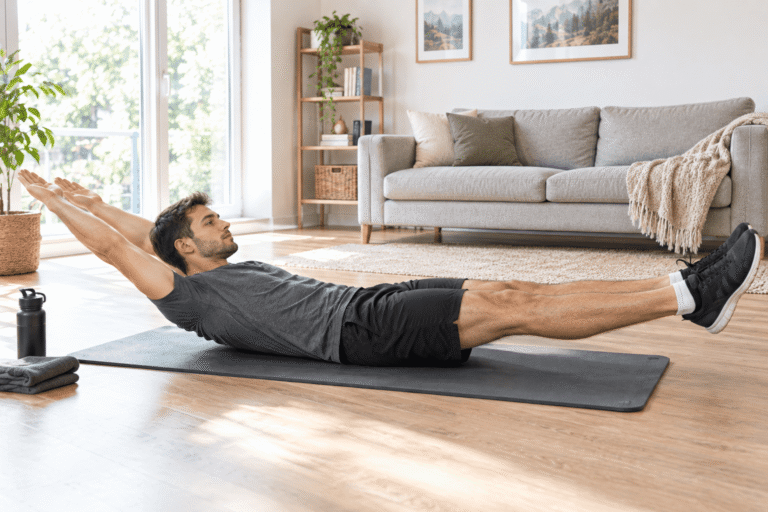
5. Dead bug (anti-extension)
Lie on your back with your arms pointing to the ceiling and your knees bent at 90 degrees above your hips. Keep your lower back gently pressed toward the floor. Slowly lower one arm behind you and the opposite foot toward the floor, then return and switch. Do 6 to 8 per side. Beginners can move only the legs, or only tap the heels down.
The dead bug is one of the best anti extension core exercises, because it trains your trunk to resist arching while your arms and legs move.
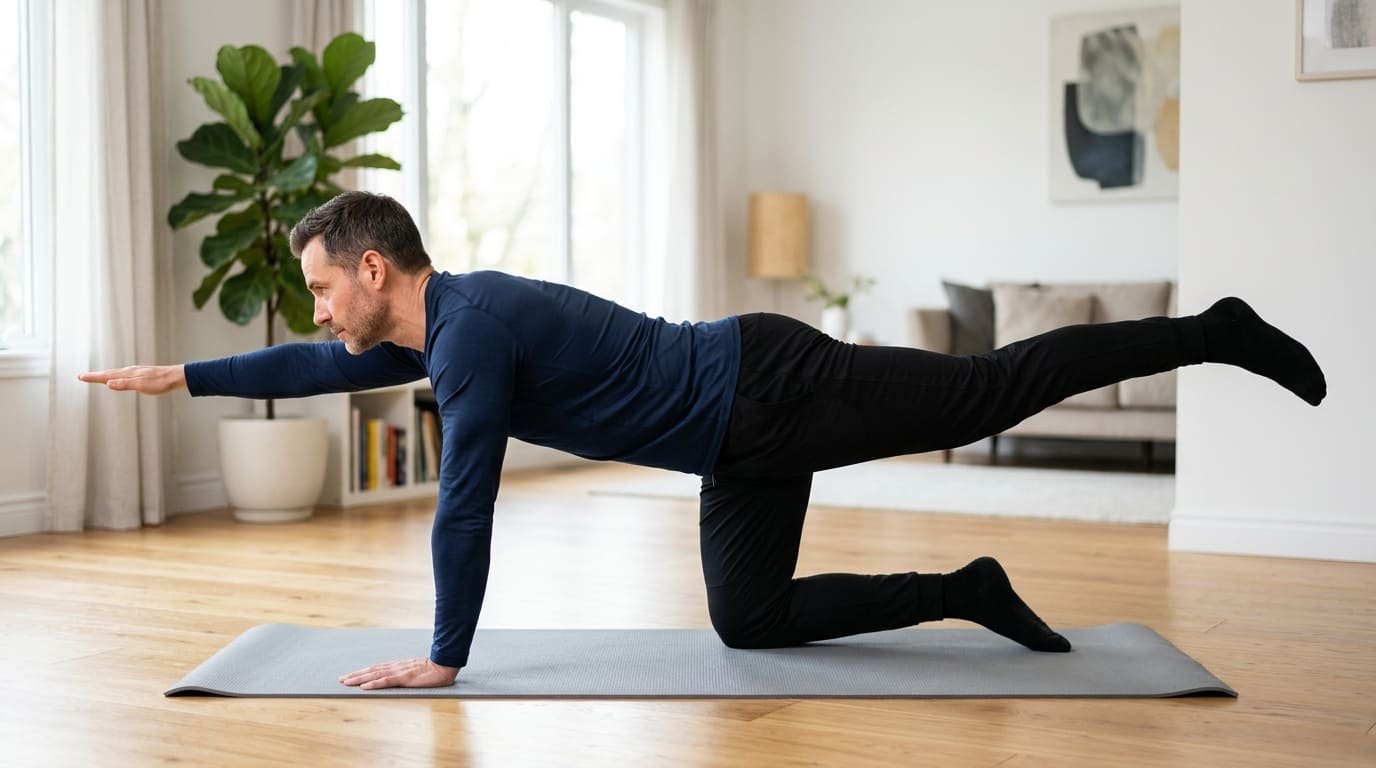
6. Bird dog
On hands and knees, with your back flat, slowly reach one arm forward and the opposite leg back until both are level with your body. Hold for 5 to 10 seconds without letting your back sag or twist. Return and switch sides. Do 6 to 8 per side. Bird dog is one of the McGill Big 3 exercises. Our guide to the McGill Big 3 explains the full set.
7. Modified curl-up
Lie on your back with one knee bent and one leg straight. Place your hands under the arch of your lower back. Lift your head and shoulders just a few centimetres, keeping your neck in line, and hold for 8 to 10 seconds. Lower and repeat. Do 5 to 6 holds, switching the bent leg halfway. This is a gentler alternative to a sit-up.
8. Side plank from knees
Lie on your side, propped on your forearm, with your knees bent. Lift your hips so your body forms a straight line from knees to head. Hold for 10 to 20 seconds per side. Progress to straight legs when ready.
9. Plank from knees or an incline
Start with your forearms on a bench, a sturdy table or the floor, and your knees down. Keep your body in a straight line from head to knees, stomach gently braced. Hold for 15 to 30 seconds. Progress to a full plank on your toes. Planks are classic isometric core exercises and anti extension core exercises at the same time.
10. Pallof press (anti-rotation)
Attach a light resistance band at chest height to something sturdy. Stand side-on, holding the band at your chest with both hands. Press your hands straight out in front and hold for 5 seconds, resisting the band’s pull to twist you. Return slowly. Do 8 to 10 per side.
11. Heel taps or marching bridge
From a glute bridge position, keep your hips lifted and slowly lift one foot a few centimetres, then the other, like slow marching. Keep your hips level. Do 6 to 8 per side.
12. Suitcase carry
Hold a moderately heavy bag or dumbbell in one hand and walk slowly for 20 to 30 metres, standing tall without leaning. Switch hands. This trains your core to stay steady during a real-life task.
| Exercise | Type | Level |
|---|---|---|
| Diaphragmatic breathing | Relaxation, deep core | Very gentle |
| Gentle abdominal brace | Isometric | Very gentle |
| Pelvic tilts | Mobility, control | Very gentle |
| Glute bridge | Strength | Gentle |
| Dead bug | Anti extension | Gentle to moderate |
| Bird dog | Anti extension, anti rotation | Gentle to moderate |
| Modified curl-up | Isometric | Moderate |
| Side plank from knees | Isometric, anti side bending | Moderate |
| Plank from knees or incline | Isometric, anti extension | Moderate |
| Pallof press | Anti rotation | Moderate |
| Marching bridge | Strength, control | Moderate |
| Suitcase carry | Functional, anti side bending | Moderate to hard |
What are anti extension core exercises?
Anti extension core exercises train your trunk to resist arching backward. When you lift something overhead, carry a heavy load in front of you, or simply stand for a long time, your lower back is tempted to arch. A core that can resist this keeps the spine in a more comfortable, neutral position. Dead bugs, planks, body saws and ab wheel rollouts are all anti extension exercises, from easiest to hardest. Our guide to ab wheel exercises covers the advanced end, which is best left until your back feels strong and settled.
Why isometric core exercises are good for sore backs
Isometric core exercises are holds, such as planks, side planks and bird dog holds. Your muscles work hard, but your spine stays still. This makes them easier to control and often more comfortable than exercises that bend the spine repeatedly, like sit-ups. Start with short holds of 10 seconds and build up gradually, rather than trying to hold one long plank.
A 10-minute routine of core exercises for back pain
Do this once a day, or at least 4 or 5 times a week. Move slowly and rest briefly between exercises.
| Order | Exercise | Dose |
|---|---|---|
| 1 | Diaphragmatic breathing | 6 breaths |
| 2 | Pelvic tilts | 10 |
| 3 | Gentle abdominal brace | 6 x 10 seconds |
| 4 | Glute bridge | 10 |
| 5 | Dead bug | 6 per side |
| 6 | Bird dog | 6 per side, 5-second hold |
| 7 | Side plank from knees | 2 x 15 seconds per side |
| 8 | Gentle back stretch, knees to chest | 30 seconds |
If your back is very sore today, do only exercises 1 to 4 and a short walk. Our guide to back stretching exercises has gentle stretches to finish with.
An 8-week core exercises for back pain progression
| Weeks | What to do | How to progress |
|---|---|---|
| 1 and 2 | Exercises 1 to 5, daily | Learn the movements, breathe steadily |
| 3 and 4 | Add bird dog and modified curl-ups | Longer holds, 2 sets |
| 5 and 6 | Add side planks and incline planks | Hold for 20 to 30 seconds |
| 7 and 8 | Add Pallof press, marching bridge and suitcase carry | Build to 3 rounds, full planks if comfortable |
Alongside this, aim to walk most days. Walking is gentle, effective and one of the simplest things you can do for a sore back. Our walking guide has a simple plan to build up.
Core exercises for posture and everyday comfort
Many people want core exercises for posture as well as for back pain. A strong core helps you hold an upright position with less effort, but posture is also about habits. Combine your core work with:
- Upper back exercises, such as rows and band pull-aparts
- Regular breaks from sitting, at least every 30 to 60 minutes
- A workstation set up so your screen is at eye level
- Hip flexor and chest stretches if you sit a lot
There is no single perfect posture. The best posture is the next one: changing position often matters more than holding one “correct” position all day. Our guides to posture exercises and anterior pelvic tilt exercises go into more detail.
Exercises to be careful with
| Exercise | Why to be careful | Try instead |
|---|---|---|
| Full sit-ups | Repeated spine bending under load can irritate some backs | Modified curl-up |
| Leg raises with both legs straight | Can strongly arch the lower back | Dead bug with bent knees |
| Russian twists with weight | Fast twisting under load | Pallof press |
| Superman holds for long periods | Can compress the lower back | Bird dog |
| Heavy deadlifts too soon | High load before control is built | Glute bridges, then light hip hinges |
These are not banned forever. Many people return to them once their back is stronger. They are just not the best place to start.
Everyday habits that help a sore back
- Keep moving. Bed rest usually slows recovery. Gentle walking helps
- Change positions often when sitting or standing
- Lift with your hips and knees, keeping loads close to your body
- Sleep well. Poor sleep can make pain feel worse
- Manage stress. Stress and pain are closely linked
- Stay patient. Most episodes of back pain improve, even if slowly
When to see a doctor first
Get medical advice before starting, or urgently if needed, if your back pain:
- Follows a fall, accident or injury
- Comes with numbness, tingling or weakness in the legs
- Comes with numbness around the groin or buttocks, or changes in bladder or bowel control (seek urgent help)
- Comes with fever, unexplained weight loss or feeling unwell
- Is severe at night or does not improve with rest
- Has not improved after several weeks
This article is general information, not medical advice. See our medical disclaimer.
Common mistakes
| Mistake | What happens | Fix |
|---|---|---|
| Holding your breath | Raises tension and pressure | Breathe out through the effort |
| Doing too much on a good day | Flare-up the next day | Increase gradually |
| Only doing crunches | Little benefit, may irritate | Mix anti extension and anti rotation work |
| Arching during planks | Strain on the lower back | Drop to knees or use an incline |
| Stopping when pain improves | Pain may return | Keep a maintenance routine |
| Expecting quick results | Frustration | Give it 6 to 8 weeks |
Using your core in daily life
The aim of core exercises for back pain is not just to do well on the mat. It is to move more comfortably in everyday life. Try using the gentle brace you practise in exercise 2 when you:
- Lift shopping bags or a laundry basket
- Get in and out of the car
- Stand up from a low chair
- Push a heavy door or a trolley
- Carry a child
A light brace, not a hard squeeze, combined with lifting from your hips and knees and keeping the load close, helps your back feel more supported in daily tasks.
What to do during a flare-up
Back pain often comes and goes. During a flare-up, do not stop moving completely. Switch to the gentlest part of your routine: breathing, pelvic tilts and short walks. Use heat if it helps. As the pain settles over a few days, gradually add back the other core exercises for back pain at a lower level, then build up again.
Core exercises for back pain in older adults
Older adults can do almost all of these exercises, with a few adjustments. Use a firm bed or a thick mat if getting down to the floor is difficult, and do side planks and planks against a wall or a kitchen counter instead of on the floor. Seated bracing, seated marching and sit-to-stands are excellent options. Our guide to core exercises for seniors has seated and standing routines.
Small, regular sessions win
The people who get the most from core exercises for back pain are rarely the ones who train hardest. They are the ones who do a short routine most days for months. Ten minutes a day is enough. Pair it with a daily walk, and you have a simple plan that suits most everyday back pain.
The bottom line
Core exercises for back pain work best when they are gentle, controlled and regular. Start with breathing, bracing, pelvic tilts and glute bridges, then add dead bugs, bird dogs, side planks and planks as your back allows. Anti extension and isometric core exercises are especially useful because they train your trunk to stay steady without repeatedly bending the spine.
Research shows exercise helps chronic low back pain, but no single type is clearly best. So pick exercises you can do consistently, combine them with walking and good daily habits, and build up over several weeks. If your pain comes with warning signs, see a doctor first.
Frequently asked questions
What are the best core exercises for back pain?
Gentle options like abdominal bracing, pelvic tilts, glute bridges, dead bugs, bird dogs, side planks from the knees and planks are a great starting point for most people with everyday back pain.
Do core exercises help lower back pain?
Research suggests exercise, including core exercise, helps reduce chronic low back pain. Core exercise does not appear to be better than other types of exercise, so consistency matters most.
What are anti extension core exercises?
Exercises that train your trunk to resist arching backward, such as dead bugs, planks and ab wheel rollouts. They help keep the lower back in a neutral, comfortable position.
Are isometric core exercises good for back pain?
Often yes. Holds like planks, side planks and bird dog holds work the core without repeatedly bending the spine, which many people with sore backs find more comfortable.
Should I avoid sit-ups with back pain?
Many people find full sit-ups irritate their back. A modified curl-up, dead bugs and planks are gentler ways to train the core while your back recovers.
How often should I do core exercises for back pain?
A short routine of about 10 minutes, 4 to 7 days a week, works well for most people. Build up gradually over 6 to 8 weeks.
Can core exercises improve posture?
They can help you hold an upright position with less effort. Combine them with upper back exercises, regular movement breaks and a good workstation set-up.
How long does it take for core exercises to help back pain?
Some people feel better within a couple of weeks, but it usually takes 6 to 8 weeks of regular practice to notice clear improvements.
Is walking or core exercise better for back pain?
Both help. Walking is gentle and improves general fitness, while core exercises build control and endurance. Doing both is ideal for most people.
What’s next?
Reading is the easy part. Pick one of these and do it today.