Knee Mobility Exercises: 12 Gentle Moves to Bend and Straighten Your Knee Better
Knee mobility exercises are for anyone whose knees feel stiff, tight or “rusty”. Maybe you notice it getting up from a chair after a long drive, kneeling in the garden, or walking down stairs. Maybe your knee does not fully straighten anymore, or you cannot sit back on your heels like you used to. Stiffness like this is very common, and it often improves with regular, gentle movement.
This guide is about mobility: helping your knee bend and straighten more comfortably, and keeping it moving well. It is different from our guide to exercises for knee pain, which focuses more on strengthening a painful knee. In practice, the two go hand in hand, and many people benefit from both.
Here you will find why knees get stiff, how to check your knee range at home, 12 knee mobility exercises from very gentle to more challenging, isometric exercises for the knee joint, simple knee exercise equipment that helps, a daily routine, and important safety notes, especially if you are recovering from surgery.
At a glance
- Knee mobility is about how far and how comfortably your knee bends (flexion) and straightens (extension)
- Stiffness often comes from inactivity, arthritis, swelling, tight muscles or recovery from injury or surgery
- Gentle, frequent movement usually helps more than occasional hard stretching
- Isometric exercises, where muscles work without the joint moving, are a useful, gentle way to strengthen a stiff or sore knee
- Simple equipment like a towel, a step, a chair or a stationary bike is often all you need
- After knee surgery, follow your surgeon’s and physiotherapist’s plan for range of motion exercises
- Stop and get advice if your knee is hot, very swollen, locked or giving way
Why do knees get stiff?
| Cause | What happens | Helpful approach |
|---|---|---|
| Long periods of sitting | Muscles and joint tissues get used to a bent position | Regular movement breaks |
| Knee osteoarthritis | Joint surfaces and surrounding tissues change | Regular exercise and strength work |
| Swelling after injury | Fluid limits how far the knee can bend | Gentle movement, elevation, medical advice |
| Tight muscles around the knee | Quads, hamstrings and calves restrict movement | Mobility and stretching |
| Recovery after surgery | Healing tissue and scar tissue can limit range | A structured rehab plan from your physiotherapist |
| Weak muscles | Less support and confidence moving the knee | Strengthening, including isometrics |
Knee stiffness is usually worst first thing in the morning or after sitting, and eases once you get moving. That pattern is a sign that movement is your friend.
How to check your knee range at home
Can your knee straighten fully?
Sit on the floor or a bed with your legs out straight. Relax your thigh, then tighten it and try to press the back of your knee down. Compare both sides. If one knee stays bent or you can slide a hand easily under it, you may have lost some extension.
How far does your knee bend?
Lie on your back and slide your heel toward your bottom. Notice how close it comes compared with the other side, and where you feel tightness. Most people can bring the heel quite close to the bottom. After surgery or with arthritis, range may be less.
| Everyday task | Knee bend needed (rough guide) |
|---|---|
| Walking on level ground | About 60 to 70 degrees |
| Climbing stairs | About 80 to 90 degrees |
| Getting up from a chair | About 90 to 100 degrees or more |
| Getting in and out of a bath | About 120 degrees or more |
| Kneeling or sitting on your heels | About 140 degrees or more |
These are rough guides only, but they show why even small gains in knee bend can make daily life easier.
12 knee mobility exercises
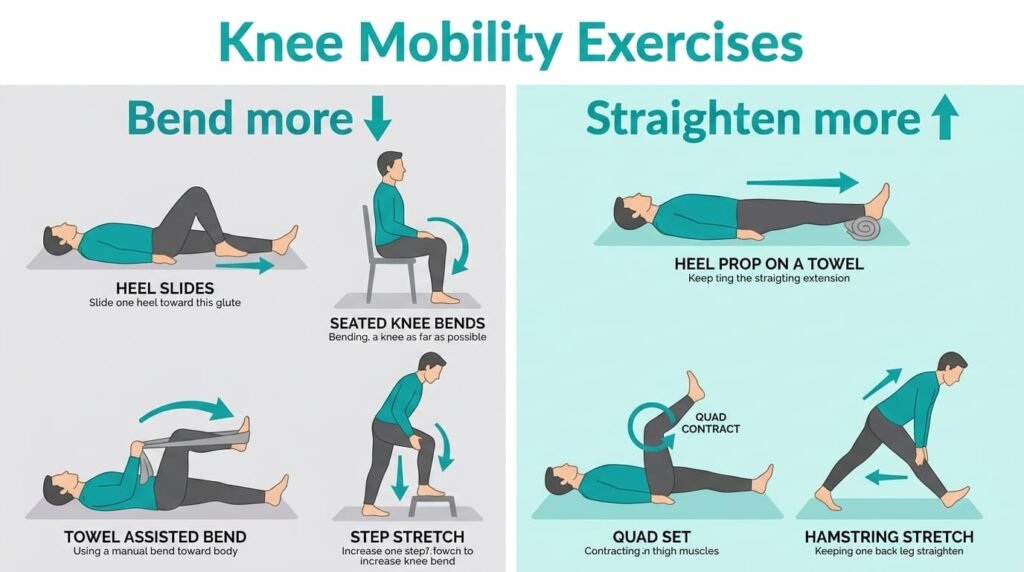
Do each exercise slowly and comfortably. A mild stretch or mild discomfort is fine. Sharp pain is not. Start with 1 set and build up to 2 or 3.
1. Heel slides
Lie on your back with both legs straight. Slowly slide one heel toward your bottom, bending your knee as far as is comfortable. Hold for 3 to 5 seconds, then slide back. Do 10 to 15 per leg. A towel under the heel or a sock on a smooth floor helps it glide.
2. Seated knee bends
Sit on a chair with your feet flat. Slide one foot back under the chair as far as is comfortable, hold for 5 seconds, then return. Do 10 to 15 per leg. This is easy to do several times a day at a desk.
3. Towel assisted knee bend
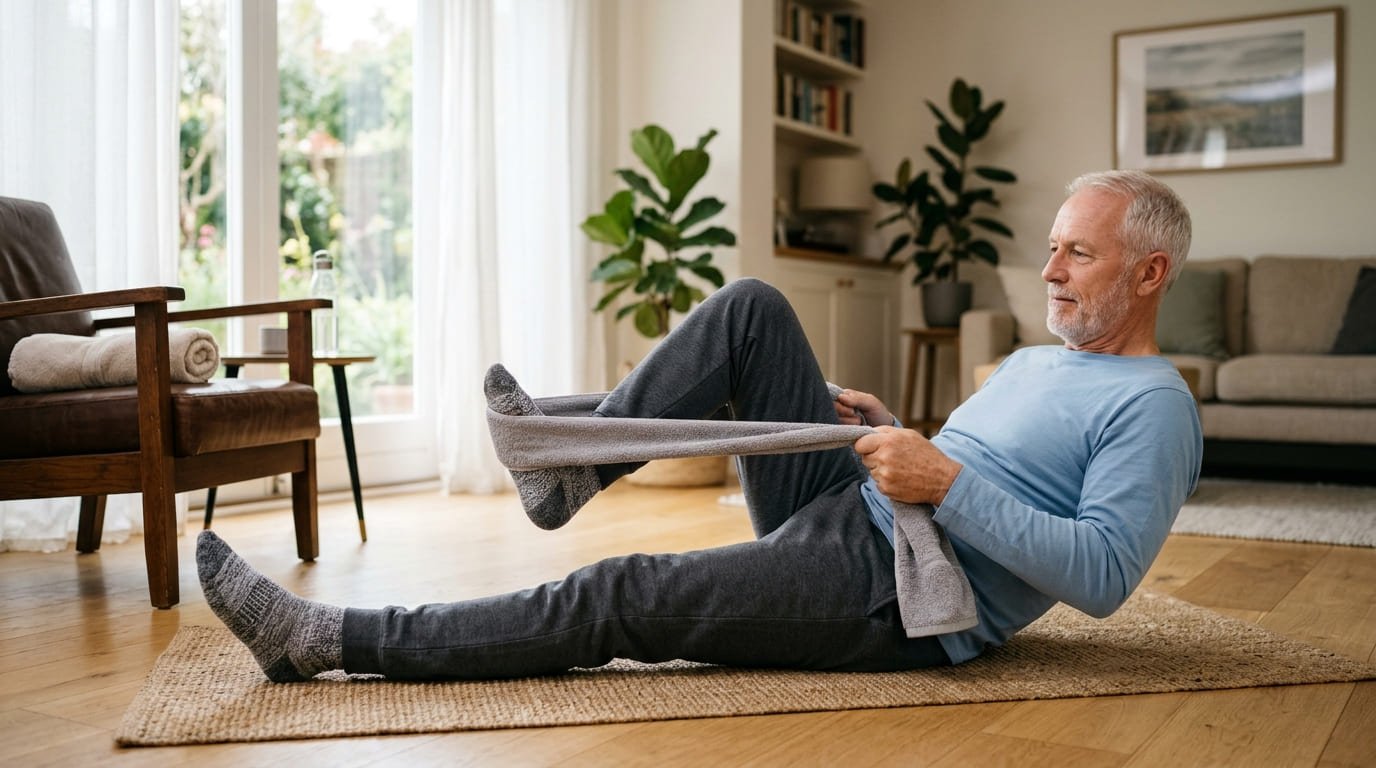
Lie on your back with a towel looped around one foot. Bend the knee and gently pull the towel to help the heel come closer to your bottom. Hold for 10 to 20 seconds. Do 5 to 8 per leg.
4. Heel prop (knee straightening)
Sit with your leg straight and your heel resting on a rolled towel, so the back of your knee is unsupported. Relax and let gravity gently straighten your knee. Hold for 1 to 3 minutes, as tolerated. Straightening is just as important as bending, especially after injury or surgery.
5. Quad sets
This is the simplest isometric exercise for knee joint strength. Sit or lie with your leg straight. Tighten the muscle on the front of your thigh, pressing the back of your knee toward the floor. Hold for 5 to 10 seconds, relax. Do 10 to 15. This is an isometric exercise for the knee joint and a classic first step after injury.
6. Stationary bike pedalling
Gentle pedalling on a stationary bike is one of the most popular knee mobility exercises. Set the seat high enough that your knee is only slightly bent at the bottom of the stroke. Pedal slowly with little resistance for 5 to 10 minutes. If a full rotation is uncomfortable, rock back and forth until it becomes easier. Our guide to the exercise bike has more on bike set-up.
7. Step stretch for knee bend
Stand facing a step, holding the rail. Place one foot on the step and gently lean forward, letting the knee bend further. Hold for 10 to 20 seconds. Do 5 per leg. Use a lower step at first.
8. Wall slides
Lie on your back with your feet on a wall and your knees bent. Let one foot slide slowly down the wall, bending the knee further with the help of gravity, then push it back up. Do 10 per leg.
9. Rocking on hands and knees
Kneel on a soft surface on your hands and knees. Gently rock your hips back toward your heels, as far as is comfortable, then return. Do 10 slow rocks. Use extra cushioning under your knees if needed. Our guide to kneeling exercises has tips on protecting your knees.
10. Standing quad stretch
Stand holding a chair. Bend one knee and bring your heel toward your bottom, holding your ankle or using a strap. Keep your knees together. Hold for 20 to 30 seconds. Our quad stretches guide has gentler versions.
11. Seated hamstring stretch
Sit on the edge of a chair with one leg straight out in front, heel on the floor. Sit tall and lean forward from your hips until you feel a stretch behind the thigh. Hold for 20 to 30 seconds. Tight hamstrings can make it harder to straighten the knee fully.
12. Calf stretch
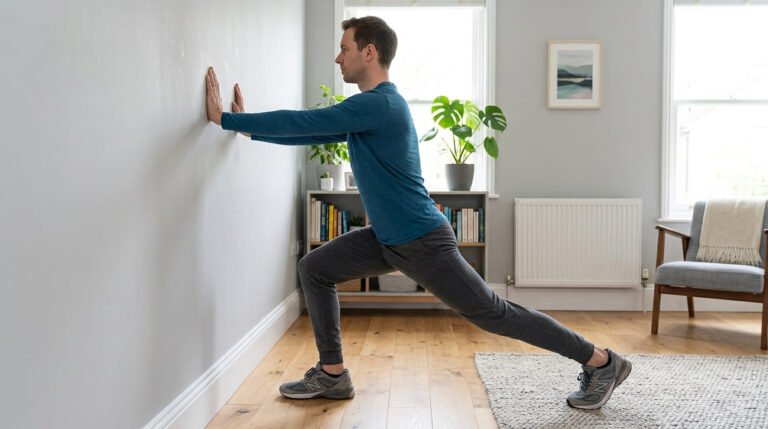
Stand facing a wall with one leg back, heel down and knee straight. Lean forward until you feel a stretch in the calf. Hold for 20 to 30 seconds. Tight calves can also limit knee straightening. Our guide to calf stretches has more options.
Isometric exercises for the knee joint
Isometric exercises are muscle contractions where the joint does not move. They are a gentle way to build strength in a stiff or sore knee, because you can work the muscles without bending the knee through a painful range.
| Isometric exercise | How to do it | Dose |
|---|---|---|
| Quad set | Tighten the thigh with the leg straight | 10 x 10 seconds |
| Straight leg raise hold | Tighten the thigh, lift the leg a few centimetres and hold | 5 to 10 x 5 seconds |
| Wall sit | Back against a wall, knees bent to a comfortable angle | 3 to 5 x 20 to 45 seconds |
| Seated knee extension hold | Straighten the knee partly while seated and hold | 5 x 10 seconds |
| Hamstring heel dig | Sit with knee bent, press the heel down and back into the floor | 5 to 10 x 5 to 10 seconds |
| Ball squeeze | Squeeze a cushion between your knees | 10 x 5 to 10 seconds |
A small study in 6 volleyball players with patellar tendon pain found that a single session of heavy isometric quadriceps contractions reduced pain during a single leg decline squat immediately, and the pain relief lasted at least 45 minutes, more than the same amount of isotonic exercise.
This was a very small study in athletes with a specific tendon problem, so it does not prove isometrics work for every knee. But it is one reason physiotherapists often use isometric holds when knees are too sore for bigger movements.
What the research says about exercise for stiff knees
For knee osteoarthritis, a common cause of stiffness, the evidence for exercise is strong. A Cochrane review of 54 randomised trials found high-quality evidence that land-based exercise reduced knee pain, and moderate-quality evidence that it improved physical function. Pain fell by about 12 points on a 0 to 100 scale and function improved by about 10 points straight after treatment, with smaller benefits still present 2 to 6 months later. Individually supervised programmes tended to do a little better than classes.
Most of these programmes combined strength, range of motion and aerobic exercise. That is a good model for your own routine: mobility work to help the knee move, strength work to support it, and general activity like walking or cycling.
Exercises to break scar tissue in knee recovery: what you should know
Many people search for exercises to break scar tissue in the knee, usually after surgery such as a knee replacement or ligament repair. It is worth being clear about what exercise can and cannot do.
- Exercise does not literally break up scar tissue. Scar tissue is a normal part of healing. Regular, gentle movement helps it form and remodel in a way that allows better movement
- Early, consistent range of motion work matters. After surgery, physiotherapists usually prescribe heel slides, knee straightening, quad sets and bike work from early on, because regaining range is easier in the first weeks and months
- Forcing painful stretches is not the answer. Aggressive stretching can increase swelling and pain, which can make stiffness worse
- Some people develop excessive stiffness, sometimes called arthrofibrosis, despite good rehab. If your range stops improving, your surgeon may recommend other treatments
If you have had knee surgery, follow your surgeon’s and physiotherapist’s programme. The exercises in this guide are similar to those used in rehab, but the timing, dose and limits should come from your own care team.
Knee exercise equipment that helps
You do not need much. Most knee mobility exercises can be done with things you already have at home.
| Equipment | What it helps with | Do you need it? |
|---|---|---|
| Towel or strap | Assisted knee bend, heel slides, quad stretch | Very useful, free |
| Rolled towel or foam roller | Heel prop for straightening | Useful |
| Sturdy chair | Seated knee bends, support for standing exercises | Essential |
| Step or stair | Step stretches, step-ups | Useful |
| Stationary bike or pedal exerciser | Gentle, repeated knee bending | Very useful |
| Small soft ball or cushion | Ball squeezes, wall slides | Nice to have |
| Light resistance band | Strength exercises like seated knee extensions | Nice to have |
| Ankle weights (light) | Progressing straight leg raises | Later, if advised |
A pedal exerciser, a small set of pedals you use while sitting in a chair, is a popular and affordable piece of knee exercise equipment for older adults and people who cannot get on a bike easily. There are no affiliate links on this page, so choose whatever is sturdy and comfortable for you.
A 10-minute routine of knee mobility exercises
| Order | Exercise | Dose |
|---|---|---|
| 1 | Stationary bike or seated pedalling | 3 to 5 minutes |
| 2 | Heel slides | 10 per leg |
| 3 | Quad sets | 10 x 5 seconds per leg |
| 4 | Heel prop (knee straightening) | 1 to 2 minutes per leg |
| 5 | Seated knee bends | 10 per leg |
| 6 | Seated hamstring stretch | 20 to 30 seconds per leg |
| 7 | Calf stretch | 20 to 30 seconds per leg |
Do this once or twice a day. Many people find their knees feel best when they do a short version in the morning and another after long periods of sitting.
A 6-week plan
| Weeks | Mobility | Strength | Activity |
|---|---|---|---|
| 1 and 2 | Daily routine above | Quad sets, straight leg raise holds | Short walks most days |
| 3 and 4 | Add towel assisted bends, step stretches | Add wall sits and seated knee extensions | Longer walks or 10 minutes on a bike |
| 5 and 6 | Add rocking on hands and knees if comfortable | Add sit-to-stands and step-ups | Walking, cycling or swimming 3 to 5 times a week |
Track your progress by measuring how close your heel gets to your bottom during heel slides, or by noting everyday tasks that become easier. Our guide to leg exercises for seniors has more strength options for later weeks.
Daily habits for happier knees
- Move often. Get up and walk around every 30 to 60 minutes if you sit a lot
- Warm up before activity. A few minutes of walking or gentle bike work helps
- Stay active. Walking, cycling and swimming keep knees moving with less impact. Our guide to water exercises for seniors suits stiff knees well
- Look after your weight. Less body weight means less load through the knees
- Wear supportive shoes for walking and exercise
Safety tips and when to get help
Get medical advice before exercising, or stop and get help, if your knee:
- Is hot, red and very swollen
- Locks, catches or gives way
- Cannot take your weight
- Has severe pain after a fall or twist
- Is getting stiffer despite regular exercise, especially after surgery
Mild discomfort during and after exercise that settles within a couple of hours is usually fine. Pain that is worse the next morning means you should do less next time.
This article is general information, not medical advice. If you are recovering from knee surgery, follow your surgeon’s and physiotherapist’s advice first. See our medical disclaimer.
Common mistakes
| Mistake | Why it is a problem | Fix |
|---|---|---|
| Only working on bending | Losing straightening affects walking | Include heel props and quad sets |
| Forcing painful stretches | Can increase swelling and stiffness | Gentle, frequent movement |
| Doing it once a week | Mobility fades without regular practice | Short daily sessions |
| Skipping strength work | Weak muscles leave the knee unsupported | Add isometrics and strength exercises |
| Ignoring swelling | Swelling limits range | Rest, elevate, and seek advice if it persists |
Knee mobility exercises at your desk
If you sit for long periods, your knees can feel stiff when you stand up. A few knee mobility exercises at your desk keep them moving through the day: seated knee bends, slowly straightening each knee and holding for 5 seconds, ankle circles, and gentle quad sets. Do 10 of each every hour or two. Standing up and walking for a minute or two is just as valuable.
Morning knee stiffness routine
Before you get out of bed, try 10 heel slides on each leg, 10 quad sets and 10 ankle pumps. It takes about 2 minutes and helps many people take their first steps of the day more comfortably.
What to pair with knee mobility work
Mobility helps your knee move, while strength helps it stay comfortable when you use that movement. Pair these knee mobility exercises with sit-to-stands, step-ups and glute bridges two or three times a week for the best results.
The bottom line
Knee mobility exercises help a stiff knee bend and straighten more comfortably. Heel slides, seated knee bends, heel props, quad sets, gentle bike work and simple stretches for the quads, hamstrings and calves are the core of a good routine. Isometric exercises for the knee joint add gentle strength when bigger movements are uncomfortable.
Keep sessions short and frequent, include both bending and straightening, and combine mobility with strength work and regular activity. Most knee exercise equipment you need is already in your home. And if you are recovering from surgery or your knee is swollen, locked or getting worse, get professional advice before pushing on.
Frequently asked questions
What are the best knee mobility exercises?
Heel slides, seated knee bends, heel props for straightening, quad sets, gentle stationary bike pedalling and stretches for the quads, hamstrings and calves are a great starting set.
How can I improve stiffness in my knee?
Move your knee gently and often, include both bending and straightening exercises, strengthen the muscles around it, and stay active with walking, cycling or swimming.
What is an isometric exercise for the knee joint?
An isometric exercise works the muscles without moving the joint, such as a quad set, a wall sit or a straight leg raise hold. They are a gentle way to build strength in a stiff or sore knee.
Can exercise break up scar tissue in the knee?
Exercise does not literally break scar tissue, but regular, guided movement after surgery helps healing tissue remodel so your knee moves better. Follow your physiotherapist’s plan.
What knee exercise equipment do I need?
Very little. A towel or strap, a sturdy chair, a step and a rolled towel cover most exercises. A stationary bike or pedal exerciser is a useful extra.
How often should I do knee mobility exercises?
Short sessions once or twice a day work well. Little and often is better than one long, intense session a week.
Is cycling good for knee mobility?
Yes. Gentle pedalling with low resistance moves the knee through a repeated range without much impact. Set the seat high enough that your knee is only slightly bent at the bottom.
Why is my knee stiff in the morning?
Knees often stiffen after periods of rest, especially with arthritis. Gentle movement such as heel slides or a short walk usually eases it within a few minutes to half an hour.
Should knee mobility exercises hurt?
You may feel a mild stretch or discomfort, but they should not cause sharp pain. Pain that is worse the next day means you should do less next time.
What’s next?
Reading is the easy part. Pick one of these and do it today.