Water Exercises for Seniors: 14 Gentle Pool Exercises and a Simple Weekly Plan
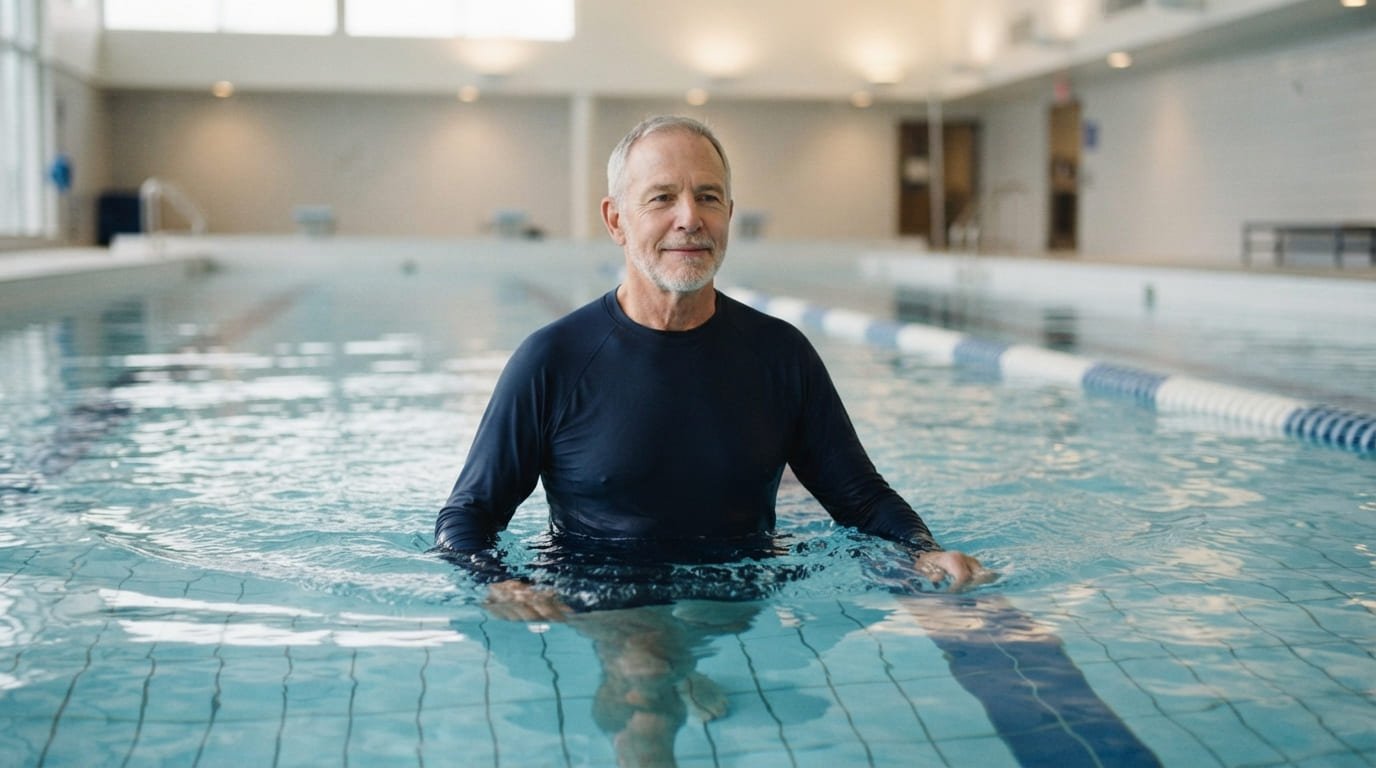
Water exercise for seniors is one of the kindest ways to stay strong and mobile as you get older. The water holds part of your weight, so your knees, hips and back take far less strain than on land. At the same time, the water pushes back against every movement, so your muscles still have to work. And if you wobble, the water slows you down, which takes a lot of the fear out of balance training.
You do not need to be a swimmer. Almost everything in this guide is done standing in chest-deep or waist-deep water, holding the side of the pool if you want to. Many people who find land exercise painful or worrying discover through water exercise for seniors that they can move freely in a pool, sometimes for the first time in years.
This guide covers why water exercise for seniors works so well, how to get started, 14 gentle pool exercises with clear instructions, a simple weekly plan, the equipment that helps, safety tips and what the research says. If you want land-based options too, our guides to leg exercises for seniors and core exercises for seniors pair well with this one.
At a glance
- Water supports part of your body weight, so pool exercise is gentle on painful joints
- The water resists every movement, which builds strength without heavy weights
- Most exercises are done standing in waist-deep to chest-deep water, holding the pool edge if needed
- Start with 15 to 20 minutes, 2 or 3 times a week, and build toward 30 to 45 minutes
- Warm water (around 28 to 32 degrees Celsius) is more comfortable for stiff joints
- Research suggests aquatic exercise improves physical function in older adults about as well as land exercise
- Check with your doctor first if you have heart, lung or skin conditions, or open wounds
Why water exercise for seniors works so well
Water has several properties that make it almost ideal for older adults.
| Property of water | What it does | Why it helps seniors |
|---|---|---|
| Buoyancy | Supports part of your body weight | Less load on painful knees, hips, feet and back |
| Resistance | Pushes back against every movement | Builds strength with no weights |
| Hydrostatic pressure | Gently squeezes the body | May ease swelling and support circulation |
| Warmth (in warm pools) | Relaxes muscles | Easier movement for stiff or arthritic joints |
| Slower movement | Falls happen in slow motion | Safer balance training, more confidence |
How much weight does the water take? Roughly speaking, standing in water up to your waist takes about half of your body weight off your joints, and standing in chest-deep water takes off around two thirds or more. The exact amount varies from person to person, but the effect is easy to feel the moment you step in.
The resistance is the other half of the story. The faster you move, the harder the water pushes back. So the same exercise can be very gentle or quite challenging, depending only on your speed. That makes senior water exercise easy to adjust from day to day.
Who is pool exercise good for?
Aquatic exercises for seniors suit almost everyone, but they are especially helpful if you:
- Have arthritis in your knees, hips or hands
- Find walking or standing exercise painful
- Are recovering from a joint replacement, once your surgeon or physiotherapist says the wound has healed and you are cleared for the pool
- Are worried about falling
- Have back pain that flares with impact
- Are carrying extra weight and find land exercise uncomfortable
- Simply enjoy the water and want a sociable way to stay active
Many community pools run aqua aerobics or aqua fit classes specifically for older adults. These classes are a great way to learn the basics, meet people and stay motivated. The exercises below are similar to what you would do in many classes, and you can also do them on your own during a quiet lane session.
Getting started safely
Choosing the right depth
| Water depth | Feel | Best for |
|---|---|---|
| Waist deep | More weight on your joints, more stable | Walking, balance work, standing exercises |
| Chest deep | Most of your weight supported | Painful joints, arm exercises, gentle jogging |
| Deep water (feet off the floor) | No impact at all | Experienced and confident swimmers with a flotation belt |
For most beginners, waist-deep to chest-deep water is the sweet spot. You can stand firmly, the water still supports you, and you can hold the pool edge whenever you want.
Water temperature
Warm water feels better on stiff joints. Therapy and hydrotherapy pools are often kept around 32 to 35 degrees Celsius, while a typical public pool is cooler, often around 27 to 29 degrees. If your pool feels chilly, move continuously, keep sessions shorter at first, and wear a light swim shirt or a thin wetsuit top if you feel the cold easily.
What to bring
- Water shoes with grippy soles. They protect your feet and stop you slipping on the pool floor and the deck
- A water bottle. You still sweat in the pool, even if you cannot feel it
- A towel and a warm layer for afterwards
- Any medication you might need, such as an inhaler or a glucose tablet, left by the poolside with the lifeguard’s knowledge
Warm-up (5 minutes)
Start every session by walking slowly in waist-deep or chest-deep water for 2 to 3 minutes. Then do 10 slow shoulder rolls, 10 gentle arm swings forward and back, and 10 slow ankle circles on each foot while holding the pool edge. This prepares your joints and gets you used to the temperature.
14 water exercises for seniors (pool exercises for elderly beginners)
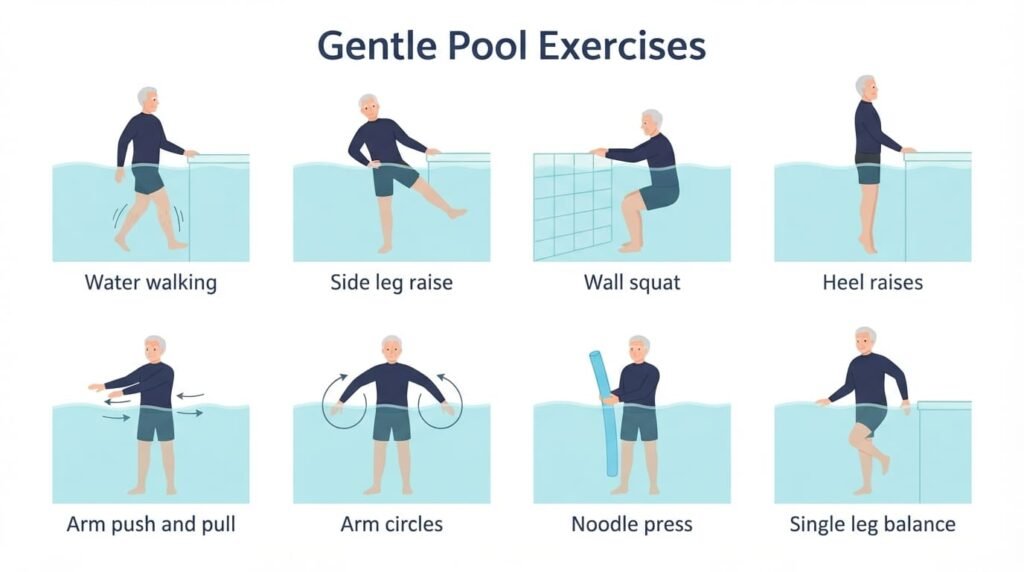
These are grouped into walking and cardio, lower body, upper body, core and balance. Do each exercise for 30 seconds to 1 minute, or for the number of repetitions shown. Move slowly at first. You can always go faster later to make it harder.
1. Water walking
Walk forward across the pool, swinging your arms naturally and placing your whole foot down, heel first. Then walk backward carefully. Water walking is the foundation of most senior water exercise programmes, and it builds leg strength, endurance and confidence. Do 2 to 5 minutes.
2. Sideways walking
Face the pool wall and walk sideways along it, stepping out with one foot and bringing the other to meet it. It works the hip muscles that help with balance. Do 1 to 2 minutes each way.
3. High knee march
Stand tall and march on the spot, lifting each knee toward hip height. Hold the pool edge with one hand if you like. Do 30 to 60 seconds.
4. Gentle water jogging
Once walking feels easy, jog gently on the spot or across the pool. The water absorbs most of the impact, so it is much kinder to your joints than jogging on land. Do 30 seconds to 2 minutes.
5. Leg swings
Hold the pool edge with one hand. Swing your outside leg forward and back like a pendulum, keeping your body upright. Then turn around and swing the other leg. Do 10 to 15 swings per leg.
6. Side leg raises
Stand side-on to the wall, holding the edge. Lift your outside leg out to the side, keeping your toes pointing forward, then lower it slowly. Do 10 to 15 per leg. This is a gentle version of land-based hip abductor work.
7. Wall squats
Stand with your back near the pool wall, feet hip-width apart. Bend your knees and lower yourself a little, as if sitting into a chair, then stand up again. The water makes this far easier on the knees than a land squat. Do 10 to 12.
8. Heel raises
Face the wall and hold the edge. Rise up onto the balls of your feet, pause, then lower slowly. Do 15 to 20. Strong calves help with walking and balance.
9. Step-ups
If your pool has a submerged step, step up with one foot, bring the other up, then step down. Lead with the other leg for the next set. Do 8 to 10 per leg.
10. Arm push and pull
Stand in chest-deep water with your arms just under the surface. Push both hands forward, palms facing away, then pull them back toward your chest, palms facing you. Do 15 to 20. Turn your palms slightly to change the resistance.
11. Arm circles
With your arms out to the sides just under the surface, make small circles forward for 20 seconds, then backward for 20 seconds. Make the circles bigger or faster to make the exercise harder.
12. Noodle press
Hold a foam pool noodle in front of you with both hands. Press it down into the water until your arms are straight, then let it float up slowly. It works the chest, shoulders and core. Do 10 to 12.
13. Flutter kicks at the wall
Hold the pool edge with both hands and let your body float out behind you, face up or face down, whichever feels easier. Kick your legs gently from the hips. If floating is hard, use a noodle under your stomach. Do 20 to 30 seconds.
14. Single leg balance
Stand near the wall in waist-deep water. Lift one foot slightly and balance for 10 to 30 seconds. Hold the wall lightly at first, then try letting go. The water slows any wobble, which makes this a safe place to practise balance.
What the research says about aquatic exercise for older adults
A systematic review and meta-analysis of 24 randomised trials looked at aquatic exercise in older adults. Compared with no exercise, aquatic exercise had a moderate positive effect on physical function. Compared with land-based exercise, it had a small additional benefit. The authors noted that many studies had a high risk of bias, but concluded that aquatic exercise may improve physical function and appears at least as effective as land-based exercise.
For arthritis specifically, a Cochrane review of 13 trials with 1,190 people with knee or hip osteoarthritis, average age 68, found that aquatic exercise gave small but meaningful short-term improvements in pain and disability, and a small improvement in quality of life, compared with no exercise.
A more recent review of 10 trials in older adults found that aquatic exercise probably improved lower body strength, measured with a 30-second chair stand test, compared with no exercise. It found no clear difference from land exercise for balance. The certainty of the evidence was very low, so these results are encouraging rather than definite.
What does that mean for you? Pool exercises for elderly people are not a magic cure, but they appear to work about as well as land exercise for keeping you moving, with the bonus of being gentler on sore joints. If the water is where you feel comfortable enough to exercise regularly, that is a very good reason to choose it.
A simple weekly plan
For most people, water exercise for seniors works best with 2 or 3 sessions a week and at least one rest day between them. Each session follows the same pattern.
| Part of session | What to do | Time |
|---|---|---|
| Warm-up | Slow water walking, shoulder rolls, arm swings, ankle circles | 5 minutes |
| Cardio | Water walking, sideways walking, march or gentle jogging | 5 to 15 minutes |
| Lower body | Leg swings, side leg raises, wall squats, heel raises | 5 to 10 minutes |
| Upper body and core | Arm push and pull, arm circles, noodle press, flutter kicks | 5 to 10 minutes |
| Balance | Single leg balance near the wall | 2 to 3 minutes |
| Cool-down | Slow walking and gentle stretches | 5 minutes |
How to progress over 8 weeks
| Weeks | Session length | How to progress |
|---|---|---|
| 1 and 2 | 15 to 20 minutes | Learn the movements, move slowly, hold the wall |
| 3 and 4 | 20 to 30 minutes | Add 1 or 2 exercises, walk a little faster |
| 5 and 6 | 30 to 40 minutes | Move faster, try short jogging intervals, hold the wall less |
| 7 and 8 | 35 to 45 minutes | Add water dumbbells or gloves, longer balance holds |
If a session leaves you very tired or sore the next day, go back to the previous step for another week. Progress is not a race.
Helpful equipment
| Equipment | What it does | Do you need it? |
|---|---|---|
| Water shoes | Grip and foot protection | Strongly recommended |
| Pool noodle | Support, balance and light resistance | Very useful and cheap |
| Aqua gloves (webbed) | Add resistance to arm exercises | Optional |
| Foam water dumbbells | Add resistance as they resist being pushed under | Optional, later |
| Flotation belt | Lets you exercise in deep water | Only for deep water work |
| Kickboard | Support for leg kicks | Optional |
There are no affiliate links on this page. Most pools have noodles and kickboards you can borrow, so it is worth asking before you buy anything.
Safety tips for older adults in the pool
- Check with your doctor first if you have a heart or lung condition, uncontrolled blood pressure, diabetes, epilepsy, incontinence, open wounds or a skin condition, or if you have recently had surgery
- Exercise where there is a lifeguard, or with a friend, especially at first
- Enter and leave the pool by the steps or a ladder, using the handrails. Pool decks are slippery
- Stay in water you can stand in unless you are a confident swimmer using a flotation belt
- Drink water before and after. You sweat in the pool, even if you do not notice it
- Get out and rest if you feel dizzy, short of breath, chest pain, or unusually tired
- Warm up and cool down gradually, especially in cooler water
- Take care when you get out, because you feel heavier on land, and your legs may feel tired
This article is general information, not medical advice. If you have a health condition, a physiotherapist or doctor can help you choose the right exercises. See our medical disclaimer.
Water exercise for arthritis and joint pain
If you have arthritis, water exercise for seniors in a warm pool can make a big difference. The warmth relaxes muscles, the buoyancy takes the load off sore joints, and the resistance builds the muscles that support those joints. Move within a comfortable range and avoid pushing into sharp pain. A little discomfort that settles within an hour or two after exercise is common. Pain that is worse the next day is a sign to do less next time.
Many people with knee or hip arthritis find it helpful to combine pool sessions with some land exercise. Our guides to exercises for knee pain and hip bursitis exercises have gentle land-based options.
Do you need to swim?
No. Everything in the main exercise list can be done standing. If you do want to swim, it is a fantastic whole-body exercise, and you can add a few gentle lengths to the end of your session. Our guide to swimming workouts for beginners explains how to build up gradually, including simple kickboard and float drills.
Combining pool and land exercise
Water exercise is excellent, but it does not replace everything. Because the water supports you, it does not load your bones in the same way as walking and standing exercise, which matters for bone strength. A good balance for many older adults is 2 pool sessions and a few short walks each week, plus some simple strength work at home. Our walking guide has an easy plan to start from, even if weight loss is not your goal.
For more on which land exercises build bone, see our guide to weight-bearing exercise and bone density.
Water exercise for seniors: classes or on your own?
Both work, and many people do a mix. Here is how they compare:
| Option | Pros | Things to consider |
|---|---|---|
| Aqua aerobics or aqua fit class | Instructor, music, company, set routine | Fixed times, pace may not suit everyone |
| Hydrotherapy session | Very warm water, supervised, tailored | Often needs a referral, limited places |
| Your own session in the shallow end | Your own pace and choice of exercises | Needs a quiet area and some self-motivation |
| Pool session with a friend | Safety, chat, motivation | Need to match schedules |
If you are new to water exercise for seniors, a class for a few weeks is a great way to learn the movements and get confident in the water. Once you know what you like, you can follow the plan in this guide on your own whenever the pool is quiet.
Signs your water exercise for seniors is working
Progress in the pool can be quiet, so it helps to know what to look for:
- Getting in and out of the pool feels easier
- You can walk across the pool faster, or for longer
- Your balance holds near the wall last longer without touching it
- Stairs, getting up from a chair or walking to the shops feel a little easier
- Your joints feel looser for a few hours after a session
- You look forward to going
A simple way to track this is the 30-second chair stand test at home: count how many times you can stand up from a chair, arms crossed, in 30 seconds. Test it once a month. Our guide to leg exercises for seniors explains how to do it safely.
The bottom line
Water exercise for seniors combines support and resistance in a way that land exercise cannot. The water takes much of the load off sore joints, pushes back against every movement to build strength, and slows you down if you wobble. Research suggests aquatic exercises for seniors improve physical function about as well as land exercise, and can ease arthritis pain and disability a little in the short term.
Start your water exercise for seniors routine with 15 to 20 minutes of water walking and a few simple exercises, 2 or 3 times a week, in waist-deep to chest-deep water. Hold the side when you need to, wear water shoes, and build up slowly over a couple of months. Above all, choose something you enjoy enough to keep doing, because that is what makes the real difference.
Frequently asked questions
What is the best water exercise for seniors?
Water walking is the best place to start. It is simple, safe and builds leg strength, endurance and confidence. Once it feels easy, add leg raises, wall squats, arm exercises and balance work.
How often should seniors do water exercise?
Two or three sessions a week is a good target, with a rest day between sessions. Start with 15 to 20 minutes and build toward 30 to 45 minutes over a couple of months.
Is water exercise good for arthritis?
Yes. A Cochrane review found aquatic exercise gave small short-term improvements in pain, disability and quality of life for people with knee and hip arthritis. Warm water is often the most comfortable.
Do I need to know how to swim to do water aerobics?
No. Almost all senior water exercise is done standing in waist-deep or chest-deep water, often holding the pool edge. Stay in water you can stand in unless you are a confident swimmer.
Is water exercise as good as exercise on land?
Research suggests aquatic exercise improves physical function in older adults at least as well as land exercise. However, land exercise such as walking loads your bones more, so a mix of both is ideal.
What should I wear for pool exercises?
A comfortable swimsuit or swim shorts with a swim shirt, plus water shoes with grippy soles. A light thermal swim top helps if you feel the cold easily.
Can water exercise help with balance?
It can help you practise balance more safely, because the water slows down any wobble. Research suggests it is about as effective as land balance training, although the evidence is limited.
Is water exercise safe after a knee or hip replacement?
Often yes, once your wound has fully healed and your surgeon or physiotherapist has cleared you for the pool. Ask them which movements to avoid and when to start.
Can pool exercises help with weight loss?
Pool exercise burns calories and can support weight loss alongside healthy eating, especially if land exercise is painful. Moving faster and for longer increases the calories you burn.
What’s next?
Reading is the easy part. Pick one of these and do it today.