
Exercises for Shoulder Pain: A Gentle, Step-by-Step Exercise Therapy Plan
Shoulder pain exercise therapy sounds clinical, but at its heart it is simple: the right movements, at the right dose, done consistently. For most everyday shoulder pain, from a stiff, achy shoulder after a long week at the desk to the nagging pain of a rotator cuff problem, exercise is one of the most effective and best-supported treatments available.
The tricky part is knowing where to start. Too little does nothing. Too much, too soon, flares the pain up. And some shoulder problems need a professional assessment before you start any exercises at all.
This guide gives you a gentle, staged approach. It explains common causes of shoulder pain, red flags that need a doctor, a simple pain guide for deciding how much to do, 12 exercises for shoulder pain arranged in three stages, a weekly plan, what the research says, and everyday habits that help your shoulder recover.
At a glance
- Exercise is a first-line treatment for most non-urgent shoulder pain
- Start gently: pain-free range of motion and isometric holds come first
- Then build strength, especially the rotator cuff and the muscles around the shoulder blade
- Use a pain guide: mild discomfort up to about 3 or 4 out of 10 that settles within 24 hours is usually acceptable
- Research suggests specific shoulder exercises work better than general exercise for shoulder pain
- Most programmes take 6 to 12 weeks to show clear improvement
- Get urgent help for shoulder pain with chest pain, breathlessness, a deformity after injury, fever or sudden weakness
Common causes of shoulder pain
| Problem | Typical signs | Exercise role |
|---|---|---|
| Rotator cuff related pain (tendinopathy) | Ache on the outside of the upper arm, worse lifting the arm or lying on it | Central part of treatment |
| Shoulder impingement-type pain | Pain lifting the arm, often between 60 and 120 degrees | Central part of treatment |
| Frozen shoulder (adhesive capsulitis) | Gradually stiffening shoulder, especially turning the arm outward | Helps maintain range, guided by stage |
| Shoulder osteoarthritis | Stiffness, grinding, pain with use, often older adults | Helps strength and function |
| Postural or overuse ache | Tight, achy upper back and shoulders after desk work | Very helpful |
| Rotator cuff tear | Weakness, sometimes after a fall or lift | Often helpful, but needs assessment first |
| Pain referred from the neck | Pain with neck movements, pins and needles down the arm | Needs neck-focused assessment |
This guide focuses on common, non-urgent shoulder pain. Our separate guides to shoulder impingement exercises and frozen shoulder exercises cover two of these conditions in more depth.
A deep ache with clicking or catching can point to the labrum. Our guide to shoulder labral tear exercises covers what research says about rehab and surgery.
Red flags: when to get help first
Do not start exercises, and seek medical help, if your shoulder pain comes with:
- Chest pain, breathlessness, sweating or pain spreading to the jaw or left arm. Call emergency services, as this can be a heart problem
- A fall or injury with severe pain, deformity, or an inability to lift the arm
- Fever, feeling unwell or a hot, red, swollen joint
- Numbness, tingling or weakness spreading down the arm
- Night pain that is severe and constant
- Unexplained weight loss or a history of cancer
If none of these apply, most shoulder pain can be helped with a gradual exercise programme. If you are unsure, a physiotherapist can assess your shoulder and tailor the plan.
This article is general information, not medical advice. See our medical disclaimer.
A simple pain guide for shoulder exercises
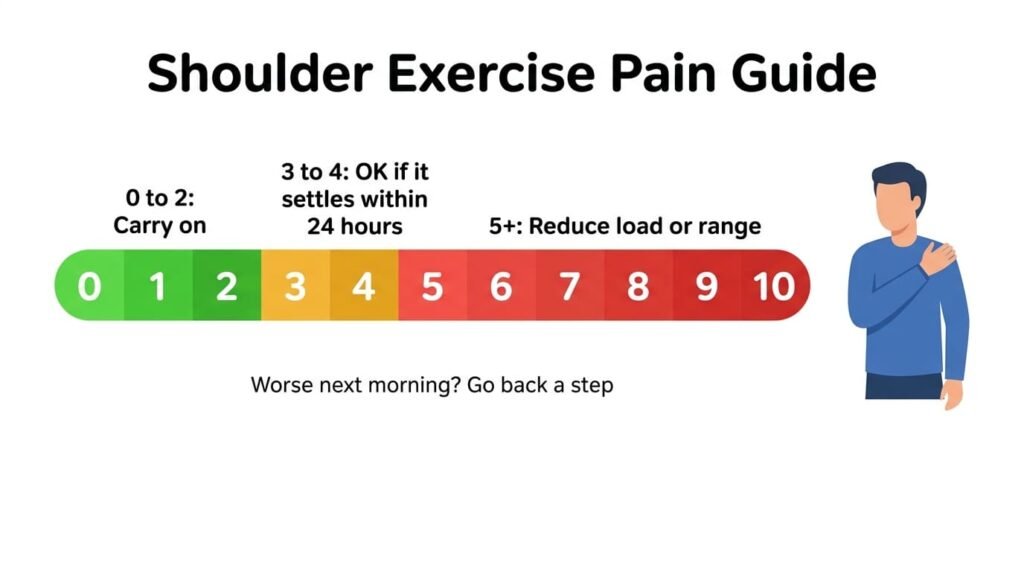
| Pain during exercise (0 to 10) | What it means | What to do |
|---|---|---|
| 0 to 2 | Comfortable | Carry on, progress when easy |
| 3 to 4 | Acceptable discomfort | Carry on if it settles within 24 hours |
| 5 or more | Too much | Reduce load, range or reps |
| Worse the next morning | Overdone | Go back a step for a few days |
This traffic light approach is used by many physiotherapists. It helps you keep moving without flaring things up. Pain during rehab does not automatically mean damage, but sharp or worsening pain is a sign to ease off.
What the research says about shoulder pain exercise therapy
A meta-analysis of randomised trials in adults with shoulder impingement found that exercise reduced pain more than non-exercise control treatments. Specific shoulder exercises, targeting the rotator cuff and shoulder blade muscles, were better than general exercises. The authors concluded that exercise should be considered for treating shoulder impingement, although the quality of evidence was very low.
A large Cochrane review of 60 trials and 3,620 participants with rotator cuff disease looked at manual therapy and exercise. The best quality trial found that a combination of manual therapy and exercise was not clearly better than placebo for overall pain and function, but its effects appeared similar to a steroid injection in other trials. The authors noted that most trials were small and at risk of bias.
And a meta-analysis of 7 trials found that progressive, resisted exercise may help rotator cuff related shoulder pain, while non-progressive exercise did not show a clear benefit.
Putting it together: exercise is a sensible, low-risk first treatment for most shoulder pain. It works best when it targets the shoulder specifically and gets gradually harder. It is not a miracle cure, and progress can be slow, but it helps many people avoid injections or surgery.
Shoulder pain exercises, stage 1: calm it down and keep it moving (weeks 1 to 2)
Goal: keep the shoulder moving without stirring up pain. Do these once or twice a day.
1. Pendulum swings
Lean forward, supporting yourself with your good hand on a table. Let the painful arm hang straight down, relaxed. Gently sway your body so the arm swings in small circles, then forward and back. Do 30 to 60 seconds. The arm should feel like a pendulum, not like it is working.
2. Table slides
Sit beside a table with your forearm resting on a towel. Slide the towel forward as far as is comfortable, leaning your body forward, then slide back. Do 10 slow reps. A gentle way to restore lifting range.
3. Assisted external rotation with a stick
Lie on your back with your elbows bent at your sides, holding a stick or umbrella with both hands. Use your good arm to gently push the painful arm outward, keeping the elbow tucked in. Hold 5 seconds, return. Do 10 reps.
4. Isometric holds
Stand in a doorway, elbow bent to 90 degrees at your side. Gently press your hand outward into the frame, then inward, then forward, each for 10 to 20 seconds, without moving the arm. Use about 30 to 50 percent effort. Do 3 to 5 holds in each direction. Isometrics often reduce pain and are a safe way to start loading the muscles.
5. Shoulder blade squeezes
Sit or stand tall. Gently draw your shoulder blades back and down, hold for 5 seconds, then relax. Do 10 reps. It wakes up the muscles that position the shoulder blade.
Shoulder pain exercises, stage 2: build strength (weeks 3 to 6)
Goal: start loading the rotator cuff and shoulder blade muscles. Do these 3 times a week, 2 to 3 sets of 10 to 15 reps.
6. Band external rotation
With a light band anchored at elbow height, elbow tucked at your side, rotate your forearm outward, then return slowly. The backbone of most shoulder rehab programmes. Our rotator cuff exercises guide has more variations.
7. Band internal rotation
Same position, with the band pulling outward. Rotate your forearm in across your stomach, then return.
8. Band row
Anchor a band at chest height. Pull your elbows back, squeezing your shoulder blades together, then return. Strengthens the upper back muscles that support the shoulder.
9. Wall slide
Face a wall with your forearms on it. Slide your arms up as far as is comfortable, then slide back down. Over time, try to go higher. This restores overhead range under control.
Shoulder pain exercises, stage 3: get back to normal (weeks 6 to 12)
Goal: build strength through bigger ranges and prepare for daily tasks and sport. Do these 2 or 3 times a week.
10. Side-lying external rotation with a dumbbell
Lie on your good side with a light dumbbell in your top hand, elbow on your side. Rotate the forearm up toward the ceiling, then lower slowly.
11. Full can raise (scaption)
Standing with light dumbbells, thumbs up, raise your arms at about 30 degrees in front of your body up to shoulder height. Lower slowly. Stay in a pain-free range.
12. Light overhead press or landmine press
When lifting your arm overhead is comfortable, start pressing a light dumbbell overhead, or try a landmine press, which is often kinder to sore shoulders. Build up gradually.
| Stage | Exercises | Frequency |
|---|---|---|
| 1 Calm and move | Pendulum, table slides, assisted external rotation, isometric holds, shoulder blade squeezes | Daily |
| 2 Build strength | Band external and internal rotation, band rows, wall slides | 3 times a week |
| 3 Get back to normal | Side-lying rotation, full can raise, light overhead pressing | 2 to 3 times a week |
A 12-week shoulder pain exercise therapy plan (exercises for shoulder pain, week by week)
| Weeks | Focus | Move on when |
|---|---|---|
| 1 and 2 | Stage 1 daily | Moving the arm causes little pain, night pain is easing |
| 3 and 4 | Stage 2, 3 times a week, plus Stage 1 as a warm-up | Band exercises feel easy at 15 reps |
| 5 and 6 | Stage 2 with stronger bands | You can lift the arm to shoulder height comfortably |
| 7 to 9 | Add Stage 3 exercises | Light pressing is comfortable |
| 10 to 12 | Stage 3 with gradual load increases | Daily tasks feel close to normal |
Not everyone moves at the same speed. If you are not improving after 6 weeks, or are getting worse, see a physiotherapist. Many shoulder problems take 3 months or more to settle fully.
Everyday habits that help shoulder pain exercise therapy work
| Habit | Why it helps |
|---|---|
| Avoid sleeping on the painful side | Reduces pressure on irritated tissues |
| Support the arm on a pillow at night | Can ease night pain |
| Take regular breaks from reaching or overhead work | Prevents repeated irritation |
| Set up your desk | Screen at eye level, elbows close to your body |
| Keep active | General movement helps pain and mood |
| Stay patient | Tendons and joints adapt slowly |
Our guides to posture exercises and thoracic mobility exercises help if desk posture is part of the problem. A stiff upper back often makes overhead movements harder on the shoulder.
Things to avoid while your shoulder is sore
- Heavy overhead lifting, behind-the-neck presses and wide-grip upright rows
- Pushing through sharp or pinching pain
- Long periods of complete rest, which can make stiffness worse
- Sudden jumps in training load when you start feeling better
- Sleeping with the painful arm above your head
Other treatments that may help
Exercise is the foundation, but your doctor or physiotherapist may also suggest pain relief medication, a steroid injection for short-term relief, hands-on therapy, or, rarely, surgery. Research suggests exercise and manual therapy may give results similar to injections over time for many people. Discuss the pros and cons with your clinician.
Common mistakes
| Mistake | What happens | Fix |
|---|---|---|
| Starting with heavy weights | Flare-ups | Begin with Stage 1 |
| Resting completely | Shoulder stiffens | Gentle movement daily |
| Doing exercises only when it hurts | Slow progress | Consistent sessions every week |
| Ignoring red flags | Serious problems missed | Get urgent signs checked |
| Quitting after 2 weeks | Before tissues adapt | Give it 6 to 12 weeks |
| Only stretching | Little strength gained | Add progressive strengthening |
Shoulder exercises for pain relief on a bad day
Some days your shoulder will feel worse, especially after a busy day or a poor night’s sleep. On those days, switch to a short pain relief session rather than skipping exercise altogether:
| Exercise | Dose | Why it helps |
|---|---|---|
| Pendulum swings | 1 minute | Gentle movement without effort |
| Isometric external rotation holds | 3 to 5 holds of 20 seconds at light effort | Isometric holds often ease pain |
| Shoulder blade squeezes | 10 slow reps | Relaxes tight upper back muscles |
| Heat pack on the shoulder | 10 to 15 minutes | Many people find warmth soothing |
These shoulder exercises for pain relief keep the joint moving and often make the rest of the day more comfortable. Return to your normal plan when the flare settles, usually within a few days.
Shoulder pain exercise therapy for desk workers
If your shoulder aches after long hours at a computer, the problem is often a mix of rounded posture, stiff upper back and tired shoulder blade muscles. Add these to your plan:
- Every hour, stand up, roll your shoulders back 10 times and do 10 shoulder blade squeezes
- Keep your keyboard close and your elbows near your sides
- Do band pull-aparts and rows three times a week
- Stretch your chest in a doorway for 30 seconds, twice a day
Small changes during the working day often make shoulder pain exercise therapy work much faster.
Sleeping with shoulder pain
Shoulder pain is often worse at night. Try lying on your back with a pillow under the painful arm, or on the other side hugging a pillow so the painful arm rests on it. Avoid lying directly on the sore shoulder or sleeping with your arm above your head. Better sleep helps your body recover and makes pain easier to cope with.
How to track your progress
| Measure | How to check |
|---|---|
| Pain at rest | Score out of 10 each morning |
| Pain with activity | Score while reaching to a high shelf |
| Range | How high you can lift your arm against a wall |
| Strength | Band colour and reps for external rotation |
| Daily tasks | Dressing, washing hair, reaching behind your back |
| Sleep | Number of nights woken by pain |
Check these once a week. Progress is rarely smooth, so look at the trend over several weeks rather than day to day. If two or three of these measures are improving, your exercises for shoulder pain are working, even if some days still hurt.
Returning to the gym or sport
When daily tasks are comfortable and you can do Stage 3 exercises without pain, start returning to your normal training at about half your previous weights or volume. Increase by about 10 to 20 percent a week if your shoulder stays settled. Overhead and throwing sports usually need the longest return, so build up gradually and keep doing rotator cuff work twice a week.
What you need for shoulder pain exercise therapy at home
| Item | Used for |
|---|---|
| A door frame | Isometric holds |
| A towel and a table | Table slides |
| A broom handle or umbrella | Assisted external rotation |
| A light resistance band | Rotations and rows |
| Light dumbbells or water bottles | Stage 3 exercises |
Everything here costs little or nothing, which is one reason exercises for shoulder pain are such a practical first step. Keep your kit in one place so it is easy to do your exercises every day.
Building confidence in your shoulder
Shoulder pain can make you nervous about using your arm, and many people start guarding it without realising. Gradually using the arm again for everyday tasks, like reaching into cupboards and carrying light bags, is part of recovery. Each small success builds confidence, and confidence helps you move more naturally, which in turn helps the shoulder recover.
Shoulder pain exercise therapy in one minute
If you remember nothing else: shoulder pain exercise therapy starts gently, builds strength slowly and keeps going for at least 6 to 12 weeks. Use the pain guide, do a little every day, and get red flags checked. Done consistently, shoulder pain exercise therapy helps most people move and sleep more comfortably again.
The bottom line
Shoulder pain exercise therapy works best as a gentle, staged plan that you follow consistently. Start by calming the shoulder with pendulums, slides and isometric holds. Then build strength in the rotator cuff and shoulder blade muscles with band rotations and rows. Finally, return to bigger ranges and normal lifting. Use the pain guide to decide how much to do, and progress gradually.
Research supports exercise as a first treatment for most shoulder pain, especially specific, progressive shoulder exercises. Give it 6 to 12 weeks, look after your sleep and posture, and get help if red flags appear or you are not improving. For most people, these exercises for shoulder pain are the most reliable path back to a comfortable, strong shoulder.
Frequently asked questions
What is the best exercise therapy for shoulder pain?
A staged programme that starts with gentle movement and isometric holds, then builds rotator cuff and shoulder blade strength with resistance bands, and finally returns to normal lifting.
How long does shoulder pain exercise therapy take to work?
Many people notice improvement within 4 to 6 weeks, but most programmes run for about 12 weeks. Some shoulder problems take longer.
Should I exercise my shoulder if it hurts?
Usually yes, gently. Mild discomfort up to about 3 or 4 out of 10 that settles within a day is generally acceptable. Avoid sharp or worsening pain, and get red flags checked.
What exercises should I avoid with shoulder pain?
Heavy overhead lifting, behind-the-neck presses, wide-grip upright rows and anything that causes sharp, pinching pain, until your shoulder is stronger.
Can shoulder exercises make pain worse?
Doing too much too soon can flare up pain temporarily. Use the pain guide, start gently and progress slowly.
Are resistance bands good for shoulder pain?
Yes. Light bands are ideal for rotator cuff and shoulder blade exercises, because the resistance is gentle and easy to adjust.
When should I see a doctor about shoulder pain?
Seek urgent help for chest pain, breathlessness, a fall with severe pain or deformity, fever, or numbness and weakness down the arm. See a doctor or physiotherapist if pain is not improving after a few weeks.
Is rest or exercise better for shoulder pain?
For most shoulder pain, gentle exercise is better than complete rest. Rest can make the shoulder stiffer. A short rest from aggravating activities is fine.
Can I do shoulder pain exercises at home?
Yes. Almost every exercise in this guide needs only a door frame, a towel, a stick and a light resistance band.
What’s next?
Reading is the easy part. Pick one of these and do it today.





I was surprised how much my desk posture impacts my rotator cuff. I really appreciate these clear stages; they make starting feel much less daunting.
Thank you, Charlotte! I’m glad you found the step-by-step guidance helpful. Desk posture is definitely worth paying attention to when working on shoulder health. Remember to take things slowly and focus on proper form!