
Frozen Shoulder Therapy Exercises: 10 Gentle Moves for Each Stage
Frozen shoulder therapy exercises are one of the main ways people manage a stiff, painful shoulder that seems to lock up for no obvious reason. Frozen shoulder, known medically as adhesive capsulitis, can make simple things like reaching for a seatbelt, fastening clothes or sleeping on that side surprisingly hard.
I want to be clear about one thing first: frozen shoulder is a medical condition, and the right plan depends on your stage, your pain and your doctor’s or physiotherapist’s assessment. This guide is not a substitute for that. What it can do is explain how the condition usually behaves, what the research says about exercise, and which gentle exercises for capsulitis are commonly used at each stage, so you can have a better conversation with your clinician and stay active safely.
You will find 10 frozen shoulder exercises, a simple daily routine, the mistakes that make pain worse and clear signs that you need medical help.
At a glance
- Frozen shoulder (adhesive capsulitis) is a painful stiffening of the shoulder joint capsule
- It often moves through a painful stage, a stiff stage and a recovery stage, but recovery is not always complete or predictable
- People with diabetes are about 5 times more likely to develop it
- Gentle exercise within comfortable limits did better than intensive stretching in one well-known study
- A steroid injection may relieve pain faster than exercise and manual therapy in the early weeks, so ask your doctor about options
- Start with pendulums, table slides and assisted lifts. Avoid forcing painful stretches
- Get a proper diagnosis first, because other shoulder problems can look similar
What is frozen shoulder?
The shoulder joint is surrounded by a capsule of connective tissue. In frozen shoulder, that capsule becomes inflamed, thickened and tight. The result is pain and a loss of movement in every direction, especially turning the arm outward and lifting it overhead.
Frozen shoulder is most common between the ages of 40 and 60, and it is more common in women. It is strongly linked with diabetes. A meta-analysis found people with diabetes were about 5 times more likely to have adhesive capsulitis, and around 30 percent of people with frozen shoulder had diabetes.
Other links include thyroid problems and a period of keeping the arm still, for example after an injury or surgery. Often there is no clear cause.
The stages of frozen shoulder
| Stage | Typical length | What it feels like | Exercise focus |
|---|---|---|---|
| Freezing (painful) | Weeks to several months | Pain, often worse at night, and movement gradually lost | Gentle movement within comfort, pain relief |
| Frozen (stiff) | Several months | Less pain but marked stiffness | Gentle range of motion work, light stretching |
| Thawing (recovery) | Months to over a year | Movement slowly returns | Progressive stretching and strengthening |
These stages are a helpful guide, but they are not a rule. A systematic review found no solid evidence that frozen shoulder reliably moves through stages to full recovery on its own. Most improvement in trials happened early, and many people still had some loss of movement years later.
That is why it is worth getting treatment and guidance rather than simply waiting for it to pass.
What the research says about frozen shoulder therapy exercises
| Question | What studies found | What it means for you |
|---|---|---|
| Is gentle or intensive exercise better? | In a study of 77 people, gentle exercise within pain limits led to better results than intensive stretching and mobilisation. 89 percent of the gentle group had normal or near-normal function at 2 years, compared with 63 percent of the intensive group | Do not force painful stretches, especially early on |
| How does exercise compare with an injection? | A Cochrane review found manual therapy and exercise for 6 weeks probably gave less improvement at 7 weeks than a steroid injection | Talk to your doctor about an injection if pain is limiting you |
| Is exercise still useful? | Most guidelines include it, and it helps maintain movement and function | Combine exercise with the treatments your clinician recommends |
The phrase “supervised neglect” in the first study sounds odd, but it simply meant gentle exercises within the pain limits, plus support and advice, instead of pushing through painful stretches. For most people, that gentle approach is the safest starting point for frozen shoulder therapy exercises.
Rules for frozen shoulder exercises
- Stay within mild discomfort. Aim for a stretch or ache of no more than 3 or 4 out of 10. Sharp pain means back off
- Little and often. Short sessions two to four times a day work better than one long session
- Warm up first. A warm shower or a warm pack for 5 to 10 minutes can make movement easier
- Relax your shoulders. Do not hitch the shoulder up toward your ear to cheat the range
- Use your good arm or a stick to help. Assisted movements are kinder than forcing the stiff arm
- Check how you feel the next day. If pain is clearly worse the next morning, you did too much
10 gentle frozen shoulder therapy exercises
1. Pendulum
- Stand beside a table and lean forward, resting your good hand on it
- Let the painful arm hang straight down, relaxed
- Gently sway your body so the arm swings in small circles, then forward and back, then side to side
Do this for 30 to 60 seconds, two or three times a day. The arm should hang loosely. This is often the first of the exercises for capsulitis because it moves the shoulder without effort.
2. Table slide
Sit beside a table with your forearm resting on a towel. Slowly slide your hand forward, bending at the waist, until you feel a gentle stretch. Hold for 5 seconds and slide back. Do 10 slow reps. A good alternative is sliding the hand out to the side.
3. Finger walk up the wall
Stand facing a wall about an arm’s length away. Walk your fingers up the wall slowly, as high as is comfortable, keeping your shoulder relaxed. Hold for a few seconds, then walk back down. Do 10 reps. Mark your highest point with a sticky note to track progress over the weeks.
4. Assisted arm lift with a stick
Lie on your back holding a broomstick or a rolled towel with both hands, shoulder-width apart. Use your good arm to help lift both arms up and back over your head, as far as comfortable. Hold for 5 seconds and lower. Do 10 reps. Lying down lets gravity help and keeps your back from arching.
5. Assisted outward rotation with a stick
Lie on your back with your elbows bent to 90 degrees and tucked in at your sides, holding a stick with both hands. Use your good arm to push the stick gently so that the painful arm’s forearm rotates outward, keeping the elbow at your side. Hold for 5 seconds and return. Do 10 reps. Outward rotation is often the most restricted movement, so go gently.
6. Cross-body reach
Sit or stand. Use your good hand to gently lift the painful arm at the elbow and bring it across your chest. Hold for 15 to 20 seconds. Do 3 to 5 reps. Keep the shoulder blade relaxed and the stretch mild.
7. Towel stretch behind the back
Hold a towel behind your back with your good hand above your shoulder and the painful hand below, near your lower back. Use the top hand to gently pull the lower hand upward. Hold for 10 to 15 seconds. Do 5 reps. This targets the movement of reaching behind your back, such as tucking in a shirt.
8. Doorway outward rotation
Stand in a doorway with your elbow bent to 90 degrees and tucked in, palm against the door frame. Turn your body slowly away from the frame until you feel a gentle stretch at the front of the shoulder. Hold for 15 to 20 seconds. Do 3 to 5 reps. Save this one for the stiff or recovery stage.
9. Gentle isometric holds
Stand beside a wall with your elbow bent at your side. Press your hand or forearm gently into the wall, outward, inward, forward and back, without moving the arm. Hold each push for 5 seconds at about a quarter of your effort. Do 5 of each. Isometrics keep the muscles working without moving through painful ranges.
10. Shoulder blade squeezes
Sit tall and gently squeeze your shoulder blades back and down, as if tucking them into your back pockets. Hold for 5 seconds. Do 10 reps. Keeping the upper back and shoulder blade muscles active helps the whole shoulder work better as movement returns. Our guide to scapular retraction exercises explains this movement in more detail.
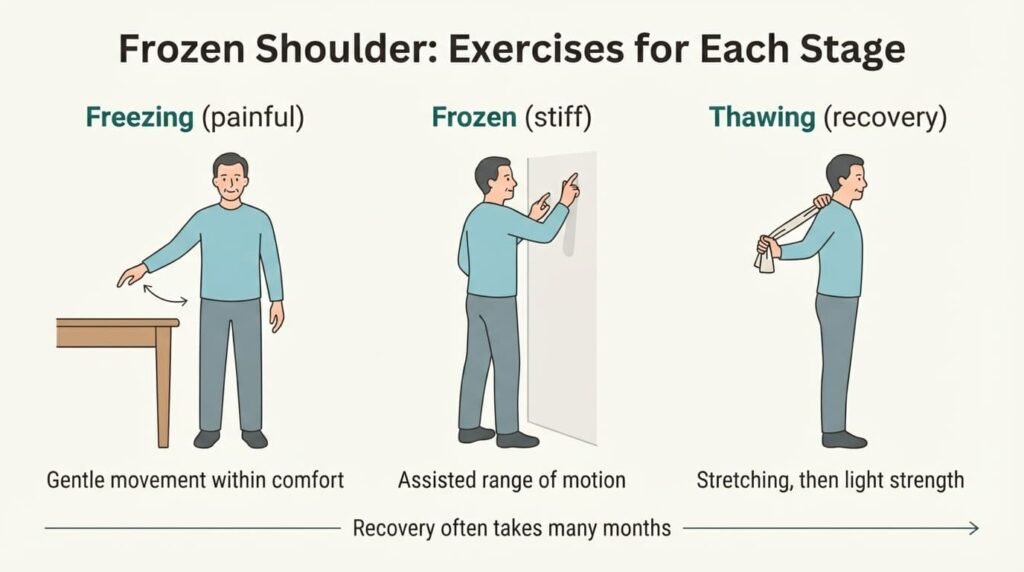
Which adhesive capsulitis exercises to do at each stage
| Stage | Main exercises | How much |
|---|---|---|
| Freezing (painful) | Pendulum, table slide, shoulder blade squeezes, gentle isometrics | 2 to 4 short sessions a day, all within comfort |
| Frozen (stiff) | Add finger walk, stick lifts, stick rotation, cross-body reach | 2 to 3 sessions a day, holding mild stretches a little longer |
| Thawing (recovery) | Add towel stretch, doorway rotation, then light strengthening | Daily stretching plus strength work 2 to 3 times a week |
When movement returns, strengthening becomes more important. Light band exercises and the moves in our guide to shoulder impingement exercises can help rebuild control, but check with your physiotherapist before adding resistance.
A simple daily routine for frozen shoulder
| Exercise | Reps or time |
|---|---|
| Warm shower or warm pack | 5 to 10 minutes |
| Pendulum | 60 seconds |
| Table slide forward and to the side | 10 each |
| Finger walk up the wall | 10 |
| Assisted arm lift with a stick (lying) | 10 |
| Assisted outward rotation with a stick | 10 |
| Shoulder blade squeezes | 10 |
This takes about 10 minutes. Repeat it two or three times a day in the stiff stage. In the painful stage, keep only the first three exercises and stay well within comfort.
Living with frozen shoulder day to day
- Sleeping. Many people find it easier to sleep on their back or on the other side, with a pillow supporting the painful arm
- Dressing. Put the painful arm into sleeves first and take it out last
- Reaching. Keep everyday items on lower shelves for now
- Pain relief. Ask your pharmacist or doctor about suitable pain relief, especially if pain stops you sleeping
- Keep the rest of you active. Walking and leg exercises help your general health and mood. Our guide to walking is an easy place to start
- Manage blood sugar. If you have diabetes, good control is part of your overall care
Setting up frozen shoulder therapy exercises at home
You do not need special equipment. A few household items cover every exercise in this guide:
| Item | Used for |
|---|---|
| A sturdy table or kitchen counter | Pendulums and table slides |
| A broomstick, walking stick or rolled towel | Assisted lifts and rotations |
| A bath towel | The towel stretch behind the back |
| A clear wall | Finger walks and isometric holds |
| A door frame | Doorway outward rotation |
| A warm pack or warm shower | Loosening the shoulder before you start |
Keep these items in one place so your routine takes no setup. Many people find it easiest to do their frozen shoulder exercises after a morning shower, at lunchtime and in the early evening, rather than late at night when pain can be worse.
Frozen shoulder and diabetes
Because frozen shoulder is so much more common in people with diabetes, it is worth knowing a few extra points if you have diabetes:
- Frozen shoulder may last longer and be more stubborn
- Both shoulders can be affected, at the same time or one after the other
- Steroid injections can raise blood sugar for a few days, so ask your doctor how to manage this
- Keeping blood sugar well controlled is part of looking after your joints and tendons
The same gentle adhesive capsulitis exercises apply, but it is especially important to have a diagnosis and a plan from your doctor or physiotherapist. If you notice shoulder stiffness and you have not been tested for diabetes, mention it to your doctor, because the two often go together.
Frozen shoulder therapy exercises and work
If your job involves desk work, lifting or overhead reaching, a few changes can help while you recover:
- Keep your keyboard and mouse close so you do not reach forward for hours
- Take a 2-minute movement break every hour for pendulums or shoulder blade squeezes
- Avoid repeated overhead lifting and heavy carrying on the painful side for now
- Talk to your employer about temporary changes if your work is physical
Short, frequent frozen shoulder therapy exercises during the working day are often easier to keep up than long sessions at home.
Other treatments to ask about
Frozen shoulder therapy exercises are usually one part of a plan. Depending on your stage and symptoms, a doctor or physiotherapist may also suggest:
- A steroid injection into the shoulder, which may ease pain faster in the early weeks
- Physiotherapy with hands-on mobilisation and a tailored exercise plan
- Hydrodilatation, where fluid is injected to stretch the capsule
- In stubborn cases, a procedure under anaesthetic to release the tight capsule
The right choice depends on your situation, which is why a proper assessment matters.
Common mistakes
| Mistake | Why it matters | Fix |
|---|---|---|
| Forcing painful stretches early | Can increase pain and inflammation | Stay within mild discomfort, especially in the painful stage |
| Not moving at all | Stiffness can worsen | Do gentle pendulums and slides several times a day |
| One long session a day | Harder on the shoulder | Short sessions spread through the day |
| Hitching the shoulder up | Gives false range and strains the neck | Relax the shoulder down before each rep |
| Expecting quick results | Frozen shoulder often takes many months | Track small gains over weeks |
| Skipping diagnosis | Other problems can look similar | See a doctor or physiotherapist first |
When to see a doctor
Get medical advice before starting frozen shoulder exercises, and urgently if you notice:
- Shoulder pain after a fall or injury, especially if you cannot lift the arm at all
- Severe pain, fever, redness or a hot, swollen joint
- Numbness, tingling or weakness down the arm
- Chest pain, shortness of breath or pain spreading to the jaw or left arm, which needs emergency care
- Unexplained weight loss or a history of cancer
Other conditions, such as rotator cuff tears, arthritis and nerve problems, can cause shoulder pain and stiffness, so a diagnosis matters.
This article is general information, not medical advice. Frozen shoulder should be diagnosed and managed by a qualified health professional. See our medical disclaimer.
Tracking your progress
Recovery from frozen shoulder is slow, so small signs of progress are worth noticing:
- Your finger walk reaches a little higher on the wall
- You can reach your seatbelt or a high shelf more easily
- Night pain becomes less frequent
- You can tuck in a shirt or reach your back pocket
- The arm swings more freely when you walk
Take a photo or note every two weeks. It is easy to feel stuck when changes happen slowly, and a record helps you see them.
The bottom line
Frozen shoulder therapy exercises work best when they are gentle, frequent and matched to your stage. Pendulums, table slides and assisted stick movements are the usual starting point, with stretches and strengthening added as pain settles and movement returns. Research suggests gentle exercise within comfortable limits works better than forcing painful stretches, and that a steroid injection may give faster early relief, so talk to your doctor about combining approaches.
Most of all, get a proper diagnosis, keep moving within comfort and be patient. Frozen shoulder can take many months to improve, but steady, sensible exercise helps you keep as much movement and function as possible along the way.
While your shoulder recovers, keep the rest of your body strong. Gentle leg and core work, such as our leg exercises for seniors and core exercises for seniors, can be done without using the painful arm, and our posture exercises help the upper back stay mobile. Staying active overall supports your mood, sleep and general health during what can be a long recovery.
Frequently asked questions
What are the best frozen shoulder therapy exercises?
The most common starting exercises are pendulums, table slides, the finger walk up the wall and assisted arm lifts and rotations with a stick. Stretches such as the towel stretch and doorway rotation are added later as pain settles.
Should frozen shoulder exercises hurt?
A mild stretch or ache is normal, but sharp or severe pain is not. Research suggests gentle exercise within pain limits works better than forcing painful stretches.
How often should I do exercises for capsulitis?
Short sessions of about 10 minutes, two to four times a day, are usually better than one long session. Your physiotherapist may adjust this to your stage.
How long does frozen shoulder last?
It often lasts many months and can take a year or more to improve. Research shows recovery is not always complete, which is why treatment and guidance are worthwhile.
Is frozen shoulder linked to diabetes?
Yes. People with diabetes are about 5 times more likely to develop frozen shoulder, and around 30 percent of people with frozen shoulder have diabetes.
Can exercise cure frozen shoulder?
Exercise helps maintain and restore movement, but it is not a quick cure. It works best alongside the treatments your doctor recommends, which may include a steroid injection or physiotherapy.
Is adhesive capsulitis the same as frozen shoulder?
Yes. Adhesive capsulitis is the medical name for frozen shoulder, a condition in which the shoulder joint capsule becomes inflamed, thickened and tight.
What should I avoid with frozen shoulder?
Avoid forcing painful stretches, heavy lifting, sudden jerky movements and keeping the arm completely still. Sleeping on the painful side can also make night pain worse for some people.
Can I do frozen shoulder exercises at home?
Yes. Most exercises need only a table, a wall, a towel and a broomstick. Get a diagnosis and, ideally, a tailored plan from a physiotherapist first.
Can frozen shoulder come back or affect the other shoulder?
It rarely returns in the same shoulder, but some people, especially those with diabetes, develop it in the other shoulder later. If the other side starts to stiffen, see your doctor early and start gentle exercises within comfort.
What’s next?
Reading is the easy part. Pick one of these and do it today.