Cable Shoulder Exercises: 10 Moves and a Beginner Shoulder Workout
Cable shoulder exercises are one of the friendliest ways to train your shoulders once you start going to a gym. The cable machine keeps tension on the muscle through the whole movement, the weight changes in small steps, and you can adjust the angle of almost any exercise with a pin and a pulley.
I know the cable machine can look intimidating the first time. There are pulleys, pins, clips and a basket of handles, and everyone else seems to know exactly what they are doing. The good news is that it is one of the easiest machines to learn, and shoulder work is a great place to start.
This guide explains how a cable machine works, how to set it up, and 10 cable shoulder exercises for the front, side and rear of the shoulders. You will also find a beginner shoulder workout, a 6-week plan and the mistakes that turn shoulder training into neck and lower back training.
At a glance
- Cable shoulder exercises keep steady tension on the muscle through the whole range of motion
- The cable lateral raise, face pull and cable reverse fly are the most useful moves for most beginners
- Train the front, side and rear of the shoulders, plus the rotator cuff
- A 2025 study found cable and dumbbell lateral raises built the side delts equally well
- Start light, use smooth reps and keep your shoulders down away from your ears
- Two shoulder sessions a week, with 8 to 12 sets in total, is plenty for beginners
- If you train at home, resistance bands can mimic most cable machine shoulder exercises
The shoulder muscles in plain English
| Muscle | Where it is | What it does | Best cable exercise |
|---|---|---|---|
| Front deltoid | Front of the shoulder | Lifts the arm forward | Cable front raise, cable press |
| Side deltoid | Outside of the shoulder | Lifts the arm out to the side | Cable lateral raise |
| Rear deltoid | Back of the shoulder | Pulls the arm back | Face pull, cable reverse fly |
| Rotator cuff | Deep around the joint | Keeps the ball centred in the socket | Cable external rotation |
| Upper and lower traps | Neck to mid back | Move the shoulder blades | Cable Y raise, cable shrug |
Most people get plenty of front shoulder work from pressing and push-ups, so the side and rear delts usually need the most attention. That is where cables really shine.
Why choose cable shoulder exercises?
- Constant tension. With dumbbells, a lateral raise is easy at the bottom and hard at the top. A cable from a low pulley keeps the side delt working from the first inch
- Easy angle changes. Move the pulley up or down to change where the exercise feels hardest
- Small weight jumps. Most stacks go up in small steps, which suits small muscles like the rear delts
- Smooth and joint-friendly. Reps feel controlled, which helps beginners learn the movement
- One arm at a time. Single-arm work helps fix differences between sides
Cables are not magic, though. A study compared cable and dumbbell lateral raises in trained lifters, each arm doing one version for 8 weeks. Both built the side delts by a similar amount, with muscle thickness increasing by about 3 to 5 percent.
So choose whichever you enjoy and can do with good form. Our guides to lateral raises and the shoulder workout with dumbbells cover the dumbbell side.
How to set up a cable machine
- Pick the pulley height. Slide the pulley up or down the column and lock it with the pin. Low for raises, around chest or face height for face pulls and rotations
- Choose the handle. A single D-handle for one-arm moves, a rope for face pulls, or no handle at all for some raises
- Clip it on. Attach the handle to the cable with the carabiner clip and check it is closed
- Set the weight. Put the pin in the stack, starting lighter than you expect
- Position yourself. Stand far enough away that the weight lifts slightly off the stack before you start, so there is tension from the first rep
When you finish, return the weight to a light setting and put the handle back. It is basic gym manners and makes life easier for the next person.
How to do cable shoulder exercises well
- Start light. Small muscles fatigue fast. Most beginners start lateral raises on the lightest plate or two
- Shoulders down. Keep your shoulders away from your ears so the traps do not take over
- Slow on the way down. Take 2 to 3 seconds to lower. The cable tension makes the lowering phase valuable
- Stand steady. Brace lightly and avoid leaning or swinging
- Full, comfortable range. Move as far as you can without pain or pinching
- 8 to 15 reps. This rep range suits shoulder isolation work well
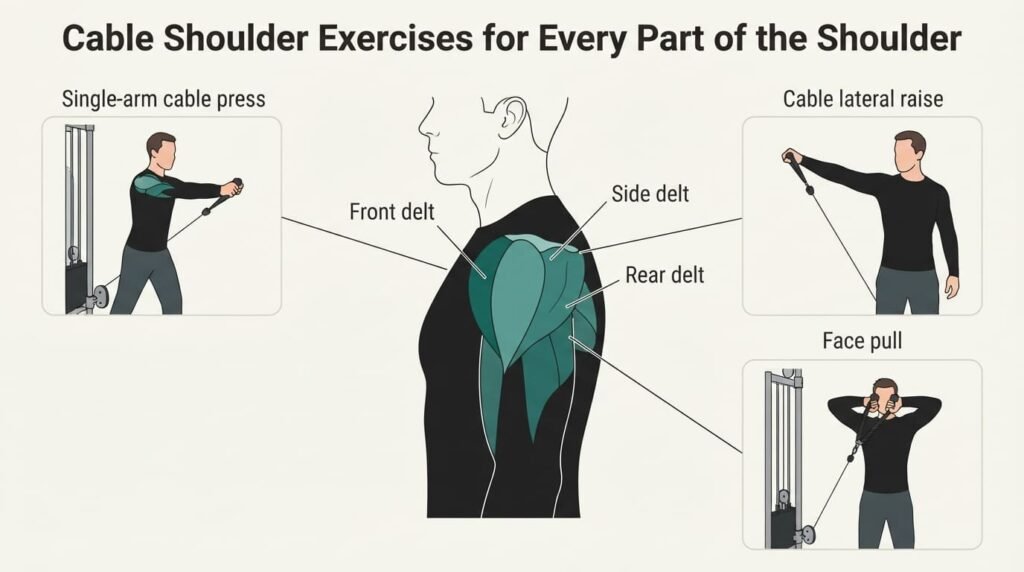
10 cable shoulder exercises
1. Cable lateral raise
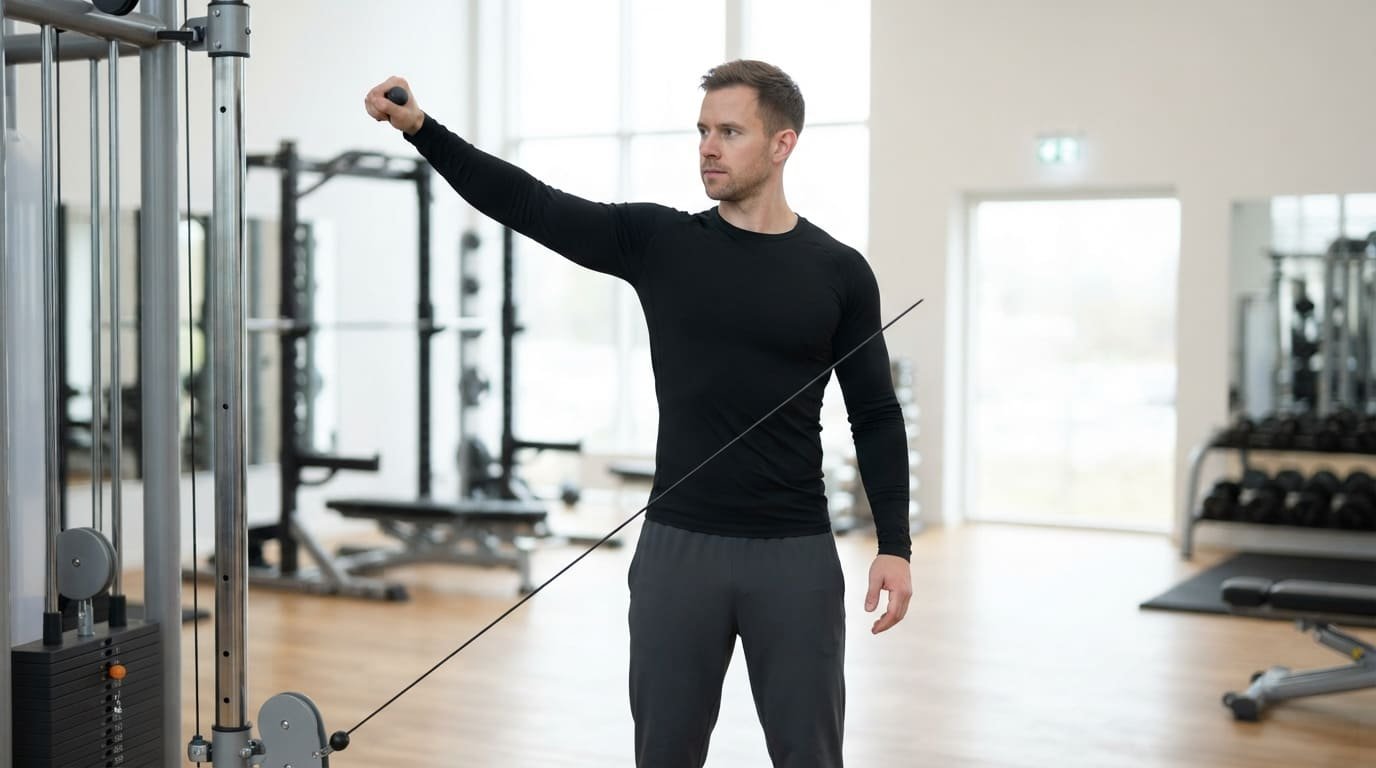
The cable lateral raise is the best single cable exercise for the side delts.
- Set the pulley at the lowest position and attach a single handle
- Stand side-on to the machine and hold the handle with the hand furthest from it, so the cable crosses in front of your body
- With a slight bend in the elbow, raise your arm out to the side until it is level with your shoulder
- Lower slowly
Dose: 3 sets of 12 to 15 per arm. Lead with your elbow, not your hand, and stop at shoulder height.
2. Behind-the-back cable lateral raise
Set up as above, but let the cable run behind your back instead of in front. Many people find this version puts a stronger stretch on the side delt at the start. 3 sets of 12 per arm.
3. Cable front raise
Stand facing away from a low pulley with the cable between your legs, holding a single handle or rope. Raise your arm straight in front of you to shoulder height and lower slowly. 2 to 3 sets of 10 to 12. Many beginners can skip this if they already do pressing exercises, because the front delts get plenty of work there.
4. Single-arm cable shoulder press
Set the pulley low and sit or kneel facing away from the machine, holding a handle at shoulder height. Press it upward and slightly forward until your arm is straight, then lower. 3 sets of 8 to 10 per arm. A smooth way to train pressing strength.
5. Face pull
The face pull is one of the most valuable shoulder cable exercises for posture and shoulder health.
- Set the pulley at upper chest or face height and attach a rope
- Hold the rope with thumbs pointing back toward you and step back until the arms are straight
- Pull the rope toward your face, separating your hands and driving your elbows out and back
- Squeeze your shoulder blades together, then return slowly
Dose: 3 sets of 12 to 15. Keep the weight moderate and focus on the squeeze.
6. Cable reverse fly
Set two pulleys at shoulder height, or use one at a time. Cross the cables, holding the left cable in your right hand and the right cable in your left. With slightly bent elbows, pull your arms out wide until they are in line with your body. Return slowly. 3 sets of 12 to 15. This is the most direct rear delt exercise on the cable machine.
7. Cable Y raise
Set the pulleys low and hold the opposite handles, or use one arm at a time. Raise your arms up and out into a Y shape, thumbs pointing up, until your hands are above your head. Lower slowly. 2 to 3 sets of 10 to 12 with a light weight. This trains the side delts and the lower traps together. Our guide to lower trap exercises explains why that matters.
8. Cable external rotation
- Set the pulley at elbow height
- Stand side-on with your working arm furthest from the machine, elbow bent to 90 degrees and tucked against a small rolled towel at your side
- Rotate your forearm outward, away from your stomach, keeping the elbow in place
- Return slowly
Dose: 2 to 3 sets of 12 to 15 per arm with a very light weight. This strengthens the rotator cuff, which helps keep the shoulder joint stable.
9. Cable upright row (to chest height)
Stand facing a low pulley holding a straight bar or rope with a grip a little wider than your shoulders. Pull it up toward your chest, leading with your elbows, and stop at about chest height. 2 to 3 sets of 10 to 12. Stopping lower and using a wider grip keeps this exercise kinder on the shoulders. Skip it if it causes pinching.
10. Cable shrug
Stand facing a low pulley holding a straight bar. Lift your shoulders straight up toward your ears, pause, and lower. 2 to 3 sets of 12 to 15. This trains the upper traps. Our trap workout covers the traps in more detail.
A beginner cable shoulder workout
This workout takes about 30 minutes and covers every part of the shoulder.
| Exercise | Sets and reps | Rest |
|---|---|---|
| Single-arm cable shoulder press | 3 x 8 to 10 per arm | 60 to 90 seconds |
| Cable lateral raise | 3 x 12 to 15 per arm | 45 to 60 seconds |
| Face pull | 3 x 12 to 15 | 45 to 60 seconds |
| Cable reverse fly | 2 x 12 to 15 | 45 seconds |
| Cable external rotation | 2 x 12 to 15 per arm | 30 to 45 seconds |
Warm up with 5 minutes of light cardio and a set of face pulls with a very light weight. Our guide to warming up before a workout has a full routine.
A 15-minute cable shoulder finisher
If you already trained chest or back, add this short finisher at the end:
- Cable lateral raise, 2 x 15 per arm
- Face pull, 2 x 15
- Cable Y raise, 1 x 12
A 6-week plan for cable machine shoulder exercises
| Week | What to do | Progression |
|---|---|---|
| 1 | Beginner workout once a week | Learn the setup and the movements with light weights |
| 2 | Beginner workout twice a week | Same weights, focus on smooth reps |
| 3 | Twice a week | Add 1 to 2 reps per set |
| 4 | Twice a week | Add one small weight step to the press and lateral raise |
| 5 | Twice a week, swap front-of-body lateral raise for behind-the-back | Keep reps controlled |
| 6 | Twice a week | Add a third set of reverse flys |
Train shoulders on non-consecutive days. If you follow a push pull legs workout, add the lateral raise and press to push days, and the face pull and reverse fly to pull days. Our next-step resistance calculator helps you decide when to move up the stack.
Your first time using the cable machine
If you are new to the gym, a little preparation makes cable shoulder exercises much less stressful:
- Visit at a quiet time. Mid-morning or early afternoon is often calmer, so you can learn the machine without feeling watched
- Ask staff. Gym staff are usually happy to show you how to move the pulley and change attachments
- Bring a plan. Write down the exercises, sets and reps before you go
- Wipe down the handles after use and return attachments to the rack
- Share the machine. If someone is waiting, offer to let them work in between your sets
Most people in the gym are focused on their own training. Nobody expects a beginner to know everything, and asking for help is completely normal.
Where cable shoulder exercises fit in your week
| Your routine | How to add shoulder cable exercises |
|---|---|
| Full-body workouts, 2 to 3 times a week | One press or lateral raise plus one rear delt move each session |
| Upper and lower split | Lateral raises and face pulls on both upper days |
| Push, pull, legs | Press and lateral raises on push day, face pulls and reverse flys on pull day |
| Home training with occasional gym visits | Use bands at home, cables when at the gym |
Aim for roughly 8 to 12 hard sets for the shoulders each week as a beginner. That is enough to make steady progress without leaving your shoulders sore and tired for your other workouts.
How to progress cable shoulder exercises
Shoulder muscles are small, so progress comes in small steps. Use this order:
- Add reps until you hit the top of the range, for example 15 reps on lateral raises
- Add a set if you have time and recover well
- Move up one weight step and drop back to the bottom of the rep range
- Slow the lowering phase to 3 seconds when you cannot add weight
If the next weight step is too big a jump, a common trick is to keep the weight the same and add a pause at the top of each rep instead.
Cable shoulder exercises at home with bands
No cable machine? A resistance band anchored to a door or a sturdy post can mimic most of these exercises:
| Cable exercise | Band version |
|---|---|
| Cable lateral raise | Stand on the band and raise your arm out to the side |
| Face pull | Anchor the band at face height and pull toward your face |
| Cable reverse fly | Hold the band in front of you with straight arms and pull it apart |
| Cable external rotation | Anchor at elbow height and rotate outward |
| Cable press | Stand on the band and press overhead |
Bands get harder as they stretch, so the feel is a little different from a cable, but they work well. Our guides to the best resistance bands for beginners and the bodyweight shoulder workout have more ideas.
Common mistakes
| Mistake | What happens | Fix |
|---|---|---|
| Going too heavy on raises | You swing and shrug | Drop the weight until reps are smooth |
| Shrugging during raises and face pulls | Upper traps take over | Keep shoulders down, neck long |
| Raising above shoulder height in lateral raises | Can pinch the shoulder for some people | Stop at shoulder height |
| Leaning away from the machine | Body weight does the work | Stand tall and brace lightly |
| Letting the weight slam down | You lose half the benefit | Control the lowering phase |
| Skipping rear delts | Shoulders become unbalanced | Include face pulls or reverse flys every session |
Safety and shoulder pain
Cable shoulder exercises are generally joint-friendly, but stop and adjust if you feel pinching at the top of a raise, clicking with pain, or pain that lasts after training. Reduce the range, lower the weight or swap the exercise. If pain persists, see a physiotherapist. Our guide to shoulder impingement exercises explains one common cause of shoulder pain when lifting the arm.
This article is general information, not medical advice. See our medical disclaimer.
The bottom line
Cable shoulder exercises are a smooth, beginner-friendly way to train every part of your shoulders. The cable lateral raise, face pull and cable reverse fly cover the side and rear delts that most people under-train, while the single-arm press and external rotation round out a complete shoulder session.
Start light, keep your shoulders down and control every rep. Two short shoulder workouts a week, with small weight increases over time, are enough to build stronger, healthier shoulders. And if you train at home, a resistance band can stand in for the cable machine.
If you are just starting, keep your first few cable shoulder workouts simple: the cable lateral raise, the face pull and the single-arm press. Learn the setup, find weights you can control for 12 smooth reps, and only then add the other exercises. A short, well-performed session teaches you far more than a long, rushed one.
Frequently asked questions
What are the best cable shoulder exercises?
For most people, the cable lateral raise, face pull and cable reverse fly are the most valuable, because they train the side and rear delts. Add a single-arm cable press and cable external rotation for a complete workout.
Are cable lateral raises better than dumbbell lateral raises?
Not necessarily. A 2025 study found both built the side delts by a similar amount. Cables keep tension at the bottom of the movement, which many people like, but both work well.
How heavy should I go on cable shoulder exercises?
Light enough to do 12 to 15 smooth reps without swinging or shrugging. For lateral raises, most beginners start on the lightest one or two plates.
How often should I train shoulders with cables?
Twice a week is ideal for most beginners, with at least a day of rest between sessions. Around 8 to 12 total sets per week is a good starting point.
Are face pulls good for posture?
Face pulls strengthen the rear delts and the muscles between the shoulder blades, which help hold the shoulders back. They are a useful part of a posture routine alongside regular movement and breaks from sitting.
Can I do cable shoulder exercises at home?
Yes, with resistance bands. Anchor a band to a door or post to copy face pulls, rotations and reverse flys, and stand on it for lateral raises and presses.
Why do I feel cable lateral raises in my neck?
Usually because the upper traps are taking over. Lower the weight, keep your shoulders down, lead with your elbow and stop at shoulder height.
Should beginners use cable machine shoulder exercises?
Yes. Cable machines are smooth, easy to adjust and change weight in small steps, which makes them very beginner-friendly once you know how to set them up.
What attachment should I use for cable shoulder exercises?
A single D-handle works for lateral raises, front raises, presses and external rotations. A rope is best for face pulls, and a straight bar suits upright rows and shrugs. For some lateral raises you can also hold the cable ball stop directly.
Can I build big shoulders with cables only?
Yes, cables can build the shoulders very well, especially the side and rear delts. Most people also include some pressing, with cables, dumbbells or a machine, for overall strength and size. Consistency and gradual progress matter more than the equipment.
What’s next?
Reading is the easy part. Pick one of these and do it today.