Mid Back Exercises: 10 Moves to Strengthen Between Your Shoulder Blades
Mid back exercises strengthen the muscles between and just below your shoulder blades. They are the muscles that hold your shoulders back, keep your upper back from rounding forward and give your neck a stable base to sit on. For most people who sit for a living, they are also the weakest muscles in the body.
I noticed mine when I started doing push-ups regularly. My chest got stronger, my shoulders started to roll forward, and by the end of a working day the area between my shoulder blades ached. A physiotherapist pointed out that I was training the front of my body five times as much as the back. A few weeks of rows and raises later, the ache was gone and my posture looked noticeably different in photos.
This guide explains which muscles make up the mid back, the ten mid back exercises that train them best, how to do each one, and simple workouts for home with a band, dumbbells or nothing at all.
At a glance
- The mid back includes the rhomboids, the middle and lower trapezius, part of the lats and the spinal muscles of the upper back
- These muscles pull the shoulder blades back and down and keep the upper back upright
- The best mid back exercises are rows, reverse flyes, face pulls, band pull-aparts and prone Y and T raises
- Train the mid back at least as often as you train your chest
- Two or three sessions a week of 10 to 15 minutes is enough to see a difference
- Even two minutes a day of resistance exercise has reduced neck and shoulder pain in office workers
- Mid back strength works best alongside upper back mobility work

Simplified illustration. The middle trapezius is shown on one side only; in the body it runs across both shoulder blades.
The muscles of the mid back
| Muscle | Where it is | What it does |
|---|---|---|
| Rhomboids | Between the spine and the inner edge of the shoulder blades | Squeeze the shoulder blades together |
| Middle trapezius | Across the upper back, at shoulder blade level | Pulls the shoulder blades toward the spine |
| Lower trapezius | A V shape below the shoulder blades | Pulls the shoulder blades down and helps you reach overhead |
| Latissimus dorsi (lats) | Wide muscles down the sides of the back | Pull the arms down and back |
| Thoracic erector spinae | Along the spine in the upper and mid back | Keep the upper back upright |
| Rear deltoids | Back of the shoulders | Pull the arms back and out |
Most people’s upper trapezius, the part that shrugs the shoulders, is already overworked. Good mid back strengthening exercises train the middle and lower trapezius and the rhomboids while keeping the upper trapezius relaxed. A study that measured muscle activity during common shoulder blade exercises identified side-lying external rotation, side-lying forward flexion, prone horizontal abduction with the thumbs up and prone extension as the best choices for doing exactly that.
Why train your mid back?
- Better posture. Strong mid back muscles hold the shoulders back and the upper back upright
- Less neck and shoulder tension. A trial in office workers with frequent neck and shoulder pain found that as little as two minutes of progressive resistance exercise a day reduced pain and tenderness over ten weeks
- Balanced training. Push-ups and presses strengthen the front. Mid back work balances them
- Healthier shoulders. The shoulder blade is the base of the shoulder joint
- Easier everyday tasks. Carrying, pulling doors, lifting children and shopping
- Ageing well. A review of exercise trials found that strengthening programmes improved an exaggerated forward curve of the upper back, as well as back muscle strength and quality of life
The one cue that makes every exercise work
Before every rep, set your shoulder blades: draw them gently back and down, as if tucking them into your back pockets. Keep your neck long and your shoulders away from your ears. Then pull.
Most mid back exercises go wrong in the same way. People shrug, yank with the arms and arch the lower back. Slow down, set the shoulder blades and squeeze for one second at the end of every rep.
The 10 best mid back exercises
They run from easiest to hardest. Pick four or five for a workout.
1. Shoulder blade squeeze
- Sit or stand tall with your arms by your sides
- Gently squeeze your shoulder blades back and down
- Hold for five seconds, then relax
Sets and reps: 2 sets of 10. The simplest of all exercises for mid back control, and easy to do at a desk.
2. Band pull-apart
- Hold a light resistance band in front of your chest with straight arms, hands shoulder-width apart
- Set your shoulder blades
- Pull the band apart by moving your hands out to the sides until the band touches your chest
- Return slowly
Sets and reps: 2 to 3 sets of 12 to 20.
3. Prone Y raise
- Lie face down with your forehead on a folded towel
- Stretch your arms overhead in a Y shape, thumbs pointing up
- Draw your shoulder blades down, then lift your arms a few centimetres
- Hold for two seconds and lower
Sets and reps: 2 to 3 sets of 8 to 12. Targets the lower trapezius.
Our guide to lower trap exercises has more Y raise variations and a 6-week plan.
4. Prone T raise
The same as the Y raise, but with your arms straight out to the sides in a T, thumbs up. This is the prone horizontal abduction movement singled out in the muscle activity research above.
Sets and reps: 2 to 3 sets of 8 to 12.
5. Superman
- Lie face down with arms overhead
- Lift your chest, arms and legs a few centimetres off the floor
- Hold for two seconds and lower
Sets and reps: 2 to 3 sets of 8. Works the spinal muscles of the upper and mid back. Our erector spinae exercises guide has more options.
6. Seated band row
- Sit on the floor with your legs straight and a band looped around your feet
- Sit tall and hold the ends with your arms straight
- Pull your elbows back past your ribs, squeezing your shoulder blades
- Return slowly
Sets and reps: 3 sets of 12 to 15.
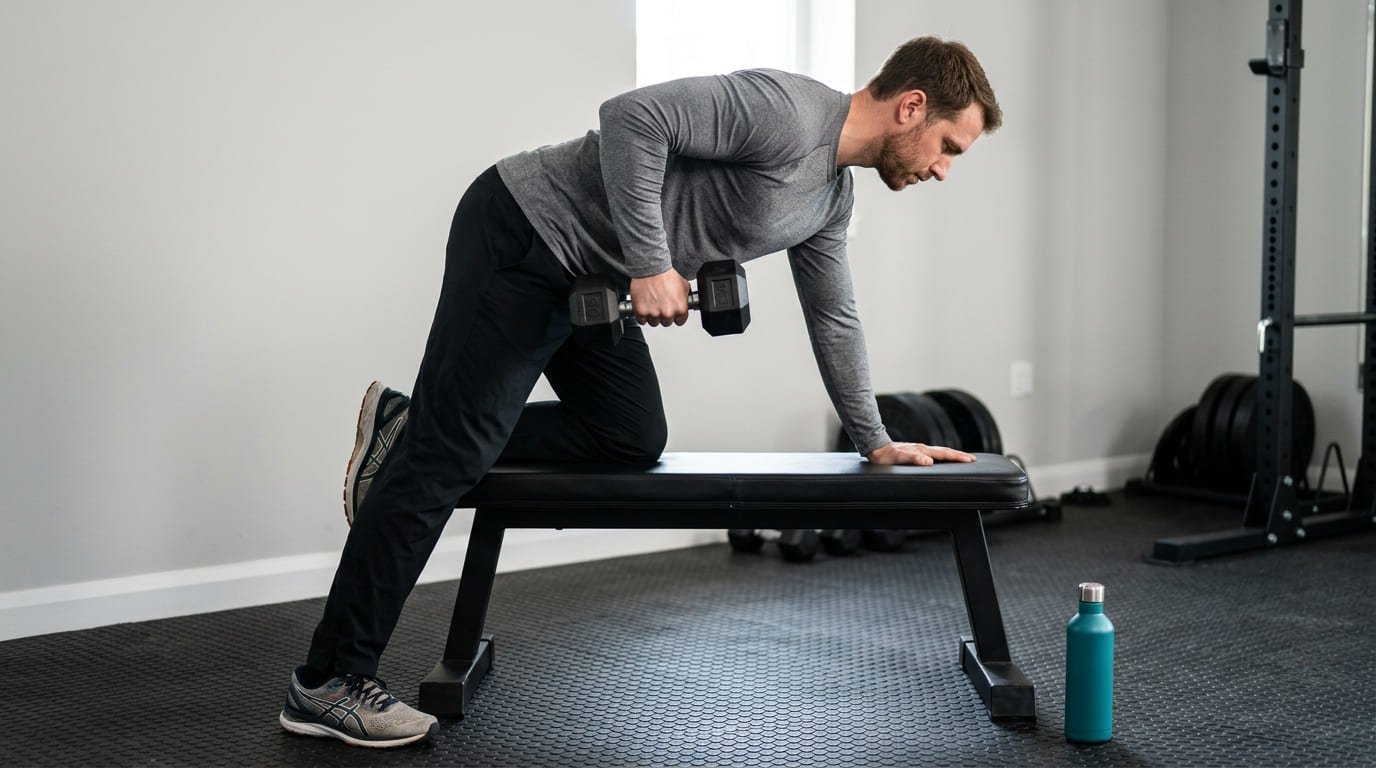
7. One-arm dumbbell row
- Place one hand and one knee on a bench or chair, back flat
- Hold a dumbbell in the other hand, arm hanging straight
- Pull the dumbbell toward your hip, leading with the elbow
- Squeeze at the top, then lower slowly
Sets and reps: 3 sets of 8 to 12 per side. One of the great upper back exercises, and the easiest to load progressively. Our back workout with dumbbells at home has more rowing variations.
8. Reverse dumbbell fly
- Hinge forward from the hips with a flat back, holding light dumbbells under your chest
- With a slight bend in the elbows, raise your arms out to the sides until they are level with your body
- Squeeze your shoulder blades, then lower slowly
Sets and reps: 3 sets of 10 to 15. Use light weights. This is about squeeze, not load.
9. Band face pull
- Anchor a band at head height
- Hold the ends with your palms facing down
- Pull the band toward your face, elbows high, finishing with your hands beside your ears
- Return slowly
Sets and reps: 3 sets of 12 to 15. Trains the rear shoulders and middle trapezius together.
10. Inverted row
- Lie under a sturdy table or a bar set at waist height
- Grip the edge with your body straight and heels on the floor
- Pull your chest up toward the edge, squeezing your shoulder blades
- Lower slowly
Sets and reps: 3 sets of 6 to 12. The more upright your body, the easier it is. Make sure the table cannot tip. Our calisthenics back workout covers inverted rows in detail.
| Exercise | Equipment | Level | Main target |
|---|---|---|---|
| Shoulder blade squeeze | None | Beginner | Rhomboids, middle trapezius |
| Band pull-apart | Band | Beginner | Middle trapezius, rear shoulders |
| Prone Y raise | None | Beginner | Lower trapezius |
| Prone T raise | None | Beginner | Middle trapezius |
| Superman | None | Beginner | Spinal muscles |
| Seated band row | Band | Beginner | Rhomboids, lats |
| One-arm dumbbell row | Dumbbell | Intermediate | Lats, rhomboids |
| Reverse dumbbell fly | Dumbbells | Intermediate | Rear shoulders, middle trapezius |
| Band face pull | Band | Intermediate | Rear shoulders, middle trapezius |
| Inverted row | Table or bar | Intermediate | Whole upper back |
Mid back workouts
Do your chosen workout two or three times a week. Rest 45 to 60 seconds between sets.
Workout 1: no equipment
| Exercise | Sets | Reps |
|---|---|---|
| Shoulder blade squeeze | 2 | 10, 5-second holds |
| Prone Y raise | 3 | 10 |
| Prone T raise | 3 | 10 |
| Superman | 3 | 8 |
| Inverted row under a table | 3 | 6 to 10 |
Workout 2: resistance band
| Exercise | Sets | Reps |
|---|---|---|
| Band pull-apart | 3 | 15 |
| Seated band row | 3 | 12 to 15 |
| Band face pull | 3 | 12 to 15 |
| Prone Y raise | 2 | 10 |
| Superman | 2 | 8 |
Workout 3: dumbbells
| Exercise | Sets | Reps |
|---|---|---|
| One-arm dumbbell row | 3 | 10 per side |
| Reverse dumbbell fly | 3 | 12 |
| Prone Y raise | 2 | 10 |
| Band pull-apart or prone T raise | 2 | 15 |
| Superman | 2 | 8 |
The two-minute desk routine
| Exercise | Time |
|---|---|
| Shoulder blade squeeze | 30 seconds |
| Band pull-apart, if you have a band at your desk | 45 seconds |
| Chin tucks | 20 seconds |
| Stand and reach overhead | 25 seconds |
Do it once or twice a day on working days. In the trial above, two minutes a day was enough to make a difference.
Mid back exercises at the gym
If you train in a gym, these machines and cables are excellent exercises for mid back strength. Use the same cue: set the shoulder blades first, then pull.
| Exercise | How | Sets and reps |
|---|---|---|
| Seated cable row | Sit tall, pull the handle to your lower ribs, squeeze | 3 x 10 to 12 |
| Chest-supported row | Lie face down on an incline bench and row two dumbbells | 3 x 10 to 12 |
| Lat pulldown | Pull the bar to your upper chest, elbows down and back | 3 x 10 to 12 |
| Reverse pec deck | Sit facing the pad and open your arms out to the sides | 3 x 12 to 15 |
| Cable face pull | Rope at head height, pull toward your face with elbows high | 3 x 12 to 15 |
The chest-supported row deserves special mention. With your chest on the bench, you cannot swing or arch your lower back, so the mid back has to do the work. For the lat pulldown, resist the urge to lean far back and yank the bar to your stomach. A slight lean and a controlled pull to the top of the chest keeps the work in the back, not the arms. The same goes for the seated cable row: sit tall and let the shoulder blades finish each rep.
Mid back exercises with household items
No band and no dumbbells? You can still train well.
- Towel row: loop a towel around a sturdy door handle (with the door closed and locked), lean back holding both ends and pull yourself toward the door
- Backpack row: fill a backpack with books and use it for one-arm rows or bent-over rows
- Water bottle reverse fly: two full bottles are a good starting weight for reverse flyes
- Towel pull-apart: hold a towel taut overhead and pull it apart as you lower it behind your head to shoulder height
How long until you notice a difference?
| Timescale | What usually changes |
|---|---|
| 1 to 2 weeks | Better awareness. Easier to sit tall and set the shoulder blades |
| 3 to 4 weeks | Less end-of-day aching for many desk workers |
| 6 to 8 weeks | More reps and heavier rows. Posture looks different in photos |
| 3 months and beyond | Lasting change, as long as you keep training two or three times a week |
These are typical patterns from training experience, not guarantees. The biggest factor is consistency.
Balance your pushing and pulling
A simple rule: do at least one set of mid back exercises for every set of chest or shoulder pressing. If your shoulders already round forward, aim for two.
| If you do this push exercise | Pair it with |
|---|---|
| Push-ups | Inverted rows or band rows |
| Dumbbell chest press | One-arm dumbbell rows |
| Overhead press | Face pulls or prone Y raises |
| Dips | Reverse flyes |
Our push pull legs workout builds this balance into a weekly plan.
Add mobility for the best results
Strength holds the shoulders back. Mobility lets the upper back get there in the first place. If your upper back is stiff, it is hard to sit tall no matter how strong the muscles are.
- Start each session with 2 to 3 minutes of thoracic mobility exercises, such as cat-cow, thread the needle and the open book
- Stretch the chest with the doorway stretch, from our back stretching exercises
- Then do your mid back strengthening exercises
Our posture exercises guide puts strength and mobility together into a full routine.
How to progress
- Perfect the form with light resistance
- Add reps up to the top of the range
- Slow the lowering to three seconds
- Add a one-second squeeze at the end of every rep
- Increase the load: a heavier band, a heavier dumbbell or a lower inverted row
Our sets and reps guide explains how to progress any exercise.
A 4-week plan for desk workers
| Week | Sessions | What to do |
|---|---|---|
| 1 | 3 a week, 10 minutes | Shoulder blade squeezes, prone Y and T raises, superman. Learn the shoulder blade set |
| 2 | 3 a week, 12 minutes | Add band pull-aparts and seated band rows |
| 3 | 3 a week, 15 minutes | Add band face pulls. Slow every lowering phase to three seconds |
| 4 | 3 a week, 15 minutes | Swap in one-arm dumbbell rows and reverse flyes if you have dumbbells |
Keep the two-minute desk routine going every working day alongside the plan. After four weeks, repeat the week 4 session and progress the load gradually, or move on to a full back workout.
Tracking helps. Take a side-on photo of your posture at the start and again after four weeks, standing relaxed as you normally would. Most people find the difference more motivating than any number.
Mid back pain: when to be careful
Mid back exercises often ease the dull ache that comes from long hours of sitting. But the mid back is also an area where pain can come from other causes, including the ribs, the lungs, the heart and the digestive organs.
This article is general information, not medical advice. Seek urgent medical help for mid back or chest pain with shortness of breath, sweating, nausea, or pain spreading to the arm or jaw. See a doctor for back pain after a fall or injury, pain with fever or unexplained weight loss, pain that wakes you at night, numbness or weakness, or pain that keeps getting worse. If you have osteoporosis, ask about safe exercises first. See our medical disclaimer.
Common mistakes
- Shrugging. The shoulders rise toward the ears and the upper trapezius takes over
- Pulling with the arms only. Start every rep by setting the shoulder blades
- Arching the lower back to move more weight
- Going too heavy on flyes and raises. These are small muscles
- Rushing the lowering phase
- Only training the mirror muscles. Chest and arms are not the whole story
- Skipping mobility. A stiff upper back limits what strength can do
The bottom line
Mid back exercises strengthen the rhomboids, the middle and lower trapezius and the spinal muscles that hold your shoulders back and your upper back upright. They balance pressing exercises, ease desk-related stiffness and support better posture.
Start with shoulder blade squeezes, band pull-aparts and prone Y and T raises. Add rows, reverse flyes and face pulls as you get stronger. Set your shoulder blades before every rep, move slowly and squeeze at the end.
Two or three short sessions a week, plus a little thoracic mobility work, is all most people need.
For more ways to move during the working day, see our full guide to desk exercises.
If you struggle to feel your shoulder blades move during rows, my guide to scapular retraction exercises breaks the movement down step by step, from simple squeezes to inverted rows.
Frequently asked questions
What are the best mid back exercises?
Rows, reverse flyes, band face pulls, band pull-aparts and prone Y and T raises. Rows build overall strength, while raises and pull-aparts target the middle and lower trapezius that hold the shoulder blades back and down.
How can I strengthen my mid back at home?
With no equipment, do shoulder blade squeezes, prone Y and T raises, supermans and inverted rows under a sturdy table. A resistance band adds pull-aparts, rows and face pulls. A pair of dumbbells adds one-arm rows and reverse flyes.
How often should I do mid back strengthening exercises?
Two or three times a week, with at least a day between harder sessions. Light exercises such as shoulder blade squeezes and band pull-aparts can be done daily, even for two minutes at a desk.
Do mid back exercises improve posture?
They help. Strong mid back muscles hold the shoulders back and the upper back upright, and exercise programmes have been shown to reduce an exaggerated upper back curve. Combine them with thoracic mobility work and regular breaks from sitting.
What are great upper back exercises for beginners?
Shoulder blade squeezes, band pull-aparts, prone Y and T raises and seated band rows. They need little or no equipment, are easy to learn and teach you to use the right muscles before you add weight.
Why does my mid back hurt when I sit?
Long sitting often lets the upper back round forward, which strains the muscles between the shoulder blades. Regular breaks, a better desk setup and exercises for mid back strength usually help. See a doctor if the pain is severe, persistent or comes with other symptoms.
What is the difference between the mid back and the upper back?
The terms overlap. The upper back usually means the area around and above the shoulder blades, and the mid back the area between and just below them. The same muscles, especially the trapezius and rhomboids, work across both.
Can mid back exercises help neck pain?
They often help neck and shoulder tension linked to desk work. In one trial, as little as two minutes of daily resistance exercise reduced neck and shoulder pain. Get persistent neck pain, or pain with arm symptoms, checked by a professional.
What’s next?
Reading is the easy part. Pick one of these and do it today.