Pull Day Workout: 3 Routines for Home and Gym (Plus a 8-Week Plan)
Pull day is the session where you pull weight toward your body rather than pushing it away. That single distinction covers your entire back, your biceps, your rear shoulders and your forearms, which is why it is one of the three sessions in the most popular training split in the world.
It is also the session most people get wrong, and for a specific reason: they treat it as a back workout with some curls added. A properly built pull day balances two different pulling directions, and skipping one of them is the single most common reason a back stops developing.
Here is something else worth saying plainly. Almost every pull day guide online assumes you have a cable machine, a lat pulldown station and a barbell. If you train at home with dumbbells, those articles leave you guessing. This guide gives you a full dumbbell-only version alongside the gym routines, because the movement patterns matter far more than the equipment.
At a glance
- Pull day trains your back, biceps, rear delts, traps and forearms
- Every good pull day contains both vertical pulling and horizontal pulling
- Three complete routines below: dumbbell-only home, full gym, and a short 30-minute version
- Train pull day once or twice a week, with 10 to 20 total working sets
- Compound exercises first, isolation work last, and never curl before you row
- A full 8-week progression plan with exact rep targets is included
What a pull day actually is
The push, pull, legs split divides your training by movement pattern rather than by body part. It works because the muscles in each group naturally work together, so you train them and then recover them at the same time.
| Session | Movement | Muscles trained |
|---|---|---|
| Push | Pushing weight away from you | Chest, shoulders, triceps |
| Pull | Pulling weight toward you | Back, biceps, rear delts, traps, forearms |
| Legs | Squatting, hinging, lunging | Quads, hamstrings, glutes, calves |
The logic is clean. Your biceps assist every rowing and pulling movement, so training them on the same day as your back means they get one hard session and then a proper rest, rather than being fatigued on two separate days. The same reasoning puts triceps with chest on push day.
The muscles you are training
Knowing what each muscle does turns exercise selection from guesswork into something obvious.
| Muscle | Where it is | What it does | Trained best by |
|---|---|---|---|
| Latissimus dorsi | The broad sheet down your back | Pulls the arm down and back | Pull-ups, pulldowns, pullovers |
| Trapezius | Upper back and neck to mid spine | Raises, retracts and lowers the shoulder blades | Rows, shrugs, Y raises |
| Rhomboids | Between the shoulder blades | Squeezes the shoulder blades together | Rows, face pulls |
| Rear deltoid | Back of the shoulder | Pulls the arm backwards | Reverse flyes, face pulls |
| Biceps brachii | Front of the upper arm | Bends the elbow, turns the palm up | Curls, chin-ups |
| Brachialis | Underneath the biceps | Bends the elbow in any grip | Hammer curls, reverse curls |
| Erector spinae | Running along the spine | Holds the spine extended | Deadlifts, good mornings, back extensions |
| Forearm flexors | Palm side of the forearm | Grip | Every pulling exercise, plus carries |
The muscle to pay attention to is the rear deltoid. It is small, it is easy to skip, and it is the one that balances out all the pressing you do on push day. Most people’s shoulders sit slightly forward because their chest work outweighs their rear delt work by a wide margin.
Vertical and horizontal pulling: the part most people miss
This is the concept that separates a good pull day from a mediocre one, and it appears in almost none of the popular guides.
Your back responds to two different pulling directions, and they build different things.
| Direction | What it looks like | What it builds | Examples |
|---|---|---|---|
| Vertical pull | Pulling down from overhead | Back width, the V shape | Pull-ups, chin-ups, lat pulldowns, pullovers |
| Horizontal pull | Pulling toward your stomach | Back thickness, posture, mid-back strength | Bent-over rows, seated rows, dumbbell rows, inverted rows |
Every pull day should contain at least one of each. If your session is all rows, you will build a thick, strong mid-back with underdeveloped lats and no visible width. If it is all pulldowns and pull-ups, you will have width but a weak mid-back and the rounded-shoulder posture that comes with it.
A simple rule that works: start with one vertical pull, then one horizontal pull, then a second of whichever direction matters more to your goal, then your isolation work.
If you sit at a desk, bias toward horizontal pulling. Rows strengthen the muscles that hold your shoulder blades back, and that is the direct counterweight to eight hours of sitting forward at a screen.
A 5-minute pull day warm-up
Pulling loads the shoulder joint and the lower back, and most pull day articles skip the warm-up entirely. Five minutes is enough.
- Arm circles: 20 seconds forwards, 20 seconds backwards
- Band or towel pull-aparts: 15 reps, squeezing the shoulder blades
- Scapular hangs or scapular shrugs: 10 reps, moving only the shoulder blades
- Cat cow: 8 slow reps to loosen the spine
- Bodyweight hip hinges: 10 reps if your session includes deadlifts or bent-over rows
- One or two ramp-up sets on your first exercise, at roughly 50 and 75 percent of your working weight
The scapular work matters most. Your shoulder blades have to move properly for any pulling exercise to load your back rather than your arms, and a few reps of deliberate scapular movement switches that on.
Routine 1: dumbbell-only pull day at home
No bar, no cables, no machines. This is the version every other guide leaves out. Roughly 40 minutes.
| Exercise | Direction | Sets | Reps | Rest |
|---|---|---|---|---|
| Dumbbell pullover | Vertical | 3 | 10 to 12 | 90 sec |
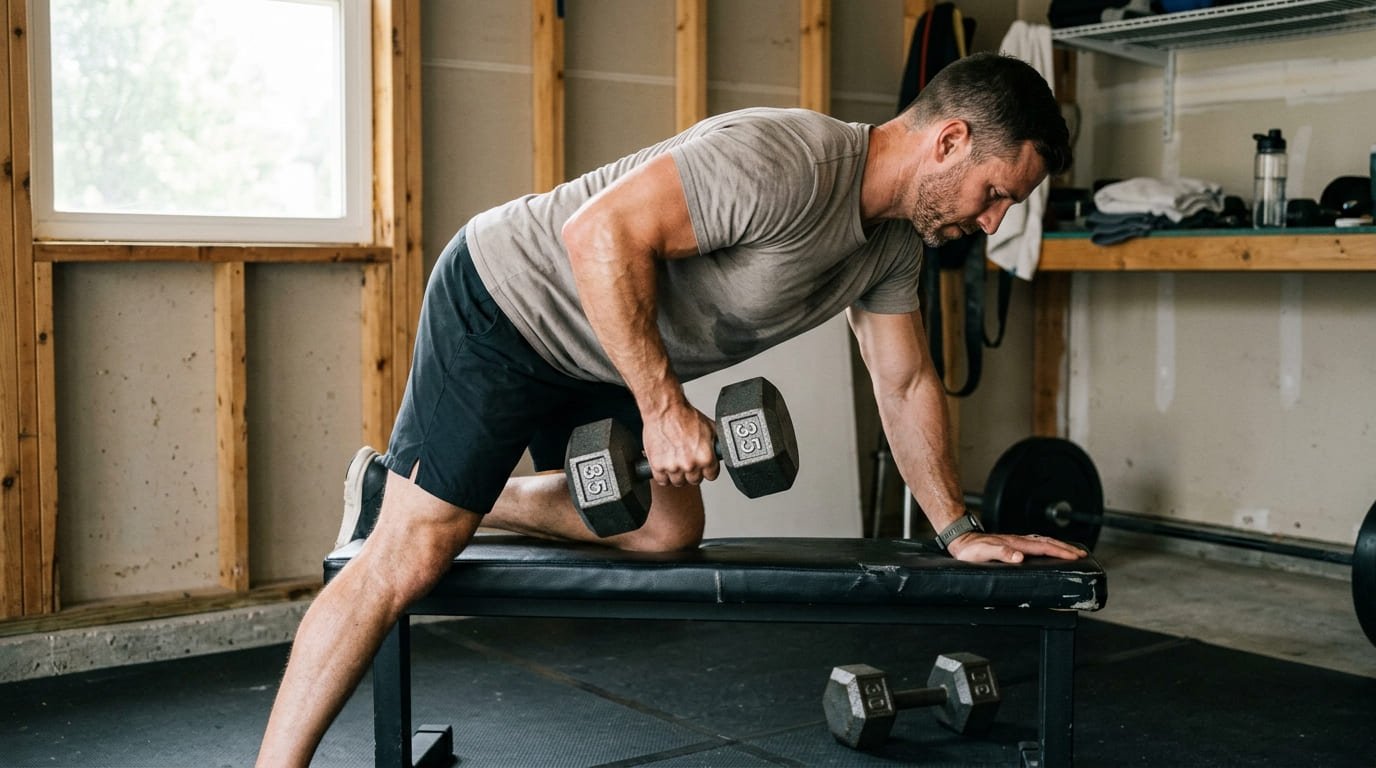
| One-arm dumbbell row | Horizontal | 4 | 8 to 12 each | 90 sec |
| Chest-supported row on an incline | Horizontal | 3 | 10 to 12 | 75 sec |
| Dumbbell Romanian deadlift | Hinge | 3 | 10 to 12 | 90 sec |
| Bent-over reverse fly | Rear delt | 3 | 15 to 20 | 45 sec |
| Dumbbell curl | Biceps | 3 | 10 to 12 | 60 sec |
| Hammer curl | Biceps and brachialis | 3 | 10 to 12 | 60 sec |
How to do the hard ones without equipment:
- Dumbbell pullover: lie across a sofa edge or on the floor, hold one dumbbell with both hands above your chest, and lower it back over your head with slightly bent arms. This is the best vertical pull available without a bar
- Chest-supported row: lie face down on a bed, sofa arm or an incline bench and row the dumbbells up. Removing your lower back from the equation lets you focus entirely on the mid-back
- Inverted row: if you have a sturdy table, lie underneath and pull your chest to the edge. This is a genuinely excellent horizontal pull and it costs nothing
If you want more variations in this format, our back workout with dumbbells at home guide covers them in depth. For vertical pulling without a bar, see pull up alternatives.
Routine 2: full gym pull day
| Exercise | Direction | Sets | Reps | Rest |
|---|---|---|---|---|
| Pull-up or lat pulldown | Vertical | 4 | 6 to 10 | 2 min |
| Barbell bent-over row | Horizontal | 4 | 6 to 10 | 2 min |
| Seated cable row | Horizontal | 3 | 10 to 12 | 90 sec |
| Straight-arm pulldown | Vertical | 3 | 12 to 15 | 60 sec |
| Face pull | Rear delt | 3 | 15 to 20 | 45 sec |
| Barbell or EZ-bar curl | Biceps | 3 | 8 to 12 | 75 sec |
| Hammer or cable curl | Biceps | 3 | 10 to 15 | 60 sec |
Note the two-minute rests on the first two exercises. Pull-ups and barbell rows are heavy compound movements, and cutting rest to 60 seconds means your later sets happen at a much lower load. That trade is rarely worth making.
Routine 3: the 30-minute pull day
For when time is short. Supersets keep the density high without cutting the important work.
| Exercise | Sets | Reps | Format |
|---|---|---|---|
| Pull-up or pullover | 3 | 8 to 12 | Straight sets, 90 sec rest |
| One-arm row + reverse fly | 3 | 10 each, then 15 | Superset, 60 sec rest |
| Romanian deadlift | 3 | 10 to 12 | Straight sets, 75 sec rest |
| Curl + hammer curl | 3 | 10 each | Superset, 45 sec rest |
Supersetting a row with a reverse fly works well because the reverse fly uses a fraction of the load, so it does not compromise the row. Never superset two heavy compound pulls together.
Exercise order, and why curls go last
The order is not arbitrary, and it follows one principle: your biceps are the weak link in every pulling movement, so you protect them until the end.
- Heaviest vertical pull first. Pull-ups or pulldowns, while you are completely fresh
- Heaviest horizontal pull second. Barbell or dumbbell rows
- Second row or second pulldown, lighter, focusing on the squeeze
- Rear delts. Small muscle, light weight, high reps
- Biceps last. Curls of two varieties, one supinated and one neutral grip
Curling first is the most common pull day mistake. Your biceps assist every row and every pull-up. Fatigue them at the start and your back work ends early because your arms failed, not because your back did. You get a good arm pump and a wasted back session.
Sets, reps and weekly volume
| Goal | Back sets per week | Back reps | Bicep sets per week | Rest |
|---|---|---|---|---|
| Build strength | 10 to 14 | 4 to 8 on compounds | 6 to 10 | 2 to 3 min |
| Build muscle size | 14 to 20 | 6 to 15 | 10 to 16 | 75 to 120 sec |
| General fitness | 8 to 12 | 10 to 15 | 6 to 10 | 60 sec |
A few rules that apply across all of them:
- Leave 1 to 3 reps in reserve on most sets. Training to failure on every set costs more in fatigue than it returns in progress
- Cover both pulling directions every session
- Count indirect bicep work. Heavy rows and chin-ups already train the biceps hard, so 16 dedicated curl sets on top of that is usually more than you need
- Rear delts need volume, not weight. Four to eight sets a week at high reps
How often should you do a pull day?
| Your training week | Pull days per week | Structure |
|---|---|---|
| 3 sessions | 1 | Push, pull, legs |
| 4 sessions | 1 to 2 | Push, pull, legs, plus a full body or a second pull |
| 5 sessions | 2 | Push, pull, legs, push, pull |
| 6 sessions | 2 | Push, pull, legs, repeated |
| 2 sessions | Included in both | Full body sessions with pulling in each |
Twice a week generally builds muscle faster than once, because training a muscle group twice per week beats once at the same total volume. If you can only manage one pull day, put more volume into it rather than accepting less total work.
Leave at least 48 hours between pull days. Your lats and biceps both need it, and grip fatigue accumulates faster than people expect.
Our guide on which muscle groups to work out together covers how the full split fits together across a week.
An 8-week progression plan
Listing exercises is the easy part. This is how you actually get stronger over two months. Use double progression: add reps until you reach the top of the range, then add weight and start again at the bottom.
| Weeks | Vertical pull | Horizontal pull | Rear delts and arms |
|---|---|---|---|
| Weeks 1 to 2 | 3 sets of 8, or assisted | 3 sets of 8 to 10 | 3 sets of 12 |
| Weeks 3 to 4 | 3 sets of 10 to 12 | 3 sets of 12 | 3 sets of 15 |
| Weeks 5 to 6 | Add weight or reduce assistance, 4 sets of 8 | Add weight, 4 sets of 8 to 10 | 3 sets of 15 with a 1-second hold |
| Weeks 7 to 8 | 4 sets of 10 to 12 | 4 sets of 10 to 12, 2-second squeeze | 4 sets of 15 |
Track two numbers and nothing else: your best set of pull-ups or pulldowns, and the weight you row for 10 clean reps. If both are higher after eight weeks, the programme worked.
Eight pull day mistakes
- Pulling with your arms instead of your back. Think about driving your elbows back and down rather than pulling with your hands
- Skipping vertical or horizontal pulling. One direction alone builds an unbalanced back
- Curling first. It sabotages every compound pull that follows
- Using momentum on rows. If your torso swings upward on each rep, the weight is too heavy and your lower back is taking the load
- Neglecting rear delts, which are the direct counterweight to all your pressing
- Letting grip end the set. Use straps on your heaviest sets only, so your back can keep working. Building grip separately fixes the root cause
- Shrugging during pulldowns. Keep the shoulders down and away from your ears so the lats do the work
- Cutting the range short. A full stretch at the top of a pulldown and a full squeeze at the bottom of a row are where the results are
When your grip fails before your back
This is a genuine and very common problem on pull day, and almost no guide addresses it.
Your forearms are smaller than your lats, so on heavy rows and pull-ups your hands often give out while your back still has plenty left. Three fixes, in order of when to use them:
- Use a mixed grip on your heaviest set, one palm facing each way, which reduces the tendency for the bar to roll out of your hands
- Use lifting straps for your top one or two sets only. Straps are not cheating on a back exercise, they let you train the target muscle properly
- Train grip separately, at the end of the session so it does not interfere. Dead hangs and farmer’s carries work best
The long-term answer is the third one. Our forearm workout at home guide covers grip training in full, and a stronger grip improves every pull you do.
What to expect afterwards
Lats and biceps both produce noticeable soreness in the first few weeks, particularly from exercises with a big stretch such as pullovers, straight-arm pulldowns and any row taken through a full range.
- Soreness peaks 24 to 48 hours afterwards and is normal, especially on a new exercise
- Lower back tightness after deadlifts and bent-over rows is common. If it is sharp rather than dull, reduce the weight and check that your back is staying flat
- Bicep tendon discomfort near the elbow usually follows a jump in curl volume. Reduce the load and slow the lowering phase
- Grip stiffness the next morning is normal and settles quickly
Mild soreness is not a reason to skip your next session. If you are not sore at all, that is also fine, since soreness is a poor measure of whether training worked.
The bottom line
A pull day is simple to build once you stop thinking in body parts and start thinking in directions. One vertical pull, one horizontal pull, a second of either, rear delts, then curls at the end. That order protects your biceps so your back gets the session it deserves.
You do not need a cable stack to do it properly. A pair of dumbbells, a sofa to lie across and a sturdy table cover every pattern in this article, which is why Routine 1 exists.
Train pull day once or twice a week, add a rep or a little weight every couple of weeks, and write down your best row and your best pull-up. Those two numbers tell you everything about whether it is working.
Curious about the small muscle that works beside your lats on every pull? Our teres major exercises guide explains what it does and how to emphasise it.
To see how pull day fits into a full week, read our push pull legs workout guide.
Frequently asked questions
What exercises should be on a pull day?
At minimum one vertical pull such as a pull-up, lat pulldown or dumbbell pullover, one horizontal pull such as a bent-over or one-arm row, a rear delt exercise such as a reverse fly or face pull, and two curl variations. Most people add a second row or pulldown and a hip hinge like a Romanian deadlift.
Can you do a pull day workout at home with just dumbbells?
Yes. Dumbbell pullovers cover the vertical pull, one-arm rows and chest-supported rows cover the horizontal pull, and reverse flyes and curls handle the rest. An inverted row under a sturdy table adds an excellent free horizontal pull. Routine 1 in this article is built entirely from dumbbells and household furniture.
How often should you do a pull day?
Once or twice a week, leaving at least 48 hours between sessions. Twice a week generally produces faster muscle growth than once at the same total volume, because training frequency matters. If you can only fit one pull day in, add volume to that single session rather than accepting less total work.
Should you do biceps on pull day?
Yes, and at the end of the session. Your biceps assist every rowing and pulling movement, so training them on pull day means they get one hard session followed by proper recovery. Curling first is a common mistake, since pre-fatigued biceps cause your back exercises to end early.
How many exercises should a pull day have?
Five to seven exercises for most people, which comes to roughly 15 to 21 working sets. Start with three or four compound movements, then finish with two or three isolation exercises. Fewer than five usually leaves a gap in either pulling direction or in rear delt work.
What is the difference between vertical and horizontal pulling?
Vertical pulling means pulling down from overhead, as in pull-ups and lat pulldowns, and it builds back width. Horizontal pulling means pulling toward your stomach, as in rows, and it builds back thickness and improves posture. A complete pull day includes both, since each one develops something the other does not.
Should deadlifts go on pull day or leg day?
Either works. Deadlifts train the posterior chain heavily, so they fit naturally on pull day, but they also fatigue the legs considerably. If you deadlift heavy, putting them on pull day protects your leg session. If your legs are the priority, keep deadlifts there and use Romanian deadlifts on pull day instead.
Why do my arms get tired before my back on pull day?
Usually because you are pulling with your hands and arms rather than driving your elbows back, or because your grip is the limiting factor. Focus on leading with the elbows, use lifting straps for your heaviest one or two sets, and train grip separately at the end of the session rather than letting it end your back work early.
What’s next?
Reading is the easy part. Pick one of these and do it today.