Hip CARs Exercise: How to Do Them, Plus Hip Hikes and a Hip Mobility Routine
The hip CARs exercise is one of the simplest ways to check in with your hips and keep them moving well. CARs stands for controlled articular rotations: slow, deliberate circles of a joint through the biggest range you can control. For the hips, that means drawing a large, slow circle with your knee while the rest of your body stays still.
If you sit a lot, feel stiff when you stand up, or notice that one hip moves less freely than the other, hip CARs can become a quick daily habit. They take a couple of minutes, need no equipment, and double as a warm-up before workouts.
This guide shows you how to do hip CARs step by step, easier and harder versions, the hip hike exercise for the side of the hip, what you should know about snapping hip exercises, and a simple daily routine you can print or save as a PDF.
At a glance
- Hip CARs are slow, controlled circles of the hip through your largest comfortable range
- Keep your pelvis and trunk still so the hip does the work
- Start standing with support, or on hands and knees
- Do 3 to 5 slow circles each way, on each side, once or twice a day
- The hip hike exercise strengthens the side of the hip that keeps your pelvis level
- Snapping hip is often harmless, but painful snapping needs a professional assessment
- Mobility works best alongside strength, so pair CARs with hip strengthening exercises
What is the hip CARs exercise and how does it work?
Controlled articular rotations come from a mobility system popular with strength coaches and physical therapists. The idea is simple: move one joint, slowly, through the largest range you can actively control, while keeping the rest of your body still. It works the muscles around the joint at every angle and gives you feedback on where your hip feels stiff or restricted.
| Feature | Hip CARs | Static hip stretch |
|---|---|---|
| Movement | Slow, active circles | Holding one position |
| Muscles | Working throughout | Mostly relaxed |
| Range | Active range you control | Often passive range |
| Best used for | Daily joint maintenance, warm-ups | Cool-downs, increasing passive flexibility |
| Time | 1 to 3 minutes | Several minutes |
How to do the hip CARs exercise standing
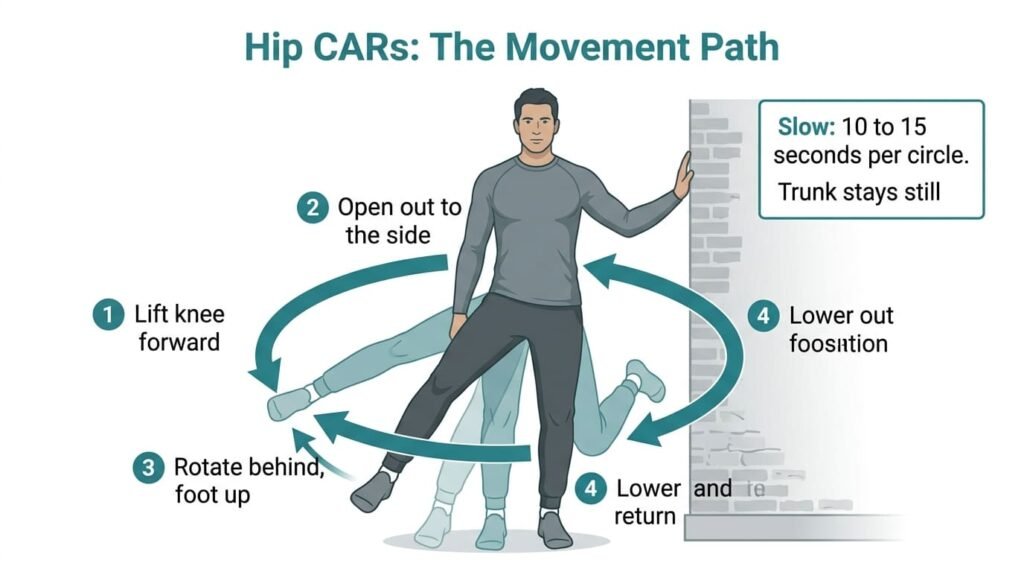
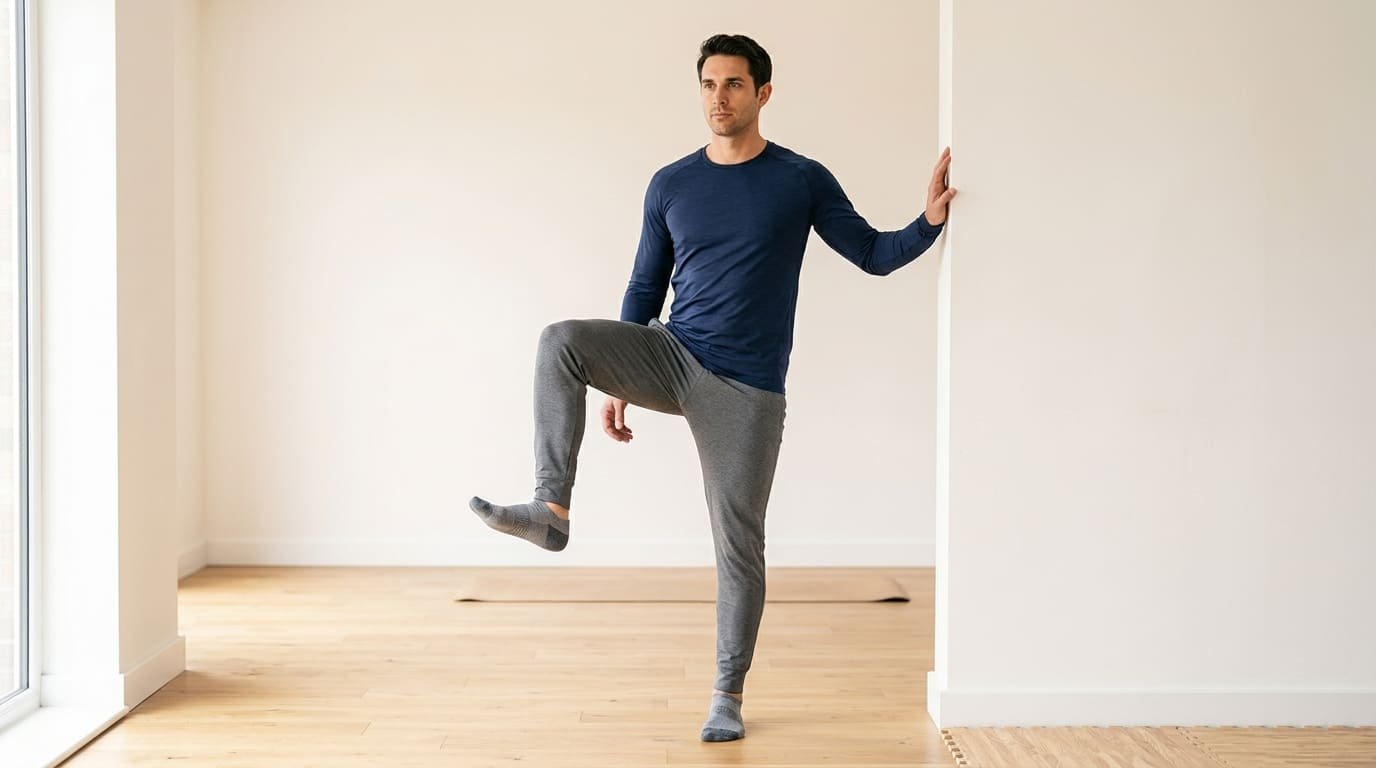
- Stand tall next to a wall or chair and hold it lightly with one hand
- Brace your stomach gently, as if preparing for a light poke
- Lift your outside knee up in front of you, as high as you can with control
- Keeping the knee bent, rotate it out to the side, opening the hip
- Bring the knee back behind you, turning the foot up toward the ceiling, as if stepping over a fence backward
- Lower the knee down and bring it back to the start
- Move slowly, taking about 10 to 15 seconds per circle
- Do 3 to 5 circles, then reverse the direction
The key is that only your hip moves. Your trunk, pelvis and standing leg should stay still. If your body leans or twists, make the circle smaller.
Hip CARs on hands and knees
This version is easier to control for many people.
- Start on hands and knees, hands under shoulders, knees under hips
- Brace your core so your back stays flat
- Lift one knee slightly off the floor and bring it forward toward your chest
- Lift it out to the side, like a dog at a lamppost
- Take it back behind you, then lower it to the start
- Do 3 to 5 slow circles each way per side
Lying hip CARs
For the gentlest version, lie on your back and draw slow circles with one bent knee, keeping your lower back gently pressed to the floor. This suits beginners and older adults.
| Version | Difficulty | Best for |
|---|---|---|
| Lying on your back | Easiest | Beginners, older adults, sore backs |
| Hands and knees | Moderate | Most people, good control |
| Standing with support | Moderate to hard | Balance and control, warm-ups |
| Standing without support | Hard | Experienced, very good balance |
Why hip mobility matters
| Daily activity | What your hips need |
|---|---|
| Walking and running | Extension behind the body |
| Squatting and sitting low | Deep flexion and some rotation |
| Getting in and out of a car | Flexion with rotation |
| Putting on socks and shoes | Flexion and external rotation |
| Turning and changing direction | Internal and external rotation |
When the hips are stiff, other joints often compensate, especially the lower back and knees. Keeping the hips moving through their full range is a simple way to make daily movement easier.
What the research says about hip mobility
There is little research on hip CARs specifically. But studies on hip mobility training in general are encouraging. A randomised trial in 24 young men with limited hip mobility compared stretching, stretching with motor control exercises, core endurance with motor control, and a control group. Both stretching groups improved hip range of motion significantly, with rotation improving by as much as 56 percent. Interestingly, the group doing core endurance and motor control work without stretching also improved, suggesting that controlled movement training plays a part.
Mobility gains also depend on regular practice. A large review of stretching found that range of motion improvements after a single session usually lasted less than 30 minutes, so consistent daily practice matters more than occasional long sessions.
The hip hike exercise
The hip hike exercise targets the gluteus medius, the muscle on the side of your hip that keeps your pelvis level when you stand on one leg. A weak gluteus medius is linked with hip, knee and lower back problems.
How to do a hip hike
- Stand side-on on a step, with one foot on the step and the other hanging off the edge
- Hold a wall or rail lightly for balance
- Keep both knees straight
- Let the hanging foot drop a few centimetres below the step by lowering that side of your pelvis
- Lift it back up by hitching that hip up, using the side of the hip on the standing leg
- Do 2 to 3 sets of 10 to 15 per side
A study of hip exercises found that weight-bearing exercises like the pelvic drop, which is essentially the hip hike, produced higher gluteus medius activation than most non-weight-bearing exercises, with side-lying hip abduction the exception.
If the step is too hard, do it standing on the floor, simply hitching one hip up and down. For more side-of-hip work, our guides to hip abductor exercises and monster walks are great next steps.
Snapping hip exercises: what to know
Snapping hip, sometimes called dancer’s hip, is a clicking or snapping feeling around the hip when you move. It is common and often harmless.
| Type | Where you feel it | Common cause |
|---|---|---|
| External snapping hip | Outside of the hip | A band of tissue (the IT band) sliding over the bony point of the hip |
| Internal snapping hip | Front of the hip or groin | A hip flexor tendon sliding over bone |
| Intra-articular | Deep in the joint, often with catching or locking | A problem inside the joint, such as a labral tear |
If your snapping is painless, it usually does not need treatment. If it is painful, gentle exercises often help, but painful snapping, catching, locking or pain deep in the groin should be assessed by a doctor or physiotherapist, because a problem inside the joint needs a different approach.
Snapping hip exercises to try (if painless or mildly uncomfortable)
| Exercise | Why it helps | Dose |
|---|---|---|
| Side-lying hip abduction | Strengthens the side of the hip | 2 x 12 per side |
| Hip hike | Strengthens the gluteus medius in standing | 2 x 12 per side |
| Glute bridge | Strengthens the glutes | 2 x 12 |
| Kneeling hip flexor stretch | Eases tight hip flexors | 30 seconds per side, 2 times |
| Lying hip CARs | Gentle, controlled movement | 3 slow circles each way per side |
| Clamshell | Activates the outer hip | 2 x 15 per side |
Move slowly and within a pain-free range. Snapping exercises should not cause sharp pain. Our hip bursitis exercises guide covers related outer hip problems and includes several of these exercises. Our glute bridges guide shows bridge variations.
A 10-minute daily hip mobility routine (printable)
Many people search for a hip mobility exercises PDF they can print and stick on the fridge. This routine is designed to be printed straight from this page, using your browser’s print option, or saved as a PDF.
| Order | Exercise | Dose |
|---|---|---|
| 1 | Lying hip CARs | 3 slow circles each way per side |
| 2 | Glute bridge | 10 slow reps |
| 3 | 90/90 hip switches (sit with both knees bent at 90 degrees and rotate side to side) | 8 switches |
| 4 | Hands and knees hip CARs | 3 circles each way per side |
| 5 | Kneeling hip flexor stretch | 30 seconds per side |
| 6 | Hip hike | 10 per side |
| 7 | Standing hip CARs with support | 3 circles each way per side |
| 8 | Deep squat hold, holding onto something | 30 seconds |
Do this once a day, or use the first four exercises as a warm-up before workouts.
A 4-week hip CARs exercise and mobility plan
| Week | Focus | What to do |
|---|---|---|
| 1 | Learn the movements | Lying hip CARs and glute bridges daily, routine 3 times |
| 2 | Build control | Add hands and knees CARs, routine 4 times |
| 3 | Add strength | Add hip hikes and clamshells, routine 5 times |
| 4 | Make it a habit | Full routine daily, or the warm-up version before workouts |
Pair mobility with strength
Mobility work is most effective when it is paired with strength. A hip that moves freely but lacks control is not much better than a stiff one. Combine CARs with:
- Glute bridges and hip thrusts
- Hip abductor exercises such as side-lying leg raises and band walks
- Squats and lunges through a comfortable range
- Core work. Our core exercises for back pain guide includes many hip-friendly moves
Our guides to thoracic mobility exercises and knee mobility exercises cover the joints above and below the hips.
Common mistakes
| Mistake | What happens | Fix |
|---|---|---|
| Moving too fast | Momentum replaces control | Take 10 to 15 seconds per circle |
| Twisting the trunk | The back moves instead of the hip | Brace gently, make circles smaller |
| Forcing the range | Pinching or discomfort in the hip | Stay within a comfortable range |
| Only doing it occasionally | Gains fade quickly | Short daily practice |
| Ignoring painful snapping | A joint problem may be missed | Get it assessed |
Safety tips
- Move slowly and stay within a pain-free range
- If you have had a hip replacement, ask your surgeon or physiotherapist which movements are safe, because some positions may need to be avoided
- Stop if you feel sharp pain, catching or locking in the hip
- Hold onto support for standing versions if your balance is not perfect
This article is general information, not medical advice. See our medical disclaimer.
When to do hip CARs
| Time | Version | Why |
|---|---|---|
| First thing in the morning | Lying hip CARs, 3 each way | Wakes up stiff hips gently |
| Before a workout | Hands and knees or standing, 3 to 5 each way | Prepares the hips for squats, lunges and running |
| During long periods of sitting | Standing with support, 3 each way | Breaks up stiffness |
| After a workout | Lying or hands and knees, 3 each way | Gentle cool-down |
| Rest days | Full routine | Keeps mobility ticking over |
Because the hip CARs exercise is so short, it fits almost anywhere. Many people attach it to an existing habit, such as after brushing their teeth or while the kettle boils.
Who can benefit from hip CARs?
- Desk workers whose hips stiffen from long periods of sitting
- Runners and walkers who want freer hip extension
- Lifters preparing for squats and deadlifts
- Older adults who want to keep everyday movements like putting on socks easier, using the lying version
- Anyone with one stiffer hip, because CARs show the difference clearly
What you might feel during hip CARs
| Feeling | What it usually means | What to do |
|---|---|---|
| Muscles working hard, especially at the back of the circle | Normal, you are working at the edge of your range | Keep going slowly |
| Gentle stretching or tightness | Normal stiffness | Stay within a comfortable range |
| A painless click | Often a tendon moving over bone | Usually fine, carry on gently |
| Pinching at the front of the hip | The range is too big or the hip is stiff | Make the circle smaller |
| Sharp pain, catching or locking | Possible joint problem | Stop and get it assessed |
Using hip CARs in your warm-up
Before lower body training, try this quick sequence: 3 standing hip CARs each way per side, 10 bodyweight squats, 10 glute bridges and 5 walking lunges per side. It takes about 3 minutes and gets your hips ready to move through a full range under load.
Making hip CARs harder
Once the standing version feels easy, make it harder by letting go of the support, slowing each circle to 20 seconds, or adding a gentle pause at the hardest point of the circle. Each change asks more of the muscles around the hip without adding any weight. The hip CARs exercise is never about speed: slower and more controlled is always better.
Hip CARs for desk workers
Long hours of sitting keep your hips bent for most of the day. Over time, many people notice stiffness at the front of the hip and in rotation. A simple habit helps: every hour or two, stand up, hold your desk and do 2 standing hip CARs each way on each side, then walk for a minute. It takes under three minutes and keeps your hips used to moving through their full range.
A simple hip mobility self-test
Lie on your back and draw one slow circle with each knee, as in the lying version of the hip CARs exercise. Notice where the circle feels smaller, stiffer or less smooth, and whether one side differs from the other. Write it down. Repeat the test every two weeks. Many people notice their circles becoming larger and smoother within a month of daily practice, which is a great motivator to keep going.
Hip CARs and other mobility work
| Joint | Matching exercise | Guide |
|---|---|---|
| Upper back | Open book rotation | Our thoracic mobility guide |
| Hips | Hip CARs, 90/90 switches | This guide |
| Knees | Heel slides | Our knee mobility guide |
| Ankles | Knee-to-wall drill | Our ankle mobility guides |
A short daily routine that moves each major joint takes less than ten minutes and keeps your whole body feeling more comfortable.
Breathing during the hip CARs exercise
Breathe slowly and steadily throughout each circle. Holding your breath tends to make your trunk stiff and your movement jerky. A good rhythm is to breathe in as the knee lifts and opens, and breathe out as it travels behind you and returns. Calm breathing helps your muscles relax, which often lets the circle grow a little larger without forcing it.
Hip CARs for older adults
For older adults, the lying version of the hip CARs exercise is a safe, gentle way to keep the hips moving for daily tasks such as getting in and out of a car, climbing stairs and putting on shoes. Start with 2 small circles each way, once a day, and build up slowly. If getting down to the floor is difficult, do the circles lying on a firm bed. Our leg exercises for seniors guide has more seated and standing options.
Little and often
Two minutes every day does far more for your hips than twenty minutes once a week. Keep it short, keep it regular, and let the habit do the work.
The bottom line
The hip CARs exercise is a simple, two-minute habit that almost anyone can learn, and it keeps your hips moving through their full range. Move slowly, keep the rest of your body still, and draw the biggest circle you can control. Start lying down or on hands and knees, and progress to standing as your control improves.
Pair hip CARs with strength work like the hip hike exercise, glute bridges and side-lying abduction, and follow the printable daily routine. If you have snapping that hurts, catches or locks, get it checked. Otherwise, a few minutes of hip mobility work each day can make sitting, standing, walking and training feel noticeably easier.
Frequently asked questions
What is the hip CARs exercise?
Hip CARs (controlled articular rotations) are slow, controlled circles of the hip through the largest range you can actively control, while keeping the rest of your body still.
How often should I do the hip CARs exercise?
Once or twice a day is ideal. Three to five slow circles in each direction, on each side, takes only a couple of minutes.
Are hip CARs good for stiff hips?
Yes. They gently move the hip through its full range and work the surrounding muscles. Regular practice, combined with strength work, often helps stiff hips feel freer.
How do you do a hip hike exercise?
Stand side-on on a step with one foot hanging off. Let that side of your pelvis drop a little, then lift it back up using the side of the hip on your standing leg. Keep both knees straight.
What exercises help snapping hip?
For painless or mildly uncomfortable snapping, hip strengthening like side-lying abduction, hip hikes, glute bridges and clamshells, plus gentle hip flexor stretches, often help. Painful snapping should be assessed by a professional.
Is there a hip mobility exercises PDF?
The daily routine table on this page is designed to be printed or saved as a PDF using your browser’s print option.
Can hip CARs help lower back pain?
Better hip mobility may reduce how much your lower back has to compensate during daily movement. They are not a treatment on their own, so combine them with core and strength work.
Should hip CARs hurt?
No. You may feel muscles working hard and some stiffness at the edges of your range, but they should not cause sharp pain. Make the circles smaller if they do.
Can I do hip CARs after a hip replacement?
Only with your surgeon’s or physiotherapist’s guidance, because some hip positions may need to be avoided after surgery.
What’s next?
Reading is the easy part. Pick one of these and do it today.