Injury Prevention Exercises: 12 Prehab Moves and a Simple Weekly Routine
Injury prevention exercises are the unglamorous part of training that most of us skip until something starts to hurt. I understand why. Nobody starts exercising because they want to do ankle balances and side planks. But when you look at the research, this is one of the areas where a small amount of effort pays off well.
The good news is that you do not need a complicated programme. A handful of simple strength and balance exercises, done two or three times a week, appear to lower the risk of many common sports and exercise injuries. The surprising part, for many people, is that stretching on its own does not seem to be the answer.
This guide explains what the research says about injury prevention exercises, the 12 best exercises for injury prevention for beginners, a simple 15-minute routine, how to fit prehab into your week, and the training habits that matter just as much as the exercises themselves.
At a glance
- Strength training has the strongest research support for reducing sports injuries
- Balance and proprioception training also appear to help, especially for ankles and knees
- Stretching on its own does not seem to reduce injury risk, although it can help with range of motion
- Structured warm-up programmes that combine strength, balance and movement work reduce injuries in team sports
- Focus on the calves, hamstrings, glutes, hips, core and upper back
- 15 to 20 minutes, 2 or 3 times a week, is enough for most people
- Sensible training load, sleep and recovery matter just as much as prehab exercises
What the research says about injury prevention exercises
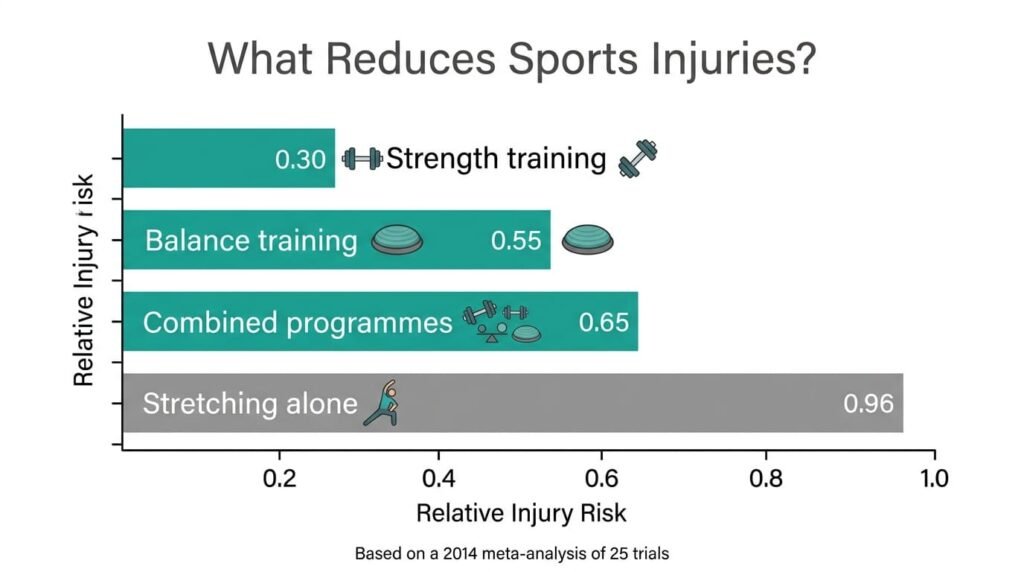
A widely cited meta-analysis pooled 25 randomised trials with more than 26,000 participants. Strength training had the largest effect, reducing sports injuries to less than a third. Proprioception and balance training and programmes combining several types of exercise also reduced injuries. Stretching, on the other hand, showed no clear benefit for injury prevention. Overuse injuries could be almost halved by exercise programmes.
Structured warm-up programmes are another strong piece of evidence. A meta-analysis of the FIFA 11+ programme, a 20-minute warm-up of running, strength, balance and jumping exercises, found it reduced football injuries by 39 percent across 4 trials.
And a large review of stretching found that static and PNF stretching had no clear effect on all-cause or overuse injuries, although stretching within a warm-up that also includes dynamic activity was still recommended for range of motion and possibly muscle injuries.
Most of this research is in athletes and team sports, not in people doing gentle home workouts. But the message is consistent: get stronger, train your balance, warm up properly, and do not rely on stretching alone.
| Type of exercise | Effect on injury risk in research | What it means for you |
|---|---|---|
| Strength training | Largest reduction | The core of any prehab routine |
| Balance and proprioception | Clear reduction | Especially useful for ankles and knees |
| Combined programmes | Clear reduction | Warm-ups that mix strength, balance and movement |
| Stretching alone | No clear reduction | Still useful for range of motion, not as your only prevention |
What are prehab exercises?
Prehab exercises are exercises done before an injury happens, to make the body more resilient. The name is a play on rehab. They usually focus on:
- Strength in muscles that take a lot of load, such as the calves, hamstrings and glutes
- Balance and control, so your joints land and move in a steady, controlled way
- Mobility in areas that often get stiff, such as the ankles, hips and upper back
- Endurance in small stabilising muscles, such as the rotator cuff and deep core
You may also hear the term corrective exercises. It usually means exercises chosen to address a specific weakness or movement problem, often by a physiotherapist or coach. The exercises below overlap a lot with both ideas, but they are general, not tailored to you.
12 of the best exercises for injury prevention
Each exercise has a target area, simple steps and a starting dose. Do them slowly and with control. Quality matters more than quantity.
1. Calf raises (calves and Achilles)
Stand on a step or flat floor, holding something for balance. Rise onto the balls of your feet, pause, then lower slowly over 3 seconds. Do 2 or 3 sets of 12 to 15. Progress to single leg calf raises when this feels easy.
Strong calves help absorb the impact of walking, running and jumping. Our guide to calf stretches pairs well with this exercise.
2. Single leg balance (ankles and knees)
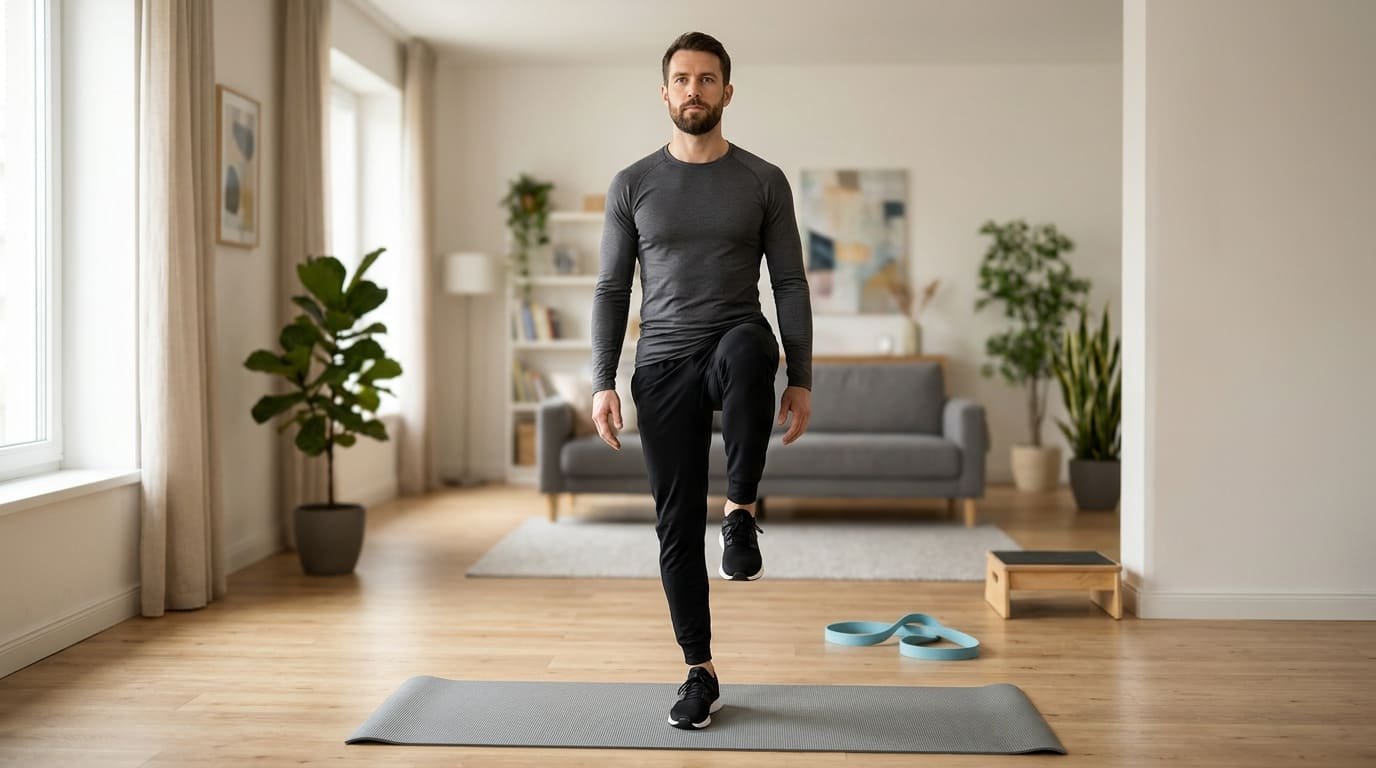
Stand on one leg near a wall, with your knee slightly bent. Hold for 30 seconds. Progress by closing your eyes, standing on a cushion, or reaching your free leg in different directions. Do 2 or 3 holds per leg.
This is one of the simplest proprioception exercises, and balance training appears in many successful injury prevention programmes. If you want more challenge, see our balance board exercises.
3. Glute bridges (hips and lower back)
Lie on your back with your knees bent and feet flat. Squeeze your glutes and lift your hips until your body forms a straight line from shoulders to knees. Pause, then lower. Do 2 or 3 sets of 12 to 15. Progress to single leg bridges.
4. Side plank (hips and core)
Lie on your side, propped on your forearm, knees bent. Lift your hips so your body is straight from knees to head. Hold for 15 to 30 seconds per side. Progress to straight legs.
5. Hamstring bridge walkouts or Nordic lowers (hamstrings)
For beginners: get into a glute bridge, then slowly walk your heels away from you a few steps and back again, keeping your hips up. Do 2 sets of 6 to 8.
For advanced exercisers: Nordic hamstring lowers, where you kneel with your ankles held and lower your body forward slowly, are a well-known hamstring injury prevention exercise in football. They are very hard, so build up carefully and only do a few reps at first.
6. Bodyweight squat with control (knees and hips)
Stand with feet shoulder-width apart. Push your hips back and bend your knees, keeping your knees in line with your toes. Lower to a comfortable depth, then stand up. Do 2 or 3 sets of 10 to 12. Focus on knees tracking over toes, not caving in.
7. Split squat (knees and hips)
Step one foot back into a staggered stance. Lower your back knee toward the floor, keeping your front knee over your ankle and in line with your toes. Push back up. Do 2 sets of 8 to 10 per leg. Our single leg squat progression takes this further.
8. Banded side steps or side lying leg raises (outer hips)
With a light band around your knees or ankles, take small steps sideways, keeping tension on the band and your toes pointing forward. Do 10 to 15 steps each way. Without a band, do side lying leg raises. Our guide to hip abductor exercises has more options.
These outer hip muscles help keep your knees from collapsing inward when you land, squat or run.
9. Dead bug (deep core)
Lie on your back with your arms pointing to the ceiling and your knees bent at 90 degrees above your hips. Slowly lower one arm behind you and the opposite leg toward the floor, keeping your lower back gently pressed down. Return and switch sides. Do 2 sets of 6 to 8 per side.
10. Bird dog (back and core)
On hands and knees, reach one arm forward and the opposite leg back until both are level with your body. Hold for 2 seconds, return, and switch sides. Do 2 sets of 8 per side. This trains your back and core to stay steady while your limbs move.
11. Band pull-aparts or prone Y raises (upper back and shoulders)
Hold a light band in front of you at shoulder height, arms straight. Pull the band apart by squeezing your shoulder blades together, then return slowly. Do 2 sets of 12 to 15. Without a band, lie face down and lift your arms into a Y shape, thumbs up. These help balance all the pushing and sitting most of us do.
12. Tibialis raises and ankle mobility (shins and ankles)
Lean your back against a wall with your heels about 30 cm from it. Lift your toes toward your shins, then lower. Do 2 sets of 15 to 20. Follow with a knee-to-wall ankle mobility drill, 10 reps per side. Our guide to tibialis anterior exercises explains why this matters for walkers and runners.
| Exercise | Main target | Type |
|---|---|---|
| Calf raises | Calves, Achilles | Strength |
| Single leg balance | Ankles, knees | Balance |
| Glute bridges | Glutes, hips, lower back | Strength |
| Side plank | Hips, core | Strength, endurance |
| Hamstring walkouts or Nordics | Hamstrings | Strength |
| Bodyweight squat | Knees, hips | Strength, control |
| Split squat | Knees, hips | Strength, control |
| Banded side steps | Outer hips | Strength |
| Dead bug | Deep core | Control |
| Bird dog | Back, core | Control |
| Band pull-aparts | Upper back, shoulders | Strength |
| Tibialis raises and ankle mobility | Shins, ankles | Strength, mobility |
A 15-minute injury prevention exercises routine
Do this 2 or 3 times a week, on its own or as part of your warm-up. Rest about 30 seconds between exercises.
| Order | Exercise | Dose |
|---|---|---|
| 1 | Single leg balance | 2 x 30 seconds per leg |
| 2 | Calf raises | 2 x 15 |
| 3 | Glute bridges | 2 x 12 |
| 4 | Banded side steps or side lying leg raises | 2 x 12 per side |
| 5 | Split squat | 2 x 8 per leg |
| 6 | Side plank | 2 x 20 seconds per side |
| 7 | Dead bug | 2 x 6 per side |
| 8 | Band pull-aparts or prone Y raises | 2 x 12 |
Rotate in the other exercises every couple of weeks to keep things fresh. Many people also include a short version of this as part of their warm-up before a workout.
Injury prevention exercises by activity
| Your activity | Common problem areas | Prioritise |
|---|---|---|
| Running and jogging | Calves, Achilles, shins, knees | Calf raises, tibialis raises, single leg balance, split squats, side steps |
| Walking and hiking | Ankles, knees, hips | Single leg balance, calf raises, glute bridges |
| Jump rope and jumping | Calves, Achilles, shins, feet | Calf raises, tibialis raises, balance, gradual load |
| Lifting weights | Lower back, shoulders, knees | Dead bug, bird dog, band pull-aparts, controlled squats |
| Football and team sports | Hamstrings, ankles, knees, groin | Nordic lowers, balance, side steps, a structured warm-up |
| Racket sports and swimming | Shoulders, elbows | Band pull-aparts, rotator cuff work, arm circles |
| Desk job plus home workouts | Neck, upper back, hips | Band pull-aparts, bird dog, glute bridges, mobility breaks |
If you run, our guides to warming up before running and core exercises for runners go into more detail.
Training habits matter as much as injury prevention exercises
Exercises are only half of injury prevention. Many injuries come from how we train, not what we lack.
| Habit | Why it matters |
|---|---|
| Increase training gradually | Sudden jumps in distance, weight or frequency are a common cause of overuse injuries |
| Warm up before every session | Dynamic warm-ups prepare muscles and joints for work |
| Mix hard and easy days | Muscles, tendons and bones need recovery time |
| Sleep well | Recovery and repair mostly happen while you sleep |
| Use good technique | Poor form under heavy load or fatigue increases strain |
| Listen to early warning signs | A niggle ignored for weeks often becomes an injury |
| Wear suitable shoes | Worn-out or unsuitable footwear can add strain |
| Take rest days | See our guide to rest day activities |
A simple rule many coaches use is to avoid increasing your weekly training load by more than about 10 percent at a time. It is a rough guide rather than a scientific law, but it is a sensible reminder to build up gradually.
Should you still stretch?
Yes, but for the right reasons. Stretching can improve range of motion and may feel good, and some activities need good flexibility. It just does not appear to prevent injuries on its own. A sensible approach is a dynamic warm-up before exercise, strength and balance work two or three times a week, and stretching afterwards or on separate days if you enjoy it or need more flexibility.
When to stop and get help
Prehab is not a substitute for proper care. See a doctor or physiotherapist if you have:
- Pain that lasts more than a week or two, or keeps coming back
- Swelling, bruising or a joint that gives way
- Pain that wakes you at night
- Numbness, tingling or weakness
- Pain after a fall or a sudden twist
If you already have knee pain, our guide to exercises for knee pain has gentler starting points.
This article is general information, not medical advice. See our medical disclaimer.
Common mistakes
| Mistake | Why it is a problem | Fix |
|---|---|---|
| Only stretching | Stretching alone has little effect on injury risk | Add strength and balance work |
| Doing prehab once and forgetting it | Benefits fade without regular practice | 2 or 3 short sessions a week |
| Rushing the reps | Less control, less benefit | Slow, controlled movements |
| Too much too soon | Prehab can cause soreness too | Start with 1 or 2 sets |
| Ignoring training load | Exercises cannot fix big jumps in training | Build up gradually |
| Copying an athlete’s routine | Too hard or not relevant | Choose exercises for your activity |
A 6-week prehab plan
| Weeks | What to do | Progression |
|---|---|---|
| 1 and 2 | 15-minute routine twice a week | Learn the movements, 1 or 2 sets |
| 3 and 4 | Routine 3 times a week | 2 sets, add single leg calf raises and longer side planks |
| 5 and 6 | Routine 3 times a week | Harder versions: eyes closed balance, single leg bridges, heavier band |
Injury prevention exercises at home with no equipment
You do not need a gym. Every exercise in this guide can be done at home with a step, a wall and a little floor space. A light resistance band is the only equipment worth buying, and it costs very little. If you do not have a band, swap band pull-aparts for prone Y raises and banded side steps for side lying leg raises. Many people find it easiest to keep a band and a mat next to the sofa and do a few injury prevention exercises during the evening.
Injury prevention for older adults
For older adults, the biggest injury risk is often a fall rather than a sports injury. The same principles apply: strength and balance work make a real difference. Calf raises holding a chair, sit-to-stands, single leg balance near a wall and gentle side steps are a great starting set. Our guide to leg exercises for seniors has a full routine with seated and standing options.
How to know your prehab is working
| Sign | What it suggests |
|---|---|
| Single leg balance lasts longer and feels steadier | Better ankle and hip control |
| Calf raises feel easier for more reps | Stronger calves and Achilles |
| Fewer niggles after runs or workouts | Your body is coping with the load better |
| Squats and lunges feel more stable | Better hip and knee control |
| You can train consistently for months | The best sign of all |
Where beginners should start
If you are new to exercise, start with just 4 of these injury prevention exercises: single leg balance, calf raises, glute bridges and bird dog. Do them twice a week for 2 weeks, then add one new exercise every week. Building the habit matters more than doing everything at once, and small, regular sessions are exactly how injury prevention exercises deliver results.
The bottom line
The best exercises for injury prevention are mostly simple strength and balance exercises: calf raises, single leg balance, glute bridges, side planks, squats, split squats, hip work, core control and upper back strength. Research suggests strength training has the biggest effect, balance training helps too, and stretching alone does not reduce injury risk.
Do 15 minutes of prehab exercises 2 or 3 times a week, warm up properly, build your training gradually and give your body time to recover. None of this guarantees you will never get hurt, but it stacks the odds in your favour, and you will feel stronger and steadier in everyday life too.
Frequently asked questions
What are the best exercises for injury prevention?
Strength and balance exercises have the best evidence. Good choices include calf raises, single leg balance, glute bridges, side planks, squats, split squats, hip abductor work, dead bugs and band pull-aparts.
Does stretching prevent injuries?
Research suggests that stretching on its own does not clearly reduce injury risk. It can improve range of motion. Strength and balance training appear to be more effective for prevention.
What are prehab exercises?
Prehab exercises are done before an injury happens, to make the body stronger and more resilient. They usually focus on strength, balance, mobility and control in commonly injured areas.
How often should I do injury prevention exercises each week?
Two or three times a week, for about 15 to 20 minutes, is enough for most people. Short, regular sessions work better than occasional long ones.
What are corrective exercises?
Corrective exercises are chosen to address a specific weakness, imbalance or movement problem. They are usually prescribed by a physiotherapist or coach after an assessment.
Can strength training prevent injuries?
In research, strength training had the largest effect of any exercise type, reducing sports injuries to less than a third in one meta-analysis of randomised trials.
What exercises prevent knee injuries?
Strength and control exercises for the hips and legs, such as squats, split squats, banded side steps and single leg balance, are commonly used to reduce knee injury risk.
Should I do prehab exercises before or after a workout?
Either works. Many people include a short version in their warm-up, or do a full routine on lighter days. Avoid very tiring prehab right before a session that needs a lot of strength or skill.
Can injury prevention exercises help runners?
Yes. Runners often benefit from calf raises, tibialis raises, single leg balance, glute work and side planks, along with increasing their weekly running gradually.
What’s next?
Reading is the easy part. Pick one of these and do it today.