Kettlebell Back Exercises: 10 Moves and 3 Workouts for a Stronger Back
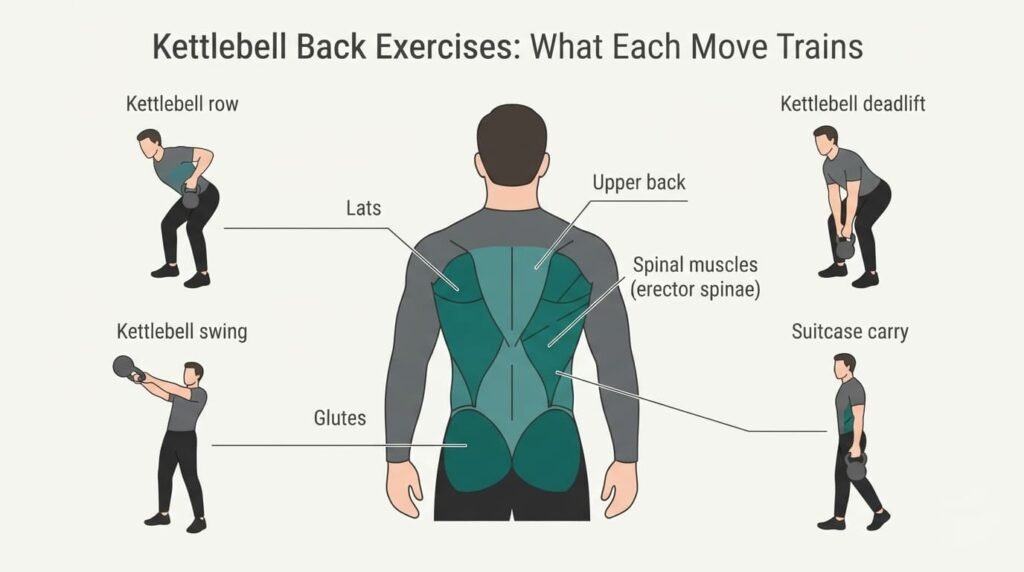
Kettlebell back exercises are one of the best ways to build a strong back at home with a single piece of equipment. One kettlebell lets you row, hinge, swing and carry, which covers the upper back, the lats, the muscles along the spine and the glutes that work with them.
I like kettlebells for back training because the handle and the offset weight make you work harder to stay steady. A row with a kettlebell feels a little different from a dumbbell row, and a carry with one bell in one hand quietly trains the muscles that keep your spine upright.
This guide explains which muscles kettlebell back exercises train, how to choose a weight, and 10 exercises with clear form cues. You will also find three ready-made back workouts, a 6-week plan and the mistakes that most often cause sore backs instead of strong ones.
At a glance
- Kettlebell back exercises train the lats, upper back, rear shoulders and the muscles along the spine
- The best moves for beginners are the kettlebell row, the kettlebell deadlift and the suitcase carry
- Learn the hip hinge before you swing. It protects your lower back
- Most beginner men start rows with 12 to 16 kg, and beginners with less lifting experience start with 6 to 10 kg
- A small trial found 8 weeks of kettlebell training reduced neck, shoulder and lower back pain and increased back strength in adults with work-related aches
- Train your back with kettlebells two or three times a week
- Stop any exercise that causes sharp back pain, numbness or tingling
Muscles kettlebell back exercises work
| Muscle | Where it is | Best kettlebell back exercise for it |
|---|---|---|
| Latissimus dorsi (lats) | Large muscles on the sides of the back | Kettlebell row, gorilla row |
| Rhomboids and middle traps | Between the shoulder blades | Row with a squeeze, high pull |
| Rear deltoids | Back of the shoulders | Kettlebell reverse fly |
| Erector spinae | Along both sides of the spine | Deadlift, swing, good morning |
| Glutes and hamstrings | Hips and back of the thighs | Swing, deadlift, Romanian deadlift |
| Quadratus lumborum and obliques | Sides of the lower back and waist | Suitcase carry, suitcase deadlift |
A strong back is not just about pulling. The muscles along your spine have to hold it steady while your hips and arms do the work. That is why hinging and carrying moves are as important as rows. Our guide to erector spinae exercises explains those spinal muscles in more detail.
Choosing the right kettlebell weight
| Your experience | Rows and carries | Deadlifts and swings |
|---|---|---|
| Complete beginner | 6 to 10 kg | 8 to 12 kg |
| Some strength training | 10 to 16 kg | 12 to 16 kg |
| Regular lifter | 16 to 24 kg | 16 to 24 kg or more |
If you only own one kettlebell, choose one you can row for 10 good reps. It will feel light for deadlifts at first, but you can slow the lowering phase or use single-leg versions to make it harder. Our guide to the kettlebell workout for beginners has more advice on buying your first bell.
Learn the hip hinge first
Almost every kettlebell back exercise uses the hip hinge: bending forward by pushing the hips back while keeping the back long and flat. Get this right and your back trains safely. Get it wrong and your lower back takes over.
- Stand with feet hip-width apart, a light kettlebell between your feet
- Soften your knees slightly
- Push your hips back as if closing a car door with your buttocks
- Let your chest come forward while keeping a long, flat back
- Stop when you feel a stretch in the backs of your thighs
- Squeeze your glutes to stand up
Practise it with a broomstick along your back. The stick should touch your head, upper back and tailbone the whole time. Our guide to the good morning exercise teaches the same pattern.
10 kettlebell back exercises
1. Kettlebell deadlift
- Stand with the kettlebell between your feet
- Hinge at the hips and bend your knees slightly to grip the handle with both hands
- Brace your stomach, squeeze your shoulder blades down and stand up by driving your hips forward
- Lower with the same hinge
Dose: 3 sets of 10 to 12. The foundation of kettlebell back training, and the best place to start.
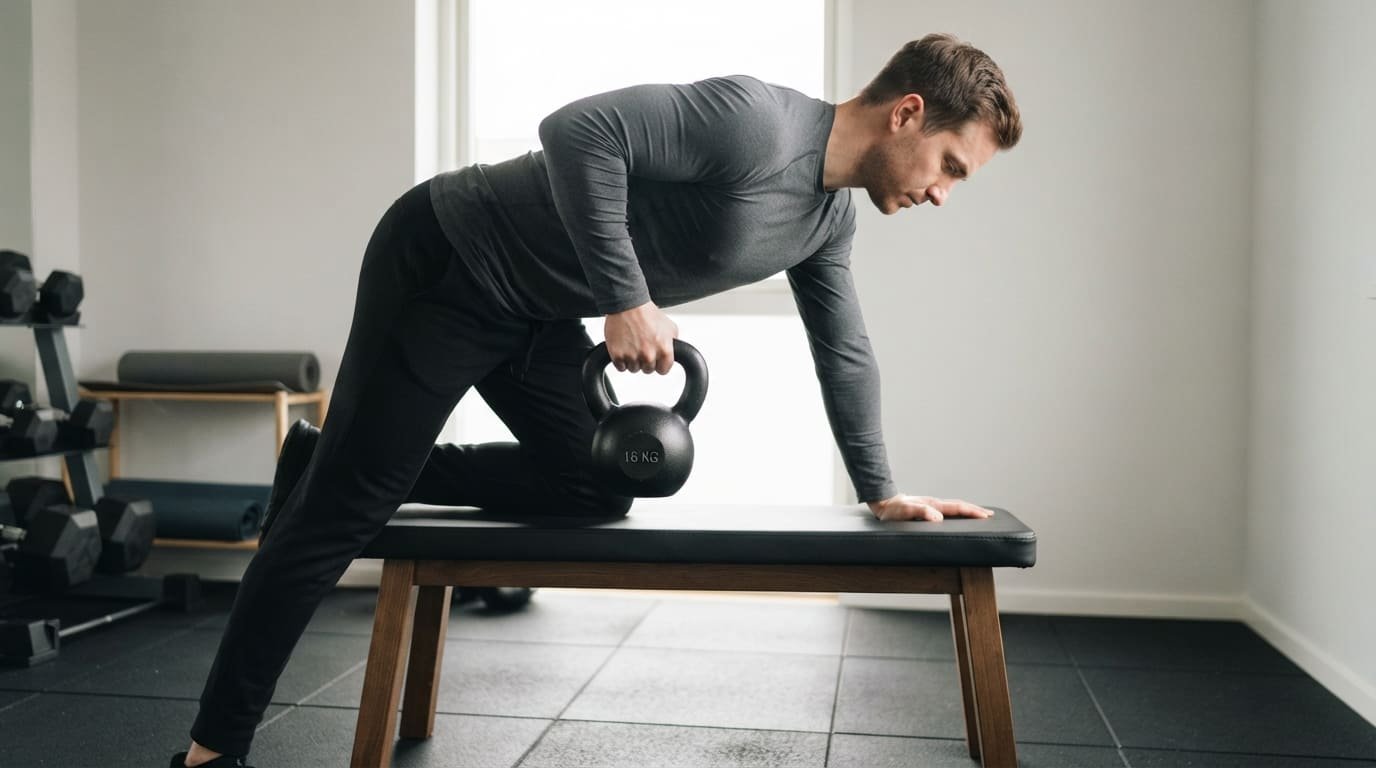
2. Kettlebell row (single-arm)
The kettlebell row is the main pulling move in this list.
- Place one hand and one knee on a bench or sturdy chair, or stand in a split stance with one hand on your front thigh
- Hold the kettlebell in the other hand with your arm straight
- Pull the kettlebell toward your hip, keeping your elbow close to your body
- Squeeze your shoulder blade toward your spine at the top, then lower slowly
Dose: 3 sets of 8 to 12 per side. Think of pulling your elbow to your back pocket, not lifting the bell with your hand.
3. Two-hand bent-over row
Hold one kettlebell by the horns (the sides of the handle) with both hands. Hinge forward to about 45 degrees and pull the bell to your lower chest. A good option if you own one bell and want a symmetrical row. 3 sets of 10 to 12.
4. Gorilla row
Place two kettlebells on the floor between your feet in a wide, deep hinge position. Hold one handle in each hand. Row one bell up while pressing the other into the floor, then switch. This trains the lats and the core together. 3 sets of 6 to 8 per side.
5. Kettlebell swing
The swing is a powerful hip hinge that trains the glutes, hamstrings and back extensors. One study measured muscle activity of about 50 percent of maximum in the lower back extensors and about 80 percent in the glutes with a 16 kg kettlebell, with rapid on-off bursts of effort.
The same study noted that many people credit swings with helping their back, while a few find they irritate it. Learn the hinge and the deadlift first. Our step-by-step guide to the kettlebell swing walks you through it.
Dose: 5 sets of 10 to 15, resting as needed.
6. Single-leg Romanian deadlift
Hold the kettlebell in one hand. Hinge forward on the opposite leg, letting the free leg reach back behind you, until your body is close to parallel with the floor. Stand back up. This trains the back, hamstrings and balance. 3 sets of 6 to 8 per side. Hold a wall with your free hand at first.
7. Suitcase carry
Hold a heavy kettlebell in one hand at your side. Stand tall and walk 20 to 30 metres without leaning toward the bell. Switch hands. The muscles on the opposite side of your trunk work hard to keep you upright. 3 rounds per side.
8. Suitcase deadlift
Stand beside the kettlebell instead of over it. Hinge down and pick it up with one hand, keeping your shoulders level. It trains the back and the side of the trunk at once. 3 sets of 8 per side.
9. Kettlebell high pull
From a deadlift position, drive your hips forward and pull the kettlebell up to chest height, elbow high and out to the side. Lower with control. It trains the upper back and rear shoulders with some power. 3 sets of 8 per side. Use a light bell and smooth technique.
10. Kettlebell reverse fly
Hold a light kettlebell in each hand, or one bell by the handle with both hands if you only have one. Hinge forward, then lift your arms out to the sides in a wide arc, squeezing your shoulder blades together. Use a light weight, 4 to 8 kg. 3 sets of 10 to 15.
What the research says about kettlebell back training
The most relevant trial for back health studied 40 adults whose jobs came with a high rate of neck, shoulder and back pain. One group did full-body kettlebell training three times a week for 8 weeks. Compared with the control group, they had less pain in the neck and shoulders and in the lower back, and their back extensor strength improved. Aerobic fitness did not change.
That is encouraging, but it is one trial. A scoping review of kettlebell research found that most studies are small and of low quality, and concluded that confidence in the reported effects is low.
My takeaway: kettlebell back exercises are a practical, enjoyable way to strengthen your back, and early evidence is positive. They are not a medical treatment, so if you have ongoing back pain, get it checked and build up gradually.
3 kettlebell back workouts
Workout A: beginner back (20 minutes)
| Exercise | Sets and reps | Rest |
|---|---|---|
| Kettlebell deadlift | 3 x 10 | 60 seconds |
| Single-arm kettlebell row | 3 x 10 per side | 60 seconds |
| Suitcase carry | 3 x 20 metres per side | 45 seconds |
| Kettlebell reverse fly | 2 x 12 | 45 seconds |
Workout B: strength and power (25 minutes)
| Exercise | Sets and reps | Rest |
|---|---|---|
| Kettlebell swing | 5 x 12 | 45 seconds |
| Gorilla row | 3 x 8 per side | 60 seconds |
| Single-leg Romanian deadlift | 3 x 8 per side | 60 seconds |
| Suitcase deadlift | 3 x 8 per side | 45 seconds |
Workout C: 15-minute back circuit
Do each exercise for 40 seconds, rest 20 seconds, and complete 3 rounds:
- Kettlebell deadlift
- Single-arm row, right
- Single-arm row, left
- Kettlebell swing
- Suitcase carry, switching hands halfway
A 6-week plan for kettlebell back exercises
| Week | Workouts | Focus |
|---|---|---|
| 1 | Workout A twice | Learn the hinge, deadlift and row |
| 2 | Workout A twice, add a 5th set of deadlifts | Build confidence with the weight |
| 3 | Workout A plus Workout C | Add swings once deadlifts feel solid |
| 4 | Workout B plus Workout C | Introduce gorilla rows and single-leg work |
| 5 | Workout B twice | Add 1 to 2 reps per set |
| 6 | Workout B plus Workout C, heavier bell for rows if available | Progress the load |
Train on non-consecutive days and include at least one rest day between back sessions. You can log your weights with our strength calculator or the next-step resistance calculator, which suggests your next weight.
Kettlebell exercises for the lower back
Many people search for kettlebell lower back exercises because their back feels weak or stiff. The deadlift, the swing and the suitcase carry all train the muscles that support the lower back. Start gently:
- Begin with deadlifts from a raised surface, such as a step, so you do not have to bend as far
- Use a light bell and slow, controlled reps
- Keep your stomach braced and your back long
- Add swings only when deadlifts feel easy and pain-free
- Pair them with core work such as the McGill Big 3 and our abdominal bracing exercises
This article is general information, not medical advice. If you have back pain that spreads down a leg, numbness, weakness, or pain that is severe or getting worse, see a doctor or physiotherapist before kettlebell training. See our medical disclaimer.
Setting up kettlebell back workouts at home
You do not need much space, but a safe setup makes kettlebell back exercises far more comfortable.
- Space. Clear an area about 2 metres by 2 metres, with nothing breakable in front of or behind you for swings
- Floor. A firm floor or a thin rubber mat is best. Avoid soft rugs that slide
- Bench or chair. A sturdy chair or the edge of a sofa works for single-arm rows
- Grip. Dry hands help. A towel nearby is useful in warm rooms
- Footwear. Flat shoes or bare feet give a stable base for deadlifts and swings
Kettlebell back exercises for posture and desk workers
Long hours at a desk tend to round the upper back and leave the muscles between the shoulder blades underused. Kettlebell back exercises can help balance that out by strengthening the muscles that pull the shoulders back and keep the spine upright.
A simple desk-worker plan is to do two sessions a week with rows, deadlifts and carries, plus a few minutes of mobility on other days. If you are short on time, even one set of rows and one suitcase carry per side on a lunch break is better than nothing. Our guide to posture exercises and the lower trap exercises guide add the smaller muscles that rows do not fully cover.
How to fit kb back exercises into your week
| Your routine | Where kettlebell back work fits |
|---|---|
| Two full-body workouts a week | One row, one hinge and one carry in each session |
| Upper and lower body split | Rows and reverse flys on upper days, deadlifts and swings on lower days |
| Three short home sessions | Rotate Workouts A, B and C |
| Running or walking most days | Two short back sessions on easier days |
| Busy weeks | The 15-minute circuit twice |
Kb back exercises also pair well with pushing moves such as push-ups and presses, which keeps the front and back of the upper body balanced.
Common mistakes
| Mistake | What happens | Fix |
|---|---|---|
| Rounding the back on deadlifts | Strain on the lower back | Hinge from the hips and keep the back long |
| Squatting the swing | The hips do not drive the bell | Push the hips back, not down |
| Pulling the row with the hand | Biceps do the work, not the back | Drive the elbow toward your hip |
| Shrugging during rows | Upper traps take over | Keep shoulders down, away from the ears |
| Leaning in suitcase carries | The trunk muscles switch off | Stand tall and level |
| Going too heavy too soon | Form breaks down | Master 10 clean reps before adding weight |
Kettlebells vs dumbbells for back training
| Point | Kettlebell | Dumbbell |
|---|---|---|
| Rows | Slightly different feel because the weight hangs below the handle | Classic and easy to load |
| Swings and power moves | Ideal | Possible but awkward |
| Carries | Excellent, comfortable to hold | Good |
| Weight jumps | Usually 4 kg steps | Smaller steps available |
| Space | One bell covers many exercises | Often need several pairs |
Both work well. Kettlebells shine for swings, carries and full-body back work, while dumbbells make small weight increases easier. Our back workout with dumbbells at home is a good alternative if you own dumbbells.
The bottom line
Kettlebell back exercises train the whole back chain: the lats and upper back with rows, the spinal muscles and glutes with deadlifts and swings, and the deep trunk muscles with carries. Learn the hip hinge first, start with deadlifts, rows and suitcase carries, and add swings and gorilla rows as your form improves.
Train two or three times a week, add weight or reps gradually, and stop if anything causes sharp pain. Six weeks of steady practice is enough to feel a stronger, steadier back in everyday life.
If you are unsure where to begin, keep it simple for the first two weeks: deadlifts, single-arm rows and suitcase carries, three sets each, twice a week. That small routine teaches the hinge, the pull and the brace that every other kettlebell back exercise depends on, and it takes less than twenty minutes including a warm-up.
Frequently asked questions
What are the best kettlebell back exercises for beginners?
The kettlebell deadlift, single-arm kettlebell row and suitcase carry are the best starting points. They teach the hip hinge, train the lats and upper back, and build the trunk strength you need before swings.
Can you build a strong back with just kettlebells?
Yes. Rows, deadlifts, swings and carries cover every major back muscle. As you get stronger you will need a heavier bell, or harder variations such as gorilla rows and single-leg deadlifts.
How heavy should my kettlebell be for back exercises?
Choose a bell you can row for 10 good reps. For most beginners that is 6 to 12 kg, while people with strength training experience often start at 12 to 16 kg.
Are kettlebell swings good for your back?
Many people find swings strengthen their back, and they work the back extensors and glutes hard. A few find swings irritate their back. Learn the hip hinge and kettlebell deadlift first, and stop if swings cause pain.
How often should I do kettlebell back exercises?
Two or three times a week, with at least one rest day between sessions. Mix rows, hinges and carries in each workout.
What is a kettlebell row good for?
The kettlebell row trains the lats, rhomboids and middle traps, the muscles that pull your arms back and hold your shoulders in a good position. It also trains grip and core stability.
Can kettlebell exercises help lower back pain?
One small trial found kettlebell training reduced lower back pain in adults whose jobs often cause aches. Evidence is still limited, so build up slowly and see a professional if your back pain is severe, spreading or not improving.
Are kb back exercises better than dumbbell exercises?
Not better, just different. Kettlebells are excellent for swings and carries, while dumbbells make small weight increases easier. Both build a strong back when used consistently.
Can I do kettlebell back exercises every day?
It is better not to train your back hard every day. Two or three sessions a week with rest days in between give the muscles time to recover and grow stronger. Light carries or mobility work on other days are fine.
Do I need two kettlebells for a back workout?
No. One kettlebell is enough for deadlifts, single-arm rows, swings, suitcase carries, high pulls and single-leg deadlifts. A second bell lets you do gorilla rows and double carries, which is a nice upgrade later.
What should I do if kettlebell back exercises hurt my lower back?
Stop the exercise that causes pain, lighten the weight and check your hip hinge. Deadlifts from a raised surface and suitcase carries are usually gentler starting points. If the pain is sharp, spreads down a leg or keeps coming back, see a physiotherapist before continuing.
How long until a kettlebell back workout makes a difference?
Most beginners feel steadier and stronger within 3 to 4 weeks of training twice a week. Visible changes in the back and noticeably heavier rows usually take 6 to 8 weeks.
What’s next?
Reading is the easy part. Pick one of these and do it today.