
The Run Walk Method: How the Galloway Method Works and How to Use It for Any Distance
The run walk method is exactly what it sounds like: you alternate short periods of running with short periods of walking, on purpose, from the start of your run. It is not giving up, and it is not cheating. It is a strategy, and it is the reason I got through my first months of running without quitting.
When I first started, I treated walking as failure. I ran until I could not run any more, stopped, felt defeated, and walked home. A running club coach told me to try something that sounded ridiculous: run for one minute, walk for one minute, from the very first step, and repeat. “Walk before you need to,” she said, “not after.” That evening I covered more ground than ever before, finished feeling good, and actually wanted to go again two days later.
This guide explains how the run walk method works, where the Galloway method came from, how to choose your ratio, how to use it for anything from your first 5K to a marathon, what the research says, and how to move toward continuous running if you want to.
At a glance
- The run walk method alternates set periods of running and walking from the start of a run
- It was popularised by former US Olympic runner Jeff Galloway, which is why it is often called the Galloway method
- Planned walk breaks reduce fatigue, let you cover more distance and can lower injury risk for beginners
- Beginners often start with 1 minute running and 1 to 2 minutes walking
- In one marathon study, run-walkers finished in similar times to runners and reported less muscle discomfort
- Walk briskly, not slowly, and take your walk breaks before you feel tired
- You can use it forever, or as a bridge to continuous running
What is the run walk method?
Instead of running continuously until you have to stop, you run for a set time or distance and then walk for a set time, and repeat. The key word is planned. The walk breaks happen on a schedule, from the beginning, while you still feel fresh.
| Approach | What happens | Typical result for beginners |
|---|---|---|
| Run until you cannot | Run hard, stop exhausted, walk home | Short distance, high discomfort, low motivation |
| Run walk method | Run and walk in planned intervals from the start | More total distance, less fatigue, more enjoyment |
The Galloway method
The best-known version is the Galloway method, named after Jeff Galloway, a former US Olympic runner who began coaching recreational runners and promoting planned walk breaks in the 1970s. His idea was that regular walk breaks let the running muscles recover before they tire, so you can keep going longer and recover faster afterwards. Galloway method running has since been used by huge numbers of first-time marathoners and returning runners.
You do not need to follow any particular brand of the method. The principle is simple, and you can set the ratio that suits you.
Why the run walk method works
- It delays fatigue. Short walk breaks give your running muscles regular rest, so they tire more slowly
- It lowers the impact. Walking puts less force through your legs than running, which matters for beginners whose bones and tendons are still adapting
- It keeps the effort under control. Walk breaks stop your heart rate drifting too high
- It is mentally easier. One minute of running at a time is far less daunting than 30 minutes
- It helps you recover faster, so you can run again sooner
What the research says
- Similar finish times, less discomfort. A study of non-elite marathon runners compared a run walk strategy with running only. Both groups finished in similar times, about 4 hours 14 minutes and 4 hours 8 minutes, with no significant difference. The run-walkers reported less muscle discomfort, although markers of stress on the heart were similar in both groups
- Beginners need gentle progression. A meta-analysis found novice runners had about 17.8 injuries per 1,000 hours of running, compared with 7.7 for recreational runners. Methods that let beginners build running gradually, such as planned walk breaks, make a lot of sense
- Big jumps are risky. A study of more than 800 novice runners suggested that increasing weekly distance by more than 30 percent over two weeks was linked with more overuse injuries, although the authors described the finding as exploratory
How to choose your run-walk ratio
Your ratio is the balance of running time to walking time. There is no single right answer. Choose one where you finish feeling like you could do a little more.
| Your current fitness | Run | Walk | Repeat |
|---|---|---|---|
| Brand new, or returning after a long break | 30 seconds | 90 seconds | 8 to 10 times |
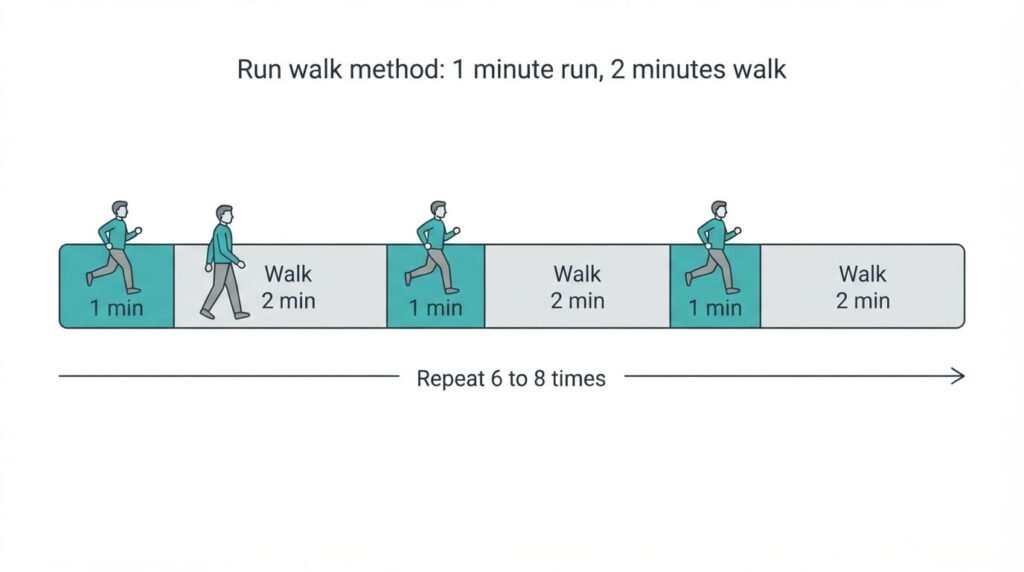
| New to running, can walk briskly for 30 minutes | 1 minute | 2 minutes | 6 to 8 times |
| Can run for about 2 to 3 minutes | 2 minutes | 1 minute | 6 to 8 times |
| Can run for about 5 minutes | 4 minutes | 1 minute | 5 to 6 times |
| Can run for 10 to 15 minutes | 8 to 9 minutes | 1 minute | 3 to 4 times |
| Experienced, using it for long runs or races | 5 to 10 minutes | 30 to 60 seconds | For the whole run |
A simple way to find your ratio
- After a 5-minute warm-up walk, run at an easy, conversational pace for 1 minute and walk for 1 minute
- Repeat for 20 minutes
- If the last few intervals felt easy, lengthen the run segments next time
- If you struggled, shorten the run segments or lengthen the walks
The run walk method works best when every run interval feels comfortable, even near the end.
How to do the run walk method well
1. Walk before you need to
The breaks should start from the first interval, while you still feel fresh. Waiting until you are tired defeats the purpose.
2. Walk briskly
The walk segments are part of the workout. Walk with purpose, swinging your arms, rather than strolling. A brisk walk keeps your heart rate up and keeps your overall pace respectable.
3. Keep the running easy
You should be able to talk in short sentences while running. The run walk method is not an excuse to sprint the running parts.
4. Use a timer
A simple interval timer on your watch or phone beeps when it is time to switch. It removes the decision-making and stops you pushing through a run segment that is too long. Our pace calculator helps you work out your overall pace, including walk breaks.
5. Make smooth transitions
Slow gradually into each walk rather than stopping dead, and ease back into running. Abrupt stops and starts make the method feel harder than it is.
An 8-week run walk method plan for beginners
Do three sessions a week with rest days in between. Start each session with 5 minutes of brisk walking and finish with 5 minutes of easy walking.
| Week | Intervals | Total time |
|---|---|---|
| Week 1 | Run 1 minute, walk 2 minutes, x 7 | 21 minutes |
| Week 2 | Run 1 minute 30 seconds, walk 2 minutes, x 6 | 21 minutes |
| Week 3 | Run 2 minutes, walk 1 minute 30 seconds, x 6 | 21 minutes |
| Week 4 | Run 3 minutes, walk 1 minute 30 seconds, x 5 | 22.5 minutes |
| Week 5 | Run 4 minutes, walk 1 minute, x 5 | 25 minutes |
| Week 6 | Run 5 minutes, walk 1 minute, x 5 | 30 minutes |
| Week 7 | Run 7 minutes, walk 1 minute, x 4 | 32 minutes |
| Week 8 | Run 9 minutes, walk 1 minute, x 3 | 30 minutes |
At the end of eight weeks you can choose to keep using a ratio such as 9 minutes running and 1 minute walking, or to keep extending the running until you run continuously. Our guide to running for beginners has a 10-week plan to 30 minutes of continuous running, and our guide on how to increase running endurance shows how to keep progressing.
How to work out your run walk pace
Your overall pace with walk breaks is simply a weighted average of your running pace and walking pace. You can use a run walk pace calculator, or work it out yourself in three steps:
- Work out how far you cover in one full cycle of running plus walking
- Add up the time one cycle takes
- Divide the time by the distance
| Example | Running | Walking | Overall pace |
|---|---|---|---|
| 1 minute run, 1 minute walk | 10:00 per mile | 16:00 per mile | About 12:18 per mile |
| 4 minutes run, 1 minute walk | 10:00 per mile | 16:00 per mile | About 10:49 per mile |
| 9 minutes run, 1 minute walk | 10:00 per mile | 16:00 per mile | About 10:23 per mile |
For the first example, in 1 minute at 10:00 per mile you cover 0.1 miles, and in 1 minute at 16:00 per mile you cover 0.0625 miles. That is 0.1625 miles in 2 minutes, which works out at about 12:18 per mile. Notice how small the cost of walk breaks becomes as the run segments get longer. A 9:1 ratio is only about 23 seconds per mile slower than running the whole way at 10:00, and many runners fade by more than that in the final miles of a race without walk breaks.
Our pace calculator converts any finish time and distance into a pace, which makes a handy run walk pace calculator once you know your total time.
The run walk method on a treadmill
A treadmill makes the run walk method very easy to control, because you can set exact speeds for each segment. Choose an easy running speed, such as 8 to 9 km/h, and a brisk walking speed, such as 5.5 to 6 km/h, and press the speed buttons when your timer beeps. Set the incline to 1 percent so the effort matches running outside. Our treadmill workouts for beginners guide includes run-walk sessions you can follow.
Moving from run-walk to continuous running
If your goal is to run without stopping, the run walk method is the most reliable way to get there. Progress like this:
| Stage | What to do | Move on when |
|---|---|---|
| Lengthen the runs | Add 30 to 60 seconds to each run segment every week or two | The run segments feel easy and controlled |
| Shorten the walks | Reduce each walk from 2 minutes to 1 minute, then to 30 seconds | You recover fully in the shorter walk |
| Fewer, longer runs | Combine segments, such as 10 minutes running, 1 minute walking, 10 minutes running | You finish feeling you could do more |
| Continuous run | Run the whole time at an easy, conversational pace | You can do this comfortably three times a week |
Do not rush it. Spending an extra week or two at each stage costs nothing and greatly lowers your chance of picking up a niggle. And remember: some excellent runners never stop using walk breaks. Galloway method running is a valid way to run for life, not just a phase.
Using the run walk method for races
The run walk method is not only for beginners. Many runners use it for half marathons and marathons.
| Race | Common approach | Tips |
|---|---|---|
| 5K | Run 2 to 4 minutes, walk 30 to 60 seconds, or walk only through water stations | Practise your ratio in training |
| 10K | Run 4 to 6 minutes, walk 30 to 60 seconds | Start with walk breaks from the first mile |
| Half marathon | Run 5 to 8 minutes, walk 30 to 60 seconds | Use walk breaks to drink and take gels |
| Marathon | Run 5 to 10 minutes, walk 30 to 60 seconds | Stick to the plan early, when it feels too easy to need breaks |
Race-day tips
- Start your walk breaks from the beginning. Saving them for when you are tired does not work as well
- Walk to the side of the course so you do not block runners behind you
- Use the walk breaks to drink, eat and check how you feel
- Practise your exact ratio on long runs in training
If you are planning a longer race, our 12 week half marathon training plan and our guide on how long it takes to train for a marathon both work well with planned walk breaks.
If you can’t run, walk
You may have seen the phrase “if you can’t run, walk”. It is often quoted as encouragement, and it captures the spirit of the run walk method perfectly: moving forward matters more than how you move.
In other words, if you can’t run, walk, and build from there. Brisk walking is excellent exercise in its own right. Many people spend two to four weeks walking briskly for 30 minutes before adding their first 30-second run intervals. Our guides to walking for weight loss and treadmill workouts for beginners both include walking plans that lead naturally into run-walk sessions.
Who the run walk method suits
| Who | Why it helps |
|---|---|
| Complete beginners | Builds fitness without the misery of running until exhausted |
| Heavier runners | Less impact per minute, so joints and tendons can adapt |
| Older runners | Gentler on the body with faster recovery |
| Runners returning from injury | A controlled way to rebuild, with professional guidance |
| Marathon and half marathon first-timers | Can finish strongly and recover faster |
| Anyone who finds continuous running boring | Breaks the run into manageable pieces |
Run walk myths
- “It is cheating.” It is a training strategy used by many experienced runners. Your race result counts the same
- “You will never become a real runner.” Plenty of people use the run walk method as a bridge to continuous running, and plenty choose to keep using it. Both are real running
- “It makes you slower.” In the marathon study above, finish times were similar. Many runners find their overall pace improves because they do not fade at the end
- “You only walk when you are tired.” The opposite. Planned breaks work because they come before fatigue
Common mistakes
- Running the intervals too fast, so the walk breaks never feel like enough
- Strolling during walk breaks instead of walking briskly
- Skipping early walk breaks because you feel good
- Changing the ratio mid-run without a reason
- Progressing too fast, lengthening run intervals by several minutes at once
- Feeling embarrassed. Nobody is watching as closely as you think
Breathing, form and avoiding niggles
Walk breaks are a perfect time to check your form and breathing. Drop your shoulders, take a few deep belly breaths and reset. Our guides to breathing while running and running form cover the details. If your shins ache as you build up, ease back and read our shin splints stretches.
Safety
The run walk method is one of the safest ways to start running. Check with your doctor first if you have a heart condition, high blood pressure, diabetes, a joint problem, are pregnant or have been inactive for a long time.
This article is general information, not medical advice. Stop and seek urgent help for chest pain, severe breathlessness, dizziness or fainting. See our medical disclaimer.
The bottom line
The run walk method alternates planned periods of running and walking from the very first step. Popularised as the Galloway method, it delays fatigue, reduces impact, keeps the effort under control and makes running far more approachable. Choose a ratio that leaves you feeling you could do a little more, walk briskly, keep the running easy, and take every walk break on schedule.
It turned my running around. Instead of running until I broke, I ran a minute, walked a minute and kept going. Whether you use the run walk method forever or as a stepping stone to continuous running, it is one of the best tools a beginner has.
Frequently asked questions
What is the run walk method?
It is a running strategy where you alternate set periods of running and walking from the start of your run, such as 1 minute running and 1 minute walking. The walk breaks are planned, not taken only when you are exhausted.
What is the Galloway method?
The Galloway method is the best-known version of the run walk method, popularised by former US Olympic runner Jeff Galloway. It uses regular planned walk breaks to reduce fatigue and help recreational runners cover longer distances comfortably.
What is a good run-walk ratio for beginners?
Many beginners start with 1 minute of running and 2 minutes of walking, or 30 seconds of running and 90 seconds of walking if they are very new. Lengthen the running segments gradually over several weeks.
Does the run walk method make you slower?
Not necessarily. In one study of non-elite marathon runners, run-walkers finished in similar times to those who ran continuously and reported less muscle discomfort.
Can you use the run walk method in a marathon?
Yes. Many first-time marathoners use ratios such as 5 to 10 minutes of running and 30 to 60 seconds of walking. Practise your exact ratio on long runs before race day.
Is galloway method running good for weight loss?
Yes. It lets you exercise for longer with less fatigue, which can increase the total energy you burn. Combine it with sensible eating and strength training for the best results.
What if I can’t run at all yet?
If you can’t run, walk. Brisk walking is excellent exercise. Build up to 30 minutes of brisk walking, then add very short run intervals, such as 30 seconds, with long walk breaks.
Should I stop using the run walk method eventually?
You do not have to. Some runners use it as a bridge to continuous running, while others keep using walk breaks for all their runs and races. Both are perfectly valid.
How do I calculate my pace with walk breaks?
Add up the distance you cover in one run and walk cycle, divide the cycle time by that distance, and you have your overall pace. With a 10:00 per mile run and a 16:00 per mile walk, a 1:1 ratio gives about 12:18 per mile and a 9:1 ratio about 10:23 per mile. A pace calculator makes this quick.
What’s next?
Reading is the easy part. Pick one of these and do it today.