Pull Up Muscles Worked: What Pull-Ups Train, Grip Differences and How to Get Your First One
Pull up muscles worked is one of the most searched questions in strength training, and for good reason. The pull-up is one of the simplest exercises in the world: a bar, your bodyweight and gravity. Yet it trains more of your upper body than almost any other single move, from the broad muscles of your back to your arms, shoulders, core and grip.
If you have ever hung from a bar and tried to pull yourself up, you will know it is also one of the hardest bodyweight exercises for beginners. That is not a sign you are weak. It simply reflects how many muscles have to work together, and how much strength it takes to lift your whole body with your arms and back.
This guide explains exactly which muscles pull-ups work, what research shows about muscle activation, how grip changes the muscles exercised by pull ups, the real benefits of pull-ups, common mistakes, and a simple plan to get your first full rep.
At a glance
- The latissimus dorsi (lats) are the main muscles worked by pull-ups
- The biceps, brachialis, forearms, middle and lower traps, rhomboids and rear delts also work hard
- Your core, especially the abs and obliques, works to stop your body swinging
- Research found lat activity during pull-ups and chin-ups exceeded 100 percent of a maximal isometric effort
- Chin-ups (palms facing you) use more biceps and chest, pull-ups (palms away) use slightly more of the lower trapezius
- Overall muscle activation is similar across grips, so choose the one that feels best for your shoulders and elbows
- Most beginners can achieve a first pull-up within 2 to 4 months of steady practice
Pull up muscles worked at a glance

| Muscle | Role in the pull-up | How hard it works |
|---|---|---|
| Latissimus dorsi | Pulls the upper arm down and back toward the body | Very high |
| Biceps brachii | Bends the elbow | High |
| Brachialis and brachioradialis | Bend the elbow, especially in neutral and overhand grips | High |
| Lower and middle trapezius | Pull the shoulder blades down and together | Moderate to high |
| Rhomboids | Pull the shoulder blades together | Moderate |
| Rear deltoids | Help pull the arms back | Moderate |
| Infraspinatus and teres minor (rotator cuff) | Stabilise the shoulder joint | Moderate to high |
| Teres major | Assists the lats | Moderate |
| Pectoralis major (lower fibres) | Assists in pulling the arms down | Moderate, more in chin-ups |
| Forearm flexors (grip) | Hold the bar | High |
| Abs and obliques | Keep the body still | Moderate |
| Erector spinae | Keep the trunk upright | Low to moderate |
So when people ask “what muscles do pull ups work”, the short answer is: mostly the lats and biceps, but also most of the upper back, shoulders, forearms and core.
Pull up muscles worked, part 1: the latissimus dorsi
The lats are the largest muscles of the upper body. They start from the lower and middle back and the pelvis, travel up the sides of your torso, and attach to the front of your upper arm. Their main job is to pull your arm down and back, which is exactly what happens in a pull-up. That is why pull-ups are often described as the best bodyweight exercise for a wider back.
Our guide to latissimus dorsi exercises covers other ways to train the lats if you cannot do a pull-up yet.
Pull up muscles worked, part 2: the arms
Your elbows bend through a large range during every pull-up, so the biceps, brachialis and brachioradialis all work hard. The biceps work more when your palms face you (chin-up grip), while the brachialis and brachioradialis take more of the load when your palms face away or toward each other.
Forearms and grip
Simply holding your bodyweight on a bar challenges your grip. Many beginners find their hands tire before their back. Dead hangs and farmer’s carries help, and our hand grip exercises and forearm workout at home guides have more options.
Pull up muscles worked, part 3: upper back and shoulders
As you pull up, your shoulder blades move down and slightly together. The lower and middle trapezius and the rhomboids control that movement. Starting each rep by “setting” your shoulder blades, pulling them down away from your ears, is one of the best cues for healthy pull-ups. Our guide to lower trap exercises explains why these muscles matter for posture and shoulder health.
The rotator cuff muscles, especially the infraspinatus, also work hard to keep the shoulder joint stable. Our rotator cuff exercises make a great warm-up before pull-ups.
Pull up muscles worked, part 4: the core
A strict pull-up is a full-body tension exercise. Your abs, obliques and lower back work to keep your legs and hips still, so the movement comes from your arms and back rather than swinging. Hollow body pull-ups, with legs slightly in front and abs braced, increase the core demand even more.
What the research says
A study of 25 adults measured muscle activity during a standard pull-up, a chin-up and a rotational pull-up. The latissimus dorsi showed the highest activation, around 117 to 130 percent of a maximal isometric effort. The biceps (78 to 96 percent), infraspinatus (71 to 79 percent), lower trapezius (45 to 56 percent), pectoralis major (44 to 57 percent), erector spinae (39 to 41 percent) and external obliques (31 to 35 percent) were also clearly active. The chin-up produced higher activation in the pectoralis major and biceps than the standard pull-up, while the pull-up produced higher lower trapezius activation.
A second study in 19 strength-trained men compared supinated, pronated, neutral and rope pull-ups. Overall muscle activation across the shoulder, arm and forearm was similar between grips, apart from the middle trapezius, which worked harder with a pronated grip than with a neutral grip. The concentric phase (pulling up) produced more activity in the biceps, brachioradialis and chest than the lowering phase.
The practical message: pull-ups are excellent for the lats whichever grip you use. Small grip changes shift the emphasis, but you do not need to obsess over them.
How grip changes the pull up muscles worked
| Grip | Hand position | Extra emphasis | Notes |
|---|---|---|---|
| Pull-up (pronated) | Palms facing away, a little wider than shoulders | Lower and middle traps, lats | The classic pull-up |
| Chin-up (supinated) | Palms facing you, shoulder width | Biceps, chest | Often easier for beginners |
| Neutral grip | Palms facing each other | Brachialis, brachioradialis | Often kindest on shoulders and elbows |
| Wide grip | Well beyond shoulder width | Upper lats, upper back | Harder, shorter range |
| Close grip | Hands close together | Arms, lower lats | Longer range of motion |
If one grip feels uncomfortable on your shoulders or elbows, try another. Because overall muscle activation is similar, the best pull-up for you is the one you can do comfortably and consistently.
Pull ups benefits
| Benefit | Why it happens |
|---|---|
| A stronger, wider back | Heavy lat and upper back work |
| Stronger arms and grip | Elbow flexors and forearms support your bodyweight |
| Better posture | Strengthens the muscles that pull the shoulders back and down |
| Balances pushing work | Offsets push-ups and presses |
| Core strength | Your trunk stays braced throughout |
| Functional strength | Climbing, pulling and lifting your own body |
| Minimal equipment | A bar at home or in a park is enough |
| Measurable progress | Easy to track reps and assistance levels |
One of the underrated pull ups benefits is how clearly they show progress. Going from a dead hang to one rep, and then to five, is a very satisfying milestone.
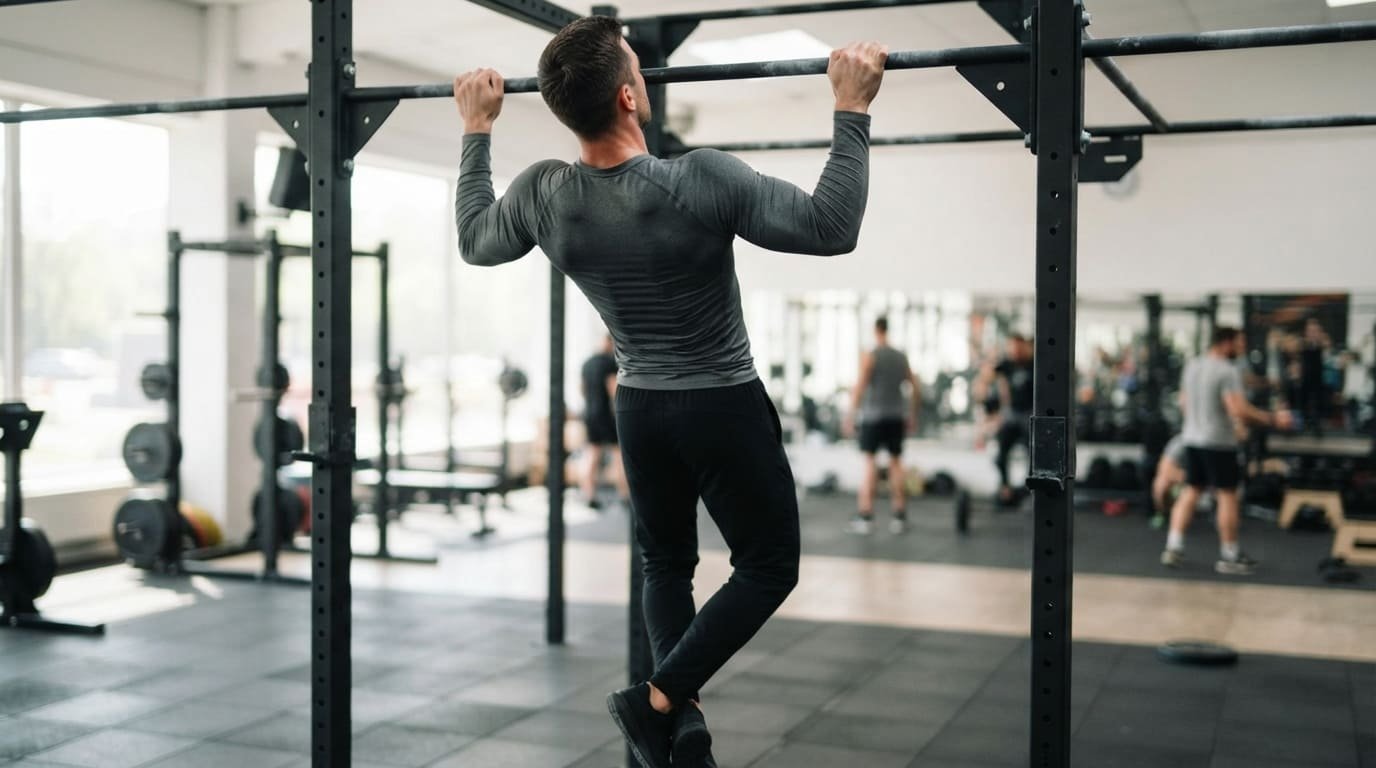
How to do a pull-up with good form
- Grip the bar with your palms facing away, hands slightly wider than your shoulders
- Hang with straight arms and your shoulders engaged, not fully relaxed
- Pull your shoulder blades down and slightly together
- Brace your core and squeeze your glutes to stop your legs swinging
- Pull your elbows down toward your ribs until your chin passes the bar
- Lower slowly, under control, to a full hang
- Breathe out as you pull, in as you lower
How to get your first pull-up
| Stage | Exercise | Goal before moving on |
|---|---|---|
| 1 | Dead hang | 30 to 45 seconds |
| 2 | Scapular pull-ups (shrug down while hanging) | 3 x 8 |
| 3 | Inverted rows under a bar or table | 3 x 12 |
| 4 | Lat pulldowns or band pulldowns | 3 x 10 with a moderate weight |
| 5 | Negative pull-ups (jump up, lower slowly) | 3 x 5, each taking 3 to 5 seconds |
| 6 | Band-assisted pull-ups | 3 x 8 with a light band |
| 7 | First full pull-up | 1 rep |
Train this progression two or three times a week. Most beginners reach a first pull-up within 2 to 4 months, though people who are heavier or new to strength training may take longer, and that is completely fine. Our pull-up alternatives guide has more stepping stones.
A 6-week pull-up plan
| Week | Session A | Session B |
|---|---|---|
| 1 | Dead hang 3 x 20 seconds, scapular pull-ups 3 x 6, inverted rows 3 x 8 | Lat pulldown 3 x 10, dead hang 3 x 20 seconds |
| 2 | Dead hang 3 x 30 seconds, scapular pull-ups 3 x 8, inverted rows 3 x 10 | Lat pulldown 3 x 10, negatives 3 x 3 |
| 3 | Negatives 3 x 4, inverted rows 3 x 12 | Band-assisted pull-ups 3 x 5, dead hang 3 x 30 seconds |
| 4 | Negatives 3 x 5, band-assisted pull-ups 3 x 6 | Lat pulldown 3 x 8 (heavier), inverted rows 3 x 12 |
| 5 | Band-assisted pull-ups 3 x 8, negatives 2 x 5 | Try a single pull-up, then band-assisted 3 x 6 |
| 6 | Pull-up attempts 3 x max, negatives 2 x 4 | Band-assisted 3 x 8, dead hang 2 x 45 seconds |
Common mistakes
| Mistake | What happens | Fix |
|---|---|---|
| Kipping or swinging | Momentum replaces muscle | Brace your core, slow down |
| Half reps | Less muscle work and strength | Full hang to chin over bar |
| Shrugging up | Neck strain, less lat work | Pull shoulder blades down first |
| Only pulling with arms | Biceps tire early | Think elbows to ribs |
| Dropping quickly | Missed strength gains, shoulder stress | Lower over 2 to 3 seconds |
| Training to failure every session | Elbow and shoulder overuse | Leave 1 or 2 reps in reserve |
Safety tips
- Warm up your shoulders first with arm circles, band pull-aparts and rotator cuff work
- Use a sturdy, securely mounted bar
- Avoid kipping until you have solid strict strength
- Stop if you feel sharp pain in your shoulders or elbows
- If you have had a shoulder injury, ask a physiotherapist before starting
This article is general information, not medical advice. See our medical disclaimer.
Which muscles work in each phase of a pull-up?
| Phase | What happens | Muscles working hardest |
|---|---|---|
| Dead hang | You hang with straight arms | Grip, forearms, shoulder stabilisers |
| Scapular set | Shoulder blades pull down | Lower traps, lats |
| Pulling up (concentric) | Elbows bend, body rises | Lats, biceps, brachialis, brachioradialis, chest |
| Top position | Chin over the bar | Lats, biceps, middle traps, rhomboids |
| Lowering (eccentric) | Slow descent | Lats, biceps, rotator cuff (controlling the movement) |
The research above found that the pulling phase produced more activity in the biceps, brachioradialis and chest than the lowering phase. The lowering phase is still valuable, because slow negatives build strength quickly and are a key step toward your first full rep.
Pull-up variations and their muscle emphasis
| Variation | Main pull up muscles worked | Difficulty |
|---|---|---|
| Standard pull-up | Lats, traps, biceps | Hard |
| Chin-up | Lats, biceps, chest | Moderate to hard |
| Neutral grip pull-up | Lats, brachialis, forearms | Moderate to hard |
| Wide grip pull-up | Upper lats, upper back | Very hard |
| Commando pull-up (hands staggered) | Lats, obliques, arms | Hard |
| L-sit pull-up | Lats, abs, hip flexors | Very hard |
| Weighted pull-up | All of the above, with more load | Advanced |
| Band-assisted pull-up | All of the above, reduced load | Beginner friendly |
Changing variations every few weeks keeps training interesting and challenges the muscles in slightly different ways.
Pull-ups at home
A doorway pull-up bar or a sturdy outdoor bar is all you need. Check that any doorway bar is rated for your body weight, fits your door frame securely and does not damage the frame. For assistance, loop a resistance band over the bar and put one foot or knee in it. If you do not have a bar, inverted rows under a sturdy table train many of the same muscles exercised by pull ups. Our calisthenics back workout has a full home routine.
How many sets and reps?
| Your level | Suggested approach |
|---|---|
| Cannot do one yet | 2 to 3 sessions a week of the progression above |
| 1 to 3 reps | Several sets of 1 to 2 reps, plus negatives |
| 4 to 8 reps | 3 to 4 sets of 3 to 6 reps, leaving 1 or 2 in reserve |
| 8 or more reps | 3 to 4 sets of 6 to 10, or add weight |
Quality matters more than quantity. Five clean reps work the pull up muscles worked far better than ten swinging, half-range reps.
Exercises that pair well with pull-ups
| Pair with | Why |
|---|---|
| Push-ups or overhead presses | Balances pulling with pushing |
| Rows | Trains the middle back from a different angle |
| Rear delt flies and face pulls | Supports shoulder health |
| Core work such as hollow holds | Builds the tension that makes pull-ups easier |
| Farmer’s carries | Grip strength for longer sets |
Our guide to horizontal and vertical pull exercises explains how to balance different pulling movements across the week.
Pull-ups if you are heavier
If you are carrying extra weight, pull-ups are harder simply because you are lifting more. That is not a reason to avoid them. Focus on the earlier stages, such as dead hangs, inverted rows, lat pulldowns and negatives, and track progress in small steps. Losing a little body fat and gaining strength together often makes the first pull-up arrive suddenly. Every stage of the progression still trains the same pull up muscles worked in the full exercise.
Where you might feel sore after pull-ups
| Area | Why it gets sore |
|---|---|
| Sides of the back, under the armpits | The lats are the main pull up muscles worked |
| Front of the upper arm | Biceps and brachialis bend the elbow |
| Forearms | Grip work holding the bar |
| Between the shoulder blades | Middle traps and rhomboids |
| Stomach | The core holds the body still |
Some soreness after new pull-up training is normal and usually fades within 2 to 3 days. Sharp pain in the elbow or shoulder is different, so stop and rest if you feel it.
A 5-minute pull-up warm-up
- Arm circles, 20 seconds each way
- Band pull-aparts, 15 reps
- Band external rotations, 12 per side
- Dead hang, 15 to 20 seconds
- Scapular pull-ups, 5 reps
- One easy set of assisted pull-ups or negatives
A good warm-up prepares the shoulders and helps the right muscles switch on.
Track your progress
Write down your dead hang time, how many negatives you did and how slowly, and which band you used for assisted reps. Small improvements every week, such as five extra seconds of hanging or a lighter band, show that your pull-up strength is building, even before the first full rep arrives.
Be patient
Pull-ups are one of the slowest bodyweight skills to build, and that is normal. Strength in the lats, arms and grip grows week by week. Keep showing up two or three times a week, and celebrate small wins along the way: a longer hang, a slower negative, a lighter band.
Rest between sessions
Leave at least one rest day between hard pull-up sessions. The lats, biceps and forearms need time to recover, and your elbow tendons adapt more slowly than your muscles.
The bottom line
So, what are the main pull up muscles worked? The lats, with strong help from the biceps, brachialis, forearms, traps, rhomboids, rear delts, rotator cuff and core. Research shows the lats work extremely hard during pull-ups and chin-ups, and while grip changes the emphasis slightly, overall muscle activation is similar.
Pull-ups build a stronger back and arms, better posture and impressive functional strength. If you cannot do one yet, follow the progression from dead hangs to negatives to band-assisted reps, two or three times a week. With patience, your first full pull-up is very achievable.
Frequently asked questions
What muscles do pull ups work?
Mainly the latissimus dorsi, plus the biceps, brachialis, forearms, middle and lower traps, rhomboids, rear delts, rotator cuff and core.
Do pull-ups work the chest?
The lower fibres of the chest help pull the arms down, especially in chin-ups. But pull-ups are mainly a back and arm exercise.
Are chin-ups or pull-ups better?
Both are excellent. Chin-ups use more biceps and are often easier for beginners. Pull-ups use slightly more lower trapezius. Research shows overall activation is similar.
Do pull-ups work abs?
Yes, your abs and obliques work to keep your body still, especially in strict or hollow body pull-ups. They are not a substitute for direct core work, though.
How many pull-ups should a beginner be able to do?
Many beginners cannot do one at first, which is normal. Getting your first strict rep is a great goal, then building to 5 to 10 over several months.
Do pull-ups build big arms?
They build the biceps, brachialis and forearms, especially chin-ups. For larger arms, add direct biceps and triceps work.
What are the main pull ups benefits?
A stronger, wider back, stronger arms and grip, better posture, core strength and the ability to lift your own bodyweight, all with minimal equipment.
How long does it take to do your first pull-up?
Usually 2 to 4 months of training two or three times a week, though it varies with body weight, starting strength and consistency.
Can I do pull-ups every day?
Daily easy practice works for some people, but most beginners progress better with two or three focused sessions a week and rest days in between.
What’s next?
Reading is the easy part. Pick one of these and do it today.