Dumbbell Pullover: How to Do It, Muscles Worked and Chest vs Lats Versions
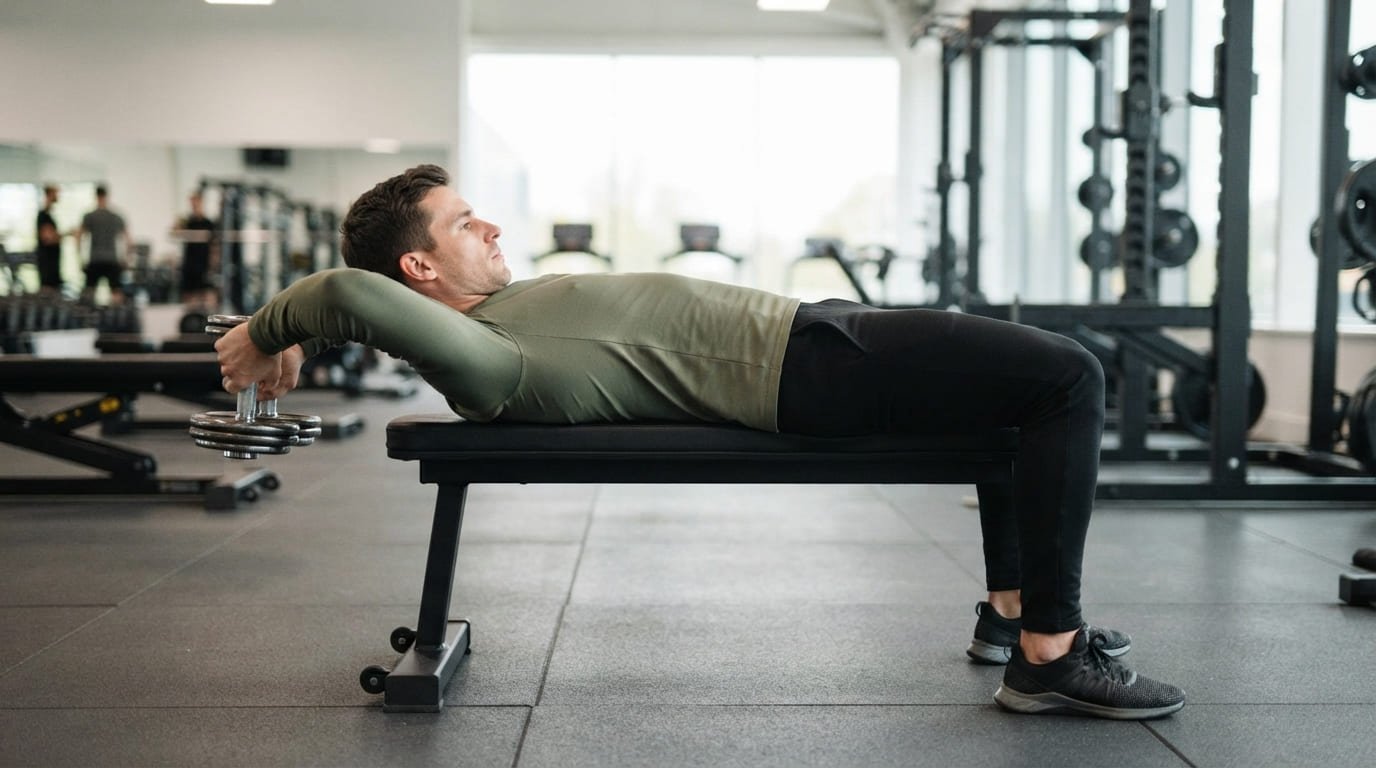
The dumbbell pullover is one of those old-school exercises that has stayed popular for decades. You lie on a bench, hold a single dumbbell over your chest, lower it in a wide arc behind your head, and pull it back over your chest. It looks simple, but it works a surprising number of muscles: the chest, the lats, the triceps and the muscles that stabilise your shoulders and core.
It is also one of the most debated exercises in the gym. Is it a chest exercise or a back exercise? The answer is both, and small changes in your technique shift the emphasis one way or the other. Done well, the pullover exercise with dumbbells is a great way to stretch and strengthen the upper body. Done badly, with too much weight or too much range, it can strain the shoulders.
This guide shows you how to do the dumbbell pullover step by step, the muscles worked, what research says, how to bias the chest or the lats, variations, workouts, and the mistakes to avoid.
At a glance
- The dumbbell pullover moves a single dumbbell in an arc from over your chest to behind your head and back
- It works the chest (pectoralis major), lats, triceps (long head), serratus anterior and core
- Research found a barbell pullover activated the chest more than the lats, depending on the lever arm
- Elbows slightly bent and a focus on squeezing the chest biases the chest
- More elbow bend, flared elbows and pulling from the armpits bias the lats
- Use a moderate weight and a comfortable range, stopping before the shoulders feel strained
- It works best as an accessory exercise after main presses or rows
What is the dumbbell pullover? Dumbbell pullover muscles worked
The pullover is a shoulder extension movement: your arms move from overhead back down toward your hips, with the elbows staying in a fixed, slightly bent position. Because both the chest and the lats can perform this movement, the pullover trains both.
| Muscle | Role in the pullover |
|---|---|
| Pectoralis major (chest) | Pulls the arms from overhead toward the chest, especially the lower and middle fibres |
| Latissimus dorsi (lats) | Pulls the arms down from overhead |
| Long head of the triceps | Assists shoulder extension and holds the elbow position |
| Serratus anterior | Stabilises the shoulder blades against the ribs |
| Teres major | Assists the lats |
| Core (abs) | Keeps the ribs and lower back steady |
How to do the dumbbell pullover
Set-up
- Choose a dumbbell you can control comfortably for 10 to 12 reps
- Lie along a flat bench with your head and upper back supported and feet flat on the floor
- Hold one end of the dumbbell with both hands, palms against the underside of the top plate, thumbs wrapped around the handle
- Press it up over your chest with your arms almost straight, elbows slightly bent
The movement
- Brace your core gently so your ribs stay down and your lower back does not arch
- Keeping the slight elbow bend, lower the dumbbell in an arc back over your head
- Go only as far as you can with control, usually until your upper arms are roughly in line with your ears
- Feel a stretch through your chest and the sides of your back
- Pull the dumbbell back over your chest along the same arc
- Breathe in as you lower, out as you pull
Take about 2 to 3 seconds to lower and 1 to 2 seconds to pull back up. Do 3 sets of 10 to 12.
Cross-bench version
The traditional pullover is done lying across a bench, with only your upper back on it and your hips lower. This gives a bigger stretch, but it is harder to keep stable. Beginners usually do best lying along the bench.
What the research says
A study of eight healthy men measured muscle activity in the pectoralis major and latissimus dorsi during a barbell pullover with a load of 30 percent of body weight. The pullover activated the pectoralis major more than the latissimus dorsi, and the activation pattern depended on the lever arm, meaning the position of the weight relative to the shoulder during the movement.
This was a small study with a barbell, so the exact numbers may differ for dumbbells. But it suggests that for most people, the pullover leans more toward the chest, and that technique and range change which muscle does more work.
Chest vs lats: how to bias each

| To emphasise | Technique changes |
|---|---|
| Chest | Elbows slightly bent and pointing forward, think about squeezing the chest as you pull back over, stop the dumbbell over your chest |
| Lats | More elbow bend, elbows flared slightly out, think about pulling from your armpits, finish lower, toward your upper stomach |
If your main goal is a dumbbell pullover for lats, you may also like the cable straight arm pulldown, which keeps tension on the lats throughout. Our guide to latissimus dorsi exercises covers both.
Benefits of the dumbbell pullover
| Benefit | Why it matters |
|---|---|
| Works chest and back together | Efficient for upper body training |
| Stretches the chest and lats under load | May help shoulder and upper back mobility over time |
| Trains the serratus anterior | Supports healthy shoulder blade movement |
| Needs only one dumbbell | Easy to do at home or in a busy gym |
| Great finisher | Light weight, big range, strong pump |
Pullover variations
| Variation | What changes | Best for |
|---|---|---|
| Dumbbell pullover on a flat bench | Standard version | Most people |
| Cross-bench pullover | Bigger stretch, more core demand | Experienced lifters |
| Floor pullover | The floor limits range | Beginners, sensitive shoulders |
| Decline pullover | Changes the angle of resistance | More chest emphasis |
| Cable pullover (straight arm pulldown) | Constant tension, standing | Lat emphasis |
| Band pullover | Light, home-friendly | Warm-ups, home training |
| Barbell or EZ-bar pullover | Two hands on a bar | Variety |
The floor pullover is an excellent place to start. Lying on the floor stops the dumbbell going too far, which protects the shoulders while you learn.
Workouts with the dumbbell pullover
Chest day
| Exercise | Sets x reps |
|---|---|
| Dumbbell bench press | 3 x 8 to 10 |
| Incline dumbbell press | 3 x 10 |
| Dumbbell pullover | 3 x 10 to 12 |
| Push-ups | 2 x as many as possible with good form |
Back day
| Exercise | Sets x reps |
|---|---|
| Lat pulldown or assisted pull-up | 3 x 8 to 10 |
| Single arm dumbbell row | 3 x 10 per side |
| Dumbbell pullover (lat bias) | 3 x 12 |
| Face pull | 2 x 15 |
Home upper body
| Exercise | Sets x reps |
|---|---|
| Push-ups | 3 x 10 |
| Single arm dumbbell row | 3 x 10 per side |
| Floor dumbbell pullover | 3 x 12 |
| Band pull-apart | 2 x 15 |
Our guides to the chest and back workout and weight bench dumbbell exercises have more full sessions.
How heavy should you go?
| Level | Typical dumbbell | Reps |
|---|---|---|
| Beginner | 4 to 10 kg | 12 to 15 |
| Intermediate | 10 to 20 kg | 10 to 12 |
| Advanced | 20 kg and above | 8 to 12 |
The weight should let you control every rep and keep your lower back flat. If your back arches or your shoulders feel pinched, go lighter or reduce the range.
Form tips
| Tip | Why it helps |
|---|---|
| Keep a fixed, slight elbow bend | Keeps the movement at the shoulder, not the elbows |
| Ribs down, core braced | Protects the lower back |
| Lower slowly | Control at the stretched position protects the shoulders |
| Stop at a comfortable stretch | More range is not always better |
| Hold the dumbbell securely | Both hands under the top plate, thumbs around the handle |
| Keep your head on the bench | Supports your neck |
Common mistakes
| Mistake | What happens | Fix |
|---|---|---|
| Going too heavy | Shoulder strain, arched back | Lighter weight, strict form |
| Too much range | Pinching at the front of the shoulder | Stop when arms reach about ear level |
| Bending and straightening the elbows | Turns into a triceps extension | Keep the elbow angle fixed |
| Arching the lower back | Back strain | Ribs down, feet flat, core braced |
| Rushing | Less muscle work | 2 to 3 seconds down |
| Loose grip | Risk of dropping the dumbbell | Secure grip, check before each set |
The pullover and shoulder mobility
Because the pullover stretches the chest and lats under a light load, many people find it helps their overhead mobility over time, particularly if they spend long hours at a desk. Pair it with thoracic mobility work for the best effect. Our thoracic mobility exercises guide is a good companion. If you like loaded mobility moves, the lying dumbbell version of the around the world exercise works the same muscles through a different arc.
Safety tips
- Skip the pullover, or use the floor version, if you have shoulder pain or impingement
- Warm up your shoulders first with arm circles and rotator cuff exercises
- Check your grip before every set
- Use a spotter or a lighter weight if you are unsure
- Stop if you feel sharp pain in your shoulders, elbows or back
This article is general information, not medical advice. See our medical disclaimer.
A classic exercise
The pullover has been a staple of strength training for many decades and was a favourite of classic bodybuilders. It is still used today by lifters, gymnasts and athletes who want to train the chest and lats through a long range of motion.
Breathing during the pullover
Take a deep breath in as you lower the dumbbell behind your head, and breathe out as you pull it back over your chest. A full breath at the stretched position helps you stay braced and feel the stretch through the chest and ribs. Do not hold your breath for the whole set.
Who should do dumbbell pullovers?
- Lifters who want an extra chest or lat exercise with a long range of motion
- Swimmers and climbers, whose sports rely on strong shoulder extension
- Home exercisers with only one or two dumbbells
- Desk workers who want to open up the chest and upper back, using a light weight
People with shoulder pain, recent shoulder injuries or limited overhead mobility should start with the floor version or skip it for now.
Alternatives to the dumbbell pullover
| If you want | Try |
|---|---|
| More lat focus | Cable straight arm pulldown, single arm cable pulldown |
| More chest focus | Dumbbell fly, incline press |
| No bench | Floor pullover, band pullover |
| A gentler shoulder position | Straight arm pulldown with a band |
How to progress the pullover
Increase the weight slowly, by about 1 to 2 kg at a time, only when every rep feels controlled. Alternatively, slow the lowering phase to 4 seconds, add a 1-second pause at the stretch, or add a third set. The pullover rewards control far more than heavy weight, so progress carefully.
Feeling the right muscles
If you feel the pullover mostly in your arms, check that your elbows stay at a fixed angle. If you feel it in your lower back, brace your core more and bring the dumbbell back over your chest a little sooner. To feel the chest, think about squeezing your arms together as the dumbbell travels back up. To feel the lats, think about pulling your elbows down toward your hips. These small mental cues make a big difference to the dumbbell pullover muscles worked.
Pullover vs row vs fly
| Exercise | Main movement | Main muscles |
|---|---|---|
| Dumbbell pullover | Arms move from overhead to over the chest | Chest, lats, triceps long head |
| Dumbbell row | Elbow pulls back toward the hip | Lats, middle back, rear delts, biceps |
| Dumbbell fly | Arms move out to the sides and back together | Chest, front delts |
Because the pullover works both the chest and lats, it fits into many different workouts. It is not a replacement for rows or presses, but it adds variety and a long range of motion.
Dumbbell pullover at home
The pullover exercise with dumbbells is ideal for home training. If you have no bench, lie on the floor, which limits the range and makes it very shoulder-friendly. If you have no dumbbell, a filled water bottle, a heavy book or a kettlebell held by the horns works as a light alternative. Make sure whatever you use is easy to grip securely.
A beginner pullover progression
| Weeks | Variation | Sets x reps |
|---|---|---|
| 1 and 2 | Floor pullover with a light dumbbell | 2 x 12 |
| 3 and 4 | Floor pullover, slightly heavier | 3 x 12 |
| 5 and 6 | Bench pullover, lying along the bench | 3 x 10 to 12 |
| 7 and 8 | Bench pullover with a 3-second lowering phase | 3 x 10 |
Progress only when the previous stage feels smooth and comfortable for your shoulders.
Kettlebell pullover
Holding a kettlebell by the horns, with the bell hanging below your hands, is a comfortable alternative grip for the pullover. It is especially handy if your gym has more kettlebells than dumbbells, or if you train at home with a kettlebell.
Sets, reps and rest
For most people, 2 to 3 sets of 10 to 12 reps with 60 to 90 seconds of rest is ideal. The pullover is an accessory exercise, so there is no need for very heavy sets of low reps. Higher reps with control give a strong stretch and pump while keeping the shoulders safe.
What to pair with the pullover
| Pair with | Why |
|---|---|
| Push-ups or presses | Completes a chest session |
| Rows | Balances the back |
| Face pulls | Supports shoulder health |
| Planks or dead bugs | Builds the core control that keeps your ribs down during pullovers |
Pullovers and shoulder health
Done carefully, the pullover can help keep your shoulders moving through a healthy overhead range. The key is control. Lower the weight slowly, stop at a comfortable stretch, and never bounce at the bottom. If you have a history of shoulder dislocation, impingement or rotator cuff problems, ask a physiotherapist whether the pullover suits you, and start with the floor version or a band.
A sample week using the pullover
| Day | Where the pullover fits |
|---|---|
| Monday (chest and triceps) | After presses, 3 x 12, chest bias |
| Thursday (back and biceps) | After rows, 2 x 12, lat bias |
Using the pullover twice a week, once with a chest focus and once with a lat focus, is a simple way to get the most from this classic exercise.
Pullover checklist
- Choose a moderate dumbbell you can grip securely
- Lie on a bench or the floor with your feet flat
- Brace your core and keep your ribs down
- Keep a fixed, slight bend in your elbows
- Lower slowly to a comfortable stretch
- Pull back over your chest with control
- Breathe in on the way down, out on the way up
When to stop a set
End the set early if your lower back starts to arch, your elbows start bending and straightening, or you feel any pinching at the front of the shoulder. These are signs that fatigue is changing your technique. Rest, lighten the weight if needed, and focus on clean, controlled reps. With the pullover, five perfect reps are worth far more than twelve sloppy ones.
What to expect
Many people notice a strong stretch and a pump in the chest and lats from the first session. Over several weeks, the pullover often helps the chest and upper back feel more open, and it adds a useful long-range movement to an upper body routine. As with any exercise, results depend on consistency, progressive overload, protein and sleep.
Grip tips
Hold the dumbbell vertically with both palms pressed flat against the underside of the top plate and your thumbs wrapped around the handle, forming a diamond shape with your hands. Check that the plates are tight before each set, especially on adjustable dumbbells. A secure grip lets you focus on the movement rather than worrying about the weight.
Stay consistent
Use the pullover once or twice a week for at least 6 to 8 weeks before judging it. Like any accessory exercise, it works best as a steady part of a balanced routine.
The bottom line
The dumbbell pullover is a simple, effective accessory exercise that works the chest, lats, triceps and serratus anterior in one movement. With small technique changes, it can be a dumbbell pullover for lats or for chest. Research suggests it leans slightly more toward the chest, but technique and range shift the emphasis, so you can use it on chest days or back days.
Use a moderate weight, keep a fixed slight bend in your elbows, brace your core and lower the dumbbell only as far as you can control. Start with the floor version if you are new or your shoulders are sensitive. Added to a balanced routine, the pullover exercise with dumbbells will help build a stronger, more mobile upper body.
Frequently asked questions
What muscles does the dumbbell pullover work?
The chest (pectoralis major), lats, long head of the triceps, serratus anterior and core muscles.
Is the dumbbell pullover a chest or back exercise?
Both. Research suggests it works the chest slightly more, but small changes in technique can shift more work to the lats.
How do I make the dumbbell pullover work my lats more?
Bend your elbows a little more, flare them slightly, think about pulling from your armpits and finish the movement lower, toward your upper stomach.
How heavy should a dumbbell pullover be?
Moderate. Most beginners start with 4 to 10 kg for 12 to 15 reps. You should be able to keep your lower back flat and control every rep.
Is the dumbbell pullover bad for your shoulders?
Not for most people when done with a moderate weight and comfortable range. If you have shoulder pain, try the floor version or skip it.
Can I do dumbbell pullovers without a bench?
Yes. The floor pullover is a great option and naturally limits the range, which protects your shoulders.
Where should pullovers go in my workout?
Usually after your main presses or rows, as an accessory exercise for 2 to 3 sets.
Do pullovers expand the rib cage?
There is no good evidence that pullovers expand the rib cage in adults. They strengthen and stretch the muscles around it.
Are cable pullovers better than dumbbell pullovers?
Cable pullovers keep constant tension and are often better for the lats. Dumbbell pullovers give a bigger stretch and work the chest more. Both are useful.
What’s next?
Reading is the easy part. Pick one of these and do it today.