Headache After Exercise: Common Causes, Quick Fixes and When to Worry
Getting a headache after exercise is frustrating. You do something good for your body, and instead of feeling energised you end up with a throbbing head and a strong urge to lie down in a dark room. If it happens once, it is easy to shrug off. If it keeps happening, it can make you wary of working out at all.
The reassuring news is that most headaches after exercise have simple, fixable causes, such as not drinking enough, training in the heat, skipping food, holding your breath during lifts or pushing much harder than usual. There is also a recognised condition called primary exercise headache, sometimes known as exertional headache, which is usually harmless but can be unpleasant.
At the same time, a small number of headaches linked to exercise are a sign of something more serious, and it is important to know the warning signs. In this guide I will explain the common causes of a headache after exercise, what research says about how often it happens, practical ways to prevent it, how to ease one when it starts, and exactly when you should see a doctor.
At a glance
- A headache after exercise is common and usually has a simple cause
- Common triggers include dehydration, heat, low blood sugar, breath holding, neck tension and sudden hard efforts
- Primary exercise headache is a recognised, usually harmless headache brought on by strenuous exercise
- In one large population study, about 12% of adults reported exertional headache at some point
- Warming up, drinking enough, eating beforehand and breathing during lifts can prevent many headaches
- A sudden, severe headache during exercise, or one with neurological symptoms, needs urgent medical help
- See a doctor about any new pattern of exercise headaches, especially the first time it happens
What is a headache after exercise?
A headache after exercise, sometimes called a headache after working out, is simply a headache that starts during or shortly after physical activity. It can feel like a dull ache, a tight band around the head, or a pulsing, throbbing pain. Some people get it on both sides of the head, others on one side or at the back.
Broadly, there are two groups:
| Type | What it means | Example causes |
|---|---|---|
| Primary exercise headache | The headache is the condition itself, with no underlying disease | Strenuous exercise triggers the headache directly |
| Secondary exercise headache | The headache is a symptom of something else | Dehydration, low blood sugar, migraine triggered by exercise, or rarely a serious problem like bleeding in the brain |
Most people with a headache after exercise have a simple secondary cause, such as not drinking enough, or a harmless primary exercise headache.
What the research says
How common is exertional headache?
In a Norwegian population study, researchers personally interviewed and examined 1,838 adults aged 18 to 65. Using their criteria, the lifetime prevalence of exertional headache was 12.3%, with a slight female predominance. Attacks typically followed long-lasting and strenuous effort.
So if you get an exercise headache, you are far from alone. Roughly one in eight adults in that study had experienced one.
How doctors define primary exercise headache
The International Classification of Headache Disorders, third edition, describes primary exercise headache as a headache brought on by and occurring only during or after strenuous physical exercise, in the absence of any other disorder that explains it. Its criteria include at least two such episodes and a duration of less than 48 hours. The classification also notes that, on first occurrence, it is essential to rule out more serious causes.
This is why I always say: if you get a headache after exercise for the first time, especially a severe one, get it checked. Most will turn out to be harmless, but that is a doctor’s call to make.
Common causes of a headache after exercise
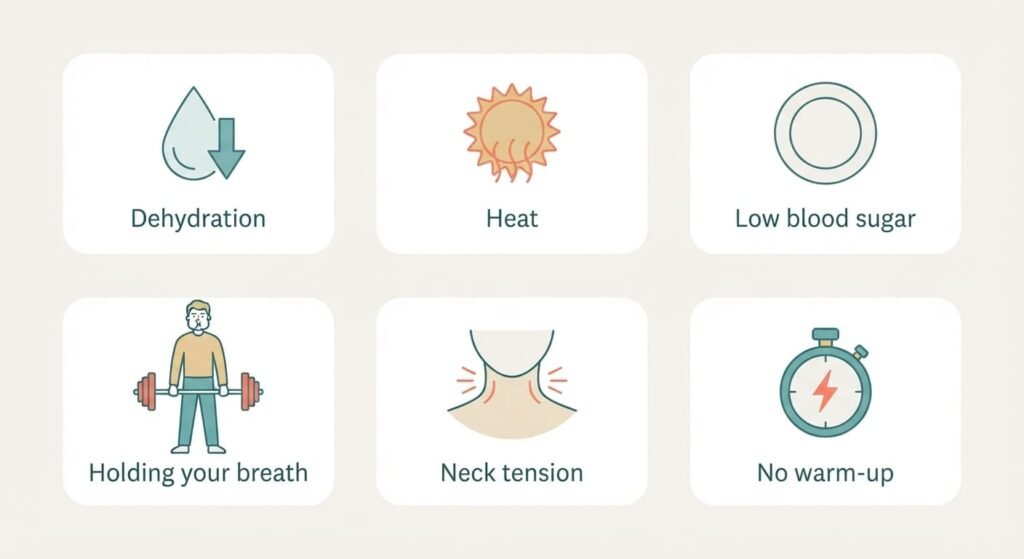
1. Dehydration
Sweating without replacing fluids is one of the most common causes. Even mild dehydration can bring on a headache, especially on hot days or during long sessions. Our water intake calculator can help you estimate your daily needs.
2. Exercising in the heat
Hot, humid conditions make your body work harder to cool down, increase sweating and can cause headaches. Heat exhaustion often starts with a headache, along with dizziness, nausea and heavy sweating.
3. Low blood sugar
Exercising on an empty stomach, or for a long time without eating, can lower your blood sugar. Headache, shakiness, sweating and feeling weak are common signs.
4. Holding your breath
Many people hold their breath when lifting heavy weights or straining hard. This sharply raises pressure in the chest and head and can trigger a headache, particularly during heavy squats, deadlifts and presses.
5. Neck and shoulder tension
Poor form, a jutting chin during exercises, or tight neck muscles can cause tension-type headaches. Running with tense shoulders or straining your neck during sit-ups are common culprits. Our tech neck exercises can help ease that tension.
6. Sudden hard efforts without a warm-up
Jumping straight into intense exercise causes a rapid rise in heart rate and blood pressure. A gradual warm-up gives your body time to adjust. Our guide to warming up before a workout has simple routines.
7. Caffeine and pre-workout supplements
Too much caffeine, or caffeine withdrawal on a day you skip your usual coffee, can trigger headaches. Pre-workout supplements often contain large doses of caffeine and other stimulants. See our guide on how long pre-workout lasts.
8. Migraine triggered by exercise
For people who get migraines, exercise can sometimes trigger an attack, especially intense exercise, heat or dehydration. Migraine headaches are often one-sided, throbbing and may come with nausea, sensitivity to light or visual disturbances.
9. Altitude, sun and tight equipment
Exercising at altitude, too much sun, and tight goggles, helmets or headbands can also cause headaches.
| Cause | Clues | Quick fix |
|---|---|---|
| Dehydration | Thirst, dark urine, worse on hot days | Drink before, during and after |
| Heat | Hot weather, heavy sweating, feeling faint | Train in cooler times, slow down, cool off |
| Low blood sugar | Trained hungry, shaky, weak | Eat a snack 1 to 2 hours before |
| Breath holding | Starts during heavy lifts | Breathe out on the effort |
| Neck tension | Tight neck, ache at the back of the head | Improve posture, relax shoulders |
| No warm-up | Starts early in a hard session | Warm up for 5 to 10 minutes |
| Caffeine | High intake or missed coffee | Keep intake moderate and consistent |
| Migraine | Throbbing, one-sided, nausea, light sensitivity | Speak to a doctor about prevention |
Primary exercise headache explained
Primary exercise headache, also called exertional headache, is a headache caused directly by strenuous exercise, with no underlying disease. Key features include:
- It starts during or after strenuous exercise
- It is often throbbing and on both sides of the head
- It can last from a few minutes up to 48 hours
- It is more common in hot weather and at altitude
- It tends to recur with the same type of exercise
Doctors usually diagnose it only after ruling out other causes. Treatment often focuses on a longer warm-up, avoiding very sudden intense efforts and, for some people, medication prescribed by a doctor before exercise.
How to prevent a headache after exercise
| Tip | Why it helps |
|---|---|
| Drink water through the day and around exercise | Prevents dehydration |
| Eat a light meal or snack 1 to 3 hours before | Keeps blood sugar steady |
| Warm up for 5 to 10 minutes | Lets heart rate and blood pressure rise gradually |
| Breathe steadily, exhale on effort | Avoids pressure spikes from breath holding |
| Build intensity gradually over weeks | Avoids sudden big efforts |
| Avoid the hottest part of the day | Reduces heat stress |
| Keep caffeine moderate and consistent | Avoids overuse and withdrawal headaches |
| Check form and relax your neck | Reduces tension headaches |
| Cool down for 5 minutes | Helps your body settle |
| Sleep well | Poor sleep increases headache risk |
How to breathe during exercise
During strength exercises, take a breath in before the effort, brace gently, and breathe out as you push or lift. Avoid holding your breath for long. During cardio, keep breathing steady and rhythmic. Our guide on how to breathe while running has simple techniques.
How to ease a headache after exercise
- Stop or slow down. Do not push through a worsening headache
- Move to a cool, shaded place if it is hot
- Drink water steadily; add an electrolyte drink after long, sweaty sessions
- Eat a snack if you trained on an empty stomach
- Rest in a quiet, dim room for a while
- Gently stretch your neck and shoulders if they feel tight
- A cool cloth on your forehead or neck can feel soothing
- Over-the-counter pain relief may help some people; follow the label and ask a pharmacist if unsure
If the headache does not ease within a few hours, keeps coming back, or you are worried, speak to a doctor.
When a headache after exercise is a warning sign
Seek urgent medical help, by calling emergency services or going to an emergency department, if you have:
- A sudden, severe headache that reaches full intensity within seconds or a minute, often described as “the worst headache of my life”
- A headache with confusion, fainting, a seizure or trouble speaking
- Weakness, numbness or drooping on one side of the face or body
- Double vision, loss of vision or loss of balance
- A stiff neck with a fever or vomiting
- A headache after a head injury
These can be signs of serious conditions such as bleeding in or around the brain, a tear in an artery in the neck, or a stroke. They are uncommon, but they need immediate attention.
When to book a doctor’s appointment
See your doctor soon if:
- You get a headache with exercise for the first time
- Your exercise headaches are new, getting worse or changing pattern
- Headaches last longer than a day or two
- You are over 50 and develop new exercise headaches
- You also have chest pain, palpitations or breathlessness during exercise
- You have high blood pressure or another medical condition
Headaches with different types of exercise
| Activity | Common cause | Tip |
|---|---|---|
| Weightlifting | Breath holding, straining, neck tension | Exhale on effort, use lighter loads with good form |
| Running | Dehydration, heat, tense shoulders | Hydrate, run in cooler times, relax your upper body |
| HIIT | Sudden intensity, low blood sugar | Longer warm-up, eat a snack before |
| Swimming | Tight goggles, breath holding, neck position | Loosen goggles, breathe rhythmically |
| Cycling | Neck posture, dehydration, sun | Adjust bike fit, drink regularly |
| Hot yoga | Heat and dehydration | Drink plenty, take breaks |
If swimming is your activity of choice, our swimming workouts for beginners guide covers comfortable breathing in the water.
Keep a simple headache diary
If headaches keep happening, write down:
- The type of exercise, intensity and duration
- The weather and temperature
- What you ate and drank, and when
- How much sleep you had
- How long the headache lasted and what it felt like
Patterns often appear within a few weeks, such as headaches only after morning runs without breakfast, or only on very hot days. A diary is also very helpful if you see a doctor.
This article is general information, not medical advice. A new or severe headache should always be assessed by a doctor. See our medical disclaimer.
What kind of headache is it?
The way a headache feels can give a few clues about its cause, although only a doctor can make a diagnosis.
| Feeling | Possible cause |
|---|---|
| Dull, tight band around the head | Tension, dehydration, neck strain |
| Throbbing on both sides during or after hard effort | Primary exercise headache, heat |
| Throbbing on one side with nausea or light sensitivity | Migraine triggered by exercise |
| Pain at the back of the head and neck | Neck tension, poor posture during exercise |
| Sudden, explosive, severe pain | Needs urgent medical assessment |
A simple plan if you keep getting headaches
If you keep getting a headache after exercise, try this 2-week experiment before your next doctor’s appointment:
- Drink a large glass of water 1 to 2 hours before training, and sip during the session
- Eat a light snack with some carbohydrate 1 to 2 hours before, such as a banana, toast or yoghurt
- Warm up for at least 10 minutes, gradually building up the intensity
- Keep the intensity moderate for the first week, then build up slowly
- Breathe out on every effort during strength exercises
- Train in the cooler part of the day
- Keep your caffeine intake the same each day
- Record every session and any headaches in a diary
If the headaches stop, you have probably found the trigger. If they continue despite these changes, that is useful information to share with your doctor.
Sleep, stress and screen time
Headaches rarely have just one cause. A short night, a stressful day at work and hours in front of a screen can all make you more likely to get a headache after working out. Tight neck and shoulder muscles from long periods at a desk then add to the strain when you exercise. Simple habits like regular breaks from screens, a consistent bedtime and a few minutes of neck and shoulder mobility each day can make a real difference.
Exercise headaches as you get older
Primary exercise headache is often described in younger adults, while new headaches that start later in life need more careful checking. If you are over 50 and you start getting headaches during or after exercise for the first time, it is especially important to see a doctor. They may want to check your blood pressure, heart and blood vessels before you return to strenuous exercise.
Should you stop exercising?
For most people, the answer is no. Regular exercise has huge benefits for your heart, mood, sleep and long-term health,. Once a doctor has ruled out serious causes, the aim is to adjust how you exercise, not to stop. Lower the intensity for a while, warm up longer, stay hydrated and build back gradually.
If your headaches are linked to very hard efforts, you might spend more time on steady, moderate exercise such as brisk walking, cycling or swimming, which are less likely to trigger an exertional headache. Our guide to steady state cardio explains how to train at a comfortable, sustainable effort.
Headaches after exercise in teenagers
Teenagers who play a lot of sport sometimes get headaches after training or matches. The same common causes apply: not drinking enough, skipping meals, hot weather and late nights. Make sure they have a water bottle, a proper meal or snack before training, and enough sleep. Any headache after a knock to the head during sport needs to be taken seriously and checked, because it could be a sign of concussion. A young person with a new, severe or unusual headache should always be seen by a doctor.
Pre-workout checklist
| Question | If the answer is no |
|---|---|
| Have I drunk water in the last couple of hours? | Drink a glass now and take a bottle with you |
| Have I eaten in the last 3 hours? | Have a light snack before you start |
| Is it very hot or humid? | Train in the shade, indoors, or at a cooler time |
| Have I planned a 5 to 10 minute warm-up? | Add one before your main session |
| Did I sleep reasonably well? | Consider an easier session today |
| Is my caffeine intake normal today? | Avoid big changes before training |
Running through this quick list before each session takes less than a minute and can prevent many exercise headaches.
Myths about headaches after exercise
| Myth | Reality |
|---|---|
| A headache after exercise means you worked hard enough | A headache is not a sign of a good workout; it usually means something needs adjusting |
| You should push through it | Pushing harder can make it worse; slow down or stop |
| It is always dehydration | Dehydration is common, but heat, food, breathing, posture and other causes matter too |
| Exercise headaches are always serious | Most are harmless, but sudden severe headaches need urgent help |
Knowing the difference between a common, fixable headache after exercise and a warning sign helps you respond calmly and sensibly.
The bottom line
A headache after exercise is common and usually has a simple cause, such as dehydration, heat, low blood sugar, breath holding, neck tension or a sudden hard effort without a warm-up. Primary exercise headache is a recognised and usually harmless condition, and in one large population study about 12% of adults had experienced an exertional headache.
Most exercise headaches can be prevented with a proper warm-up, enough fluids and food, steady breathing and a gradual build-up of intensity. But never ignore a sudden, severe headache or one with neurological symptoms, and always get a first-time or changing pattern of exercise headaches checked by a doctor. Once serious causes are ruled out, you can usually keep exercising comfortably with a few simple changes.
Frequently asked questions
Why do I get a headache after exercise?
Common causes include dehydration, heat, low blood sugar, holding your breath, neck tension, sudden intense effort without a warm-up, caffeine and migraine triggered by exercise.
Is a headache after working out dangerous?
Usually not, but a sudden, severe headache or one with confusion, weakness, vision changes or a stiff neck needs urgent medical help.
What is an exertional headache?
An exertional headache, or primary exercise headache, is a headache brought on by strenuous exercise without any underlying disease. It lasts less than 48 hours.
How do I stop getting headaches after exercise?
Warm up properly, drink enough fluids, eat a snack beforehand, breathe steadily during lifts, avoid training in extreme heat and build intensity gradually.
Can dehydration cause a headache after exercise?
Yes. Dehydration is one of the most common causes. Drink water before, during and after exercise, especially on hot days.
Why do I get a headache after lifting weights?
Holding your breath and straining can sharply raise pressure in the head. Breathe out during the effort and check your neck position.
How long does an exercise headache last?
Many last from a few minutes to a few hours. Primary exercise headache can last up to 48 hours. See a doctor if it lasts longer or keeps returning.
Should I exercise with a headache?
If you already have a headache, light activity may be fine for some people, but avoid intense exercise and stop if it gets worse.
When should I see a doctor about exercise headaches?
See a doctor the first time it happens, if the pattern changes, if headaches last more than a day or two, or if you are over 50 with new headaches.
What’s next?
Reading is the easy part. Pick one of these and do it today.