
CanDo AccuForce Exercise Band: How the Force Indicators Work, Colors, Exercises and Buying Guide
The CanDo AccuForce exercise band is a flat latex resistance band with one clever difference: it shows you how hard you are pulling. Small printed boxes on the band change shape as you stretch it, so you can see when you have reached a set level of stretch, and therefore a set level of resistance. For anyone doing rehab, physiotherapy homework or simple strength training at home, that turns a vague “pull until it feels hard” into something you can measure and repeat.
I have used plain flat therapy bands for years, first for a sore shoulder and later for warm-ups and travel workouts. What always bothered me was the guesswork. Was today’s set harder than last week’s, or had I just stood a step further from the door? With a normal band, I honestly could not tell. That is exactly the problem the CanDo AccuForce exercise band was designed to solve, and it is why physiotherapists and clinics often stock it.
This guide explains how the CanDo AccuForce exercise band works, what the colors mean, which size to buy, how to use the indicators to track progress, 14 exercises you can do with it, how it compares with other bands, and the safety points to know, especially around latex. I have pulled the product details from manufacturer and retailer listings, and I note where sellers disagree.
At a glance
- The CanDo AccuForce exercise band is a flat, 5 inch wide, low powder latex band made by CanDo
- Printed indicators change from a rectangle to a square at 50, 100, 150 and 200 percent elongation
- Each indicator corresponds to a specific amount of applied force, so you can repeat the same effort every session
- The main colors run yellow (x-light), red (light), green (medium), blue (heavy) and black (x-heavy)
- Four indicator levels on each of five colors gives 20 measurable steps of progression
- It is sold as pre-cut lengths, 6 yard rolls, 50 yard rolls and multi-color sets
- It contains natural rubber latex, so it is not suitable for people with a latex allergy
What is the CanDo AccuForce exercise band?
CanDo is a long-established brand of therapy and fitness equipment from Fabrication Enterprises, a US company. Its standard exercise bands are flat sheets of elastic latex that you cut to length and use for rehab and strength training. The CanDo AccuForce exercise band takes that familiar format and adds printed force indicators along its length.
Retailer listings describe the CanDo AccuForce exercise band as a low powder latex band with a uniform width of 5 inches. It comes in color-coded resistance levels that follow the widely used Thera-Band color sequence, which CanDo is licensed to use. That means a green AccuForce band sits at roughly the same place in the resistance scale as a green band from many other therapy brands.
How the AccuForce indicator works
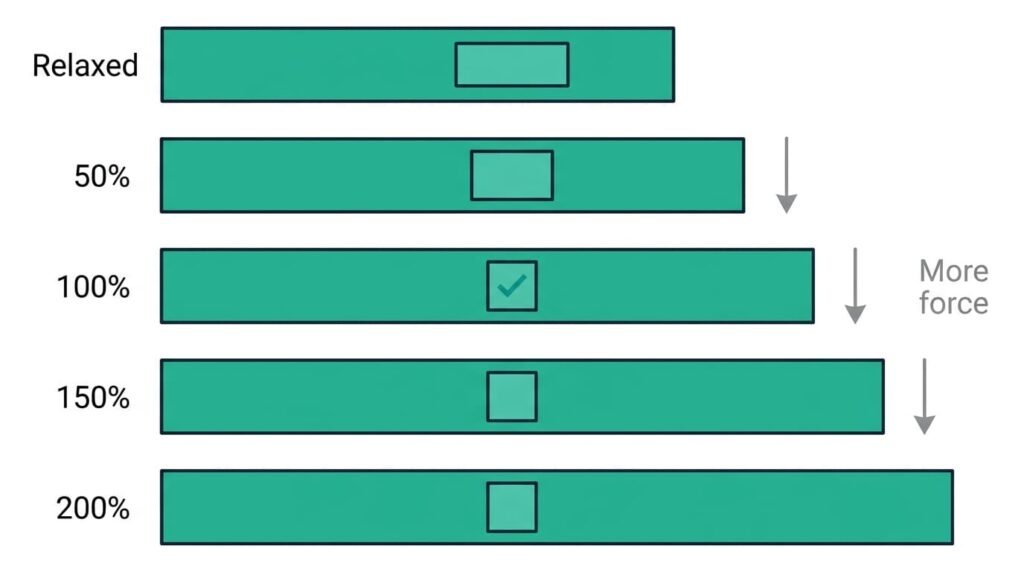
The key feature is the indicator. Printed at intervals along the band are small boxes. When the band is relaxed, each box is a rectangle. As you stretch the band, the box stretches too. When a particular level of elongation is reached, the box becomes a square.
According to retailer descriptions, each band has four patented indicators that show when 50, 100, 150 and 200 percent elongation has been reached. Each of those points corresponds to a specific amount of applied force for that color. So instead of guessing, you pull until the chosen box turns square, and you know you have applied the same force as last time.
| Indicator | Elongation | What it means in practice |
|---|---|---|
| First indicator | 50 percent | Band stretched to one and a half times its resting length. Light effort |
| Second indicator | 100 percent | Band stretched to double its resting length. A common working level |
| Third indicator | 150 percent | Two and a half times resting length. Harder |
| Fourth indicator | 200 percent | Three times resting length. Hardest level for that color |
Retailers summarise this as 20 measurable levels of progressive exercise: four indicator levels for each of five resistance colors. In other words, a CanDo AccuForce exercise band gives you small, repeatable steps between colors, rather than one big jump from green to blue.
Why measured resistance matters
Elastic bands have a quirk that weights do not: the resistance changes as you stretch them. The further you pull, the harder it gets. That is great for strength training, because it matches how many muscles get stronger through a movement, but it makes progress hard to track. Small differences in how far you stand from an anchor, how you wrap the band around your hand or how much slack you leave can change the effort a lot.
The indicators on the CanDo AccuForce exercise band give you a visual target. Pull to the same square each time, and the effort is far more consistent than it would be by feel alone. That consistency is useful for physiotherapists writing home exercise programmes, for people recovering from injury who need to progress carefully, and for anyone who simply likes to know they are getting stronger.
What the research says about elastic band training
There is no large body of research on the AccuForce product itself, but there is good evidence that elastic band training works and that measuring resistance matters.
- Elastic bands build strength as well as weights. A systematic review and meta-analysis of eight studies found no difference in strength gains between training with elastic devices, such as tubes and bands, and training with conventional equipment such as weight machines and dumbbells, for either the upper or lower body
- Muscle activation is comparable. A study of rehabilitation exercises found that, at each person’s maximal level, elastic tubing and dumbbells produced similarly high levels of muscle activation in the main muscles worked
- Small daily doses help. A randomised trial of office workers with frequent neck and shoulder pain found that just 2 minutes a day of progressive resistance training with elastic tubing, five days a week for 10 weeks, reduced pain and tenderness and increased strength compared with a control group
- Band resistance varies more than labels suggest. A technical study that measured the tension of eight colors of a well-known therapy band at different levels of stretch found significant differences between the measured values and the manufacturer’s reference values for five colors. That is a good reason to use a visual guide to stretch, like the AccuForce indicators, rather than relying on color alone
CanDo AccuForce exercise band colors and resistance levels
The CanDo AccuForce exercise band follows the familiar color order, from least to greatest resistance. Most retailers list five colors in the AccuForce range:
| Color | Resistance level | Typical uses |
|---|---|---|
| Yellow | X-light | Early rehab, small muscles such as the rotator cuff, older adults, very deconditioned beginners |
| Red | Light | Shoulder rehab, wrist and ankle work, gentle strength training |
| Green | Medium | General strength for most beginners, legs and hips, upper back |
| Blue | Heavy | Stronger muscles, rows, chest presses, leg work for fitter users |
| Black | X-heavy | Large muscle groups, strong users, advanced rehab stages |
Some sellers list the wider CanDo color scale, which also includes tan (lighter than yellow) and silver and gold (heavier than black), and one clinical supplier lists only four AccuForce colors. If you need a specific color, check the exact product code with your supplier before ordering. One retailer listing says squaring the first indicator on a yellow band takes about 1 pound of force, and squaring the last indicator on a black band takes about 9.75 pounds. I could not confirm a full manufacturer force chart, so treat those figures as approximate.
How the 20 levels fit together
Because each color has four indicators, the CanDo AccuForce exercise band creates a ladder of small steps. A typical progression might look like this:
| Step | Color | Target indicator |
|---|---|---|
| 1 | Yellow | 50 percent |
| 2 | Yellow | 100 percent |
| 3 | Yellow | 150 percent |
| 4 | Yellow | 200 percent |
| 5 | Red | 100 percent |
| 6 | Red | 150 percent |
| 7 | Red | 200 percent |
| 8 | Green | 100 percent |
| 9 | Green | 150 percent |
| 10 | Green | 200 percent |
Exactly where one color’s 200 percent overlaps with the next color’s lower levels depends on the bands, so use this as a guide. In practice, many people work between the 100 and 200 percent indicators, and move up a color when they can comfortably reach 200 percent for all their reps.
Sizes and formats
The CanDo AccuForce exercise band is sold in several formats. Product codes vary by seller, but these are the common options:
| Format | What you get | Best for |
|---|---|---|
| Pre-cut 4 foot lengths | Single bands ready to use, sometimes sold in boxes of many | Home users and clinics handing bands to patients |
| 6 yard roll | About 5.5 metres of band in a dispenser box, cut to length | Home users who want several lengths, small clinics |
| 50 yard roll | About 46 metres in a dispenser box | Busy clinics and gyms |
| 5-color sets | One of each color, yellow to black, as lengths or rolls | Progressive programmes, clinics, families |
| Intensity Loop | A separate, heavier closed loop product using AccuForce markers | Strength training such as assisted pull-ups and banded squats |
Every flat CanDo AccuForce exercise band is 5 inches wide. Rolls are designed to be cut with scissors to whatever length you need. Most upper body exercises use a length of about 4 feet (1.2 metres). Leg exercises and anchored exercises may need 5 to 6 feet.
What about the Intensity Loop?
CanDo also sells the Intensity Loop, a closed loop band about 1.5 inches wide that uses the same marker idea, but at much higher forces. Retailer listings describe the red Intensity Loop reaching 25 pounds at 100 percent and 40 pounds at 200 percent, with heavier colors going higher still. It is a different product designed for strength training, not the flat CanDo AccuForce exercise band this guide focuses on.
Who is the CanDo AccuForce exercise band for?
| Who | Why it suits them |
|---|---|
| Physiotherapy patients | Home exercises can be prescribed at an exact indicator, so progress is controlled |
| Physiotherapists and clinics | Clear, repeatable targets make programmes easier to explain and monitor |
| Older adults | Light colors and small steps suit gentle, progressive strength work |
| Beginners at home | A cheap, compact way to start strength training with measurable progress |
| People returning from injury | Small increments reduce the risk of doing too much too soon |
| Travellers | Flat bands weigh almost nothing and fold into a bag |
It is less suited to people who want very heavy resistance for big lifts, where weights, heavy loops or the Intensity Loop make more sense, and it is not suitable for anyone with a latex allergy.
How to set up your band
Cutting a length from a roll
Use sharp scissors and cut straight across the band. A clean cut reduces the risk of small nicks that can grow into tears. Measure your length with the band relaxed, not stretched. About 4 feet is right for most arm exercises, and 5 to 6 feet gives you room for leg exercises or tying a loop.
Holding the band
Wrap each end once around your hand and grip with the band lying flat across your palm. Avoid wrapping it many times or twisting it into a rope, which concentrates stress and can damage the band. Handles, sold separately by CanDo and others, make longer sessions more comfortable.
Anchoring the band
For rows, presses and rotations, you need a fixed anchor. A door anchor is the safest option. Close the door firmly on the anchor, on the hinge side if possible, and make sure the door opens away from you. Never tie a CanDo AccuForce exercise band to furniture that could move or tip.
Making a loop
For leg exercises such as side steps and clamshells, tie the ends together in a simple knot to make a loop. Check the knot is secure before you start, and keep the indicator boxes visible on the outside.
How to use the indicators properly
The indicators only help if you read them the same way every time. These tips make your CanDo AccuForce exercise band as consistent as possible:
- Mark your start position. Note how far you stand from the anchor or where you hold the band. A strip of tape on the floor is ideal
- Choose one indicator to watch. Usually one near the middle of the stretched section
- Pull until it squares. At the end of each rep, the chosen box should just become a square
- Record the color and indicator. For example, “green, 100 percent, 3 x 12”
- Progress in small steps. When the reps feel easy, move to the next indicator, then to the next color
| Week | Example shoulder external rotation programme |
|---|---|
| Week 1 | Yellow, 100 percent, 2 x 12 |
| Week 2 | Yellow, 150 percent, 2 x 12 |
| Week 3 | Yellow, 200 percent, 3 x 12 |
| Week 4 | Red, 100 percent, 3 x 12 |
| Week 5 | Red, 150 percent, 3 x 12 |
| Week 6 | Red, 200 percent, 3 x 12 |
That is the real strength of the CanDo AccuForce exercise band: progress you can see, step by step, rather than a big leap to the next color.
14 exercises with the CanDo AccuForce exercise band
Warm up for a few minutes first with marching, arm circles and gentle movement. Move slowly, take about two seconds to stretch the band and three seconds to let it return, and keep your joints soft rather than locked. Unless your physiotherapist says otherwise, start with 2 sets of 10 to 15 reps.
Upper body
1. Shoulder external rotation. Anchor the band at elbow height. Stand side-on with your elbow bent to 90 degrees and tucked at your side. Rotate your forearm outward to the target indicator, then return slowly. A staple of rotator cuff rehab, and a big part of our shoulder impingement exercises.
2. Shoulder internal rotation. Same set-up, facing the other way, rotating the forearm in toward your stomach.
3. Seated row. Sit with your legs straight and the band around your feet. Pull the ends toward your lower ribs, drawing your shoulder blades back. Our scapular retraction exercises guide explains the shoulder blade movement.
4. Band pull-apart. Hold the band in front of your chest with straight arms and pull your hands apart until the band touches your chest.
5. Chest press. Anchor the band behind you at chest height, or wrap it around your upper back, and press your hands forward.
6. Bicep curl. Stand on the middle of the band and curl your hands toward your shoulders.
7. Overhead tricep extension. Anchor one end under your back foot, hold the other behind your head and straighten your elbow. Our resistance band tricep workout has more options.
8. Lateral raise. Stand on the band and raise your arms out to the sides to shoulder height, thumbs slightly up.
Lower body
9. Seated knee extension. Sit on a chair with the band looped around one ankle and anchored to the chair leg behind you. Straighten the knee. Useful in knee rehab, and featured in our exercises for knee pain.
10. Ankle dorsiflexion and plantarflexion. Sit with your leg straight. Loop the band around the ball of your foot and point your toes away (plantarflexion), then anchor it in front and pull your toes toward you (dorsiflexion). Great after ankle sprains.
11. Clamshell. Tie a loop just above your knees. Lie on your side with knees bent and lift the top knee.
12. Side steps. With a loop around your ankles or above your knees, step sideways in a half squat. Our monster walks guide covers variations.
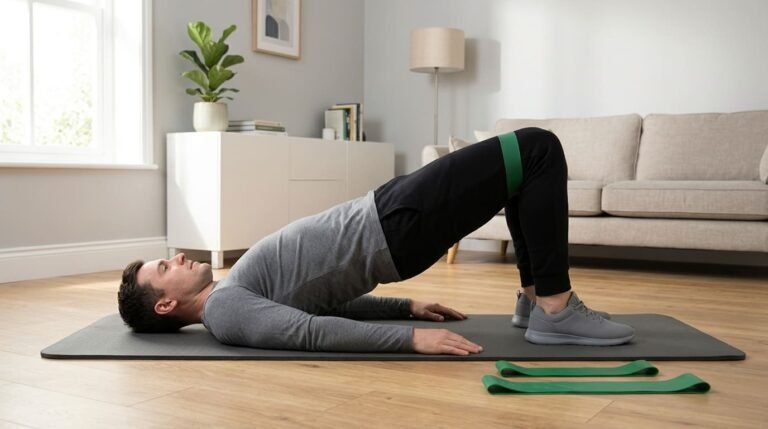
13. Glute bridge. With a loop above your knees, lift your hips while pressing your knees gently outward.
14. Standing hip extension. Anchor the band low in front of you and loop it around one ankle. Keeping your body upright, take the leg straight back.
| Exercise | Main muscles | Typical starting color |
|---|---|---|
| Shoulder external rotation | Rotator cuff | Yellow or red |
| Shoulder internal rotation | Subscapularis | Yellow or red |
| Seated row | Upper back, biceps | Green |
| Band pull-apart | Rear shoulders, upper back | Yellow or red |
| Chest press | Chest, triceps | Green or blue |
| Bicep curl | Biceps | Red or green |
| Overhead tricep extension | Triceps | Red or green |
| Lateral raise | Side shoulders | Yellow or red |
| Seated knee extension | Quadriceps | Red or green |
| Ankle dorsiflexion and plantarflexion | Shin and calf | Red or green |
| Clamshell | Side of the hip | Red or green |
| Side steps | Hip abductors | Red or green |
| Glute bridge | Glutes | Green or blue |
| Standing hip extension | Glutes, hamstrings | Red or green |
Our guides to the resistance band leg workout and resistance band ab workout give you full routines you can follow with a CanDo AccuForce exercise band.
A simple 20-minute full-body routine
Do this two or three times a week with a rest day in between. Pick a color and indicator that lets you finish each set with two or three reps in reserve.
| Exercise | Sets x reps |
|---|---|
| Seated row | 3 x 12 |
| Chest press | 3 x 10 to 12 |
| Band pull-apart | 2 x 15 |
| Bicep curl | 2 x 12 |
| Overhead tricep extension | 2 x 12 |
| Side steps | 2 x 12 each way |
| Glute bridge | 3 x 15 |
| Standing hip extension | 2 x 12 each leg |
Our guide to sets and reps explains how to adjust the numbers for your goal.
How it compares with other bands
| Band type | Measurable resistance | Width and feel | Best for |
|---|---|---|---|
| CanDo AccuForce exercise band | Yes, visual indicators at 50 to 200 percent | 5 inch flat latex | Rehab, measured home programmes |
| Standard CanDo exercise band | No, color only | 5 inch flat latex, latex-free versions available | General rehab and fitness |
| Other flat therapy bands | Usually no | Often 4 to 6 inch flat | General rehab and fitness |
| Mini loop bands | No | Narrow closed loops | Glute and hip work |
| Tube bands with handles | No | Round tubing with handles | Strength training, travel |
| Heavy loop bands, including the Intensity Loop | Intensity Loop yes, most others no | Long, thick loops | Assisted pull-ups, heavy strength work |
If you want a broader overview of band types, our guide to the best resistance bands for beginners explains the pros and cons of each.
AccuForce vs the standard CanDo exercise band
The standard CanDo exercise band and the CanDo AccuForce exercise band share the same basic format and color system. The difference is the printed indicators. If you are following a physiotherapy programme that specifies exact progressions, or you like tracking your training precisely, the AccuForce band is worth the small extra cost. If you just want a band for general warm-ups, or you need a latex-free option, the standard range may suit you better.
Safety, latex and care
Latex allergy
The CanDo AccuForce exercise band is made of natural rubber latex, and listings carry a warning that it may cause allergic reactions. Low powder reduces the amount of powder on the band, but it does not make it latex-free. If you or anyone in your household has a latex allergy, do not use it. CanDo makes latex-free versions of its standard exercise band, so ask your supplier for those instead.
Inspect before every use
- Check the whole band for nicks, tears, thin spots and sticky or brittle patches
- Replace the band if you find any damage. A band that snaps can whip back toward your face
- Keep it away from sharp jewellery, long nails and rough surfaces
Care and storage
- Store it away from direct sunlight, heat and radiators, which break down latex
- Keep it clean and dry. Wipe with a damp cloth and let it air dry if needed
- Avoid oils, lotions and solvents, which can weaken latex
- Follow any care instructions that come with your band
Safe technique
- Never stretch the band beyond about three times its resting length, which is beyond the 200 percent indicator
- Keep the band away from your face, and do not release it suddenly while stretched
- Make sure anchors are secure before you pull
- Keep movements slow and controlled
- Stop if you feel sharp pain, and follow your physiotherapist’s guidance after injury or surgery
Some retailer listings also carry a California Proposition 65 chemical warning, which is common for latex and vinyl products sold in the United States.
This article is general information, not medical advice. If you are using a CanDo AccuForce exercise band for rehabilitation, follow the colors, indicators and exercises your physiotherapist recommends. See our medical disclaimer.
Buying tips
- Check the product code. AccuForce products have their own codes, separate from the standard CanDo exercise band. A mistake here is easy to make
- Pick the right format. A pre-cut length or a 6 yard roll suits most home users. A 50 yard roll is really for clinics
- Start light. If you are unsure, start one color lighter than you think you need. The indicators give you room to progress
- Consider a set. A five-color set lets you progress for months and use different colors for different muscles
- Check the seller. Some medical suppliers sell only to clinical buyers. Others sell to anyone
- Confirm latex-free needs before ordering, because the AccuForce band contains latex
Common mistakes
- Ignoring the indicators, which turns a measurable band into a guesswork band
- Changing your starting position from session to session, so the indicators mean different things
- Jumping a whole color when the next indicator would do
- Using a band that is too long or too short, so you cannot reach the right indicator comfortably
- Snapping the band back instead of controlling the return
- Storing it on a sunny windowsill, which shortens its life
- Using it with a latex allergy
The bottom line
The CanDo AccuForce exercise band is a simple idea done well. It takes a standard 5 inch flat latex therapy band and adds indicators that turn from rectangles to squares at 50, 100, 150 and 200 percent stretch, so you can see and repeat the force you apply. With five colors from yellow to black, that gives you 20 small, measurable steps of progress.
If you are doing physiotherapy at home, returning from injury, or just want to know your band workouts are really getting harder, the CanDo AccuForce exercise band is one of the most practical tools you can buy. Choose a sensible starting color, mark your position, pull to the same square every time and write it down. For someone like me who spent years guessing with plain bands, that small square is a genuinely useful upgrade.
Prefer pre-formed loops to flat bands? My guide to the CanDo band exercise loop 3 piece set explains the three sizes and 18 exercises to do with them.
Frequently asked questions
What is a CanDo AccuForce exercise band?
It is a flat, 5 inch wide, low powder latex resistance band made by CanDo. Printed indicators change from rectangles to squares as you stretch it, showing when you reach 50, 100, 150 and 200 percent elongation, so you can apply a measurable, repeatable force.
How do the AccuForce indicators work?
Small rectangles are printed on the band. As you stretch it, they lengthen. When a specific level of elongation is reached, the rectangle becomes a square. Each of the four indicators corresponds to a specific amount of applied force for that color.
What colors does the CanDo AccuForce exercise band come in?
Most retailers list yellow (x-light), red (light), green (medium), blue (heavy) and black (x-heavy). Some list the wider CanDo scale including tan, silver and gold, so check the product code with your supplier.
Is the CanDo AccuForce exercise band latex-free?
No. It is made of natural rubber latex and is labelled low powder, not latex-free. People with a latex allergy should not use it. CanDo makes latex-free versions of its standard exercise band.
Which color should a beginner start with?
Many beginners start with yellow or red for shoulder and small muscle work, and green for larger muscles such as the legs and upper back. If unsure, start lighter. The indicators let you progress in small steps.
How long should my band be?
About 4 feet (1.2 metres) works for most upper body exercises. Leg exercises and anchored exercises may need 5 to 6 feet. Rolls can be cut to any length with sharp scissors.
How is the AccuForce band different from a regular CanDo exercise band?
Both are flat 5 inch latex bands with the same color system. The AccuForce band adds printed force indicators, which make resistance measurable and repeatable. The standard band relies on color and feel alone.
How often should I replace my band?
Replace it as soon as you see nicks, tears, thin spots or sticky or brittle patches. With regular use and careful storage away from sunlight and heat, a band usually lasts many months, but inspect it before every session.
What’s next?
Reading is the easy part. Pick one of these and do it today.