Teres Major Exercises: 10 Moves for the Lat’s Little Helper
The teres major is a small, thick muscle that runs from the bottom corner of your shoulder blade to the front of your upper arm. You have almost certainly trained it without knowing its name, because it works on every pull-up, pulldown and row you have ever done.
Anatomists sometimes call it the lat’s little helper, and the nickname is accurate. It does the same three jobs as the latissimus dorsi, attaches right beside it, and fires alongside it. The difference is where it starts: the lat comes from your spine and pelvis, while the teres major comes from your shoulder blade. That one detail explains how to emphasise it, why it gets tight, and why it is so often confused with a completely different muscle that sits just above it.
This guide clears up the teres major versus teres minor confusion, explains honestly how far you can target it, gives you ten exercises for home and gym, and covers what to do when the area at the back of your armpit feels knotted and sore.
At a glance
- The teres major pulls the arm down, back and into internal rotation, the same actions as the lat
- It is not part of the rotator cuff. The teres minor is, and does the opposite rotation
- You cannot isolate it, but pulling with the arm close to the body emphasises it
- Pull-ups, pulldowns, rows, pullovers and straight-arm pulldowns all train it
- It attaches to the shoulder blade, so shoulder blade control decides how well it works
- Tightness at the back of the armpit often traces to this muscle
Where it is and what it does
| Feature | Teres major |
|---|---|
| Starts at | The lower outer corner of the shoulder blade, on the back surface |
| Attaches to | The front of the upper arm bone, right beside the lat tendon |
| Shape | Short, thick and rounded |
| Nerve | Lower subscapular nerve |
| Part of the rotator cuff? | No |
Its three actions at the shoulder:
- Extension: pulling the arm down and back from in front of you, as in a straight-arm pulldown
- Adduction: pulling the arm in toward your side from a raised position, as in a wide pulldown
- Internal rotation: turning the upper arm inward
Those are exactly the actions of the latissimus dorsi. The two tendons run together and attach side by side on the upper arm, which is why the muscles almost always work as a pair.
The detail that matters for training: because the teres major starts on the shoulder blade rather than the spine, it can only pull effectively if the shoulder blade is held steady. The rhomboids and middle trapezius anchor the blade, and the teres major pulls the arm from that anchored base. If your shoulder blades slide around during a pull, this muscle loses its platform.
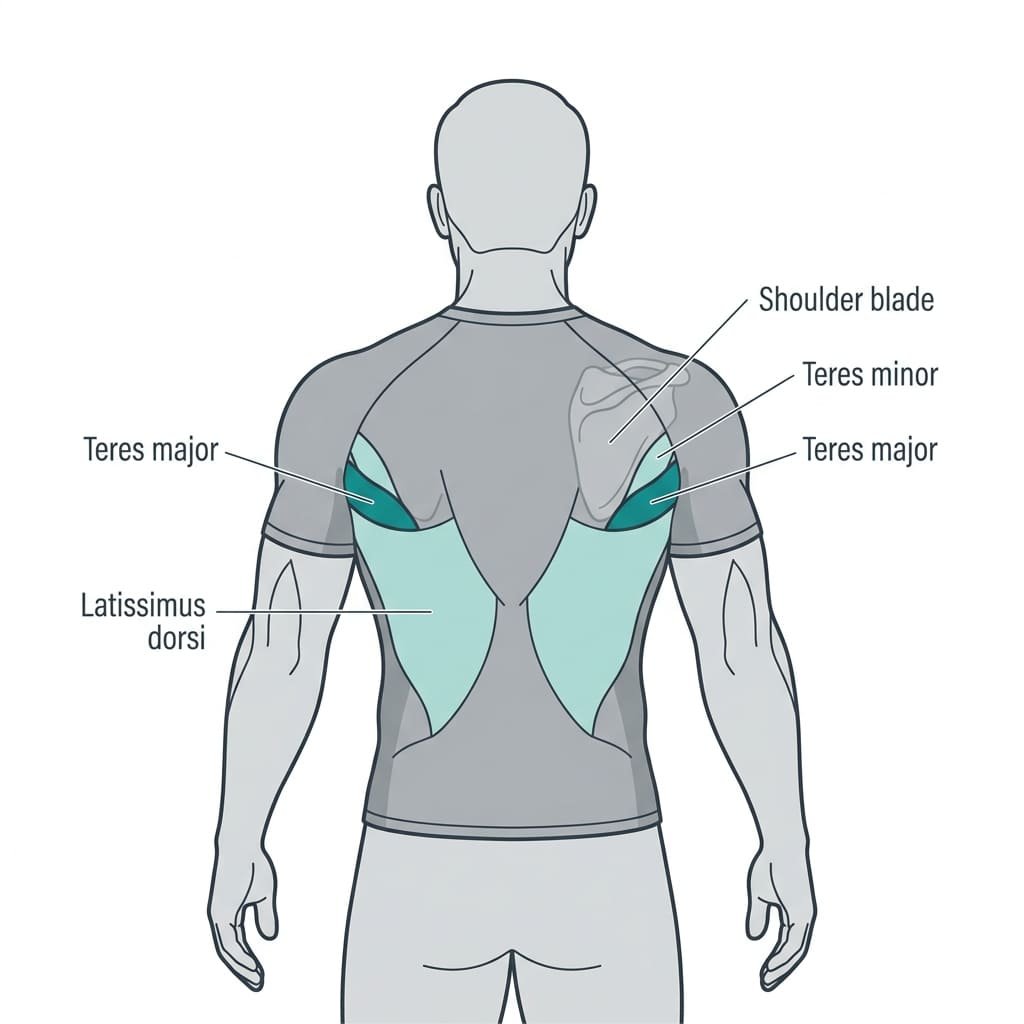
Teres major versus teres minor
The names suggest a big and small version of the same muscle. They are not. They sit next to each other and do opposite jobs.
| Feature | Teres major | Teres minor |
|---|---|---|
| Position | Lower, at the bottom corner of the shoulder blade | Just above, along the outer edge of the blade |
| Rotator cuff member? | No | Yes, one of the four |
| Rotation it produces | Internal, turning the arm inward | External, turning the arm outward |
| Main partner | Latissimus dorsi | Infraspinatus |
| Main role | Powerful pulling | Stabilising the shoulder joint |
| Attaches to | Front of the upper arm | Back of the upper arm, at the joint capsule |
| Best trained by | Pull-ups, rows, pulldowns | External rotations, face pulls |
| Typical load | Moderate to heavy | Light, high reps |
Why this matters in practice. A programme with plenty of pulling builds the teres major, which rotates the arm inward. Add pressing, which trains other internal rotators, and you have a lot of inward pull on the shoulder. The teres minor and infraspinatus provide the opposite pull. Training both sides keeps the shoulder balanced, which is why the routine below includes external rotation work even though this article is about the teres major.
Can you target the teres major?
Not in isolation, and it is worth being honest about that. The teres major and the lat share their actions and their attachment, and your nervous system recruits them together. Any exercise for one trains the other.
What you can do is shift the emphasis a little.
| Variable | Effect on teres major emphasis |
|---|---|
| Arm path close to the body | Tends to favour the teres major and lower lat |
| Neutral or underhand grip | Slightly more teres major involvement than a very wide overhand grip |
| Pulling from a stretched, overhead position | Loads it in its lengthened range |
| Shoulder blades held steady | Lets it pull the arm rather than drag the blade |
| Very wide grip | Shifts emphasis toward the upper lat |
The practical takeaway: you do not need special exercises. You need the pulling exercises you already know, performed with the elbows travelling close to your sides, a full stretch at the top and steady shoulder blades. If your back training already includes a vertical pull and a horizontal pull, your teres major is being trained.
If your goal is simply a stronger, wider back, you do not need to think about this muscle separately. This level of detail matters most when the area feels tight or sore, or when you are curious about what you are training.
10 teres major exercises
At home with dumbbells or a band
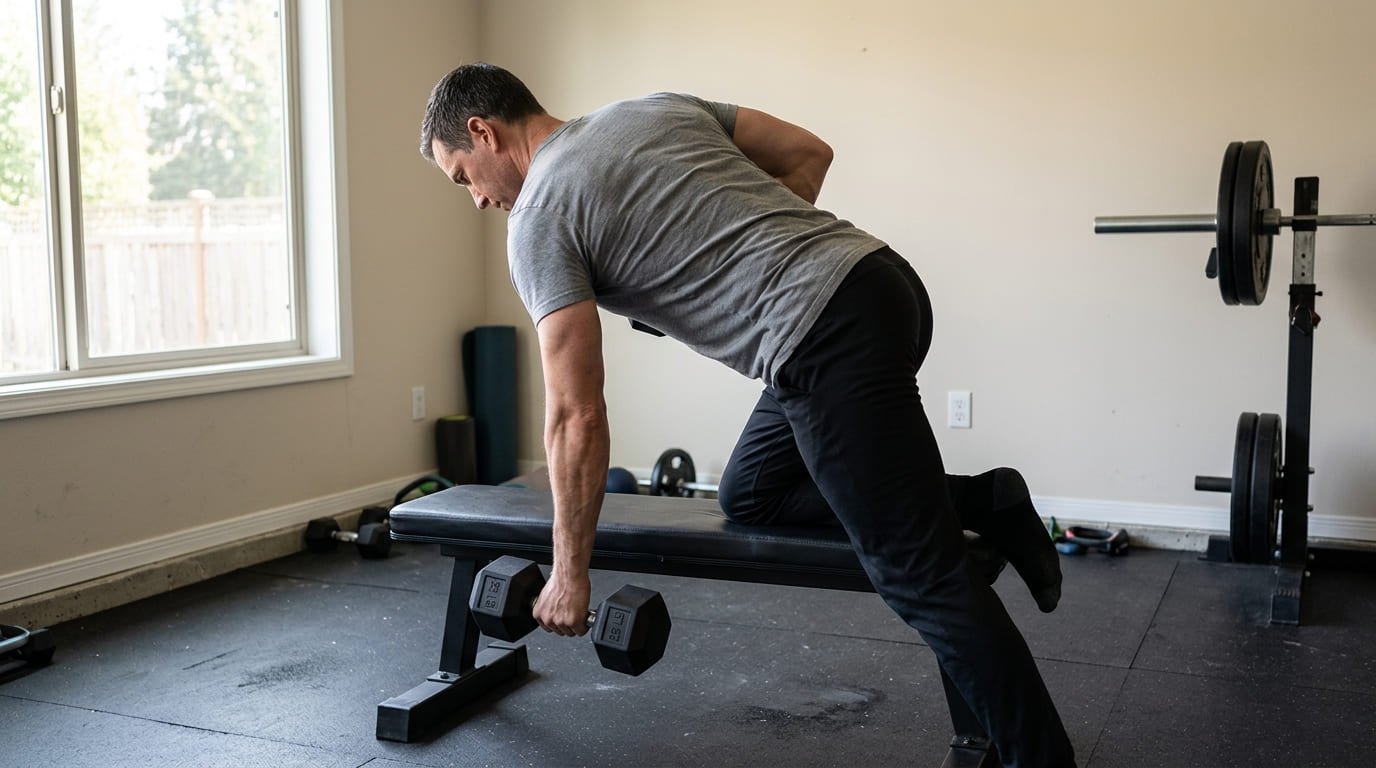
1. Single-arm dumbbell row
Support yourself on a chair or bench, hinge forward and row a dumbbell toward your hip, keeping the elbow close to your side.
- Reps: 3 to 4 sets of 8 to 12 per side
- Row to the hip, not the chest. The lower arm path is what biases the teres major and lower lat
2. Dumbbell pullover
Lie on the floor or across a sofa, hold one dumbbell above your chest with both hands, and lower it back over your head with slightly bent elbows. Pull it back using your back muscles rather than your arms.
- Reps: 3 sets of 10 to 12
- The best home exercise for loading it in a stretched position
3. Straight-arm band pulldown
Anchor a band above head height. With arms nearly straight, pull the band down to your thighs in an arc.
- Reps: 3 sets of 12 to 15
- This is pure shoulder extension, which removes the biceps and puts the work on the lats and teres major
4. Inverted row with an underhand grip
Lie under a sturdy table or a low bar and pull your chest up to it with palms facing you, elbows close to your ribs.
- Reps: 3 sets of 8 to 12
5. Low-to-high band row
Anchor a band low. With a slight forward lean, pull the handle up and back toward your hip, squeezing at the end.
- Reps: 3 sets of 12 per side
Our back workout with dumbbells at home guide has more rowing variations that fit here.
In the gym
6. Chin-up or neutral-grip pull-up
Pull from a dead hang until your chin clears the bar, with palms facing you or each other.
- Reps: 3 to 4 sets of 5 to 10
- Start each rep by setting the shoulder blades down, then pull
7. Neutral-grip lat pulldown
Using a handle that lets your palms face each other, pull to the upper chest with the elbows driving down toward your ribs.
- Reps: 3 sets of 8 to 12
8. Straight-arm cable pulldown
The cable version of exercise 3, which keeps tension constant through the whole range.
- Reps: 3 sets of 12 to 15
9. Seated cable row, close grip
Row a close handle to your lower ribs, keeping your torso still.
- Reps: 3 sets of 10 to 12
If you cannot yet do a pull-up, our pull up alternatives guide covers the progression.
For shoulder balance
10. Side-lying external rotation
Lie on your side with the top elbow bent to 90 degrees and tucked against your ribs, holding a very light dumbbell. Rotate the forearm up toward the ceiling, then lower slowly.
- Reps: 2 to 3 sets of 15 per side
- This trains the teres minor and infraspinatus, the muscles that oppose the teres major’s inward rotation
Two short routines
Home routine, about 20 minutes
| Exercise | Sets | Reps | Rest |
|---|---|---|---|
| Dumbbell pullover | 3 | 10 to 12 | 75 sec |
| Single-arm dumbbell row | 3 | 10 per side | 60 sec |
| Straight-arm band pulldown | 3 | 15 | 45 sec |
| Underhand inverted row | 3 | 8 to 12 | 75 sec |
| Side-lying external rotation | 2 | 15 per side | 30 sec |
Gym routine, about 25 minutes
| Exercise | Sets | Reps | Rest |
|---|---|---|---|
| Chin-up or neutral-grip pull-up | 4 | 5 to 10 | 2 min |
| Seated cable row, close grip | 3 | 10 to 12 | 90 sec |
| Neutral-grip lat pulldown | 3 | 10 to 12 | 75 sec |
| Straight-arm cable pulldown | 3 | 12 to 15 | 60 sec |
| Face pull or external rotation | 3 | 15 | 45 sec |
Either routine slots into the pulling half of a week. Our pull day workout guide shows how it fits into a full session, and how vertical and horizontal pulling balance out.
Sets, reps and frequency
| Goal | Weekly pulling sets | Rep range | Frequency |
|---|---|---|---|
| General fitness | 8 to 10 | 10 to 15 | 1 to 2 sessions |
| Building muscle | 12 to 18 | 6 to 15 | 2 sessions |
| Shoulder balance and health | 8 to 12, plus external rotation work | 10 to 20 | 2 sessions |
- Count these as back sets. The teres major is trained by your back work, so there is no need to add extra volume on top
- Use a full range. Let the arms reach fully overhead at the top of a pulldown so the muscle is loaded in its stretched position
- Leave 48 hours between hard pulling sessions
- Add one set of external rotation for every three or four sets of pulling
Three technique cues that change the feel
1. Set the shoulder blade first
Before each pull, draw your shoulder blades slightly down and back, then move the arm. This gives the teres major a stable base. If your shoulders shrug toward your ears as you pull, the upper traps have taken over.
2. Drive the elbow, not the hand
Think about pulling your elbow toward your back pocket. Leading with the hand turns the movement into a biceps exercise.
3. Own the stretch
At the top of a pulldown or the bottom of a pullover, pause for a second in the lengthened position before starting the next rep. Much of the benefit, and most of the mobility, comes from loading that range.
If your teres major feels tight or sore
A knotted, tender spot at the back of the armpit, just below the shoulder joint, is a common complaint. It often shows up after a jump in pull-up volume, a lot of swimming or climbing, or long periods with the arms held forward at a desk.
What tends to help:
- Ball release: stand side-on to a wall with a tennis or massage ball trapped between the wall and the back of your armpit. Lean in gently and move slowly for 60 to 90 seconds
- Overhead lat and teres stretch: hold a door frame with one hand above head height, sit your hips back and lean away, letting the side of your back lengthen. Hold 30 seconds per side
- Child’s pose with a side reach: from kneeling, walk both hands to one side and sink back. Hold 30 seconds per side
- Sleeper or cross-body stretch: for the back of the shoulder generally
- Reduce pulling volume by a third for a week or two rather than stopping completely
| What you feel | More likely | What to do |
|---|---|---|
| A tender knot at the back of the armpit after heavy pulling | Muscular tightness | Ball release, stretching, reduce volume briefly |
| Tightness reaching overhead, arm will not fully straighten up | Short lats and teres major | Overhead stretches and pullovers through full range |
| Pain at the front of the shoulder when lifting the arm | Often not this muscle | Get it assessed |
| Pain with weakness, numbness or tingling down the arm | Not a simple muscle issue | See a doctor or physiotherapist |
| Sudden sharp pain during a pull or throw | Possible strain | Stop, rest, and seek assessment |
Tight lats and teres major limit overhead reach. If you cannot raise your arms fully overhead without your ribs flaring or your back arching, these muscles are often part of the reason. Our rib flare exercises guide covers the overhead reach test that reveals it.
A 4-minute warm-up before pulling
A short warm-up makes pulling feel better and gives the shoulder blades the control this muscle depends on.
- Arm circles: 20 seconds each direction
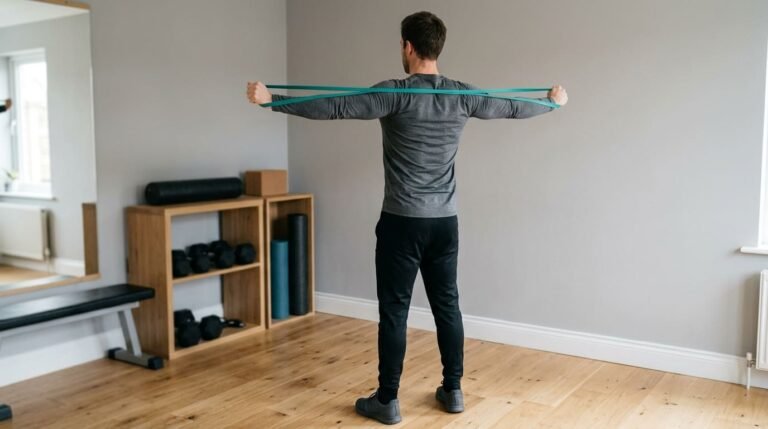
- Band pull-aparts: 15 reps, squeezing the shoulder blades together
- Scapular pull-downs: hang from a bar or hold a band overhead and pull the shoulder blades down without bending the elbows, 10 reps
- Overhead lat stretch on a door frame: 20 seconds per side
- Light external rotations: 12 per side with a band or very light dumbbell
- One easy set of your first exercise at about half your working weight
The scapular pull-down is the most relevant step. It rehearses exactly the first movement of every pull-up and pulldown, where the blade sets before the arm moves.
Why this muscle matters outside the gym
It is easy to treat a small muscle as a detail for bodybuilders, but the teres major is involved in a surprising amount of ordinary movement.
- Pulling yourself up out of a pool, onto a ledge or up a climbing wall
- Swimming, where it drives the arm back through the water in freestyle and butterfly
- Rowing and paddling, on water or on a machine
- Chopping, raking and digging, all of which pull the arm down and back against resistance
- Throwing, where it helps accelerate the arm and then slow it down
- Carrying shopping, where it helps hold the arm firmly against your side
- Pushing yourself up from a chair using the armrests
It also contributes to how your back looks from behind. A developed teres major adds thickness just below the back of the shoulder, at the top of the lat, which is part of what gives the upper back its shape. That is a pleasant side effect of good pulling work rather than a reason to train it separately.
Seven common mistakes
- Shrugging during pulls, which shifts the work to the upper traps
- Cutting the range short at the top of pulldowns and missing the stretched position
- Pulling with the hands, so the biceps tire before the back does
- Using only a very wide grip, which emphasises the upper lat
- Swinging the torso on rows and pulldowns to move more weight
- Ignoring external rotation, leaving the shoulder pulled inward
- Chasing isolation, when good general pulling already covers this muscle
The bottom line
The teres major is the lat’s partner. It pulls your arm down, back and inward, it attaches right beside the lat, and it is trained by every vertical and horizontal pull you do.
You cannot isolate it, and you do not need to. Keep your elbows close to your sides, use a neutral or underhand grip on some of your pulling, take each rep to a full stretch, and hold your shoulder blades steady so the muscle has a firm base to work from. Pullovers and straight-arm pulldowns are the two exercises that emphasise it most.
Then balance it. Add a little external rotation work for the teres minor and infraspinatus, which rotate the arm the other way, and deal with any tightness at the back of the armpit with a ball and an overhead stretch before it turns into a problem.
For the muscle that holds the shoulder blade flat against the ribs, see our winged scapula exercises.
Frequently asked questions
What does the teres major muscle do?
It extends the shoulder, pulling the arm down and back, adducts it, pulling the arm toward the body, and internally rotates the upper arm. These are the same actions as the latissimus dorsi, and the two muscles attach side by side and work together during pulling movements.
What are the best teres major exercises?
Pull-ups and chin-ups, neutral-grip lat pulldowns, single-arm dumbbell rows pulled toward the hip, dumbbell pullovers and straight-arm pulldowns. Pullovers and straight-arm pulldowns emphasise it most because they involve pure shoulder extension with the arm travelling close to the body.
What is the difference between teres major and teres minor?
The teres major is not part of the rotator cuff. It internally rotates the arm and works with the lats for pulling. The teres minor is one of the four rotator cuff muscles, externally rotates the arm and stabilises the shoulder joint. They sit next to each other and perform opposite rotations.
Can you isolate the teres major?
No. It shares its actions and attachment point with the latissimus dorsi, so both are recruited together. You can shift emphasis slightly by keeping the elbows close to the body, using a neutral or underhand grip, and loading the fully stretched overhead position.
How do I release a tight teres major?
Stand side-on to a wall with a tennis or massage ball between the wall and the back of your armpit, and lean in gently for 60 to 90 seconds. Follow with an overhead stretch holding a door frame and leaning away, for 30 seconds per side. Reduce pulling volume for a week or two.
Can I train the teres major at home?
Yes. Dumbbell pullovers, single-arm dumbbell rows, straight-arm band pulldowns and underhand inverted rows under a sturdy table all train it without gym equipment. A resistance band anchored above a door covers the pulldown movements well.
Is the teres major part of the rotator cuff?
No. The rotator cuff consists of the supraspinatus, infraspinatus, teres minor and subscapularis. The teres major does not attach to the shoulder joint capsule, so it is not included, even though its name and position cause frequent confusion with the teres minor.
Why does the back of my armpit hurt after pull-ups?
Usually muscular tightness or soreness in the teres major and lat after a jump in pulling volume. It typically settles with a few days of reduced volume, ball release and overhead stretching. Sharp pain, weakness, or numbness and tingling down the arm should be assessed by a professional.
What’s next?
Reading is the easy part. Pick one of these and do it today.