
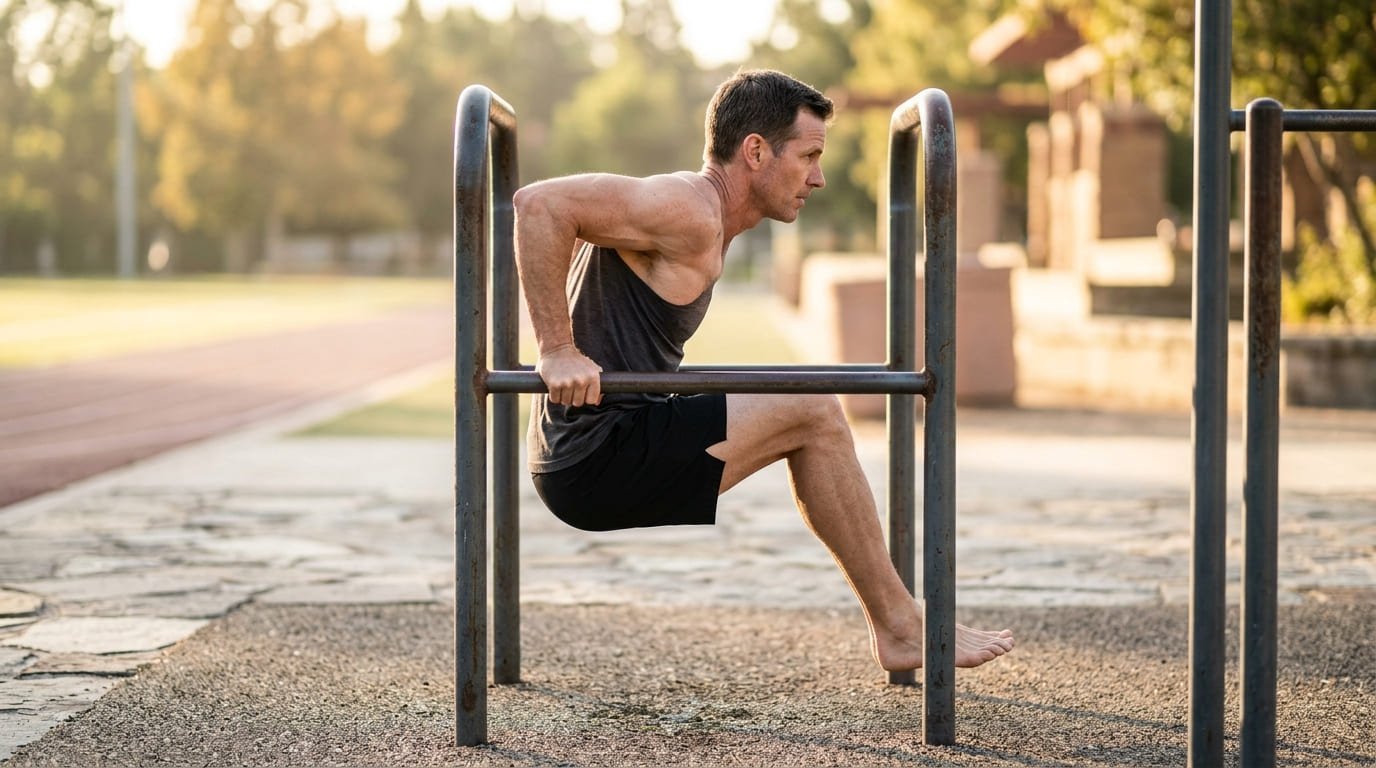
The Dip Exercise: Form, Chest vs Triceps, and Your First Rep
The dip is one of the few bodyweight exercises that can genuinely build strength for years. You start unable to do one, then you can do ten, then you hang a weight from your waist and keep going. Very few movements scale that far without a barbell.
It is also one of the easiest to do badly, and one of the most likely to irritate a shoulder when you do. That combination is why this guide spends as much time on the setup and the progression as on the exercise itself.
Two things here that most dip articles skip. First, a proper six-stage progression for the large number of people who cannot yet do a single rep, because “do dips” is useless advice if you cannot do one. Second, an honest look at bench dips, which are the variation most often recommended to beginners and are actually the hardest version on your shoulders.
At a glance
- Dips train chest, triceps and front shoulders in one movement
- Leaning forward emphasises the chest, staying upright emphasises the triceps
- Lower until your upper arms are roughly parallel to the floor, no deeper at first
- Bench dips place the shoulder in its most vulnerable position, despite being the usual beginner recommendation
- A six-stage progression below takes you from zero to your first full rep
- Once you can do 10 to 12 clean reps, add weight rather than chasing higher numbers
What the dip actually trains
| Muscle | How much work it does | What increases its share |
|---|---|---|
| Pectoralis major, lower fibres | Substantial | Leaning the torso forward, wider grip |
| Triceps, all three heads | Substantial | Staying upright, narrow grip, full lockout |
| Anterior deltoid | Moderate | Present in every variation |
| Rhomboids and lower traps | Stabilising | Holding the shoulder blades down and back |
| Core | Stabilising | Keeping the legs still rather than swinging |
The dip is a compound push, which makes it the pulling movement’s mirror image on push day. The useful thing about it is the range: the bottom position stretches the chest and the front of the shoulder further than most pressing exercises, which is part of why it builds so well and also why the setup matters so much.
Chest dips versus tricep dips
Same exercise, two setups, genuinely different emphasis. This is the single most useful thing to understand about dips.
| Element | Chest emphasis | Triceps emphasis |
|---|---|---|
| Torso | Leaned forward 20 to 30 degrees | Upright, almost vertical |
| Elbows | Allowed to travel out at roughly 45 degrees | Tucked close to the ribs, pointing backwards |
| Grip width | Slightly wider | Shoulder width or narrower |
| Legs | Bent and tucked behind you | Hanging straight down |
| Chin | Tucked toward the chest | Looking straight ahead |
| Bottom position | Chest lowered toward the level of the bars | Upper arms to parallel, body upright |
Pick one and hold it for the whole set. The most common error is drifting between the two, starting upright and collapsing into a forward lean as you tire. That moving target is where shoulders get irritated, because the joint keeps changing its position under load.
If you want more tricep-focused options that do not involve a dip station, our tricep exercises at home guide covers nine alternatives.
How to do a dip properly
- Grip the bars with your palms facing inward and your arms straight, supporting your body weight
- Set your shoulder blades down and back before you move. This is the most important cue in the whole exercise. Think about pushing your shoulders away from your ears
- Brace your core and tuck your legs, either bent behind you or hanging straight
- Lower under control, taking two to three seconds, in whichever elbow path your chosen variation calls for
- Stop when your upper arms reach roughly parallel to the floor. Deeper is not automatically better, particularly early on
- Press back up by driving through your palms, keeping the same torso angle you descended with
- Stop just short of locking out if your elbows are sensitive, otherwise finish with arms straight
The single biggest form error is letting the shoulders shrug up toward the ears at the bottom. When that happens, the shoulder blade loses its stable base and the load transfers onto the joint capsule at the front of the shoulder. If you feel a pinch at the front of your shoulder, this is almost always why.
How deep should you go?
This causes more argument than it deserves, and the honest answer depends on you.
- Upper arms to parallel is a sensible target for most people and covers the productive range
- Slightly below parallel increases the chest stretch and can build more, if your shoulders tolerate it comfortably
- Much deeper than that puts the shoulder into an extended, internally rotated position under full body weight, which is where problems tend to start
The rule that works: go as deep as you can while keeping your shoulder blades pinned down and back. The moment they shrug up or your shoulder starts to roll forward, that is your floor for now. Depth often improves on its own as you get stronger and your shoulders adapt.
A sharp pinch at the front of the shoulder is a stop signal, not something to push through. A stretch across the chest is normal. The two feel different, and the difference matters.
Six stages to your first dip
Most beginners cannot do a single dip, and telling them to do dips anyway is why so many give up on the exercise. Work through these in order, moving on when you can hit the target comfortably.
| Stage | Exercise | Target before moving on |
|---|---|---|
| 1 | Incline push-up on a counter or table | 3 sets of 15 |
| 2 | Support hold on the bars, arms locked, shoulders down | 3 holds of 30 seconds |
| 3 | Band-assisted dip, or feet on the floor between low bars | 3 sets of 8 |
| 4 | Negative dip: jump to the top, lower for 5 seconds | 3 sets of 5 |
| 5 | Partial dip, lowering a third of the way and pressing up | 3 sets of 8 |
| 6 | Full dip | Your first rep |
How each stage works:
- The support hold is the most underrated stage. Simply holding yourself at the top with locked arms and depressed shoulder blades builds the stability the movement needs, and it teaches the shoulder position before any load moves
- Band assistance means looping a resistance band across the bars and kneeling in it. A thicker band removes more body weight
- Negatives build strength fast because you are far stronger lowering than pressing. Five seconds down, step off, repeat
- Partials bridge the gap between negatives and full reps, and you extend the range as you get stronger
Expect four to eight weeks from stage one to your first rep if you are starting from scratch and training twice a week. Some people take longer, and that is normal rather than a failure.
The problem with bench dips
Bench dips are the version nearly every beginner article recommends, usually because they need no equipment beyond a chair. They deserve a caveat that almost nobody gives them.
In a bench dip, your hands are behind your body and fixed in place while your body travels straight down. That forces your shoulder into extension with the arm internally rotated, under your body weight, with no ability to adjust. It is the position most likely to compress the structures at the front of the shoulder.
Compare that with a parallel bar dip, where your hands are beside your body and your torso can find a comfortable angle. The shoulder stays in a much friendlier position throughout.
This does not make bench dips forbidden. Plenty of people do them without any trouble. But if you have any shoulder history, or you feel anything at the front of the joint, they are a poor first choice.
Better beginner alternatives:
- Close-grip push-ups, which train the same muscles with the shoulder in a far safer position
- Diamond push-ups, once close-grip feels easy
- Band-assisted parallel bar dips, if you have access to bars
- Overhead or lying tricep extensions, which isolate the triceps without loading the shoulder joint
If you do bench dips anyway, keep your hands close to your body, do not drop below a 90-degree elbow bend, and keep your bottom close to the bench rather than walking your feet far out.
Seven dip variations
| Variation | Difficulty | Best for |
|---|---|---|
| Bench or chair dip | Easiest | Convenience, but see the caveat above |
| Band-assisted dip | Adjustable | Building toward your first full rep |
| Machine-assisted dip | Adjustable | Gyms with an assisted dip station |
| Parallel bar dip, upright | Moderate | Triceps emphasis |
| Parallel bar dip, leaning forward | Moderate | Chest emphasis |
| Weighted dip | Hard | Progressing once bodyweight is easy |
| Ring dip | Hardest | Advanced stability, not a beginner option |
Rings deserve a warning. The instability recruits far more stabilising muscle, which is genuinely useful, but it also means the shoulder has to control a moving support under full body weight. Build a solid base of 12 or more clean bar dips before going anywhere near them.
Sets, reps and where dips fit
| Your level | Sets and reps | Frequency |
|---|---|---|
| Working toward your first rep | 3 to 4 sets of your current progression | 2 to 3 times a week |
| Can do 1 to 5 reps | 4 sets of 2 to 4, stopping well short of failure | 2 times a week |
| Can do 6 to 12 reps | 3 to 4 sets of 6 to 10 | 2 times a week |
| Can do more than 12 | 3 to 4 sets of 6 to 10 with added weight | 1 to 2 times a week |
Where they go in a session: early, as one of your main pressing movements. Dips are a compound exercise that demands fresh shoulders and triceps, so they belong near the start of a push session rather than as a finisher.
When to add weight: once you can complete 10 to 12 clean reps with a full range and stable shoulders. Chasing 25 bodyweight reps builds endurance rather than strength. A dipping belt, a dumbbell held between the feet, or a loaded backpack all work.
Our chest and tricep workout guide shows how dips fit alongside pressing in a full session.
A 4-minute warm-up before dipping
Dips load the shoulder at the end of its range under full body weight, which makes the warm-up more than a formality. None of the dip guides I read included one.
- Arm circles: 20 seconds forwards, 20 seconds backwards
- Band pull-aparts: 15 reps, which wakes up the muscles that hold the shoulder blades back
- Shoulder dislocates with a band or towel: 10 slow reps
- Scapular push-ups: 10 reps, arms straight, moving only the shoulder blades
- Push-ups: 10 reps at a comfortable height
- Support hold: 20 seconds at the top of the bars with shoulder blades set
The scapular push-ups and the support hold are the two that matter. Both rehearse the exact shoulder blade position you need to hold during every rep, which means your first working set does not become the place where you find it.
What to do if you have no dip bars
Parallel bars are the ideal, but plenty of people training at home do not have them. These alternatives rank from best to worst.
| Option | How it works | Verdict |
|---|---|---|
| Two sturdy kitchen counters or worktops | Corner counters at a right angle | Excellent if the layout allows it |
| Parallettes or push-up bars | Low bars on the floor, feet out in front | Good, and cheap to buy |
| The corner of two stable chairs | A chair either side, backs facing in | Workable, but check stability carefully every time |
| A door frame pull-up bar with dip attachment | Purpose built | Excellent |
| Playground or outdoor gym bars | Most parks have them | Excellent and free |
| Bench or chair dips | Hands behind the body | Last resort, see the caveat above |
Test any improvised setup with your full body weight before you start a set, and never use anything on wheels or with a folding mechanism. A chair that slides mid-rep is how people land badly.
If your shoulders hurt
Dips have a reputation for being hard on shoulders. That reputation is partly deserved and largely avoidable.
Work through this list in order:
- Check your shoulder blades. Down and back before you start, and held there throughout. This alone resolves most cases
- Reduce the depth. Stop above parallel for a few weeks and rebuild from there
- Pick one torso angle and hold it for the whole set, rather than drifting between upright and leaning
- Warm the shoulders up properly with band pull-aparts, arm circles and a set of push-ups before your first working set
- Balance your pressing with pulling. A pressing-heavy programme pulls the shoulder forward over time. Adding rowing volume settles a surprising number of shoulder complaints
- Switch to bar dips from bench dips if you have been doing the latter
- Take a break from dips and use close-grip push-ups and tricep extensions for a few weeks
Persistent pain, pain that wakes you at night, clicking with pain, or weakness and loss of range deserves assessment from a physiotherapist rather than another form tweak.
Eight common dip mistakes
- Shrugging at the bottom, which is the root of most shoulder trouble
- Drifting between chest and tricep positions within a single set
- Going too deep too soon, before the shoulders have adapted
- Swinging the legs to generate momentum, which removes the work from the muscles you are training
- Half reps, stopping well above parallel and calling it a rep
- Rushing the descent. Two to three seconds down is where a large share of the benefit sits
- Chasing rep numbers instead of adding weight once you pass 12
- Starting with bench dips when you have shoulder history
Dips versus other pressing exercises
| Exercise | Chest emphasis | Tricep emphasis | Shoulder demand | Equipment |
|---|---|---|---|---|
| Dip, leaning forward | High | Moderate | High | Parallel bars |
| Dip, upright | Moderate | High | High | Parallel bars |
| Close-grip push-up | Moderate | High | Low | None |
| Bench press | High | Moderate | Moderate | Bench and bar |
| Overhead press | Low | Moderate | High | Dumbbells or bar |
| Tricep extension | None | High | Low | Dumbbells or band |
The dip’s advantage is the amount of chest and tricep work it delivers from one movement, with a long range and easy loading through a belt. Its cost is the shoulder demand. If that demand is a problem for you, close-grip push-ups plus a tricep extension covers most of the same ground for far less joint stress. Our guide to incline and decline push-ups covers how to scale push-ups in both directions.
The bottom line
The dip is worth learning. It builds chest and triceps together, it scales from assisted reps all the way to heavy weighted sets, and it needs nothing more than a set of parallel bars.
The two things that decide whether it works for you are the shoulder blade position and the honesty of your depth. Set the blades down and back before every rep, hold one torso angle for the whole set, and stop at the depth where you can keep that position rather than the depth you think you should reach.
If you cannot do one yet, start at stage one and work the progression. Support holds and negatives build the strength faster than most people expect, and four to eight weeks of consistent work is a realistic timeline for that first rep.
Frequently asked questions
What muscles does the dip exercise work?
Primarily the lower fibres of the chest, all three heads of the triceps and the front deltoids, with the mid-back and core working to stabilise. Leaning your torso forward shifts more work to the chest, while staying upright with elbows tucked shifts it to the triceps.
How do I do dips if I cannot do a single one?
Work through a six-stage progression: incline push-ups, then support holds at the top of the bars, then band-assisted dips, then slow negatives, then partial reps, then full dips. Support holds and negatives build strength fastest. Most beginners reach their first rep in four to eight weeks training twice a week.
Are dips bad for your shoulders?
Not inherently, but they place high demand on the shoulder joint, so form matters more than in most exercises. Keeping your shoulder blades pulled down and back throughout prevents the majority of problems. Going very deep, shrugging at the bottom or drifting between torso angles mid-set are the usual causes of irritation.
What is the difference between chest dips and tricep dips?
Chest dips use a forward torso lean of 20 to 30 degrees, a slightly wider grip and elbows travelling out at around 45 degrees. Tricep dips keep the torso upright with elbows tucked close to the ribs and a narrower grip. Choose one position and hold it for the entire set.
How deep should you go on dips?
Lower until your upper arms are roughly parallel to the floor. Go as deep as you can while keeping your shoulder blades pinned down and back, and stop at whatever depth that position starts to break down. Depth generally improves as you get stronger, so there is no need to force it early.
Are bench dips bad for you?
They place the shoulder in its most vulnerable position, with the arm behind the body and internally rotated under load, and the hands fixed so the joint cannot adjust. Many people do them without issue, but if you have any shoulder history, close-grip push-ups or parallel bar dips are considerably better choices.
How many dips should I be able to do?
For most beginners, reaching 8 to 12 clean full-range reps is a solid target. Once you pass 12, add weight through a dipping belt, a dumbbell between your feet or a loaded backpack rather than chasing higher rep counts, since strength gains slow considerably above that range.
How often should I do dips?
Two times a week for most people, with at least 48 hours between sessions. If you are working through the progression toward your first rep, three lighter sessions a week works well because the volume per session is lower. Place dips early in a push session while your triceps and shoulders are fresh.
What’s next?
Reading is the easy part. Pick one of these and do it today.