Push Day Workout at Home: A Beginner’s Dumbbell and No-Equipment Plan
A push day workout trains every muscle that pushes weight away from your body: your chest, the front of your shoulders and your triceps. For a beginner at home, that means five or six exercises, about 45 minutes, done once or twice a week. You can do the whole thing with a pair of dumbbells, or with nothing but the floor and a sturdy chair.
When I first heard people at the gym talking about “push day,” I assumed it was some advanced bodybuilding thing I’d never need. It turned out to be one of the simplest ideas in training. You group the muscles that work together, you train them in the same session, and then you give them a few days off while you train something else. Once that clicked, planning my week at home got a lot easier.
This guide gives you two complete push day workouts, one with dumbbells and one with no equipment at all, plus the warm-up, the sets and reps, how to progress, and where push day fits into a normal week.
At a glance
- Muscles trained: chest, front shoulders, triceps
- Session length: 40 to 50 minutes including warm-up
- Exercises: 5 or 6, chest first, triceps last
- Sets and reps: 3 sets of 8 to 12 for most moves
- How often: once or twice a week, at least 48 hours apart
- Equipment: a pair of dumbbells, or none at all
- Best paired with: a pull day and a leg day
What a push day actually is
Almost every upper body exercise either pushes something away from you or pulls something toward you. A push-up pushes. A shoulder press pushes. A row pulls. A bicep curl pulls. A push day simply collects all of the pushing movements into one workout.
The reason this works so well is that pushing exercises share muscles. When you do a push-up, your chest does most of the work, but your shoulders and triceps help a lot. When you do a shoulder press, your shoulders lead and your triceps help again. So by the time you reach the end of a push workout, those three muscle groups have all been worked from a few different angles, and they can recover together over the next couple of days.
The muscles a push day trains
| Muscle | Where it is | Main push day exercises |
|---|---|---|
| Chest (pectorals) | Front of your upper body | Push-ups, floor press, chest fly |
| Front shoulders (anterior delts) | Front of the shoulder joint | Shoulder press, pike push-ups |
| Side shoulders (lateral delts) | Outside of the shoulder | Lateral raises |
| Triceps | Back of the upper arm | Dips, overhead extensions, close-grip push-ups |
The side shoulders aren’t really a pushing muscle. They lift your arm out to the side. But they sit right next to the front shoulders and recover on the same schedule, so most push day workouts include a lateral raise. If you want the full picture on that one, I wrote a separate guide on lateral raises and how to do them without shrugging.
Push day, pull day and leg day
Push day is usually one part of a three-way split called push, pull, legs. Pull day covers your back and biceps. Leg day covers your quads, hamstrings, glutes and calves. Together they train your whole body without any one session getting too long.
You don’t have to follow the full split to benefit from a push day, though. Plenty of people do two full body workouts and one push day, or alternate upper and lower body days. If you’re still working out which muscles belong together, my guide to which muscle groups to work out together goes through the common options.
Is a push day right for a beginner?
Honest answer: it depends on how many days a week you can train.
If you can only work out two or three times a week, full body workouts are usually the better choice. Each muscle gets trained more often, and you don’t lose a whole week of chest training because you missed one session. That’s why most beginner plans, including the full body workout for beginners on this site, start there.
A push day starts to make sense when:
- You can reliably train four or more days a week
- You’ve done a few months of full body workouts and want more volume for your upper body
- Your sessions are getting too long because you’re trying to fit everything in
- You enjoy focusing on one area and really feeling it
I stayed on full body workouts for my first three months, and I’m glad I did. When I switched to push, pull and legs, I already knew how to do a push-up and a press properly, so the extra volume actually helped instead of just making me sore.
What you need (and what you don’t)
For the dumbbell version, a pair of adjustable dumbbells is ideal because the weight you use for a shoulder press is very different from the weight you use for a floor press. Fixed dumbbells work too if you have a light pair and a heavier pair. If you’re shopping, my guide to the best adjustable dumbbells for home covers what to look for.
You don’t need a bench. Every dumbbell exercise below is done on the floor or seated on a chair. A bench is nice to have later, but the floor press is honestly kinder to beginner shoulders than a bench press, because the floor stops your elbows from dropping too low.
For the no-equipment version, you need a clear bit of floor and a sturdy chair or a low step that won’t slide. That’s it.
A five-minute push day warm-up
Pushing exercises put a lot of load through your shoulders, so don’t skip this. Five minutes is enough.
- Arm circles: 20 seconds forwards, 20 seconds backwards, small circles growing larger
- Wall slides: back and arms against a wall, slide your arms up and down 10 times
- Band pull-aparts or reverse flys with no weight: 15 reps to wake up the upper back
- Incline push-ups on a kitchen counter: 10 easy reps
- One light warm-up set of your first exercise at about half your working weight
If you want a longer routine you can use before any session, my full warm-up before a workout guide has one.
The dumbbell push day workout
This is the session I’d give to anyone with a pair of dumbbells and a few months of training behind them. It starts with the biggest movement, when you’re freshest, and finishes with the smaller muscles that are already a bit tired from helping out.
| Exercise | Sets | Reps | Rest |
|---|---|---|---|
| Dumbbell floor press | 3 | 8 to 12 | 90 seconds |
| Push-ups (any level) | 3 | As many good reps as possible, stop 2 short of failure | 90 seconds |
| Seated dumbbell shoulder press | 3 | 8 to 12 | 90 seconds |
| Dumbbell lateral raise | 3 | 12 to 15 | 60 seconds |
| Dumbbell overhead tricep extension | 3 | 10 to 12 | 60 seconds |
| Chair dips (optional finisher) | 2 | 8 to 12 | 60 seconds |
Total time is around 40 minutes plus the warm-up. If you’re short on time, drop the chair dips and do two sets of the lateral raise instead of three.
1. Dumbbell floor press
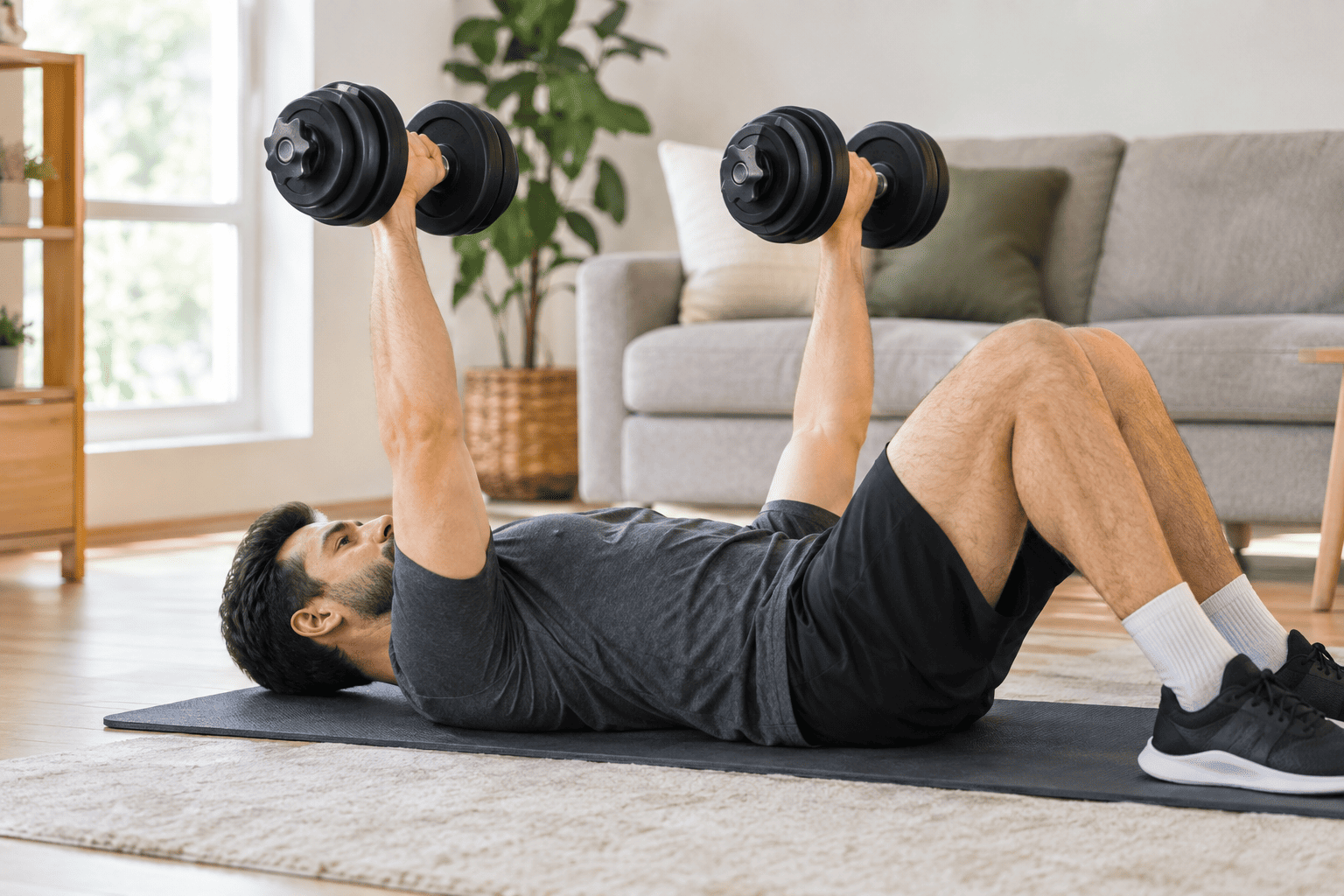
Lie on your back with your knees bent and your feet flat. Hold a dumbbell in each hand with your upper arms resting on the floor at about 45 degrees from your body, not flared straight out to the sides. Press both dumbbells up until your arms are straight above your chest, then lower them slowly until your upper arms touch the floor again.
Pause for a second when your elbows touch. Don’t bounce them off the floor. That pause is what makes the exercise safe and effective, because it takes away the momentum.
Beginner tip: if you’ve never pressed dumbbells before, start lighter than you think. Controlling two separate weights is harder than it looks, and the first few sessions are mostly about learning to keep them steady.
2. Push-ups at your level
Push-ups are the best chest exercise that exists for home training, and they’re a good second exercise because they hit the chest from a slightly different angle to the floor press. The key is picking the version that lets you do at least 6 clean reps.
- Wall push-ups: the starting point if a full push-up feels far away
- Incline push-ups: hands on a kitchen counter, then a sofa arm, then a low step
- Knee push-ups: fine, as long as your hips stay in line with your body
- Full push-ups: the goal, and a great test of strength
- Decline push-ups: feet raised, for when full push-ups get easy
Whichever version you use, keep your body in a straight line from head to heels (or knees), lower your chest until it’s a few centimetres from the surface, and push back up. My guide to incline and decline push-ups has the full progression if you want to work through it step by step.
3. Seated dumbbell shoulder press
Sit on a sturdy chair with your back supported. Hold the dumbbells at shoulder height with your palms facing forwards, or slightly towards each other if that feels better on your shoulders. Press them overhead until your arms are almost straight, then lower them back to shoulder height.
Sitting down helps a lot as a beginner. It stops you from arching your lower back and leaning back to cheat the weight up, which is the most common mistake with this exercise. Brace your stomach like you’re about to be poked, and keep your ribs down.
4. Dumbbell lateral raise
Stand tall with a light dumbbell in each hand at your sides. With a very slight bend in your elbows, raise your arms out to the sides until they’re level with your shoulders, then lower them slowly.
Go light. Seriously light. Lateral raises are the exercise where ego ruins everything. If you have to swing your body or shrug your shoulders up towards your ears, the weight is too heavy. Most beginners do better with 2 to 4 kg than anything heavier. There’s more on this in my shoulder workout with dumbbells guide.
5. Dumbbell overhead tricep extension
Sit or stand holding one dumbbell with both hands, cupping the top end. Press it straight overhead. Keeping your upper arms close to your head, bend your elbows to lower the dumbbell behind your head, then straighten your arms to lift it back up.
This one stretches the long head of the triceps, which is the biggest part of the muscle, so it’s worth including even though your triceps have already done a lot of work. If it bothers your elbows, try it lying on the floor instead, lowering the dumbbell towards the top of your head.
6. Chair dips
Sit on the edge of a sturdy chair that’s pushed against a wall so it can’t slide. Put your hands on the edge next to your hips, walk your feet forwards, and slide your bottom off the seat. Bend your elbows to lower yourself a short way, then press back up.
Keep your knees bent to make it easier and straighten your legs to make it harder. Only go as low as feels comfortable in the front of your shoulders. For most beginners, that’s until the upper arms are roughly parallel with the floor, and sometimes less. If dips hurt your shoulders at all, skip them. The overhead extension already covers your triceps.
The no-equipment push day workout
No dumbbells, no problem. Bodyweight push training can take you a surprisingly long way, and this version works well for travel days too.
| Exercise | Sets | Reps | Rest |
|---|---|---|---|
| Push-ups (your level) | 4 | Stop 2 reps short of failure | 90 seconds |
| Pike push-ups | 3 | 6 to 10 | 90 seconds |
| Close-grip push-ups | 3 | 6 to 12 | 75 seconds |
| Chair dips | 3 | 8 to 12 | 60 seconds |
| Plank shoulder taps | 3 | 10 per side | 60 seconds |
| Wall push-up hold (finisher) | 2 | 20 to 30 seconds at the bottom | 45 seconds |
Pike push-ups for your shoulders
Start in a push-up position, then walk your feet forwards and push your hips up so your body forms an upside-down V. Bend your elbows to lower the top of your head towards the floor between your hands, then press back up. This shifts a lot of the work from your chest to your shoulders, which makes it the bodyweight version of a shoulder press.
If it’s too hard, do them with your hands on a step or the edge of a sofa. If it’s too easy, raise your feet on a chair.
Close-grip push-ups for your triceps
Do a normal push-up, but place your hands under your shoulders instead of wider, and keep your elbows tucked close to your ribs as you lower. Your triceps take on much more of the work. You don’t need the famous diamond push-up with your hands touching, which is hard on a lot of people’s wrists. Just bring your hands in to shoulder width. My tricep exercises at home guide has a few more options if these feel awkward.
Plank shoulder taps
Hold a high plank with your feet a little wider than hip width. Lift one hand to tap the opposite shoulder, put it back down, then switch. The goal is to keep your hips completely still. It’s a great way to finish a push workout, because it trains shoulder stability while your shoulders are already tired. I wrote a whole guide to plank shoulder taps if your hips keep rocking.
Push day workout for women
The push day workout for women is exactly the same workout. The muscles are the same, the exercises are the same, and the way you progress is the same. What changes, for most beginners, is the starting point.
A lot of women I’ve talked to start with incline push-ups rather than floor push-ups, and use lighter dumbbells for the shoulder press and lateral raise at first. That’s completely normal and not a sign of anything except where you are right now. Upper body pushing strength builds quickly once you train it consistently.
A few things are worth saying clearly, because they come up so often:
- Push day won’t make you bulky. Building a lot of muscle takes years of deliberate effort and eating for it. A few sets of presses and push-ups will make you stronger and more defined, not bigger in a way you didn’t choose.
- Chest training doesn’t change breast size. Breast tissue is mostly fat, not muscle. Training the pectoral muscles underneath can improve posture and upper body strength, but it won’t meaningfully make breasts bigger or smaller.
- Toned arms come from the triceps. The back of the upper arm is the triceps, and push day trains them more than any other session.
If you’d like a complete home routine designed around this, my chest workouts for women guide goes deeper on the chest side.
How many sets, reps and how much rest
For most beginners, 3 sets of 8 to 12 reps is the sweet spot for the main exercises. The last couple of reps of each set should feel genuinely hard, but you should still be able to do them with good form. A useful rule is to finish each set feeling like you could have done one or two more.
| Goal | Sets per exercise | Reps | Rest between sets |
|---|---|---|---|
| Learning the movements (first 4 weeks) | 2 | 10 to 12, easy | 60 to 90 seconds |
| Building strength and muscle | 3 | 8 to 12 | 90 seconds |
| Getting stronger on the big moves | 3 to 4 | 6 to 8 | 2 minutes |
| Shoulders and arms (smaller muscles) | 2 to 3 | 12 to 15 | 60 seconds |
Rest matters more than people think. If you rush your rest to make the workout feel harder, your later sets get weaker and you actually do less useful work. A timer on your phone helps. So does writing down what you did, which I’ll come back to in a minute.
How to progress without hurting your shoulders
The simplest progression method for home training is called double progression, and it’s the one I’ve used almost the entire time I’ve been training.
- Pick a rep range, say 8 to 12.
- Start with a weight you can lift for 8 good reps on all three sets.
- Each session, try to add a rep or two.
- When you can do 12 reps on all three sets, increase the weight slightly and drop back to 8 reps.
For bodyweight exercises, you progress by moving to a harder version instead of adding weight. Counter push-ups become sofa push-ups, sofa push-ups become knee push-ups, and so on.
A few shoulder-friendly rules I stick to:
- Increase the weight in small jumps, especially for shoulder presses and lateral raises
- Never press through a sharp or pinching pain in the front of your shoulder
- Keep your elbows at about 45 degrees on presses and push-ups, not flared out wide
- Balance every push day with a pull day, so your back keeps up with your chest
That last one is important. If you only train pushing, your shoulders tend to roll forwards over time. Rows and other pulling exercises keep things balanced. My back and biceps workout makes a natural partner session.
If you want to see how your numbers compare as you get stronger, the strength calculator is a fun way to check in every couple of months.
Where push day fits in your week
Here are three ways to fit push day into a week, depending on how many days you can train.
| Days per week | Monday | Tuesday | Wednesday | Thursday | Friday | Saturday |
|---|---|---|---|---|---|---|
| 3 days | Push | Rest | Pull | Rest | Legs | Rest |
| 4 days | Push | Legs | Rest | Pull | Full body | Rest |
| 6 days | Push | Pull | Legs | Push | Pull | Legs |
The three-day version is a good entry point, although each muscle only gets trained once a week. The four-day version adds a full body day so your chest and shoulders get a second, lighter hit. The six-day version is for people who’ve been training for a while and recover well. It’s a lot for a beginner, and I wouldn’t start there.
If you want to lay out your week and keep track of it, the workout schedule planner lets you drop sessions onto days and print the plan. And if you’re not sure how many days to aim for in the first place, my guide on how many days a week to work out can help.
Push day vs a chest and tricep workout
People often ask whether push day is the same thing as a chest and tricep workout. They’re close, but not identical. A chest and tricep session focuses on those two muscles and usually leaves the shoulders out or keeps them light. A push day always includes dedicated shoulder work, like a press and a lateral raise.
If your shoulders tend to get sore easily, or you train them on a separate day, a chest and tricep workout might suit you better. If you want one session that covers all your pushing muscles, push day is the simpler choice.
Common push day mistakes
These are the mistakes I made myself, or watched friends make, when we started.
- Doing shoulders first. If you start with shoulder presses, your shoulders are tired for the chest exercises, which need them to help. Chest first, shoulders second, triceps last.
- Flaring the elbows. Elbows straight out to the side at 90 degrees puts a lot of strain on the front of the shoulder. Tuck them in to about 45 degrees.
- Too many exercises. Eight or nine exercises in one push day is too much volume for most beginners. Five or six is plenty.
- Heavy lateral raises. Swinging heavy dumbbells up with your whole body mostly trains your ego.
- Skipping pull day. Pushing without pulling is the fastest way to end up with rounded shoulders.
- Going to failure on every set. Leave a rep or two in the tank, especially on push-ups and dips, where form tends to fall apart at the end.
- Chasing soreness. Being very sore isn’t proof of a good workout. Steady progress in your reps and weights is.
What to expect the day after
It’s normal to feel some stiffness in your chest, shoulders and the back of your arms a day or two after your first few push days. That’s called delayed onset muscle soreness, and it fades as your body gets used to the training. It should feel like general tightness, not sharp pain in a joint.
Gentle movement usually helps more than complete rest. A walk, some light stretching, or a pull day on the next day are all fine. My guide on how to reduce muscle soreness has more ideas if it’s bothering you.
If you ever feel sharp pain in your shoulder during a press, a clicking that hurts, or pain that doesn’t settle within a few days, stop that exercise and get it checked. Pushing through joint pain isn’t brave. It’s just how small niggles turn into long breaks.
A simple 4-week plan to get started
If you want something to follow straight away, here’s how I’d introduce push days over a month.
| Week | Push day sets | Focus |
|---|---|---|
| Week 1 | 2 sets of each exercise | Learn the movements, find your starting weights |
| Week 2 | 2 sets, add 1 to 2 reps where you can | Smooth reps, consistent tempo |
| Week 3 | 3 sets of each exercise | Build volume |
| Week 4 | 3 sets, add reps or weight | Start double progression properly |
Write every session down. Exercise, weight, sets and reps. It takes 30 seconds and it’s the single best thing you can do to make sure you’re actually progressing. If you like a visual nudge to keep going, the workout streak tracker is what I use to stay consistent.
And if you’d rather start with a complete plan that already includes pushing, pulling and legs in balanced full body sessions, the dumbbell workout plan for beginners is a good place to begin before moving to a push, pull and legs split.
If you want to go deeper on the chest part of this session, my dumbbell chest workout without a bench adds flys, squeeze presses and pullovers.
Frequently asked questions
What is a push day workout?
A push day workout is a session that trains all the muscles you use to push weight away from your body: your chest, your front and side shoulders, and your triceps. It usually includes a chest press or push-ups, a shoulder press, a lateral raise and a tricep exercise.
What exercises should I do on push day at home?
With dumbbells, a good home push day is floor presses, push-ups, a seated shoulder press, lateral raises and overhead tricep extensions. Without equipment, use push-ups, pike push-ups, close-grip push-ups, chair dips and plank shoulder taps.
How many exercises should a push day have?
Five or six exercises is plenty for most beginners. Start with one or two chest exercises, add one or two for your shoulders, and finish with one or two for your triceps. More than that usually means your later exercises suffer.
How many times a week should I do push day?
Once or twice a week. If you train three days a week, one push day inside a push, pull and legs split works. If you train six days, you can do push day twice. Leave at least 48 hours between push days so your chest and shoulders recover.
Can beginners do a push pull legs split?
Yes, but full body workouts are usually better for the first few months if you only train two or three days a week. A push, pull and legs split makes more sense once you can train four or more days a week and know the basic movements well.
Is push day the same as chest and triceps?
Not quite. A chest and tricep workout focuses on those two muscles, while a push day also includes dedicated shoulder exercises like a shoulder press and lateral raises. Both are good options, depending on how you organise the rest of your week.
Should women do push day workouts?
Yes. The push day workout for women is the same workout, just often starting with easier versions like incline push-ups and lighter dumbbells. It builds upper body strength and definition in the arms and shoulders without making you bulky.
What should I do after push day?
The day after push day, train something that doesn’t rely on the same muscles, like a pull day or a leg day, or take an active rest day with a walk. Avoid another heavy pushing session until your chest and shoulders have had about 48 hours to recover.
Source: NHS, Physical activity guidelines for adults aged 19 to 64