Shoulder Labral Tear Exercises: A Gentle Physical Therapy Plan in 4 Phases
Being told you have a labral tear in your shoulder can be worrying. It sounds serious, and many people assume it means surgery. In reality, many shoulder labral tears are managed without an operation, and a structured exercise programme is usually the first step.
The labrum is a ring of tough cartilage around the shoulder socket. A tear can cause deep shoulder pain, clicking, catching or a feeling that the shoulder is unstable. Good shoulder labral tear physical therapy exercises aim to calm the joint down, restore comfortable movement, and build strength in the rotator cuff and shoulder blade muscles so they can support the joint better.
In this guide to shoulder labral tear exercises, I will explain what a shoulder labral tear is, the different types, what research says about exercise and surgery, and a 4-phase physical therapy plan with step-by-step exercises. I will also cover what to avoid, how long recovery usually takes and when to get specialist help.
At a glance
- The labrum is a ring of cartilage that deepens the shoulder socket and helps keep the joint stable
- Common types include SLAP tears (top of the labrum) and Bankart tears (front, often after dislocation)
- Many labral tears, especially SLAP tears in non-athletes, are treated with physical therapy first
- A randomised trial found no clear benefit of SLAP repair or biceps tenodesis over sham surgery
- Exercises focus on pain-free mobility, rotator cuff strength and shoulder blade control
- Progress slowly through phases, and avoid heavy overhead and behind-the-head positions early on
- Always follow your doctor or physiotherapist’s advice, especially after a dislocation or surgery
What is a shoulder labral tear?
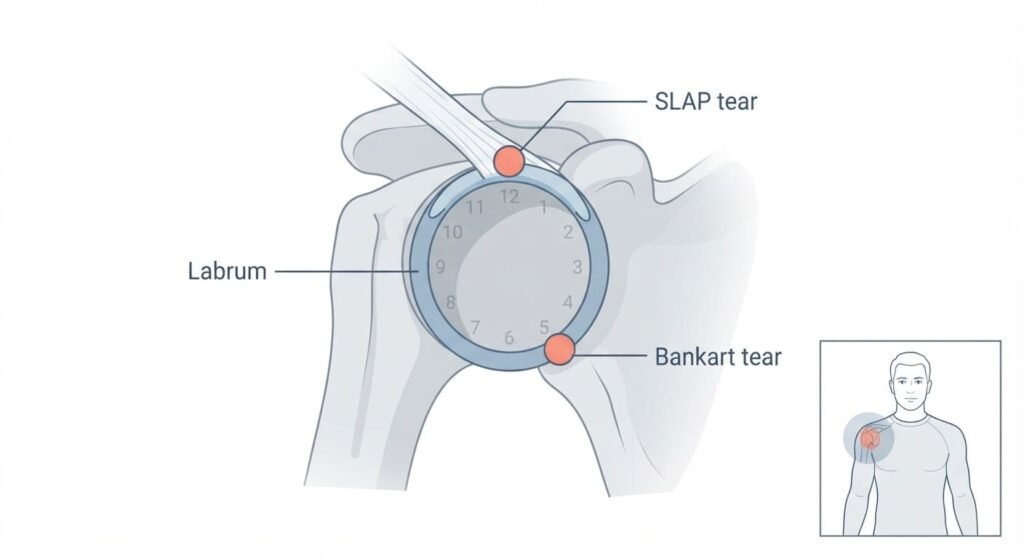
Your shoulder is a ball-and-socket joint, but the socket (the glenoid) is quite shallow. The labrum is a ring of fibrous cartilage attached around the rim of the socket. It deepens the socket, helps keep the ball centred and provides an attachment point for the long head of the biceps tendon and some ligaments.
| Type of tear | Where | Common causes |
|---|---|---|
| SLAP tear | Top of the labrum, where the biceps tendon attaches | Repetitive overhead activity, falls on an outstretched arm, heavy lifting, age-related wear |
| Bankart tear | Front and lower part of the labrum | Shoulder dislocation |
| Posterior tear | Back of the labrum | Repeated pushing, such as heavy bench pressing, or a backward force |
| Degenerative fraying | Anywhere | Normal age-related changes, often without symptoms |
Common symptoms
- A deep, aching pain inside the shoulder
- Clicking, catching, popping or grinding with certain movements
- Pain with overhead movements or reaching behind you
- A feeling of weakness or instability
- Reduced range of motion
Not every labral tear causes symptoms. Imaging often shows labral changes in people with no shoulder pain, especially as we get older. That is one reason why the diagnosis needs a careful clinical assessment, not just a scan.
What the research says
Surgery versus sham surgery for SLAP tears
A double-blind randomised trial in Norway included 118 people with an isolated type II SLAP lesion who were candidates for surgery. During arthroscopy, they were randomly assigned to labral repair, biceps tenodesis or sham surgery, where the surgeon looked inside the joint but did not repair anything. At 6 months and 2 years, there were no significant differences between the groups in any outcome. Postoperative stiffness occurred in some patients after the real operations.
This does not mean surgery is never useful. It is still important for some people, such as those with repeated dislocations or certain athletes. But for many people with SLAP tears, especially those who are not high-level overhead athletes, it supports trying a good rehab programme first.
Results of nonoperative treatment
A study of people with SLAP tears looked at outcomes after nonoperative treatment, which included anti-inflammatory medication and a physical therapy programme focused on shoulder blade stabilisation exercises and stretching of the back of the shoulder capsule. Among those whose nonoperative treatment was successful, pain, function and quality of life all improved significantly at an average follow-up of about 3 years, and all returned to sport. However, about half of the overall group went on to have surgery, and overhead athletes were less likely to return to the same level.
The honest picture: shoulder labral tear physical therapy exercises help many people a great deal, but not everyone. That is why a phased plan, regular review and a clear idea of when to seek more help all matter.
Principles of labral tear rehab
| Principle | What it means |
|---|---|
| Calm before strengthen | Settle pain and irritation first |
| Pain-free range | Work within a range that does not cause sharp pain or catching |
| Shoulder blade first | Good shoulder blade control supports the joint |
| Rotator cuff strength | These small muscles keep the ball centred in the socket |
| Gradual overhead return | Overhead and behind-the-back positions come last |
| Patience | Most programmes run for at least 6 to 12 weeks |
A simple pain guide
| Pain during exercise (0 to 10) | What to do |
|---|---|
| 0 to 2 | Fine, continue |
| 3 to 4 | Acceptable if it settles within 24 hours |
| 5 or more, or sharp pain, catching or instability | Stop that exercise and reduce the range or load |
Phase 1 shoulder labral tear exercises: calm and gentle mobility (weeks 0 to 2)
These early shoulder labral tear exercises restore gentle movement without stressing the labrum. Do them once or twice daily.
1. Pendulum swings
Lean forward with your good hand on a table and let the sore arm hang down relaxed. Gently sway your body so the arm swings in small circles and forward and back. 30 to 60 seconds each direction.
2. Table slides
Sit at a table with your hand on a towel. Slowly slide the towel forward as you lean your body forward, then return. 10 to 15 reps.
3. Assisted external rotation with a stick
Lie on your back or stand with your elbow tucked to your side and bent to 90 degrees. Hold a stick or umbrella in both hands and use your good arm to gently push the sore hand outward. Only go to a comfortable point. 10 reps, holding 3 seconds.
4. Shoulder blade setting
Sit or stand tall. Gently draw your shoulder blades back and slightly down, as if putting them in your back pockets. Hold 5 seconds and relax. 10 reps. Our guide to scapular retraction exercises explains this movement in more detail.
5. Isometric shoulder holds
Stand next to a wall with your elbow bent at 90 degrees. Gently press your hand or forearm into the wall in different directions (outward, inward, forward, backward) without moving the arm. Hold 5 to 10 seconds at a low effort, 5 reps each direction.
Phase 2 shoulder labral tear exercises: early strength (weeks 2 to 6)
Once you can move comfortably, start building strength in the rotator cuff and shoulder blade muscles, 3 to 4 times a week.
6. Band external rotation
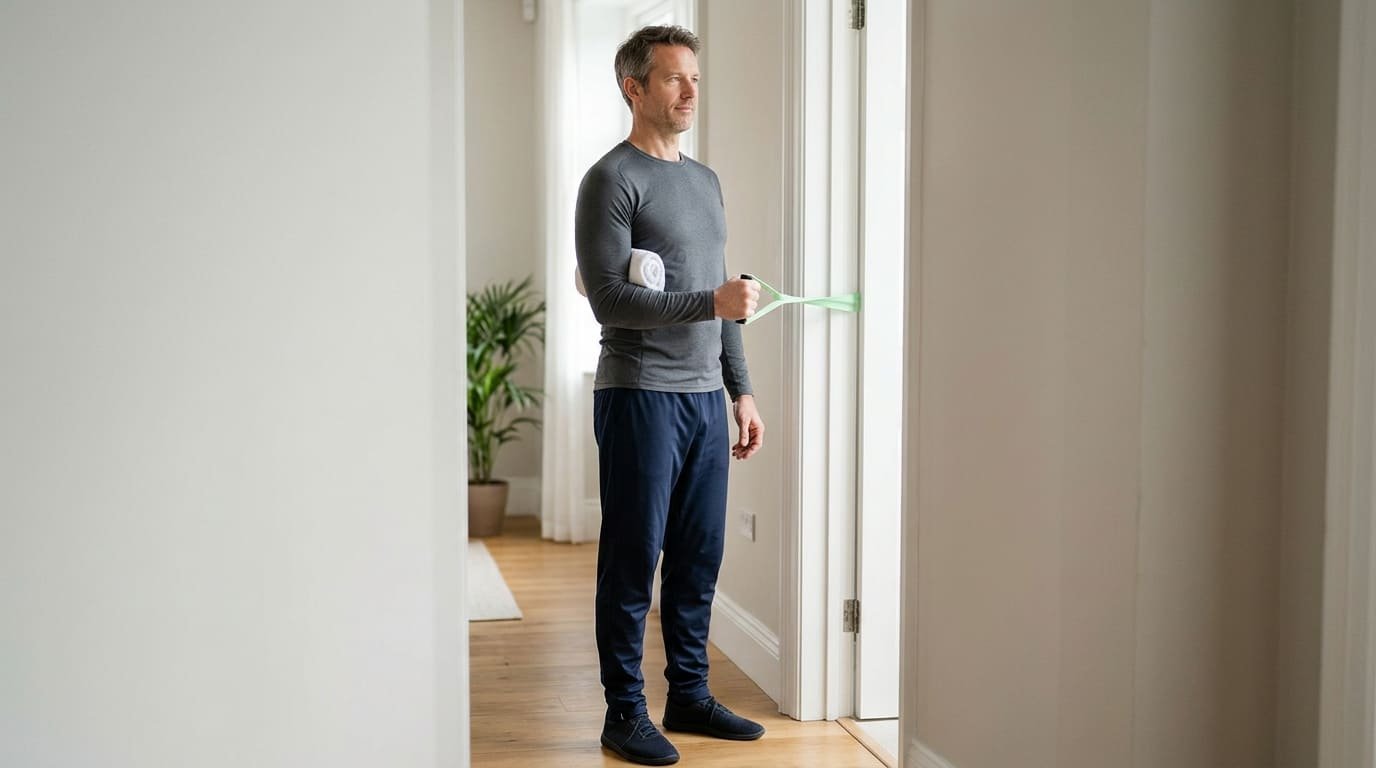
Attach a light resistance band at elbow height. Stand side-on, elbow bent to 90 degrees and tucked to your side (a rolled towel under the arm helps). Rotate your forearm outward, then slowly return. 3 sets of 12 to 15.
7. Band internal rotation
Same setup, facing the other way, rotating your forearm inward across your body. 3 sets of 12 to 15.
8. Band rows
Hold a band anchored in front of you at chest height. Pull your elbows back, squeezing your shoulder blades together, then return slowly. 3 sets of 12.
9. Side-lying external rotation
Lie on your good side with a small towel under the elbow of your top arm. Holding a very light weight, keep your elbow at your side and rotate your forearm up toward the ceiling, then lower slowly. 3 sets of 10 to 15. Our rotator cuff exercises guide covers this in detail.
10. Wall slides
Stand facing a wall with your forearms on it. Slowly slide your arms up as far as is comfortable, keeping your shoulder blades gently set, then slide back down. 2 to 3 sets of 10.
Phase 3 shoulder labral tear exercises: strength and control (weeks 6 to 12)
11. Prone Y and T raises
Lie face down on a bench or bed with your arm hanging. Lift the arm out to the side in a T position, or forward and up in a Y position, with your thumb pointing up. Use no weight or a very light one. 3 sets of 10.
12. Wall push-up plus
Do a push-up against a wall, then at the top push a little further so your shoulder blades spread apart. 3 sets of 10 to 12. Progress to a counter, then the floor when comfortable.
13. Scaption raise
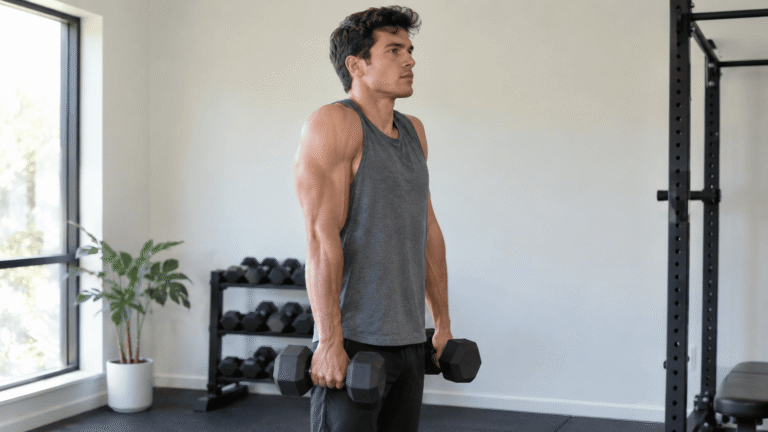
Stand holding light dumbbells, thumbs up. Raise your arms in a V shape, about 30 degrees in front of your body, to shoulder height. Lower slowly. 3 sets of 10 to 12.
14. 90/90 external rotation with band
When earlier work is comfortable, raise your elbow to shoulder height with the elbow bent at 90 degrees and rotate your forearm upward against a light band. This position is more demanding, so only add it when your clinician agrees. 3 sets of 10.
Phase 4: Return to full activity (week 12 onwards)
In this phase, the goal is to return to lifting, sport and overhead activity. Typical steps include:
- Gradually reintroducing pressing and pulling exercises with light weights
- Adding overhead movements slowly, starting with landmine presses rather than strict overhead presses
- Sport-specific drills, such as easy throwing progressions for throwing athletes
- Continuing rotator cuff and shoulder blade work twice a week for maintenance
| Exercise | Phase | Main focus |
|---|---|---|
| Pendulum swings | 1 | Gentle movement |
| Table slides | 1 | Forward reach |
| Assisted external rotation | 1 | Rotation range |
| Shoulder blade setting | 1 | Scapular control |
| Isometric holds | 1 | Pain-free activation |
| Band external rotation | 2 | Rotator cuff |
| Band internal rotation | 2 | Rotator cuff |
| Band rows | 2 | Upper back, shoulder blades |
| Side-lying external rotation | 2 | Rotator cuff |
| Wall slides | 2 | Overhead range |
| Prone Y and T raises | 3 | Lower trap, rear shoulder |
| Wall push-up plus | 3 | Serratus anterior |
| Scaption raise | 3 | Shoulder strength |
| 90/90 external rotation | 3 | Overhead control |
Exercises and positions to avoid early on
The right shoulder labral tear exercises matter, but so does knowing what to leave out for now.
| Position or exercise | Why to be careful |
|---|---|
| Behind-the-neck presses and pulldowns | Stress the front of the shoulder |
| Heavy overhead pressing | Loads the top of the labrum |
| Deep dips | Push the ball forward in the socket |
| Very wide-grip bench press | Stresses the front of the joint |
| Throwing at full effort | High load on the biceps and labrum |
| Sleeping on the sore shoulder | Often aggravates pain |
These are not banned forever. Most can be reintroduced gradually later in rehab if your shoulder tolerates them.
Daily life tips
- Keep objects close to your body when lifting
- Avoid reaching into the back seat of a car with the sore arm
- Sleep on your back or the other side, with a pillow supporting the sore arm
- Take regular breaks from long periods of overhead work
How long does recovery take?
| Situation | Typical timeline |
|---|---|
| Mild SLAP tear managed with rehab | 6 to 12 weeks for meaningful improvement |
| Return to lifting weights | Often 3 to 4 months |
| Return to overhead sport | Often 4 to 6 months or more |
| After labral repair surgery | Often 4 to 6 months, sometimes longer |
Everyone recovers at a different pace. Steady progress over weeks is a good sign.
When surgery may be considered
Surgery may be discussed if:
- Your shoulder has dislocated, especially more than once
- You still have significant pain or instability after 3 to 6 months of good rehab
- You are a high-level overhead or contact athlete with persistent symptoms
- There is another problem, such as a large rotator cuff tear or a cyst pressing on a nerve
If you do have surgery, exercises are still central to recovery. Follow your surgeon’s protocol carefully, because early restrictions after labral repair are important.
When to see a professional
See a doctor or physiotherapist promptly if:
- Your shoulder dislocates or feels like it slipped out
- You have numbness, tingling or weakness in your arm
- Pain is severe or wakes you at night most nights
- You cannot lift your arm
- Symptoms do not improve after a few weeks of exercise
Our guide to exercises for shoulder pain covers other common causes of shoulder pain.
This article is general information, not medical advice. A labral tear should be diagnosed by a qualified clinician. See our medical disclaimer.
SLAP tear exercises: what is different?
SLAP tears affect the top of the labrum where the long head of the biceps attaches. Because of that connection, SLAP tear exercises often pay extra attention to the biceps and to the back of the shoulder.
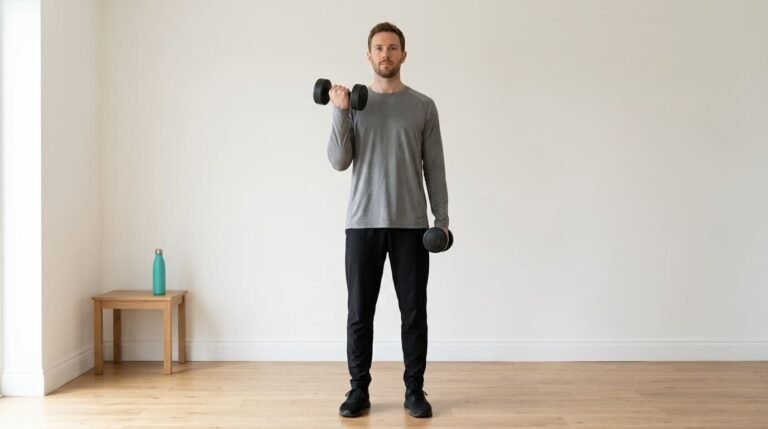
- Gentle biceps loading: once pain settles, light hammer curls or band curls with the elbow by your side can help the biceps tolerate load again. Avoid heavy curls with the arm reaching behind the body early on
- Posterior shoulder mobility: a tight back of the shoulder is common in throwers and is thought to increase stress on the top of the labrum. A gentle cross-body stretch, held for 30 seconds, is a common addition when your clinician agrees
- Careful overhead progression: overhead positions combined with rotation, such as the cocking position in throwing, are usually introduced last
| SLAP tear exercise | How to do it | When to add |
|---|---|---|
| Cross-body stretch | Pull the sore arm gently across your chest with the other hand, hold 30 seconds | Phase 1 to 2, if comfortable |
| Band biceps curl | Elbow by your side, curl a light band slowly | Phase 2 |
| Sleeper stretch (gentle) | Lie on the sore side, elbow at shoulder height, gently press the forearm down | Only if advised by a clinician |
| Hammer curl | Light dumbbells, elbows by your sides | Phase 3 |
After a dislocation (Bankart tears)
If your labral tear happened with a dislocation, the priorities change a little. The front of the shoulder needs time to settle, and positions where the arm is out to the side and rotated backward, like the top of a throwing motion, are the most likely to cause the shoulder to slip again. Early labral tear rehab after a dislocation usually focuses on rotator cuff strength with the arm by your side, shoulder blade control, and a gradual return toward those higher-risk positions.
Younger people who dislocate their shoulder during contact sport have a higher chance of it happening again, so they are more likely to be offered a surgical opinion. Always get a dislocation assessed by a doctor.
Returning to the gym with a labral tear
| Exercise | Early alternative | Later progression |
|---|---|---|
| Barbell bench press | Push-ups on a raised surface, narrow grip dumbbell press | Moderate grip barbell press |
| Overhead press | Landmine press | Light dumbbell overhead press |
| Lat pulldown behind the neck | Pulldown to the front of the chest | Assisted pull-ups |
| Dips | Close-grip push-ups | Bench dips only if pain free, then avoid deep dips |
| Upright rows | Face pulls | Light lateral raises |
Many people can keep training their legs, core and the other arm through most of their recovery. Keeping active helps your overall fitness and mood while the shoulder settles. Our bodyweight shoulder workout has gentle options for later stages.
A sample 20-minute session (Phase 2)
| Exercise | Sets x reps |
|---|---|
| Pendulum swings (warm-up) | 1 minute |
| Shoulder blade setting | 1 x 10 |
| Band external rotation | 3 x 12 |
| Band internal rotation | 3 x 12 |
| Band rows | 3 x 12 |
| Side-lying external rotation | 2 x 12 |
| Wall slides | 2 x 10 |
Do this routine of shoulder labral tear exercises 3 or 4 times a week. If your shoulder feels worse the next day, reduce the number of sets or the band tension. Shoulder labral tear exercises work best when they are done consistently over many weeks, not pushed hard for a few days.
The bottom line
A shoulder labral tear does not automatically mean surgery. Many people improve with a structured programme of shoulder labral tear exercises that restores gentle movement, then builds rotator cuff and shoulder blade strength, then gradually returns to overhead and sporting activity. A randomised trial found no clear benefit of two common SLAP operations over sham surgery, which supports trying good rehab first in many cases.
Start with gentle shoulder labral tear exercises for mobility, follow the phases, respect pain and catching, and give it at least 6 to 12 weeks. Work with a physiotherapist where possible, and seek specialist advice if your shoulder dislocates, feels unstable or does not improve.
Frequently asked questions
Can a shoulder labral tear heal without surgery?
The labrum has a limited blood supply, so tears may not fully heal, but many people become pain free and fully functional with physical therapy that strengthens the muscles around the joint.
What are the best shoulder labral tear exercises?
Pendulum swings, assisted external rotation, shoulder blade setting, band external and internal rotation, rows, side-lying external rotation, wall slides and prone Y and T raises are common choices.
What should I avoid with a labral tear?
Early on, avoid behind-the-neck presses and pulldowns, heavy overhead pressing, deep dips, very wide-grip bench press and full-effort throwing.
How long does labral tear rehab take?
Many people see meaningful improvement within 6 to 12 weeks. Returning to lifting or overhead sport often takes 3 to 6 months.
Is a SLAP tear the same as a labral tear?
A SLAP tear is one type of labral tear, affecting the top of the labrum where the biceps tendon attaches. SLAP tear exercises often include extra biceps and back-of-shoulder work.
Can I do shoulder labral tear exercises and still lift weights?
Often yes, with modifications. Avoid painful positions, use lighter loads and build back gradually with your clinician’s guidance.
Does a labral tear need an MRI?
An MRI or MR arthrogram can help confirm a tear, but scans often show labral changes in people without pain, so a clinical assessment is essential.
Do shoulder labral tear physical therapy exercises really work?
Many people improve significantly with them. A study of nonoperative treatment found clear improvements in pain and function for those who responded, though some still needed surgery.
When is surgery needed for a labral tear?
Surgery may be considered after dislocations, persistent instability, or when symptoms remain after 3 to 6 months of good rehab.
What’s next?
Reading is the easy part. Pick one of these and do it today.