
ITB Syndrome Exercises: 14 Moves to Ease Outer Knee Pain and Get Back to Running
If you have ever felt a sharp, nagging pain on the outside of your knee a few kilometres into a run, there is a good chance you have met iliotibial band syndrome, usually shortened to ITB syndrome or ITBS. It is one of the most common running injuries, and it has a frustrating habit of showing up at the same point in every run, then easing off as soon as you stop.
The good news is that ITB syndrome usually responds well to the right exercises. The less good news is that the right exercises are not always the ones people reach for first. Many runners spend weeks stretching and foam rolling the side of the thigh, with mixed results. Research points in a different direction: strengthening the hip muscles, especially the gluteus medius, and adjusting training load tend to matter far more.
In this guide to iliotibial band syndrome exercises, I will explain what ITB syndrome is, why it happens, what research says about stretching and strengthening, and then walk you through 14 ITB syndrome exercises in three stages, from calming things down to getting back to running. You will also find a sample weekly plan, a return to running schedule and the mistakes that keep people stuck.
At a glance
- ITB syndrome causes pain on the outside of the knee, often during running or cycling
- The IT band itself barely stretches; research found it lengthened by less than 0.5% in common stretches
- Runners with ITB syndrome have been found to have weaker hip abductors on the painful side
- Hip strengthening is the most common feature of successful ITB syndrome exercise programmes
- Start with pain-free strength work, then progress to single-leg and running-specific exercises
- Reduce running volume rather than stopping all activity, and return gradually
- See a professional if pain is severe, persistent, or comes with swelling or locking
What is ITB syndrome?
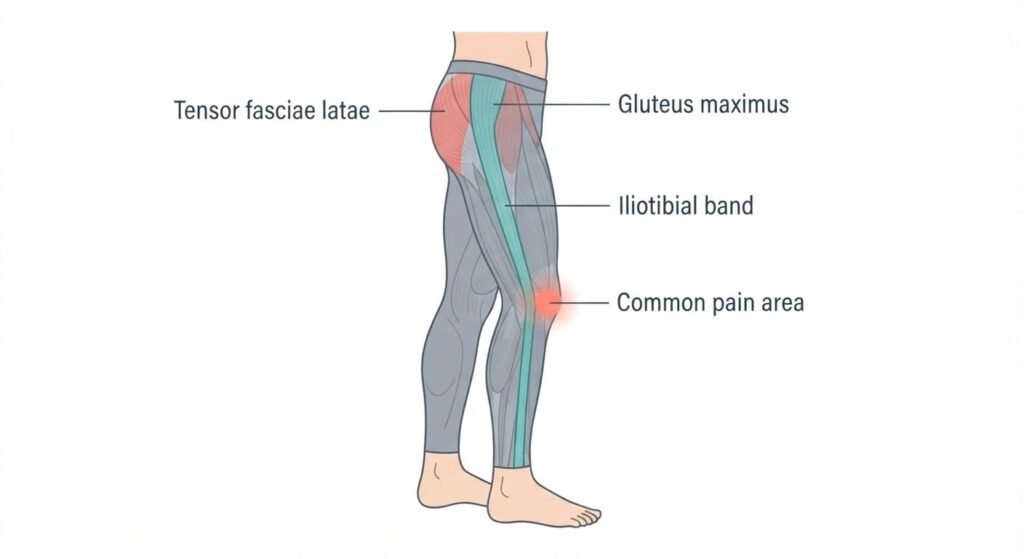
The iliotibial band, or IT band, is a thick strip of connective tissue that runs down the outside of your thigh, from the hip to just below the knee. At the top it connects to two muscles: the tensor fasciae latae (TFL) at the front of the hip and part of the gluteus maximus at the back. At the bottom it attaches to the outside of the shin bone.
ITB syndrome is an overuse problem where the area on the outside of the knee becomes irritated and painful. For a long time it was described as the band “rubbing” over the bone. More recent thinking suggests that compression of a sensitive layer of fat and tissue under the band, near the outside of the thigh bone, plays a big part. Either way, the result is the same: pain on the outside of the knee that gets worse with repetitive bending and straightening.
| Common sign | What it feels like |
|---|---|
| Location | Outside of the knee, sometimes up the side of the thigh |
| Timing | Often starts at a predictable point in a run or ride |
| Running downhill | Usually makes it worse |
| Walking down stairs | Can be painful |
| After stopping | Pain often eases quickly at rest |
| Swelling or locking | Uncommon; if present, see a professional |
Who gets ITB syndrome?
ITB syndrome is most common in runners, cyclists, hikers and anyone who does a lot of repetitive knee bending. One systematic review estimated that it accounts for about 10% of running injuries. It often appears after a sudden jump in training, such as a longer long run, more hills, a new route with a sloping road, or a new pair of shoes.
Why does ITB syndrome happen?
There is rarely one single cause. Common contributors include:
- A sudden increase in training load, especially distance, hills or speed
- Weak hip muscles, particularly the gluteus medius, which helps stop the knee drifting inward and the pelvis dropping on each step
- Running on cambered roads or always running the same direction around a track
- Lots of downhill running, which keeps the knee in the range that tends to irritate the area
- Running form, such as a narrow, crossover stride or overstriding
- Cycling setup, such as a saddle that is too high or cleats in the wrong position
The good news is that most of these can be changed. ITB syndrome exercises deal with the strength side, and simple training changes deal with the load side.
What the research says
Can you actually stretch the IT band?
A study that combined cadaver research with measurements in living people looked closely at the anatomy and stretching behaviour of the IT band. The researchers found that the band is firmly attached along the thigh bone, and that common stretching manoeuvres produced very small strains. In living participants, the band lengthened by less than 0.5% during hip abduction. The authors concluded that their results challenge the reasoning behind several common treatments, and that future work should focus on the muscle part of the system, the TFL and glutes.
That does not mean gentle stretching or foam rolling is useless. Many people find they feel looser and more comfortable afterwards. But it does mean you should not expect to “lengthen” your IT band, and stretching alone is unlikely to fix the problem.
Weak hips and ITB syndrome
A study of 24 distance runners with ITB syndrome compared their hip abductor strength with their own healthy leg and with 30 healthy runners. The injured leg was clearly weaker. After a 6-week rehabilitation programme focused on strengthening the gluteus medius, hip abductor strength increased by about 35% in women and 51% in men, and 22 of the 24 runners were pain free and back to running, with no recurrence reported at 6 months.
This was a small case series without a control group, so it cannot prove that strengthening caused the recovery. But it set the direction for most modern rehab.
What a recent review found
A 2024 systematic review looked at 13 studies of conservative treatment for runners with ITB syndrome. The studies were too different to combine statistically, but hip abductor strengthening was the most common treatment strategy. Pain improved by 27% to 100% and function by 10% to 57% over 2 to 8 weeks. The authors concluded that a conservative approach built around hip abductor strengthening, sometimes combined with other therapies, is effective for reducing pain and improving function.
Put simply: the best ITB syndrome exercises focus on strengthening the hips and controlling the knee, with stretching and rolling as optional extras for comfort.
Principles before you start
| Principle | What it means in practice |
|---|---|
| Calm it down first | Reduce running volume and avoid the activities that trigger sharp pain for a short time |
| Pain guide | Mild discomfort up to about 3 out of 10 during exercise is usually fine if it settles within 24 hours |
| Strength is the priority | Most of your time should go on hip and leg strength |
| Progress gradually | Move from two-leg to single-leg, and from slow to dynamic |
| Fix the load | Plan a slow, structured return to running |
| Be consistent | Do your exercises 3 to 4 times a week for at least 6 weeks |
Stage 1 ITB syndrome exercises: calm and activate (week 1 to 2)
These gentle ITB syndrome exercises wake up the hip muscles without irritating the knee. Do them daily or every other day.
1. Side-lying hip abduction
Lie on your painful side’s opposite side, so the sore leg is on top. Bend the bottom knee for balance. Keep the top leg straight, toes pointing forward or slightly down, and lift it to about 30 to 40 degrees, leading with your heel. Pause, then lower slowly. Do not roll your hips backward. 2 to 3 sets of 12 to 15.
2. Clamshell
Lie on your side with knees bent and feet together. Keeping your feet touching, lift your top knee without letting your pelvis roll back. Lower slowly. 2 to 3 sets of 15. Our guide to the clamshell exercise covers form and progressions.
3. Glute bridge
Lie on your back, knees bent, feet hip-width apart. Push through your heels and lift your hips until your body forms a straight line from shoulders to knees. Squeeze your glutes, pause, then lower. 3 sets of 12. See our glute bridges guide for variations.
4. Standing isometric hip abduction
Stand side-on to a wall with the painful leg nearest it. Bend that knee to 90 degrees and press the outside of the knee into the wall, as if trying to push the wall away, while standing tall on the other leg. Hold 20 to 30 seconds. Repeat 4 times. This also trains the standing leg.
5. Gentle foam rolling of the side and front of the hip
Rather than grinding on the side of the thigh, gently roll the front and side of the hip where the TFL sits and the outer glutes. Spend 30 to 60 seconds on each area, at a comfortable pressure. This is optional and for comfort only.
Stage 2 ITB syndrome exercises: build strength (week 2 to 5)
Once Stage 1 feels easy, move on to these ITB syndrome exercises 3 to 4 times a week. Keep 1 or 2 Stage 1 moves as a warm-up.
6. Banded lateral walk
Place a resistance band around your legs just above the knees or around your ankles. Bend your knees slightly, keep your chest up and step sideways, keeping tension on the band. 3 sets of 10 to 15 steps each way. Our monster walks guide has more versions.
7. Single-leg glute bridge
Set up as for the glute bridge, then lift one foot off the floor. Push through the heel of the other foot to lift your hips, keeping them level. 3 sets of 8 to 10 per side.
8. Side plank with top leg lift
Lie on your side propped on your forearm, knees bent or legs straight. Lift your hips into a side plank. For an extra challenge, lift your top leg a few centimetres and hold. 3 holds of 15 to 30 seconds per side.
9. Lateral step-down
Stand on a low step with the painful leg. Slowly lower the other heel toward the floor by bending the standing knee, keeping the knee in line with your second toe and your pelvis level. Lightly tap and return. 3 sets of 8 to 10. Start with a very low step.
10. Single-leg Romanian deadlift
Stand on one leg with a slight knee bend. Hinge at the hip, reaching your hands toward the floor as your other leg lifts behind you. Keep your hips level and your knee steady. Return to standing. 3 sets of 8 per side. Hold a wall for balance at first.
Stage 3 ITB exercises for runners: return to running strength (week 4 onwards)
When the Stage 2 moves feel strong and pain free, these ITB exercises for runners bridge the gap between the gym and the road.
These ITB syndrome exercises prepare your hips and knees for the repeated single-leg loading of running.
11. Split squat or rear-foot elevated split squat
Stand in a long stride with your back foot on the floor or on a bench behind you. Lower your back knee toward the floor, keeping your front knee tracking over your toes. 3 sets of 8 per side.
12. Step-up with knee drive
Step up onto a sturdy box or step with the working leg and drive the opposite knee up to hip height, standing tall. Step down slowly. 3 sets of 8 to 10 per side.
13. Small single-leg hops
When single-leg exercises feel strong and pain free, try small, quiet hops on the spot on one leg, landing softly with your knee over your toes. 3 sets of 10 per side. Stop if it causes pain.
14. Skater bounds (controlled)
Jump sideways from one leg to the other, landing softly and holding each landing for a second. Start with small distances. 3 sets of 6 per side.
| Exercise | Stage | Main focus |
|---|---|---|
| Side-lying hip abduction | 1 | Gluteus medius |
| Clamshell | 1 | Deep hip rotators, glute med |
| Glute bridge | 1 | Glutes |
| Standing isometric hip abduction | 1 | Hip abductors, standing leg control |
| Gentle foam rolling | 1 | Comfort |
| Banded lateral walk | 2 | Glute med under tension |
| Single-leg glute bridge | 2 | Glutes, pelvic control |
| Side plank with leg lift | 2 | Lateral hip and core |
| Lateral step-down | 2 | Knee control |
| Single-leg Romanian deadlift | 2 | Hip stability, hamstrings, glutes |
| Split squat | 3 | Leg strength |
| Step-up with knee drive | 3 | Running-specific strength |
| Single-leg hops | 3 | Spring and landing control |
| Skater bounds | 3 | Lateral control, power |
A sample weekly plan for ITB syndrome exercises
| Day | Session |
|---|---|
| Monday | Stage exercises (20 to 25 minutes) |
| Tuesday | Easy walk, bike or swim, or short run if allowed |
| Wednesday | Stage exercises |
| Thursday | Rest or gentle mobility |
| Friday | Stage exercises |
| Saturday | Easy run or cross-training as tolerated |
| Sunday | Rest |
A return to running plan
Most people with ITB syndrome do not need to stop moving completely, but they usually need to cut back. A simple approach:
- Run only as far as you can before the pain starts, then stop. If pain appears after 3 km, plan runs of 2 km
- Run on flat ground and avoid long downhills for now
- Run every other day rather than on back-to-back days
- Increase your distance by small steps, for example 10% to 20% per week, only when runs stay pain free
- Add hills and speed work last
| Week | Example running plan |
|---|---|
| 1 | 3 runs of 10 to 15 minutes on flat ground, run-walk if needed |
| 2 | 3 runs of 15 to 20 minutes |
| 3 | 3 runs of 20 to 25 minutes |
| 4 | 3 to 4 runs of 25 to 30 minutes, one with a few gentle hills |
| 5 and beyond | Gradually return to your usual routine |
Our run-walk method guide is a helpful way to rebuild. You can also look at your technique with our guide to running form, as a slightly wider step and a slightly higher cadence can reduce load on the outside of the knee for some runners.
Other things that can help
- Check your shoes: very worn shoes or a sudden change in shoe type can contribute
- Vary your route: avoid always running on the same side of a sloping road
- Cross-train: swimming and walking keep fitness up while your knee settles
- Cyclists: check saddle height and cleat position
- Ice or heat: some people find these comfortable for short-term relief
Common mistakes
| Mistake | Why it slows recovery | Better approach |
|---|---|---|
| Only stretching and rolling the IT band | The band barely lengthens | Prioritise hip strengthening |
| Running through sharp pain | Keeps the area irritated | Run only to the point before pain starts |
| Stopping all exercise | Fitness and strength drop | Keep moving with pain-free activities |
| Rushing back to long runs | Pain returns | Build distance gradually |
| Doing exercises for a week only | Strength takes time | Stick with it for at least 6 weeks |
| Ignoring hills and camber | Common triggers | Run on flat ground at first |
When to see a professional
See a doctor or physiotherapist if:
- The pain is severe or does not improve after 2 to 3 weeks of sensible changes
- Your knee swells, locks or gives way
- You have pain on the inside of the knee or deep in the joint
- You had a specific injury, such as a fall or twist
- You have pain at night or when resting
A professional can confirm the diagnosis, rule out other knee problems and tailor your rehab. Our guide to exercises for knee pain covers other common causes.
This article is general information, not medical advice. See our medical disclaimer.
IT band syndrome exercises for cyclists and hikers
ITB syndrome is not only a runner’s problem. Cyclists often feel it after long rides or a change in bike setup, and hikers often notice it on long descents. The same IT band syndrome exercises apply, because the underlying need is the same: stronger hips and better control of the knee over many repetitions.
- Cyclists can keep riding at an easy effort if it is pain free, but should check saddle height, saddle fore and aft position and cleat angle. A saddle that is too high makes the knee straighten more at the bottom of each stroke
- Hikers can use poles on descents to reduce the load on the knees, take shorter steps downhill and build up the length of hikes gradually
- Both groups benefit from the single-leg strength work in Stage 2 and Stage 3, because pedalling and walking downhill are repeated single-leg efforts
Why strength works better than stretching alone
I find it helps to think of the IT band as a strap that transfers force rather than a muscle you can lengthen. The muscles that pull on it, the TFL and glutes, are what change with training. When your gluteus medius is strong, it keeps your pelvis level and your knee tracking well each time your foot lands. That reduces the repeated stress on the outside of the knee.
This is why ITB syndrome exercises that strengthen the hips tend to work better over time than stretching alone. Stretching may give short-term relief, which is perfectly fine as an extra, but strength gives your body a lasting way to cope with running.
The bottom line
ITB syndrome is a common and usually very treatable cause of outer knee pain. Research suggests the IT band itself barely stretches, while runners with ITB syndrome often have weaker hip abductors on the painful side. That is why the best ITB syndrome exercises focus on hip and leg strength, starting with simple moves like side-lying hip abduction, clamshells and bridges, then progressing to single-leg work, step-downs and gentle hops.
Combine those exercises with a smarter running load, flat routes and a gradual return, and most people can get back to pain-free running within weeks. Be patient, be consistent, and if pain is severe or persistent, get it checked by a professional.
Frequently asked questions
What are the best ITB syndrome exercises?
The best iliotibial band syndrome exercises focus on the hips: side-lying hip abduction, clamshells, glute bridges, banded lateral walks, single-leg bridges and lateral step-downs are the core of most ITB syndrome exercise programmes.
Should I stretch my IT band?
Gentle stretching may feel good, but research shows the IT band lengthens by less than 0.5% in common stretches. Strengthening the hips is more important.
Is foam rolling good for ITB syndrome?
It can feel relieving for some people, especially around the hip, but it is not a cure. Focus on strength exercises and training load.
Can I keep running with ITB syndrome?
Often yes, but run only as far as you can before pain starts, on flat ground, and build up gradually.
How long does ITB syndrome take to heal?
Many runners improve within 4 to 8 weeks with hip strengthening and sensible training changes, though some cases take longer.
Why does ITB syndrome hurt more going downhill?
Downhill running keeps the knee bent in the range that tends to irritate the outside of the knee, and it increases load on the area.
How often should I do IT band syndrome exercises?
Three to four times a week for at least 6 weeks is a common approach, progressing as the exercises become easy.
Do weak glutes cause ITB syndrome?
Research has found weaker hip abductors on the painful side of runners with ITB syndrome. Weak glutes are a common contributor, though not the only one.
When should I see a doctor for outer knee pain?
If the pain is severe, does not improve within a few weeks, or comes with swelling, locking, giving way or pain at rest.
What’s next?
Reading is the easy part. Pick one of these and do it today.