Beaded Jump Rope: Why Beginners Like It, How to Size It and How to Use It
A beaded jump rope looks a bit old-fashioned, like something from a school playground. Yet these ropes have become a favourite with adults who are learning to skip, and it is easy to see why. The small plastic beads give the rope a little weight, hold its shape and make a clear click on the floor with every turn.
That sound and feel are the main reasons I would suggest a beaded rope to many beginners. When a thin speed rope whips around, it can be hard to tell where it is. A jump rope with beads moves in a steady, visible arc, and the regular clack gives you a rhythm to jump to.
This guide explains how a beaded jump rope works, how it compares with other ropes, who should buy one and who should not. You will also find sizing advice, three starter workouts and a buying checklist.
At a glance
- A beaded jump rope is a cord covered in short plastic segments, called beads
- The beads add weight, hold the rope’s shape and click on the floor, which helps with timing
- That makes a beaded jump rope for beginners a popular first choice
- It is slower than a speed rope and less suited to fast double unders
- Beads are also louder, can sting if they hit you and can mark delicate floors
- To size one, use the stand-on test. Most are shortened by removing beads
- No studies have tested beaded ropes specifically. The benefits here come from general skipping research and practical coaching
What is a beaded jump rope?
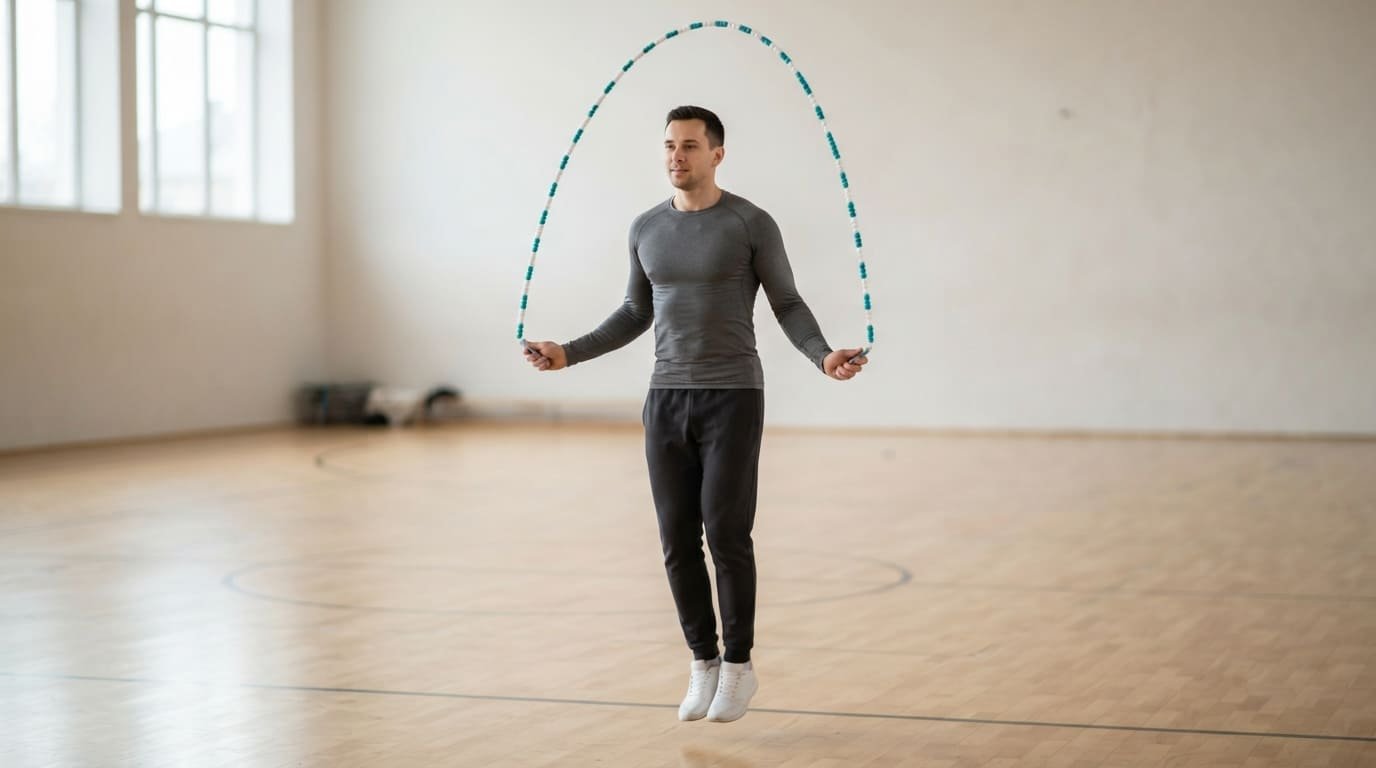
A beaded jump rope, sometimes called a segmented rope, has a nylon or cotton cord running through dozens of short, hard plastic tubes. The beads slide onto the cord side by side and are held in place by a knot or stopper near each handle.
Beaded ropes have been used in school gyms and competitive jump rope for many years. They come in bright colours, and you will often see people using them for freestyle tricks and Double Dutch, as well as for ordinary fitness skipping.
If you search for a beaded rope jump guide, you will find a lot of talk about “feedback”. All this means is that you can feel and hear the rope better. Since most people’s first problem is timing, that feedback is useful.
Why beginners like a beaded jump rope
| Feature | What it does | Why it helps a beginner |
|---|---|---|
| A little extra weight | The rope has more momentum | It keeps turning even if your rhythm is not perfect |
| Holds its shape | The rope forms a stable, open arc | Fewer kinks, tangles and twists |
| Clicks on the floor | You hear each turn | Sound gives you a rhythm to jump to |
| Easy to see | Bright, thick and slower | You can see the rope coming |
| Slower turn | Fewer turns per minute at the same effort | More time to jump |
None of this makes skipping easy on day one. You will still catch your feet. But in my view, many people get through that frustrating first week more quickly with a rope they can feel and hear.
If you are brand new to skipping, our guide on how to jump rope for beginners walks you through setup, drills and a 4-week plan.
Another nice detail is that when the rope hits something, the beads tend to swing through rather than wrap tightly around your ankle the way a thin cable can. Though a hit from a bead can still sting, particularly on bare skin.
What the research says
I should be upfront about this. When I looked for research on beaded ropes, I could not find any studies that test them specifically or compare them with other rope types. So you should be sceptical of any claim that a beaded rope is proven to be better. The advice in this guide comes from practical coaching experience and from how the ropes physically behave.
There is good evidence for skipping in general, though. A review of 21 studies with more than 1,000 mostly young participants found that jump rope training produced small to moderate improvements in resting heart rate, body fat, cardiorespiratory endurance, strength, jumping and sprinting.
And in a randomised trial of 59 healthy young adults, 8 weeks of rope skipping improved fitness, measured by maximal oxygen uptake, in both an interval group and a steady pace group, compared with a group that did no exercise. Body composition did not change, and both exercise groups enjoyed their sessions about equally.
My takeaway is simple. The rope matters less than whether you keep using it. If a jump rope with beads makes skipping more pleasant and less frustrating, that is a very good reason to choose one.
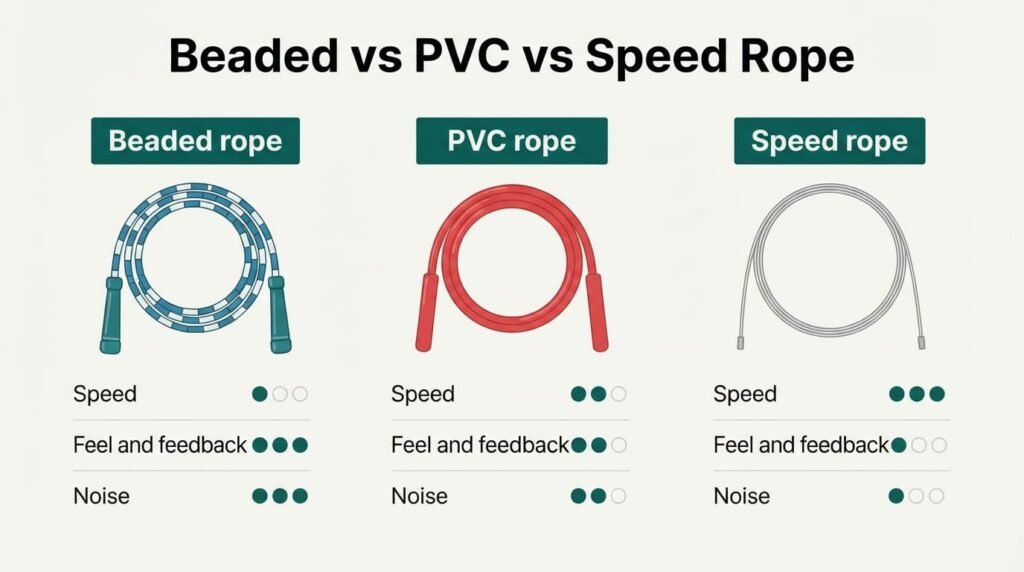
Beaded jump rope vs other ropes
| Rope type | Speed | Feedback | Noise | Best for |
|---|---|---|---|---|
| Beaded rope | Slow to medium | High | Loud | Beginners, rhythm work, tricks, Double Dutch |
| PVC rope | Medium | Medium | Medium | General fitness, a good all-rounder |
| Speed cable | Fast | Low | Low to medium | Fast skipping and double unders |
| Weighted rope | Slow | High | Medium | Upper body effort and timing |
| Cotton or fabric rope | Slow | Low | Quiet | Quiet indoor use, children |
| Ropeless handles | Not applicable | Low | Quiet | Very small spaces, low ceilings |
If you are still deciding, our honest guide to the best jump rope for beginners compares every rope type by goal, with no brand rankings.
Beaded vs PVC
A PVC rope is the classic cheap gym rope. It is quieter and works well for general cardio, but lighter PVC ropes can kink and be harder to feel. A beaded rope holds its shape better. If you already own a PVC rope and it is not causing problems, you do not need to swap it.
Beaded vs speed rope
A speed cable is built for fast turns. It is excellent once your timing is good, but it can be harder to learn with and hurts more when it catches you. A beaded rope is slower, which suits learning but limits very fast skipping and double unders.
Beaded vs weighted
Both are heavier than a thin rope and easy to feel. A weighted jump rope usually carries more load, so it asks more of your shoulders and forearms. A beaded rope is lighter, and a better choice if you mainly want help with timing rather than extra upper body work.
Who should buy one, and who should not
| You are | Beaded rope? | Why |
|---|---|---|
| A beginner who keeps losing the rhythm | Yes | Sound and feel help timing |
| Learning tricks and crossovers | Yes | It holds an open loop and is easy to control |
| Buying for children | Yes | Colourful, durable and easier to feel |
| Practising Double Dutch | Often yes | Common choice for long ropes |
| Training for double unders | Probably not | A speed rope is faster |
| Skipping in a flat with neighbours below | Probably not | Clicks and impact are loud |
| Skipping on a delicate wooden floor | Be careful | Beads can leave marks |
If you are completely new, our guide to the jump rope workout explains how to skip properly and gives you several beginner routines.
How to size a beaded jump rope
Use the same stand-on test as any rope. Stand on the middle of the rope and pull the handles straight up. For a beginner, the handles should reach about your armpits. Our full guide on how long a jump rope should be has a chart by height.
To shorten most beaded ropes:
- Look inside the handle or at the end of the cord to find how it is secured
- Undo the knot or stopper at one end
- Slide off a few beads, roughly 2 or 3 at a time
- Re-tie the knot or stopper and test the rope
- Repeat until it feels right
- Keep the spare beads and spare cord, so you can lengthen it again
Do not cut the cord until you are sure of the length, and even then leave a little extra. If you are between sizes, stay on the longer side for now. Some beaded ropes come in fixed lengths and cannot be shortened as easily, so check before you buy.
How to use a beaded jump rope
- Hold the handles lightly and keep your elbows close to your sides
- Keep your hands around hip height, slightly in front of your body
- Start with the rope behind your heels and swing it over your head with your wrists and forearms
- Listen for the click as the beads touch the floor in front of you
- Jump just after the sound or just as the rope reaches your toes
- Jump only 2 to 3 cm off the floor and land softly on the balls of your feet
- Look straight ahead, not at your feet
Use the click
Try this simple drill for your first session. Hold both handles in one hand and swing the rope beside your body. Listen to the click, and jump each time you hear it. Do this for 30 seconds, then swap hands. When the rhythm feels natural, try it with the rope turning over your head. Many people find this helps them learn much faster than simply trying and tripping.
Which step to use
Research on teenagers found that a basic two-foot bounce produced lower impact forces than an alternating foot step. It was a small study of 16 boys, so it does not apply directly to everyone, but it supports starting with the simple two-foot bounce and adding other steps when your calves are ready.
3 starter workouts with a beaded jump rope
Warm up with 2 to 3 minutes of marching, ankle circles and arm swings. See our guide to warming up before a workout for more.
Session 1: learn the rhythm (10 minutes)
| Part | What to do | Time |
|---|---|---|
| Rhythm drill | Swing the rope beside you and jump to the click | 2 minutes |
| Intervals | 15 seconds skipping, 45 seconds rest | 6 rounds |
| Cool down | Easy walking and calf stretches | 2 minutes |
Session 2: build the time (12 minutes)
Skip for 30 seconds, then rest for 30 seconds, and repeat 10 times. If you trip, simply reset and carry on. Your goal is the total time on the rope, not perfection.
Session 3: skip and strength (15 minutes)
Do 3 rounds of this circuit, resting for 60 seconds between rounds.
- Skip for 40 seconds
- 10 bodyweight squats
- Skip for 40 seconds
- 8 incline push-ups
- Skip for 40 seconds
- 20-second plank
A simple week
Start with 2 sessions in the first two weeks, then move to 3. Leave a day between sessions to let your calves and shins adapt, and walk on the days between. Our guide to calf stretches makes a good finisher.
Your first week with a beaded jump rope for beginners
Here is how I would approach the first few sessions with a beaded jump rope for beginners. Treat it as a skill to practise, not a workout to get through.
| Day | What to do | Goal |
|---|---|---|
| Day 1 | Rhythm drill for 3 minutes, then 5 tries at single jumps over the rope | Learn to turn and jump |
| Day 3 | Rhythm drill for 2 minutes, then 6 rounds of 15 seconds on, 45 seconds off | String a few jumps together |
| Day 5 | 8 rounds of 20 seconds on, 40 seconds off | Get to 10 jumps in a row |
| Day 7 | Rest or walk, then stretch your calves | Let your lower legs adapt |
Do not worry if you only manage three or four jumps in a row at first. That is completely normal with any rope. Count your best run of jumps in each session and watch that number climb. Going from 5 to 20 jumps in a row usually feels like a big breakthrough, and it often happens faster than people expect.
Many people also search for a beaded rope jump routine that lasts longer. Save that for later. Your calves and shins need a few weeks to adapt even when your timing feels great, because the skill often improves faster than your lower legs do.
Floors, noise and where to skip
Beaded ropes are noisier and harder on surfaces than other ropes, so where you skip matters.
| Surface | Good for beads? | Notes |
|---|---|---|
| Rubber gym floor | Excellent | Easy on joints and on the rope |
| Wooden sports floor | Excellent | A slight give and a clear click |
| Jump rope mat | Very good | Protects floors and rope, and gives a defined space |
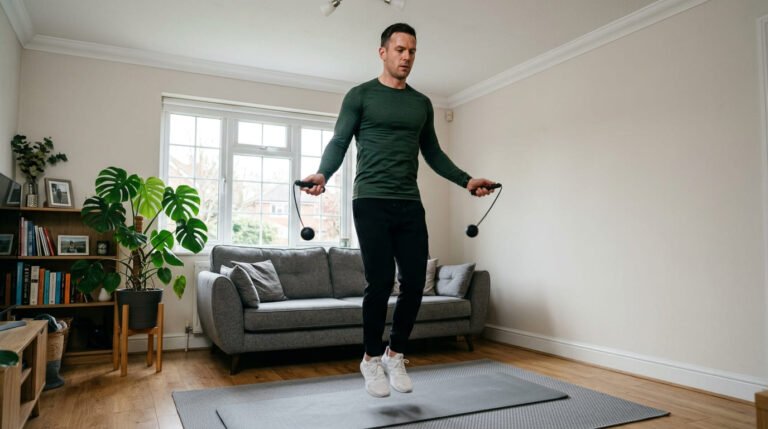
| Smooth home wood floor | Careful | Beads can scratch or dent, so use a mat |
| Thick carpet | Poor | Catches the rope and reduces the click |
| Concrete or tarmac | Okay for short sessions | Hard on shins, and it wears beads faster |
If you live above other people, a beaded rope may not be the kindest choice. The click and the landing noise can travel. Try daytime sessions on a thick mat, skip outdoors or choose a quieter fabric rope. Our high knees exercise also has a low-impact, quieter option.
Looking after your rope
- Hang it up rather than leaving it in a tangled heap
- Check the beads and knots now and then. A loose knot can send beads flying across the room
- Replace cracked beads, since they can chip or pinch the skin
- Wipe the rope down if you use it outdoors
- Keep it away from very cold floors if you can, because hard plastic gets more brittle in the cold
What to look for in a beaded jump rope
- Adjustable length. Check how it shortens and whether spare beads are included
- Bead size. Longer beads are often thicker and heavier, while shorter beads flex more for tricks
- Comfortable handles. Long handles help with tricks. Short, grippy ones suit fitness
- Smooth turning. The cord should rotate freely in the handle
- Length for your height. Very tall skippers may need a longer rope
There are no affiliate links on this page, and I do not earn anything if you buy a rope. I have not tested individual brands, so this is general buying advice, not a review. Our guide to home gym equipment for beginners covers other low-cost gear.
Common mistakes
| Mistake | What happens | Fix |
|---|---|---|
| Using a rope that is too long | It slaps and slows down | Remove a few beads and test |
| Cutting the cord too early | You cannot go back | Test for a week first |
| Jumping before the click | The rope catches your feet | Wait for the sound and stay relaxed |
| Jumping too high | More impact and quicker tiredness | Stay low, 2 to 3 cm |
| Skipping for too long too soon | Sore calves and shins | Use short intervals and build slowly |
| Wearing shorts when learning | Beads sting bare skin | Wear full-length leggings or joggers at first |
Safety and when to back off
Skipping is high impact, so build up slowly whichever rope you use. Rest and take stock if you feel pain along your shin, in your Achilles or in your knees. Our guide to shin splints stretches explains what to do. Check with a doctor or physiotherapist before you start if you have a joint problem, have had a recent injury or have been told to avoid high-impact exercise.
This article is general information, not medical advice. See our medical disclaimer.
The bottom line
A beaded jump rope is one of the friendliest ropes to learn with. The extra weight, stable shape and clear click make it easier to feel your timing, and that can be just what you need to get past the frustrating early stage. It also suits tricks, children and Double Dutch. It is not the best option for fast double unders, quiet flats or delicate floors.
No study has shown that a beaded rope is better than any other, so choose the rope that suits your space and that you enjoy using. Size it with the stand-on test, begin with short intervals, and listen for the click. Consistency, not the rope, is what will get you fitter.
Frequently asked questions
Are beaded jump ropes good for beginners?
Yes, many beginners find them easier. The rope turns at a steady pace, holds its shape and clicks on the floor, which all help with timing. No studies have compared rope types directly, but practical experience supports them as a good first choice.
What is the difference between a beaded jump rope and a PVC rope?
A beaded rope is made of hard plastic segments on a cord, so it is heavier, holds its shape and is noisier. A PVC rope is a single flexible tube, which is lighter and quieter but can kink and is harder to feel.
Are beaded jump ropes good for double unders?
They can be used for double unders, and some people like them, but a speed rope usually makes them easier because it turns much faster. Learn your basic skipping first, then choose a faster rope if double unders are your goal.
How do you shorten a beaded jump rope?
Undo the knot or stopper at the end of the cord, slide off a few beads and re-tie it. Test the new length, keep the spare beads and only cut the cord once you are sure.
Do beaded jump ropes hurt?
They can sting if they hit bare skin, a little like any rope, especially when you are learning. Full-length leggings or joggers help. Hits usually become much rarer as your timing improves.
Is a jump rope with beads good for weight loss?
Any rope can help you burn calories when you use it regularly. The rope type matters less than how long and how often you skip, along with your diet. Choose the rope that you are most likely to keep using.
Are beaded jump ropes loud?
Yes, compared with cloth or thin cable ropes. The beads click on the floor with every turn. That helps your timing, but it may disturb neighbours or family, so use a mat or skip outside if noise is a problem.
Will a beaded jump rope damage my floor?
It can scratch or dent delicate wooden floors, especially over time. Use a jump rope mat or a rubber gym mat at home, or skip on a sports floor or outdoors.
What size beaded jump rope should I buy?
Choose one that reaches about your armpits when you stand on the middle of the rope. As a rough guide, that is about 3 feet longer than your height. Adjustable ropes are the safest choice.
What’s next?
Reading is the easy part. Pick one of these and do it today.