Lower Trap Exercises: 10 Moves for Healthier Shoulders and Posture
Lower trap exercises are the quiet heroes of shoulder training. Everyone knows the upper traps, the muscles that rise toward your ears when you shrug or feel stressed. Far fewer people train the lower part of the same muscle, which pulls the shoulder blades down and helps them rotate smoothly as you lift your arms.
A proper prone Y raise surprises most beginners. Plenty of people can press dumbbells overhead without much trouble, yet find that lifting their empty hands off the floor in a Y position is hard work. That gap is common, and it is exactly why I think these exercises are worth learning.
This guide explains what the lower traps do, how to feel them working, and 10 lower trap exercises from easiest to hardest. It also includes a 6-week plan, the mistakes that turn lower trap work into upper trap work, and what the research says about which moves work best.
At a glance
- The lower trapezius runs from the middle of your spine up to the shoulder blades in a V shape
- It pulls the shoulder blades down and helps rotate them upward when you raise your arms
- The best lower trap exercises lift the arms overhead or in a Y shape while keeping the shoulders away from the ears
- Research found the prone overhead arm raise produced the highest lower trap activity of the exercises tested
- Start with wall slides and prone Y raises with no weight, then add bands and light dumbbells
- Two or three sessions a week of 2 to 3 sets is enough
- If you shrug during the reps, the upper traps are taking over. Lighten the load
What the lower traps do
The trapezius is one large muscle with three parts. The upper fibres run from your neck to the top of your shoulders. The middle fibres run sideways from your spine to your shoulder blades. The lower fibres fan up from the middle of your back to the inner edge of each shoulder blade.
| Part | Main job | Familiar exercise |
|---|---|---|
| Upper trapezius | Lifts and rotates the shoulder blades upward | Shrugs |
| Middle trapezius | Pulls the shoulder blades together | Rows, reverse flys |
| Lower trapezius | Pulls the shoulder blades down and helps rotate them upward | Prone Y raise, wall slides |
The lower traps work as a team with the upper traps and the serratus anterior every time you raise your arms. If they are weak, the upper traps often do more than their share, which is why lower trap exercises often come up in posture and shoulder programmes. Our guide to serratus anterior exercises covers the other key partner.
Why train your lower traps?
- Smoother overhead movement. Reaching up to a shelf, pressing a weight or throwing a ball all depend on the shoulder blades rotating well
- Better balance between muscles. Many people have busy upper traps and underused lower traps, especially after years of desk work
- Posture support. The lower traps help hold the shoulder blades down and back, which helps you sit and stand more comfortably
- A complete back workout. Rows and pull-downs train the middle back, but few common exercises target the lower traps directly
How to feel your lower traps working
Before adding exercises, learn the feeling.
- Sit or stand tall
- Gently pull your shoulder blades down toward your back pockets, as if sliding them into the opposite back pocket
- Keep your neck long and your shoulders away from your ears
- Hold for 5 seconds and relax
You should feel a light tightening in the middle of your back, below the shoulder blades. That is the cue you will use in every exercise below: shoulders down, neck long. Our guide to scapular retraction exercises explains the related squeeze for the middle traps.
What the research says
A well-known study measured muscle activity during common shoulder exercises. The overhead arm raise done lying face down, in line with the direction of the lower trapezius fibres, produced the highest lower trap activity of all the exercises tested. That is the prone Y raise.
Another study looked for exercises that work the lower and middle traps while keeping the upper traps relatively quiet. Side-lying external rotation, side-lying forward flexion, prone horizontal abduction with external rotation and prone extension were the most suitable for restoring balance within the trapezius.
Both studies measured muscle activity, not long-term results, so they tell us which moves target the lower traps best rather than proving what each one fixes. The list below is built around these findings.
How to do lower trapezius exercises well
- Shoulders down first. Set your shoulder blades down before every rep
- Light weights only. Most people start with no weight at all. Even 1 to 2 kg is plenty for prone raises
- Thumbs up. Turning your thumbs toward the ceiling in Y raises keeps the shoulder in a comfortable position
- Slow and controlled. Lift for 2 seconds, pause, lower for 3 seconds
- Keep your neck relaxed. If your neck tightens, you are probably shrugging
- Stop before pain. Muscle fatigue is fine. Pinching or sharp shoulder pain is not
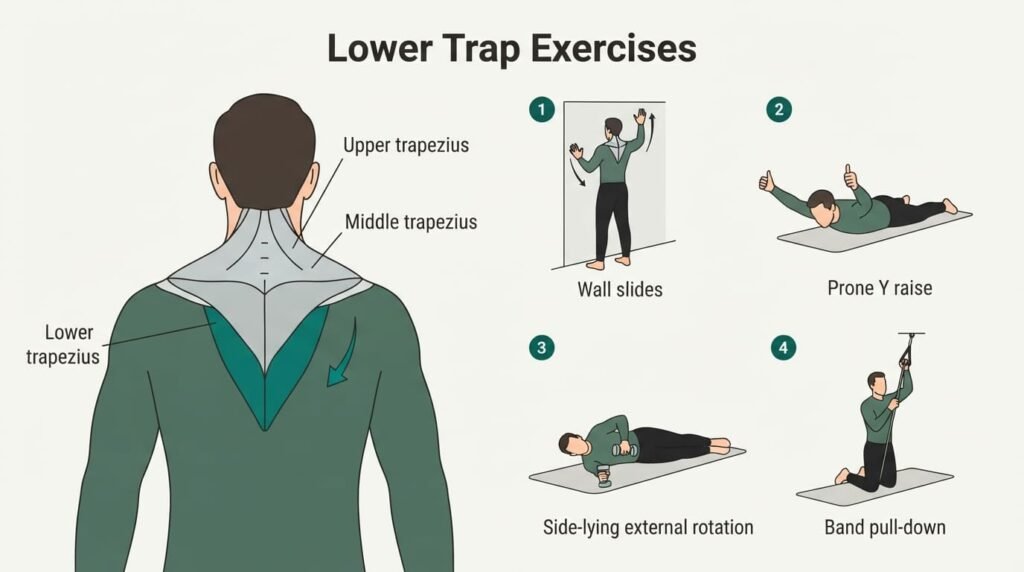
10 lower trap exercises, easiest to hardest
| Level | Exercise | Equipment |
|---|---|---|
| 1 | Scapular depression hold | None |
| 2 | Wall slides | Wall |
| 3 | Wall Y lift-off | Wall |
| 4 | Prone Y raise, no weight | Floor or bed |
| 5 | Prone shoulder extension | Floor or bed |
| 6 | Side-lying external rotation | Light dumbbell or none |
| 7 | Band pull-down with a squeeze | Resistance band |
| 8 | Prone Y raise with light dumbbells | Light dumbbells |
| 9 | Incline bench Y raise | Bench and light dumbbells |
| 10 | Face pull to overhead press | Resistance band |
1. Scapular depression hold
Sit tall on a chair with your hands resting on the seat beside your hips. Press gently into your hands and pull your shoulder blades down, so your neck looks longer. Hold for 5 seconds. Do 2 sets of 10. This is the easiest way to switch on the lower traps without lifting anything.
2. Wall slides
- Stand with your back against a wall, feet a short step away
- Place your forearms and the backs of your hands on the wall in a goalpost position
- Slide your arms up the wall into a Y, keeping your shoulders down
- Slide back down, pulling your elbows toward your back pockets
Dose: 2 to 3 sets of 10. Our guide to the wall angels exercise covers this movement in detail.
3. Wall Y lift-off
Face the wall, standing close. Place your hands on the wall above your head in a Y shape, thumbs up. Keeping your arms straight, lift your hands an inch off the wall and hold for 2 seconds. Lower and repeat. Do 2 sets of 8 to 10. You will feel it low between your shoulder blades.
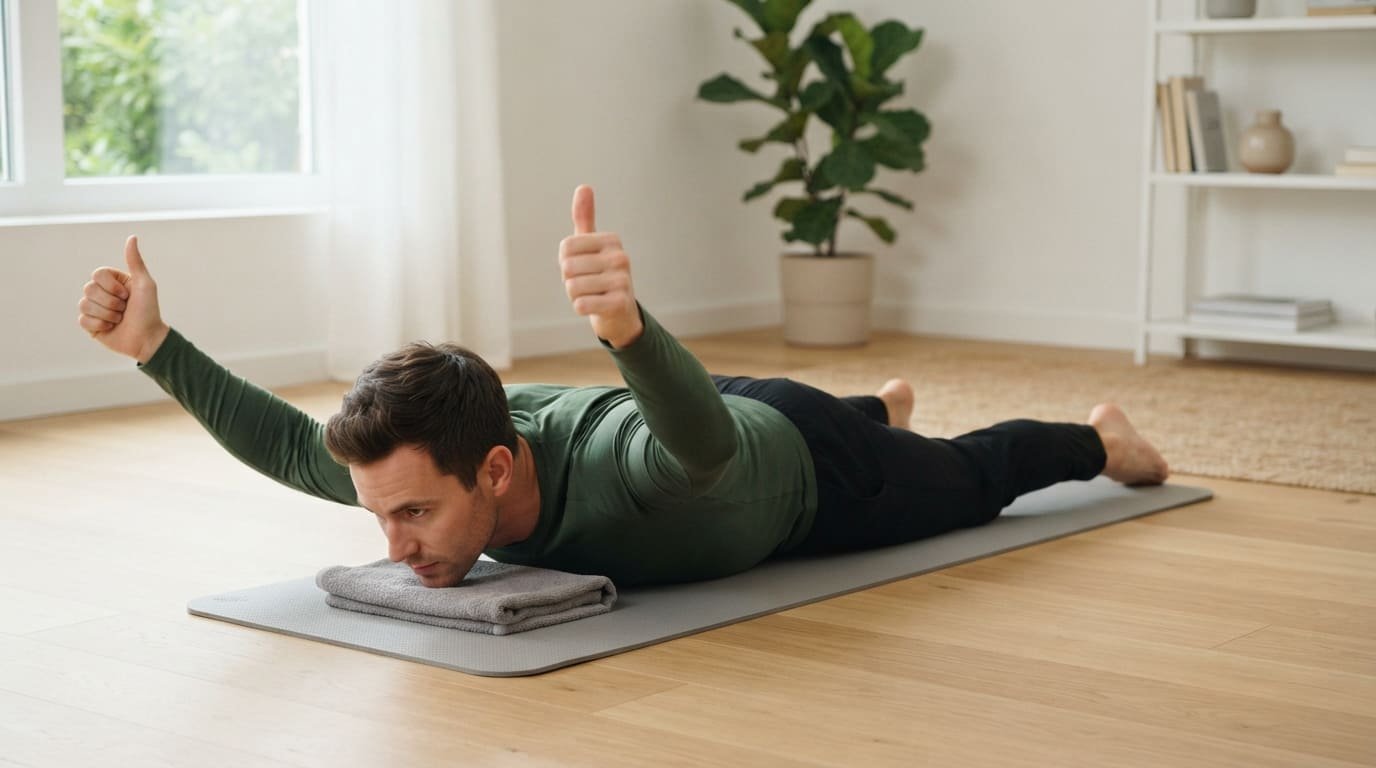
4. Prone Y raise, no weight
This is the gold-standard lower trap exercise.
- Lie face down on the floor or a firm bed, with a small towel under your forehead
- Reach your arms overhead in a Y shape, thumbs pointing up
- Set your shoulder blades down toward your back pockets
- Lift your arms a few centimetres off the floor and hold for 2 seconds
- Lower slowly
Dose: 2 to 3 sets of 8 to 12. If you can only lift a tiny bit, that is normal. Range improves quickly.
5. Prone shoulder extension
Lie face down with your arms by your sides, palms facing your legs. Pull your shoulder blades down and back, then lift your arms toward the ceiling a few centimetres. Hold for 2 seconds and lower. Do 2 sets of 10 to 12.
6. Side-lying external rotation
- Lie on your side with a rolled towel between your top elbow and your side
- Bend the top elbow to 90 degrees, forearm resting across your stomach
- Rotate your forearm up toward the ceiling, keeping the elbow on the towel
- Lower slowly
Dose: 2 to 3 sets of 12 per side, with no weight or a very light dumbbell. This trains the rotator cuff and the lower traps together.
7. Band pull-down with a squeeze
Anchor a band high on a door. Hold an end in each hand with straight arms overhead. Pull your shoulder blades down first, then pull your hands down and out to the side in a wide arc until they reach shoulder height. Return slowly. Do 2 to 3 sets of 12. Our calisthenics back workout uses similar pulling moves.
8. Prone Y raise with light dumbbells
Once the bodyweight version feels easy for 3 sets of 12, hold 0.5 to 2 kg dumbbells or small water bottles. The form stays exactly the same. Most people need to drop their reps at first.
9. Incline bench Y raise
Set a bench to a low incline and lie chest down on it. Let your arms hang, then raise them in a Y with thumbs up. The incline lets your arms move through a bigger range than on the floor. Use very light weights, 1 to 3 kg, and do 2 to 3 sets of 10.
10. Face pull to overhead press
Anchor a band at face height. Pull the band toward your face with elbows high, then press your hands up overhead into a Y while keeping your shoulders down. Return slowly. Do 2 to 3 sets of 10. It links the middle and lower traps in one smooth movement.
A 6-week lower trap exercises plan
Do this two or three times a week, at the end of an upper body session or on its own. It takes about 10 minutes.
| Week | Exercises | Sets and reps |
|---|---|---|
| 1 | Scapular depression hold, wall slides | 2 x 10 each |
| 2 | Wall slides, prone Y raise (no weight) | 2 x 10, 2 x 8 |
| 3 | Prone Y raise, prone shoulder extension | 3 x 10, 2 x 10 |
| 4 | Prone Y raise, side-lying external rotation, band pull-down | 3 x 12, 2 x 12 per side, 2 x 12 |
| 5 | Prone Y raise with light dumbbells, band pull-down | 3 x 8, 3 x 12 |
| 6 | Incline Y raise, face pull to overhead press | 3 x 10, 3 x 10 |
If the weighted versions feel too hard in week 5, stay with bodyweight for another week. Progress is slower for small stabilising muscles, and that is fine.
Adding low trap exercises to your workouts
| Your current routine | Where to add lower trap work |
|---|---|
| Upper body day | 2 sets of prone Y raises after your rows |
| Push day with overhead pressing | Wall slides as a warm-up, band pull-downs after |
| Full body workout | One lower trap exercise as the last move |
| Desk work days | Scapular depression holds every couple of hours |
Our trap workout with dumbbells covers all three parts of the trapezius, and our mid back exercises guide fills in the rows and reverse flys that pair well with this plan.
A 3-minute desk routine for the lower traps
Long hours at a keyboard are one of the main reasons people look for exercises for the lower traps. This short routine can be done in your chair or standing at your desk, with no equipment.
| Move | How to do it | Time |
|---|---|---|
| Scapular depression hold | Press hands into the seat and pull shoulders down | 5 holds of 5 seconds |
| Seated Y reach | Sit tall, reach arms up in a Y with thumbs back, shoulders down | 8 slow reps |
| Doorway chest stretch | Forearms on a door frame, gently lean through | 30 seconds |
| Chin tuck | Glide your head straight back, keeping your eyes level | 8 reps |
| Shoulder blade squeeze | Squeeze shoulder blades back and down | 8 reps |
Repeat it two or three times on long working days. It works well alongside our chin tuck exercise guide and our desk exercises.
Lower traps and overhead lifting
If you press dumbbells overhead, do pull-ups or lift anything above your head, your shoulder blades need to rotate upward smoothly. The lower traps, upper traps and serratus anterior share this job. Low trap exercises make sense as a warm-up before overhead work and as accessory work afterwards.
A simple approach:
- Before pressing: 1 set of 10 wall slides and 1 set of 8 prone Y raises, no weight
- After pressing: 2 sets of band pull-downs or light prone Y raises
- On pulling days: add 2 sets of face pulls to overhead press
Our shoulder workout with dumbbells and bodyweight shoulder workout both pair well with this.
How to tell your lower trap exercises are working
Because the lower traps are small and deep, progress is easier to feel than to see. Look for these signs after three to six weeks:
- Prone Y raises feel smoother, and you can lift your arms a little higher off the floor
- You can do wall slides all the way up without your shoulders creeping toward your ears
- Overhead pressing feels more stable at the top
- Your neck and upper shoulders feel less tense after a long day at the desk
- You can add a light dumbbell to your Y raises without losing form
Write down your reps and the weight you use each week. Small, steady increases in exercises for the lower traps are a good sign, even if nothing looks different in the mirror.
Common mistakes
| Mistake | What happens | Fix |
|---|---|---|
| Shrugging | Upper traps take over | Set shoulders down before each rep and lighten the load |
| Using too much weight | Arms swing and form breaks | Start with no weight |
| Arching the lower back in prone raises | You lift with your back, not your shoulders | Keep your forehead on the towel and hips down |
| Thumbs turned down | Can pinch the front of the shoulder | Point thumbs to the ceiling |
| Rushing | Momentum replaces muscle | Pause for 2 seconds at the top |
| Only training lower traps | Unbalanced shoulder work | Keep your rows, presses and rotator cuff work too |
Who benefits most from lower trap exercises
- Desk workers. Long hours of typing often leave the upper traps tense and the lower traps underused. Pair this plan with our posture exercises
- People who lift overhead. Stronger lower traps help the shoulder blades rotate smoothly under load
- Swimmers, climbers and racquet sport players. Their sports demand lots of overhead work
- People with a winging shoulder blade. Our winged scapula exercises guide covers that pattern specifically, alongside the serratus anterior
Safety and when to get help
Lower trapezius exercises are gentle and low risk. Stop and get advice if you have:
- Sharp pain in the shoulder during or after exercises
- Pain that wakes you at night
- Weakness when lifting your arm, or a recent fall onto the shoulder
- Numbness or tingling down the arm
Shoulder pain while raising the arm can have several causes. Our guide to shoulder impingement exercises explains one common pattern, but persistent pain deserves a proper assessment.
This article is general information, not medical advice. See our medical disclaimer.
The bottom line
Lower trap exercises train the part of the trapezius that pulls your shoulder blades down and helps them rotate as you lift your arms. The prone Y raise, wall slides, prone shoulder extension and side-lying external rotation are the core moves, backed by muscle activity research.
Start with no weight, keep your shoulders away from your ears, and add bands and light dumbbells only when your form is solid. Two or three short sessions a week for six weeks is enough to feel a real difference in how your shoulders move.
Frequently asked questions
What are the best lower trap exercises?
The prone Y raise produced the highest lower trap activity in a well-known study. Wall slides, prone shoulder extension, side-lying external rotation and band pull-downs are also excellent choices.
How do I know if my lower traps are weak?
A simple sign is finding prone Y raises very hard even with no weight, or noticing your shoulders creep toward your ears whenever you lift your arms. A physiotherapist can test it properly if you have shoulder pain.
How often should I do low trap exercises?
Two or three times a week is enough for most people. Gentle versions such as scapular depression holds and wall slides can be done more often.
Should I use weights for lower trapezius exercises?
Start without weights. When you can do 3 sets of 12 prone Y raises with good form, add very light dumbbells of 0.5 to 2 kg. The lower traps respond to control and volume more than heavy loads.
Do lower trap exercises improve posture?
They can help you hold your shoulder blades in a more comfortable position, especially when combined with mid back and chest work. Posture also depends on habits such as breaking up long periods of sitting.
Why do I feel lower trap exercises in my neck?
That usually means the upper traps are taking over. Set your shoulder blades down before each rep, reduce the weight or range, and keep your neck long.
Can I train lower traps at home?
Yes. Most exercises in this guide need only the floor, a wall, a resistance band or light dumbbells. A few water bottles work well in place of dumbbells.
What is the difference between lower trap and mid back exercises?
Mid back exercises such as rows mainly pull the shoulder blades together, which trains the middle traps and rhomboids. Lower trap exercises pull the shoulder blades down and help them rotate upward, often with the arms overhead.
Can I do lower trap exercises with a shoulder injury?
Gentle versions such as scapular depression holds and wall slides are often part of shoulder rehab, but the right exercises depend on the injury. If you have a diagnosed or painful shoulder problem, ask a physiotherapist which exercises for the lower traps suit you.
How long does it take to strengthen the lower traps?
Most people notice smoother, easier prone Y raises and wall slides within 3 to 4 weeks. Adding light weight with good form usually takes around 6 weeks of training two or three times a week.
What’s next?
Reading is the easy part. Pick one of these and do it today.