Suitcase Carry Exercise: How to Do It, Benefits and Beginner Workouts
The suitcase carry exercise is about as simple as strength training gets. You pick up a heavy weight in one hand, stand tall and walk. That is it. Yet this one-sided carry is one of the best exercises you can do for your core, your grip and your posture, because your body has to work hard just to stop you leaning toward the weight.
If you have ever carried a heavy shopping bag or a suitcase through an airport, you already know the feeling. Your body wants to tip toward the load, and your waist, hips and back muscles quietly fight to keep you upright. The suitcase carry trains exactly that skill, in a controlled, progressive way.
This guide explains how to do the suitcase carry exercise with good form, which muscles it works, what research says about loaded carries, the real suitcase carry benefits, how heavy to go, variations, workouts and the common mistakes to avoid.
At a glance
- The suitcase carry means walking while holding a weight in one hand at your side
- It is also called a single arm farmers carry or a one-arm carry
- The main challenge is resisting leaning toward the weight, which trains the obliques and quadratus lumborum
- It also builds grip strength, shoulder stability and hip strength
- Research on strongman events found carrying exercises challenge the body differently from lifting exercises
- Start with a moderate dumbbell or kettlebell and walk 20 to 30 metres per side
- Stand tall, keep your shoulders level and walk slowly
What is a suitcase carry?
A suitcase carry is a loaded carry where you hold a single weight on one side of your body, like carrying a suitcase, and walk a set distance or time. Because the load is only on one side, your body has to resist being pulled sideways. That makes it an anti-lateral flexion exercise: your core works to stop you bending to the side.
| Carry | How you hold the load | Main challenge |
|---|---|---|
| Farmer’s carry | A weight in each hand | Grip, total body strength |
| Suitcase carry | One weight in one hand | Core resisting side bending |
| Front rack carry | Weights held at the chest | Upper back and core, breathing |
| Overhead carry | Weight held overhead | Shoulder stability and core |
| Bear hug carry | Sandbag or ball hugged to the chest | Whole body bracing |
If you already do farmer’s carries, the suitcase carry is the perfect next step. Our farmers carry guide covers the two-handed version.
Muscles worked

| Muscle | Role |
|---|---|
| Obliques (opposite side to the weight) | Stop you bending toward the load |
| Quadratus lumborum (opposite side) | Deep lower back muscle that holds the torso upright |
| Transversus abdominis | Braces the trunk |
| Gluteus medius | Keeps the hips level as you walk |
| Forearms and grip | Hold the handle |
| Trapezius and shoulder muscles | Keep the shoulder from being pulled down |
| Erector spinae | Keep you upright |
| Legs | Carry you forward |
Notice that the hardest-working core muscles are on the side opposite the weight. If the weight is in your right hand, your left obliques and left quadratus lumborum work hardest to stop you leaning right.
What the research says about loaded carries
A study by spine researcher Stuart McGill and colleagues measured trunk and hip muscle activity, spine load and stiffness during strongman events, including the farmer’s walk, super yoke, Atlas stone lift, suitcase carry, keg walk, tire flip and log lift. In heavy carries, muscles such as the quadratus lumborum helped make up for the hips’ limited sideways strength, with the stiffened torso acting as a support for the pelvis. Carrying events challenged different abilities from the lifting events. The authors concluded that loaded carrying would enhance traditional lifting-based strength programmes.
In plain terms: carries train your core to do its real job, keeping your trunk stiff and steady while your arms and legs move. That is why the suitcase carry is a staple in many back-friendly and athletic programmes. Our guide to the McGill Big 3 includes related core exercises.
How to do the suitcase carry exercise
- Place a dumbbell or kettlebell beside one foot
- Hinge at your hips and bend your knees to pick it up, keeping your back flat, as if doing a one-arm deadlift
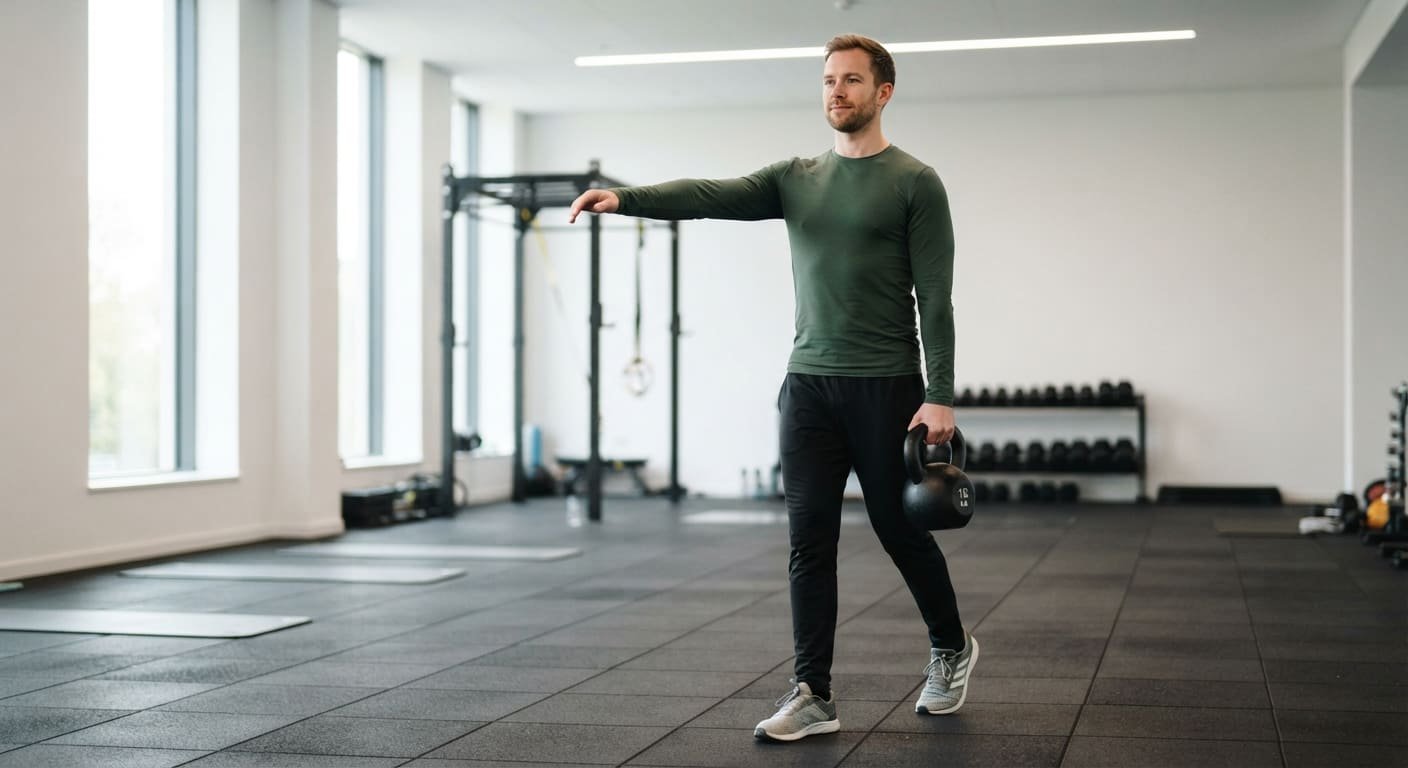
- Stand tall with the weight at your side, arm straight, shoulders level
- Brace your core gently and keep your ribs stacked over your hips
- Walk slowly and steadily, taking normal-length steps
- Keep your body upright. Do not lean toward or away from the weight
- Walk 20 to 30 metres, or for 20 to 40 seconds
- Set the weight down carefully, switch hands and repeat on the other side
Helpful cues
| Cue | What it does |
|---|---|
| Stand tall like you are being pulled up by a string | Prevents slumping |
| Shoulders level, like carrying a tray of drinks | Stops the weight dragging the shoulder down |
| Squeeze the handle hard | Builds grip and shoulder stability |
| Walk on a line | Encourages control and hip stability |
| Breathe behind the brace | Lets you stay tight without holding your breath |
Suitcase carry benefits
| Benefit | Why it matters |
|---|---|
| Core strength against side bending | Protects your back during everyday carrying |
| Grip strength | Helps with deadlifts, pull-ups and daily tasks |
| Shoulder stability | Keeps the shoulder joint centred under load |
| Hip strength and balance | The gluteus medius keeps your pelvis level |
| Posture | Trains you to stand tall under load |
| Real-world strength | Mimics carrying shopping, luggage and children |
| Simple and safe | Easy to learn and easy to scale |
| Exposes imbalances | One side often feels harder than the other |
Many people discover that one side is noticeably weaker. Doing the weaker side first and matching the reps on the stronger side helps even things out over time. Our hand grip exercises guide is useful if your grip gives out before your core.
How heavy should you go?
| Level | Starting weight (rough guide) | Distance or time |
|---|---|---|
| Beginner | 8 to 16 kg | 20 metres or 20 seconds per side |
| Intermediate | 16 to 32 kg | 30 metres or 30 seconds per side |
| Advanced | 32 kg or more | 40 metres or 40 seconds per side |
These are rough starting points. The right weight is one that challenges you but still lets you walk tall without leaning. If you lean toward the weight, it is too heavy. If you can walk for a minute with no effort, go heavier.
Suitcase carry variations
| Variation | How | Why |
|---|---|---|
| Suitcase hold (static) | Stand still holding the weight | Learn the position first |
| Suitcase march | March slowly on the spot | Hip and core control in a small space |
| Kettlebell suitcase carry | Use a kettlebell | Different grip and balance |
| Trap bar or plate carry | Hold a plate by the edge or a trap bar handle | Harder grip challenge |
| Offset carry | One weight in the rack position, one at the side | Mixes two challenges |
| Suitcase carry with step-ups | Carry the weight up and down stairs | Real-world strength |
| Waiter walk | One weight held overhead | Shoulder stability |
Suitcase carry at home
No weights? Fill a backpack, a bag for life or an actual suitcase with books or water bottles. Carry it in one hand along a hallway or around your garden. It works just as well, and you can add weight gradually.
Workouts with the suitcase carry exercise
Core finisher (8 minutes)
| Exercise | Dose |
|---|---|
| Suitcase carry | 3 x 30 metres per side |
| Side plank | 2 x 20 seconds per side |
| Dead bug | 2 x 8 per side |
Full-body strength (30 minutes)
| Exercise | Sets x reps |
|---|---|
| Goblet squat | 3 x 10 |
| Dumbbell row | 3 x 10 per side |
| Push-ups | 3 x 10 |
| Romanian deadlift | 3 x 8 |
| Suitcase carry | 3 x 30 metres per side |
Kettlebell session
| Exercise | Sets x reps |
|---|---|
| Kettlebell swing | 4 x 15 |
| Kettlebell goblet squat | 3 x 10 |
| Suitcase carry | 3 x 30 metres per side |
| Halo or around the body pass | 2 x 8 each way |
Our kettlebell workout for beginners has more ideas.
A 6-week suitcase carry plan
| Week | Weight | Dose (per side) | Sessions |
|---|---|---|---|
| 1 | Light to moderate | 2 x 20 metres | 2 |
| 2 | Same | 3 x 20 metres | 2 |
| 3 | Slightly heavier | 3 x 20 metres | 2 to 3 |
| 4 | Same | 3 x 30 metres | 2 to 3 |
| 5 | Heavier | 3 x 30 metres | 3 |
| 6 | Same | 3 x 40 metres | 3 |
Add weight only when you can walk the full distance tall, with level shoulders and no leaning.
Common mistakes
| Mistake | What happens | Fix |
|---|---|---|
| Leaning toward the weight | The core stops working properly | Use a lighter weight, stand tall |
| Leaning away to counterbalance | Turns into a side bend | Keep shoulders level |
| Shrugging the shoulder | Neck tension | Pull the shoulder down and back |
| Walking fast | Less control | Slow, steady steps |
| Picking up with a rounded back | Back strain | Hinge at the hips |
| Only training one side | Imbalances | Always do both sides |
Suitcase carries and back health
Because carries train the core to stay stiff and upright, many back-focused programmes include the suitcase carry exercise or similar loaded walks. If your back is sensitive, start with light weights and short distances, and stop if you feel sharp pain. Our core exercises for back pain guide is a good place to start before loading carries.
Safety tips
- Pick up and put down the weight with a hip hinge, not a rounded back
- Clear your walking path of obstacles
- Choose a weight you can grip securely
- Stop if you feel sharp pain in your back, shoulder or wrist
This article is general information, not medical advice. See our medical disclaimer.
Why carrying on one side is so effective
Most gym exercises are symmetrical. Squats, deadlifts, bench presses and even farmer’s carries load both sides of the body evenly. Real life is rarely like that. You carry a child on one hip, a bag on one shoulder and a suitcase in one hand. The suitcase carry exercise trains your body for exactly those lopsided moments.
When the weight sits in your right hand, gravity tries to bend your trunk to the right. To stay upright, the muscles on your left side have to switch on and hold firm for every single step. At the same time, your hips have to stay level while you shift your weight from one leg to the other. That combination of side-to-side stability and walking is hard to train any other way.
It is also one of the most honest exercises in the gym. If one side of your core or hips is weaker, you will feel it straight away, because you will start to tilt or your steps will become uneven. That makes the suitcase carry a useful check on your balance as well as a strength builder.
Suitcase carry vs farmer’s carry
| Feature | Suitcase carry | Farmer’s carry |
|---|---|---|
| Load | One weight, one hand | Two weights, both hands |
| Total weight moved | Lower | Higher |
| Main core challenge | Resisting side bending | General bracing |
| Grip challenge | High on one hand | High on both hands |
| Hip challenge | High, the pelvis must stay level | Moderate |
| Best for | Core stability, balance, imbalances | Overall strength, grip, work capacity |
Both are worth doing. Many coaches use the farmer’s carry to build overall strength and the suitcase carry to train trunk control. If you only have one dumbbell or kettlebell at home, the single arm farmers carry is the obvious choice, because it gives you a serious challenge with very little equipment.
Picking up and putting down safely
The walk is the fun part, but most problems happen at the start and end of a set, when people grab the weight with a rounded back or twist as they put it down.
- Stand with the weight beside your foot, not in front of you
- Push your hips back and bend your knees until you can reach the handle with a flat back
- Squeeze the handle, pull your shoulder down and back, then stand up by driving through your feet
- Pause for a breath at the top, check your shoulders are level, then start walking
- To finish, stop walking, brace again and lower the weight with the same hip hinge
Think of the pickup and set-down as a one-arm deadlift. If you treat those moments with the same care as the walk, the suitcase carry stays one of the safest loaded exercises you can do.
Breathing while you carry
A common mistake is to hold your breath for the whole walk. That works for a few seconds but quickly leaves you light-headed. Instead, take a breath in, brace your middle gently, and then keep breathing in short, controlled breaths while you hold that brace. You should be able to say a few words while carrying. If you cannot, the weight or distance is too much for now.
Short on space? Use turns
You do not need a long corridor. In a small room or garage, walk 5 to 10 metres, stop, turn slowly and walk back. Turning is actually a useful extra challenge, because your body has to resist the weight swinging as you change direction. Keep the turns slow and deliberate, and count the total distance or time rather than lengths.
Where suitcase carries fit in your week
| Your training | How to add suitcase carries |
|---|---|
| Two full-body sessions a week | 3 rounds per side at the end of each session |
| Three strength sessions a week | Add carries to 2 of the 3 sessions |
| Mostly walking or running | One short carry session after a walk, twice a week |
| Home workouts | Use a loaded bag as the final exercise |
| Busy weeks | One 5-minute carry block is better than nothing |
Because carries are not very tiring for the muscles, they recover quickly. Most people can do them two or three times a week without any problem. Put them at the end of a session so your grip is still fresh for bigger lifts like rows and deadlifts.
Suitcase carries for older adults and runners
For older adults, carrying is a daily skill: shopping, laundry baskets, garden tools. A light suitcase carry with a 4 to 8 kg dumbbell or a bag of shopping is a practical way to keep that strength. Start with a static hold beside a wall or kitchen counter, then progress to walking a few metres.
Runners often like the suitcase carry because it trains the hip muscles that keep the pelvis level on each stride. Our guide to hip abductor exercises has more ideas for that area, and our back muscle exercises guide covers the upper back muscles that help keep your shoulders level under load.
Ways to progress the suitcase carry exercise
Adding weight is the obvious way to make the suitcase carry exercise harder, but it is not the only option. If you train at home with a single dumbbell or kettlebell, these progressions keep the challenge going:
| Progression | How it makes the carry harder |
|---|---|
| Walk further | More time under load for the core and grip |
| Walk slower | Each step demands more balance and control |
| Add a pause | Stop for 3 seconds every 5 steps, standing tall |
| Use a thicker handle | Wrap a towel around the handle for a tougher grip |
| Carry up stairs | Adds leg work and more hip stability |
| Bottoms-up kettlebell | Hold the kettlebell upside down for a big grip and shoulder challenge |
Change only one thing at a time. For example, keep the same weight for a few weeks and add distance, then go back to a shorter distance with a heavier weight. This steady approach is how the suitcase carry exercise keeps paying off month after month, without needing a full rack of dumbbells.
Exercises that pair well with suitcase carries
The suitcase carry exercise works nicely alongside a few other moves. Side planks train the same side-bending resistance without walking. Single-leg Romanian deadlifts and step-ups build the hip strength that keeps your pelvis level. Rows strengthen the upper back that keeps your shoulder from being pulled down. Our oblique exercises guide has more options for the side of your core.
The bottom line
The suitcase carry exercise is simple, practical and powerful. Holding a weight in one hand and walking tall trains your obliques, deep core, glutes, grip and shoulders to keep you upright against an uneven load, exactly the strength you use carrying shopping or luggage. Research on loaded carries suggests they challenge the body in ways traditional lifts do not.
Start with a moderate weight, walk 20 to 30 metres per side, keep your shoulders level and never lean toward the load. Add a few rounds to the end of your workouts two or three times a week, and you will feel the suitcase carry benefits in your core, grip and everyday strength within weeks.
Frequently asked questions
What is a suitcase carry?
A suitcase carry is walking while holding a weight in one hand at your side, like carrying a suitcase. It trains your core to resist leaning toward the load.
What muscles does the suitcase carry work?
Mainly the obliques and quadratus lumborum on the side opposite the weight, plus the deep core, glutes, grip, shoulders and legs.
What are the main suitcase carry benefits?
Better core strength against side bending, a stronger grip, more stable shoulders and hips, better posture and practical carrying strength.
Is a suitcase carry the same as a single arm farmers carry?
Yes. A single arm farmers carry and a suitcase carry are the same exercise: a weight held in one hand while walking.
How heavy should a suitcase carry be?
Heavy enough to challenge you while you can still walk tall without leaning. Many beginners start with 8 to 16 kg.
How far should I walk in a suitcase carry?
Start with 20 to 30 metres per side, or 20 to 40 seconds, for 2 or 3 rounds.
Can I do suitcase carries at home?
Yes. A loaded backpack, shopping bag or real suitcase works well. Carry it along a hallway or around your garden.
Is the suitcase carry good for back pain?
Many people find light carries helpful for building core stability. Start light, keep good posture and stop if you feel sharp pain.
How often should I do the suitcase carry exercise?
Two or three times a week, usually at the end of a workout, is plenty for most people.
What’s next?
Reading is the easy part. Pick one of these and do it today.