
How Long Should You Jump Rope? Daily Times by Goal and Fitness Level
How long should you jump rope? It is one of the first questions people ask after buying a rope, and the internet gives answers that range from “two minutes a day” to “an hour”. The honest answer depends on your fitness, your goal and how your calves are coping. Five minutes can be a hard workout for a beginner, while an experienced skipper might happily go for 30.
This guide gives practical answers. You will find recommended skipping times for beginners, intermediate and experienced skippers, times by goal (general health, weight loss, fitness, boxing), how many days a week to skip, how much jumping rope is equivalent to 10,000 steps, and how to build up safely.
At a glance
- Beginners: about 5 to 10 minutes per session, including rests, 3 times a week
- After a month or two: 10 to 20 minutes, 3 to 5 times a week
- Experienced skippers: 20 to 30 minutes or more, mixing steady and interval work
- Skipping counts as vigorous activity, so 75 minutes a week meets the minimum WHO activity guideline
- In energy terms, about 25 to 30 minutes of continuous moderate skipping roughly equals walking 10,000 steps
- Total time includes rests: a 15-minute session might have 8 to 10 minutes of actual skipping
- Build up slowly to protect your calves, shins and Achilles
How long should you jump rope? Times by fitness level
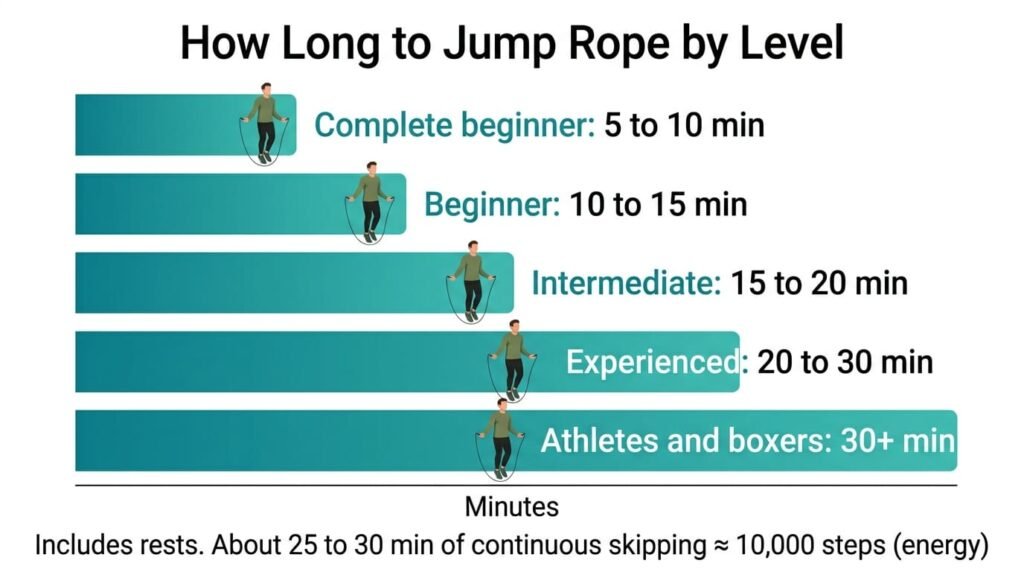
| Your level | Session length (including rests) | Actual skipping time | Sessions per week |
|---|---|---|---|
| Complete beginner | 5 to 10 minutes | 2 to 5 minutes | 3 |
| Beginner (2 to 4 weeks in) | 10 to 15 minutes | 5 to 8 minutes | 3 to 4 |
| Intermediate (1 to 3 months) | 15 to 20 minutes | 8 to 15 minutes | 3 to 5 |
| Experienced (3 months or more) | 20 to 30 minutes | 15 to 25 minutes | 4 to 5 |
| Athletes and boxers | 30 minutes or more | 20 to 30 minutes or more | 4 to 6 |
If you are wondering “how long should I jump rope as a beginner”, the answer is less than you think. Your heart and lungs may feel ready for more, but your calves and Achilles tendons adapt more slowly. Start short and let your lower legs catch up.
How skipping fits the activity guidelines
The World Health Organization recommends that adults do at least 150 to 300 minutes of moderate activity, or 75 to 150 minutes of vigorous activity, each week, or an equivalent mix. It also recommends muscle-strengthening activities on two or more days a week.
Skipping is vigorous activity for almost everyone. That means:
| Weekly skipping | What it covers |
|---|---|
| 75 minutes | The minimum vigorous activity guideline |
| 150 minutes | The upper end of the vigorous range |
| 3 sessions of 25 minutes | 75 minutes, minimum guideline met |
| 5 sessions of 15 minutes | 75 minutes, minimum guideline met |
| 30 minutes of skipping plus 90 minutes of walking | Roughly equal to the minimum when combined |
You do not have to get all of your activity from skipping. Mixing skipping with walking, cycling or other activities is often easier on the body and more enjoyable.
How long should you jump rope for your goal?
| Goal | Suggested time | Notes |
|---|---|---|
| General health and fitness | 15 to 20 minutes, 3 to 4 times a week | Combine with walking and strength work |
| Weight loss | 15 to 30 minutes, 4 to 5 times a week | Diet matters most. See our jump rope weight loss guide |
| Building cardio fitness | 15 to 25 minutes, including intervals | Two interval sessions a week works well |
| Boxing and footwork | 3-minute rounds, 3 to 6 rounds | Matches boxing round timing |
| Warm-up before training | 3 to 5 minutes | Easy pace |
| Calf and ankle strength for runners | 5 to 10 minutes, 2 times a week | Add after easy runs |
Can you jump rope every day?
Some experienced skippers do short, easy sessions every day. For beginners, it is better to skip 3 or 4 days a week with rest days between, because the calves and Achilles need time to adapt. If you want to move every day, walk or cycle on the days in between.
How much jumping rope is equivalent to 10,000 steps?
This is a popular question, and there is no perfect answer, because steps and skipping are measured differently. Here is the most useful way to compare: by energy used.
Walking 10,000 steps at a normal pace of about 100 to 120 steps per minute takes roughly 80 to 100 minutes. At about 3.5 METs, that is roughly 280 to 350 MET-minutes. Moderate skipping is rated at about 11.8 METs in the Compendium of Physical Activities.
| Body weight | Calories in about 10,000 walking steps (rough) | Continuous moderate skipping to match |
|---|---|---|
| 60 kg (132 lb) | About 290 to 370 | About 24 to 30 minutes |
| 75 kg (165 lb) | About 370 to 460 | About 24 to 30 minutes |
| 90 kg (198 lb) | About 440 to 550 | About 24 to 30 minutes |
So, in energy terms, about 25 to 30 minutes of continuous moderate skipping is roughly the same as walking 10,000 steps. Note that 25 to 30 minutes of continuous skipping is a lot, so most people would split it into intervals over a longer session. And the two are not identical: walking is gentle and can be done all day, while skipping is intense and needs recovery. Our steps to calories calculator estimates your walking burn more precisely.
Does a step counter count skipping?
Most phones and fitness trackers count skipping jumps as steps, but not accurately. Some count every jump, some count only some, and wrist-worn trackers may struggle because your hands move in small circles. Treat any step count from skipping as a rough guide only.
How long should you jump rope each week? A 6-week build-up
| Week | Session | Skipping time per session | Sessions |
|---|---|---|---|
| 1 | 20 seconds on, 40 seconds off, 8 rounds | About 3 minutes | 3 |
| 2 | 30 seconds on, 30 seconds off, 10 rounds | 5 minutes | 3 |
| 3 | 45 seconds on, 30 seconds off, 10 rounds | 7 to 8 minutes | 3 to 4 |
| 4 | 60 seconds on, 30 seconds off, 10 rounds | 10 minutes | 3 to 4 |
| 5 | 2 minutes on, 1 minute off, 6 rounds | 12 minutes | 4 |
| 6 | 3 minutes on, 1 minute off, 5 rounds | 15 minutes | 4 |
If you are new, start with our guide on how to jump rope. When you are ready for variety, our jump rope workout and skipping rope cardio workout guides have plenty of routines.
Signs you are doing too much
| Sign | What to do |
|---|---|
| Calves sore for more than 3 days | Take extra rest, reduce session length |
| Pain along the inside of the shin | Rest, see our shin splints stretches, reduce volume |
| Achilles pain, especially in the morning | Stop skipping and get it assessed if it persists |
| Sessions feel worse, not better, each week | Take a lighter week |
| Tripping more than usual | Fatigue, finish the session early |
Does intensity change how long you should skip?
Yes. Ten minutes of hard intervals can be as tiring as 20 minutes of steady skipping. If you mostly do high-intensity sessions, keep them shorter and do no more than two or three a week. If you mostly skip at an easy, steady pace, you can go a little longer and more often.
| Session type | Typical length | Weekly frequency |
|---|---|---|
| Easy steady skipping | 15 to 30 minutes | 3 to 5 |
| Interval or HIIT skipping | 10 to 20 minutes | 2 to 3 |
| Sprint skipping | 5 to 10 minutes of work | 1 to 2 |
How many calories in each length of session?
| Session (continuous moderate skipping) | 60 kg | 75 kg | 90 kg |
|---|---|---|---|
| 5 minutes | About 60 | About 80 | About 95 |
| 10 minutes | About 125 | About 155 | About 185 |
| 20 minutes | About 250 | About 310 | About 370 |
| 30 minutes | About 370 | About 465 | About 560 |
These are rough estimates for continuous skipping. If your session includes rests, the actual number will be lower. Our guide on how many calories jumping rope burns explains the method.
Recovery between sessions
Your lower legs do most of the work in skipping, so look after them:
- Stretch your calves after every session. Our calf stretches guide has a short routine
- Skip on a forgiving surface. See our guide to the jump rope mat and shoes
- Do calf raises and tibialis raises twice a week to build resilience
- Walk on rest days to keep blood flowing without more impact
- Sleep well, because recovery happens mostly at night
Common mistakes
| Mistake | What happens | Fix |
|---|---|---|
| Skipping 30 minutes on day one | Very sore calves, possible shin pain | Start with 5 to 10 minutes |
| Skipping every day as a beginner | No time to adapt | 3 to 4 days a week |
| Counting only time, not rest | Overestimating your work | Track actual skipping time |
| Long sessions at high intensity | Fatigue and sloppy form | Keep HIIT sessions short |
| Ignoring warning signs | Small niggles become injuries | Reduce volume early |
This article is general information, not medical advice. Check with a doctor before starting vigorous exercise if you have heart, joint or balance problems. See our medical disclaimer.
How long should you jump rope at different ages?
| Age group | Typical session | Notes |
|---|---|---|
| Children | 5 to 15 minutes of playful skipping | Games, rhymes and counting challenges work well |
| Teenagers | 10 to 20 minutes | Great for fitness and coordination |
| Adults 18 to 50 | 10 to 30 minutes | Build up gradually |
| Adults over 50 | 5 to 15 minutes, with longer rests | Joints and tendons adapt more slowly |
| Older adults | Low impact alternatives first | Marching with a ropeless rope, then short intervals if suitable |
The question of how long should you jump rope changes a little with age. Tendons tend to become stiffer and recover more slowly over the years, so older beginners benefit from shorter sessions, more rest days and plenty of calf strengthening. If balance is a concern, a ropeless rope or simply marching on the spot gives you similar cardio with less risk of tripping.
How long should I jump rope if I am heavier?
If you are carrying extra weight, each landing puts more load on your calves, knees and feet. That does not mean you cannot skip, but it does change how long you should start with.
| Week | Session | Skipping time |
|---|---|---|
| 1 and 2 | 10 to 15 seconds skipping, 45 seconds rest, 6 to 8 rounds | 1 to 2 minutes |
| 3 and 4 | 20 seconds skipping, 40 seconds rest, 8 rounds | About 3 minutes |
| 5 and 6 | 30 seconds skipping, 30 seconds rest, 8 to 10 rounds | 4 to 5 minutes |
Combine these short sessions with walking, cycling or swimming on other days. Skip on a forgiving surface and wear cushioned shoes. As your fitness improves and your body adapts, you can follow the main build-up plan. Our walking for weight loss guide pairs well with this approach.
Does it matter when you jump rope?
Not really. The best time is the time you can stick to. Some people like a short morning session to wake up. Others prefer skipping after work to clear their head. If you skip in the morning, take a little longer to warm up, because your calves and ankles tend to be stiffer after sleep. If you skip in the evening, finish at least an hour before bed if vigorous exercise keeps you awake.
How to track your skipping time
- Use a simple interval timer app with work and rest periods
- Note the actual skipping time, not just the session length
- Record your best continuous run each week
- Count jumps in 60 seconds once a month to measure speed
- Keep notes on how your calves feel the next day
Tracking actual skipping time, not just the session length, gives you an honest answer to how long you jump rope each week and helps you progress without overdoing it.
Turning time into rounds
Many people find it easier to think in rounds than minutes. A round of 30 seconds skipping and 30 seconds rest takes 1 minute. Ten rounds equals a 10-minute session with 5 minutes of actual skipping. As you get fitter, increase the skipping part of each round before you add more rounds. This simple structure makes it easy to answer how long to jump rope in each session without overthinking it.
What is the minimum amount of skipping that helps?
Even short bouts count. Studies on running show that as little as 5 to 10 minutes a day at a slow pace is associated with health benefits, and skipping is similarly vigorous. So if you only have five minutes, skip for five minutes. Several short sessions across a week add up, and they keep the habit alive on busy days.
| Weekly skipping time | What you can expect |
|---|---|
| Under 30 minutes | A good start, small fitness gains |
| 30 to 75 minutes | Noticeable fitness gains within a few weeks |
| 75 to 150 minutes | Meets the vigorous activity guidelines |
| Over 150 minutes | Extra fitness, but more recovery needed |
Is there such a thing as too much?
Yes. Beyond about 30 to 45 minutes of actual skipping a day, most people gain little extra benefit, and the risk of calf, Achilles and shin problems rises. If you want more exercise than that, add lower impact activities such as walking, cycling, rowing or swimming. They give your cardiovascular system more work while letting your lower legs recover.
Combining skipping with other exercise
| Your weekly plan | How long should you jump rope? |
|---|---|
| Skipping is your only exercise | 15 to 25 minutes, 4 to 5 times a week |
| Skipping plus walking | 10 to 20 minutes, 3 to 4 times a week |
| Skipping plus strength training | 10 to 15 minutes after strength sessions, 2 to 3 times a week |
| Runners adding skipping | 5 to 10 minutes, twice a week |
When you combine activities, how long should you jump rope becomes a question of balance rather than a single number. Count your total weekly activity, and use skipping for the short, intense part of it.
Three example weeks
| Person | Weekly plan | Total skipping |
|---|---|---|
| Busy beginner | 3 sessions of 10 minutes (half skipping, half rest) | About 15 minutes |
| Regular exerciser | 4 sessions of 15 minutes plus 2 walks | About 40 minutes |
| Experienced skipper | 2 interval sessions of 15 minutes, 2 steady sessions of 25 minutes | About 60 to 70 minutes |
These examples show that how long should you jump rope depends on where you start. The busy beginner is doing exactly the right amount for their stage, even though it looks small on paper. After a few months, they can move toward the regular exerciser’s week.
Be patient with your progress
The most common mistake is trying to answer how long should you jump rope with the biggest number you can manage. A better approach is to find the smallest amount that feels challenging, repeat it until it feels comfortable, and then add a little more. That slow, steady approach is what builds lasting fitness without injuries.
A simple weekly record
Each week, note the number of sessions, your total actual skipping time and how your calves felt. After a month, you will have a clear, personal answer to how long you can skip comfortably, and a solid base to build from.
The bottom line
So, how long should you jump rope, really? Beginners should aim for about 5 to 10 minutes per session, three times a week, including rests. After a month or two, 10 to 20 minutes, three to five times a week, works well for most people. Experienced skippers can go 20 to 30 minutes or more. In energy terms, around 25 to 30 minutes of continuous moderate skipping roughly equals walking 10,000 steps.
Whatever your level, build up gradually, track your actual skipping time, and listen to your calves. Combined with walking and a little strength training, regular skipping will comfortably meet the weekly activity guidelines and make you noticeably fitter within a few months.
Frequently asked questions
How long should you jump rope a day?
Beginners should start with 5 to 10 minutes including rests. As you improve, 15 to 20 minutes is plenty for most people. Experienced skippers can do 20 to 30 minutes or more.
How long should I jump rope as a beginner?
Start with about 5 to 10 minutes per session, three times a week, using short intervals like 20 to 30 seconds of skipping with equal or longer rest. Add a little each week.
Is 10 minutes of jumping rope a day enough?
For general health, 10 minutes of skipping on most days adds up to 50 to 70 minutes of vigorous activity a week. Add some walking and you will meet the activity guidelines.
How much jumping rope is equivalent to 10,000 steps?
In energy terms, about 25 to 30 minutes of continuous moderate skipping roughly matches walking 10,000 steps, depending on your body weight and pace.
How long to jump rope to lose weight?
Aim for 15 to 30 minutes of skipping, four to five times a week, combined with sensible eating. Weight loss depends far more on your total calorie balance than on any single session.
Can I jump rope every day?
Experienced skippers can do short daily sessions. Beginners do better with three or four days a week, because the calves and Achilles need time to adapt to the impact.
Is 30 minutes of jump rope too much?
Not for experienced skippers, especially with rests. For beginners, 30 minutes of skipping is too much and likely to cause sore calves or shin pain. Build up over several weeks.
How many jumps should I do a day?
Many people aim for 1,000 to 2,000 jumps a day once they are comfortable, which is roughly 10 to 20 minutes of skipping. Beginners should start with a few hundred.
How long should a jump rope session be for boxing?
Boxers often skip in 3-minute rounds with 1 minute of rest, matching fight rounds. Three to six rounds is common.
What’s next?
Reading is the easy part. Pick one of these and do it today.





I never realised my shins would need such a slow buildup. It is brilliant to have these realistic targets to keep me on track with my fitness.
Thank you, Charlotte, for sharing your experience! Building up gradually is so important when it comes to fitness. Setting realistic goals helps you stay consistent and make steady progress. Keep up the great work!