Isometric, Isotonic and Isokinetic Exercise: The Difference
If you have come across the words isometric, isotonic and isokinetic and found them more confusing than useful, you are not alone. They sound technical and interchangeable, and most explanations online simply swap one piece of jargon for another.
The distinction is genuinely simple once you see the pattern. All three words describe what stays constant during a muscle contraction. Isometric means the length stays the same. Isotonic means the tension stays the same. Isokinetic means the speed stays the same.
That is the whole idea. What follows is what each one means in practice, which exercises fall into each category, when each is genuinely useful, and two related terms, closed chain and open chain, that describe something different and matter more for exercise selection than any of the above.
At a glance
- Isometric: the muscle contracts but does not change length, as in a plank
- Isotonic: the muscle changes length under load, which covers almost all normal training
- Isokinetic: movement happens at a fixed speed, which requires specialist machines
- Isotonic splits into concentric (lifting) and eccentric (lowering) phases
- Closed chain versus open chain is a more useful distinction for everyday training
- Most people only ever need isometric and isotonic work
The difference in one table
| Type | What stays constant | What the muscle does | Example | Equipment needed |
|---|---|---|---|---|
| Isometric | Muscle length | Contracts without moving the joint | Plank, wall sit, dead hang | None |
| Isotonic | Tension on the muscle | Shortens and lengthens through a range | Squat, curl, push-up | Anything, or nothing |
| Isokinetic | Speed of movement | Shortens or lengthens at a fixed rate | Rehab dynamometer | Specialist machine |
The Greek roots make it stick: iso means equal, metric relates to length, tonic relates to tension, and kinetic relates to motion.
One honest technical caveat. True isotonic exercise, meaning genuinely constant tension, barely exists outside a laboratory. In a real biceps curl, the tension your muscle produces changes throughout the range because leverage changes. The term is used loosely in fitness to mean any exercise where the muscle changes length under load, and that is how this article uses it.
Isometric exercise
An isometric contraction produces force without changing the muscle’s length. The joint does not move. You are pushing or holding against something that does not give way, or resisting gravity in a fixed position.
Common examples:
- Plank and side plank
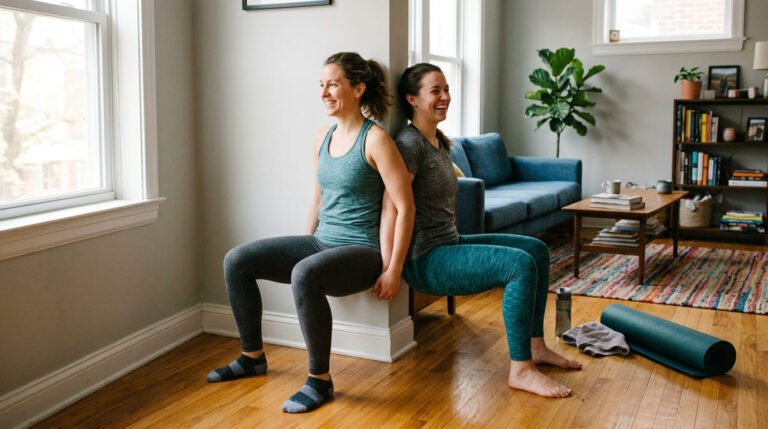
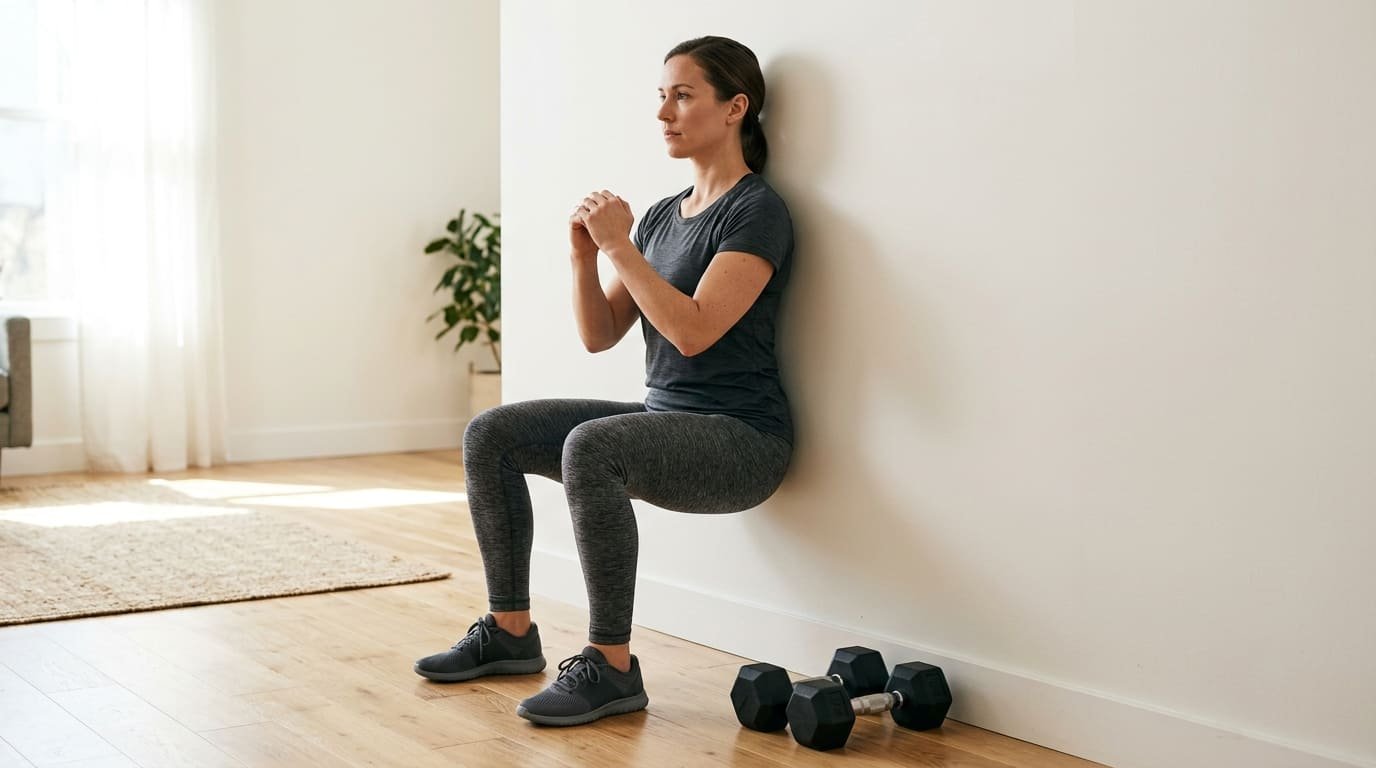
- Wall sit
- Dead hang from a bar
- Glute bridge hold at the top
- Pushing against a wall at a fixed angle
- Pausing mid-rep, such as holding the bottom of a squat
What isometric work is genuinely good for:
- Building stability in positions you need to hold, which is why planks and carries feature in core training
- Training with a painful joint. Because the joint does not move, you can often load a muscle at a comfortable angle when moving through the range would hurt. This is why isometrics appear so often in rehabilitation
- Strengthening a specific sticking point, by holding the position where a lift usually fails
- Training with no equipment, since your own body and a wall are enough
- Training quietly, which matters more than it sounds if you live in a flat
The main limitation: strength gains from isometric training are somewhat specific to the joint angle you train. Holding a squat at 90 degrees builds strength mostly around 90 degrees, with less carryover to other positions. Training at several angles reduces this, but it is why isometrics complement full-range work rather than replacing it.
Typical prescription: 3 to 5 holds of 20 to 45 seconds, or shorter maximal pushes of 5 to 10 seconds against an immovable object.
Isotonic exercise
This covers almost everything you would recognise as normal training. The muscle changes length under load and the joint moves through a range.
Isotonic exercise has two phases, and the distinction matters.
| Phase | What the muscle does | Example in a biceps curl | Strength available | Soreness produced |
|---|---|---|---|---|
| Concentric | Shortens under load | Lifting the weight up | Lower | Less |
| Eccentric | Lengthens under load | Lowering the weight down | Roughly 20 to 50 percent higher | Considerably more |
The eccentric phase is the underused one. You are stronger lowering a weight than lifting it, which is why you can lower a weight you cannot lift. That fact underpins a lot of useful training:
- Negative reps let you train a movement you cannot yet perform, such as lowering slowly from the top of a pull-up or a dip
- Slowing the lowering phase to three or four seconds increases the training stimulus without adding weight
- Eccentric loading is a well-established tool in tendon rehabilitation
- Eccentric work produces most of your muscle soreness, which is why downhill running and deep lunges leave you aching
Typical prescription: 3 to 4 sets of 6 to 15 reps for most goals, with a controlled lowering phase of two to three seconds.
Isokinetic exercise
Isokinetic exercise keeps the speed of movement constant regardless of how hard you push. The resistance adjusts moment by moment to match your effort, so you cannot accelerate the limb.
This requires a machine called an isokinetic dynamometer, which you will find in sports science labs, physiotherapy clinics and elite sports settings rather than in gyms.
Why it exists:
- Maximum loading at every angle. With a dumbbell, the hardest point of a curl is around the mid-range and the rest of the movement is comparatively easy. An isokinetic machine matches your maximum output throughout the entire range
- It is safe under fatigue. Because the machine will not let you move faster than the set speed, the load simply drops as you tire, rather than becoming too heavy
- It measures precisely, which makes it valuable for identifying left-to-right imbalances and deciding when an athlete is ready to return to sport after an injury
Why it barely matters for most people: the equipment costs thousands and is not available in commercial gyms. If you are training at home or in an ordinary gym, you will never do isokinetic exercise, and you are not missing anything essential.
What people often mean instead: when someone calls swimming or cycling “isokinetic”, they are usually describing exercise performed at a fairly steady speed. That is not the technical definition, but the loose usage is common.
Which type should you actually use?
| Your situation | Best emphasis | Why |
|---|---|---|
| Building general strength | Isotonic | Full range loading with progressive overload |
| Building muscle size | Isotonic, with slow eccentrics | Length change under tension drives growth |
| Training around a painful joint | Isometric | Load the muscle without moving the joint |
| Building core stability | Isometric | Your core’s job is resisting movement |
| No equipment at all | Both isometric and isotonic | Holds and bodyweight movements |
| Rehabilitating a serious injury | Isometric, progressing to isotonic | Guided by a clinician |
| Testing for imbalances after injury | Isokinetic | Precise measurement, clinic setting |
| Training quietly in a flat | Isometric | No impact and no noise |
The practical answer for nearly everyone: build your programme from isotonic exercise, add isometric holds where stability is the goal or where a joint is irritated, and ignore isokinetic entirely unless a clinician puts you on a machine.
Closed chain and open chain: the more useful distinction
Two other terms come up constantly alongside the iso- family, and they describe something genuinely more useful for choosing exercises.
| Type | Definition | Examples | Characteristics |
|---|---|---|---|
| Closed chain | The hand or foot is fixed against a surface | Squat, push-up, lunge, pull-up | Multiple joints move together, more stabiliser work, generally more transferable |
| Open chain | The hand or foot moves freely | Leg extension, biceps curl, lateral raise | Usually one joint, easier to isolate one muscle |
Why this matters more day to day:
- Closed chain exercises train coordination between joints, which is how your body actually works when you stand up, climb stairs or carry something
- Closed chain generally means more muscle worked per exercise, making it more time efficient
- Open chain is better for isolating a specific muscle, which is useful when one area lags behind
- Open chain is easier to load precisely, which is why it appears so often in rehabilitation for one joint
A sensible programme uses mostly closed chain compound movements with some open chain isolation work added where needed. That is exactly what a well-built session already looks like, whether or not anyone uses the terminology.
A session using all three ideas
Here is what this looks like when you stop thinking in categories and just train.
| Exercise | Type | Chain | Sets and reps |
|---|---|---|---|
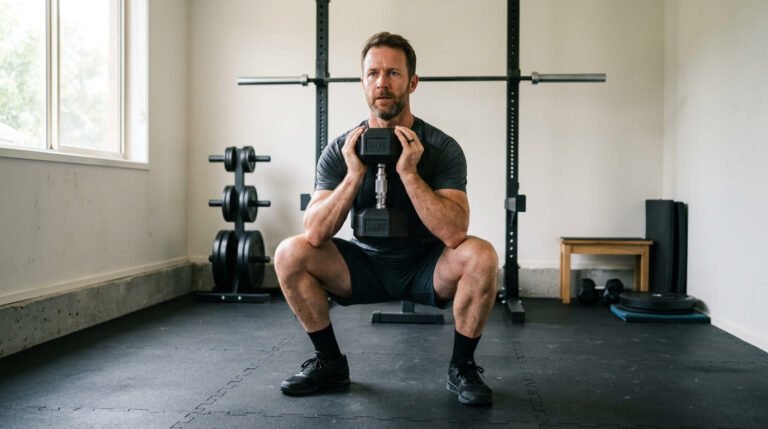
| Goblet squat | Isotonic | Closed | 3 x 8 to 12 |
| Push-up | Isotonic | Closed | 3 x 8 to 15 |
| One-arm row | Isotonic | Open | 3 x 10 to 12 |
| Slow eccentric chin-up, 5 seconds down | Isotonic, eccentric emphasis | Closed | 3 x 4 |
| Wall sit | Isometric | Closed | 3 x 30 to 45 sec |
| Side plank | Isometric | Closed | 3 x 20 to 40 sec each |
| Lateral raise | Isotonic | Open | 2 x 12 to 15 |
No isokinetic work appears, because it cannot without a laboratory machine, and the session is complete without it.
When isometrics genuinely beat moving exercises
Worth a section of its own, because isometrics are usually treated as a lesser option and there are cases where they are the better choice.
- An irritated joint. If a shoulder hurts through part of its range, an isometric hold at a comfortable angle lets you keep loading the muscle while the range settles
- Early tendon complaints. Isometric holds are widely used as a starting point in tendon rehabilitation, partly because they are well tolerated
- Core training. Your deep core muscles mainly resist movement rather than create it, so holds train them in the way they actually function. Our transverse abdominis exercises guide is built around this principle
- Blood pressure considerations work both ways. Sustained isometric holds raise blood pressure more than dynamic exercise during the effort, so anyone with high blood pressure should mention isometric training to their doctor. Interestingly, isometric training has also shown promising results for reducing resting blood pressure over time
- Learning a position. Holding the top of a glute bridge or the bottom of a squat teaches the position far faster than moving through it quickly
10 isometric exercises worth knowing
If you want to add isometric work, these cover the whole body and need almost nothing.
| Exercise | What it trains | Prescription |
|---|---|---|
| Plank | Deep core, anti-extension | 3 holds of 30 to 45 sec |
| Side plank | Obliques, anti-side-bend | 3 holds of 20 to 40 sec each side |
| Wall sit | Quads | 3 holds of 30 to 60 sec |
| Glute bridge hold | Glutes, hamstrings | 3 holds of 30 sec |
| Dead hang | Grip, shoulders, lats | 3 holds of 20 to 45 sec |
| Bird dog hold | Lower back, deep core | 3 holds of 15 sec each side |
| Split squat hold at the bottom | Quads, glutes, balance | 3 holds of 20 sec each leg |
| Push-up hold halfway down | Chest, triceps, core | 3 holds of 15 to 30 sec |
| Farmer’s carry | Grip, traps, whole trunk | 3 carries of 30 to 45 sec |
| Copenhagen hold | Inner thigh, adductors | 3 holds of 15 to 20 sec each side |
Carries deserve a mention because they are isometric in an unusual way: the trunk holds a fixed position while the legs move underneath. That combination makes them one of the most transferable exercises there is, and our farmer’s carry guide covers loading and distance in full.
How to use eccentric training
Since the lowering phase is where you are strongest and where most of the growth stimulus sits, here are four practical ways to use it.
1. Slow the lowering phase
Take three to four seconds to lower on every rep of your normal exercises. This increases the training stimulus at the same weight, which is particularly useful when you have limited equipment at home.
2. Use negatives for movements you cannot yet do
If you cannot do a pull-up or a dip, jump or step to the top position and lower yourself as slowly as possible. Three to five reps of a five-second lower builds the strength for your first full rep faster than almost anything else. Our pull up alternatives guide uses exactly this method.
3. Add a pause at the stretched position
Pausing for one to two seconds at the bottom of a squat, push-up or curl removes stored elastic energy and forces the muscle to produce the force from a dead stop.
4. Respect the soreness
Eccentric work produces considerably more muscle soreness than concentric work, particularly when it is new to you. Introduce it gradually rather than converting your whole programme overnight, or your next two sessions will suffer.
| Method | Difficulty added | Best used for |
|---|---|---|
| 3 to 4 second lowering | Moderate | Limited equipment, building muscle |
| Negative-only reps | Large | Learning pull-ups, dips and chin-ups |
| Paused reps | Moderate | Breaking through sticking points |
| Weighted negatives | Very large | Advanced, use sparingly |
Common misunderstandings
- Thinking isometric means easy. A hard wall sit or a heavy carry is brutally demanding
- Assuming isotonic means constant tension. In practice the tension varies throughout every rep because leverage changes
- Calling swimming or cycling isokinetic. Steady speed is not the same as machine-controlled speed
- Believing isometrics build no muscle. They do, particularly at longer muscle lengths, though usually less than full-range work at the same effort
- Doing only isometrics and expecting strength across the full range
- Ignoring the eccentric phase, which is the most productive and most overlooked part of normal training
Other training words worth decoding
A few more terms appear alongside these and cause similar confusion.
| Term | What it means | Everyday example |
|---|---|---|
| Concentric | Muscle shortens under load | Standing up out of a squat |
| Eccentric | Muscle lengthens under load | Lowering into a squat |
| Plyometric | A fast stretch immediately followed by a contraction | Jump squat, box jump |
| Compound | Multiple joints move | Squat, row, push-up |
| Isolation | One joint moves | Biceps curl, leg extension |
| Unilateral | One limb at a time | Lunge, one-arm row |
| Bilateral | Both limbs together | Back squat, bench press |
Plyometric is the one most often confused with the others. It describes speed and the stretch-shortening cycle rather than what stays constant, and it sits inside isotonic exercise rather than alongside it. Our speed and agility guide covers where plyometrics fit and why they matter for power.
Unilateral is the one most worth acting on. Training one limb at a time exposes side-to-side differences that bilateral work hides, and it roughly doubles the load on each limb without needing heavier weights, which is why it is so useful when training at home with a limited set of dumbbells.
A practical test: try a set of split squats on each leg and count how many clean reps you manage. A gap of more than two or three reps between sides is worth addressing with extra single-leg work, and it is the kind of imbalance a back squat will happily hide for years.
The bottom line
Strip away the terminology and it comes down to this. Isometric means holding still under load. Isotonic means moving under load, which describes almost every exercise you will ever do. Isokinetic means a machine controls your speed, which will not apply to you unless you end up in a clinic or a sports lab.
Build your training from isotonic exercise with a controlled lowering phase, because that combination drives most strength and muscle gains. Add isometric holds for core work, for stability, and whenever a joint is too irritated for full-range movement. And pay more attention to the closed chain and open chain distinction than to the iso- words, because that one actually changes which exercises you pick.
Frequently asked questions
What is the difference between isometric, isotonic and isokinetic exercise?
Isometric means the muscle contracts without changing length, as in a plank. Isotonic means the muscle shortens and lengthens under load, which covers most normal exercise like squats and curls. Isokinetic means the movement happens at a machine-controlled constant speed, which requires specialist equipment found in clinics and labs.
What is an example of isokinetic exercise?
Using an isokinetic dynamometer, a machine found in physiotherapy clinics and sports science labs that holds your limb to a fixed speed while the resistance adjusts to match your effort. It is used mainly for measuring strength imbalances and deciding when an athlete can safely return to sport, not for general training.
Are planks isometric or isotonic?
Planks are isometric. Your muscles contract to hold the position but your joints do not move and the muscles do not change length. A push-up, by contrast, is isotonic, because the chest and triceps shorten and lengthen as your body moves up and down.
Do isometric exercises build muscle?
Yes, though generally less than full-range exercise at the same effort. Isometric holds performed at longer muscle lengths, such as pausing at the bottom of a squat, build more than holds in shortened positions. Strength gains are also somewhat specific to the angle you train at.
Is walking isotonic or isokinetic?
Walking is isotonic, since your muscles shorten and lengthen through a range as you move. It is not isokinetic despite being performed at a fairly steady pace, because nothing is controlling the speed of your individual joints. That loose usage is common but technically incorrect.
What is the difference between closed chain and open chain exercise?
In closed chain exercise your hand or foot stays fixed against a surface, as in a squat, push-up or pull-up. In open chain exercise it moves freely, as in a leg extension or biceps curl. Closed chain movements work more muscles together and transfer better to everyday tasks, while open chain movements isolate a single muscle more easily.
Which type of exercise is best for beginners?
Isotonic exercise using closed chain movements such as squats, push-ups and rows, since these build strength through a full range and transfer well to daily life. Add isometric holds like planks and wall sits for core stability. Isokinetic training is not available or necessary outside clinical settings.
Is eccentric the same as isotonic?
Eccentric is one half of isotonic exercise. Isotonic movement has a concentric phase, where the muscle shortens as you lift, and an eccentric phase, where it lengthens as you lower. You are typically 20 to 50 percent stronger during the eccentric phase, which is why slow lowering and negative reps are such useful training tools.
What’s next?
Reading is the easy part. Pick one of these and do it today.