
Body Recomposition: How to Lose Fat and Build Muscle at the Same Time
For years the standard advice was that you had to choose. Eat more to build muscle and accept some fat, or eat less to lose fat and accept losing some muscle. Doing both at once was said to be impossible.
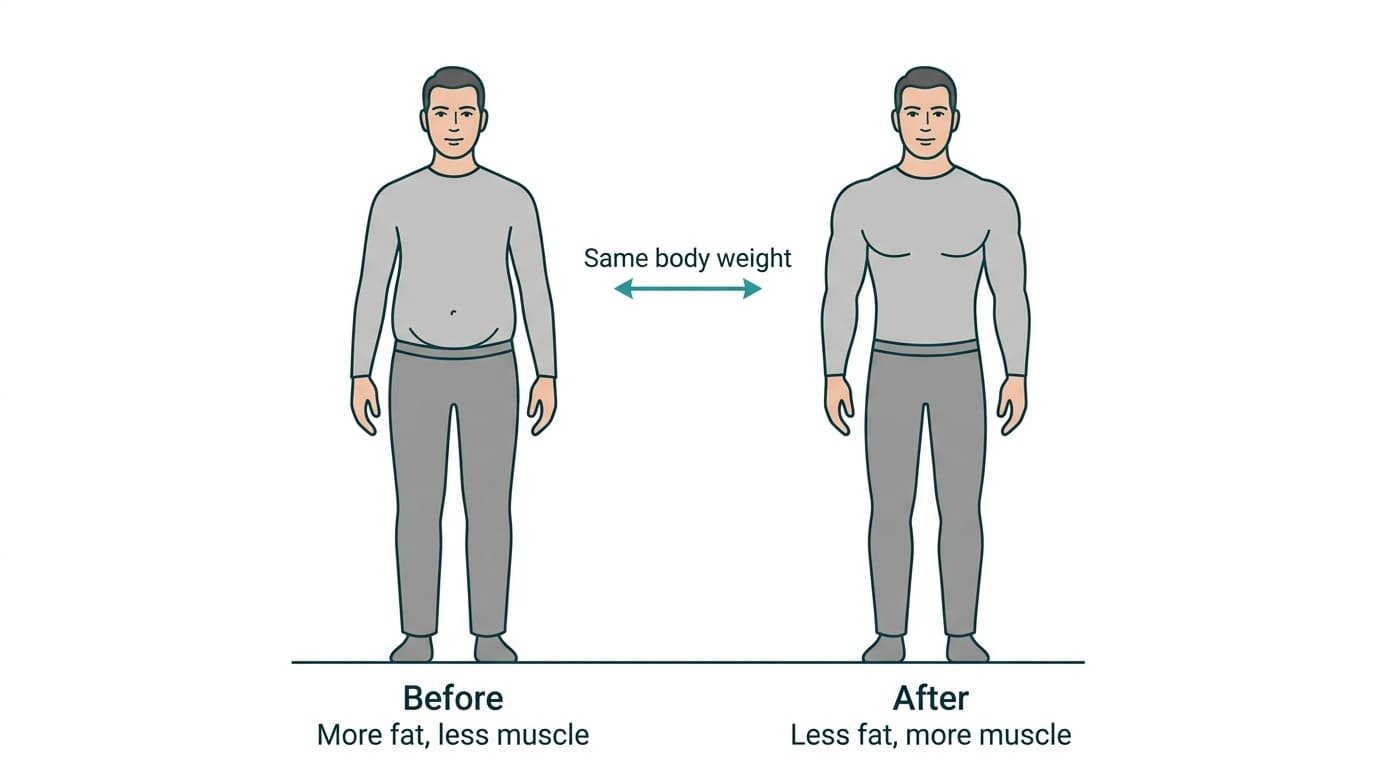
It is not impossible. It is called body recomposition, and for beginners it is the normal result of training properly and eating sensibly. My own first year looked like this: the scale moved by barely two kilograms, but my waist dropped a belt notch and my shirts got tighter across the shoulders. If I had only watched my weight, I would have thought nothing was happening.
This guide explains how recomposition works, who it works best for, how to set your calories and protein, how to train, and how to tell whether it is working when the scale will not tell you.
At a glance
- Body recomposition means losing fat and gaining muscle over the same period
- It works best for beginners, people returning after a break, and people with more body fat to lose
- Eat at maintenance or in a small deficit of about 10 to 20 percent
- Eat 1.6 to 2.2 grams of protein per kilogram of body weight each day
- Lift weights 3 to 4 times a week and get stronger over time
- Track your waist, photos and strength. Your weight may hardly change
- Allow at least 12 weeks before judging
What body recomposition is
Your body weight is made up of fat and everything else: muscle, bone, organs and water. Body recomposition means changing the ratio. Fat goes down and muscle goes up, sometimes with little change in total weight.
| Approach | Calories | What happens | Best for |
|---|---|---|---|
| Bulking | A surplus | Muscle gain, with some fat gain | Lean, experienced lifters who want maximum muscle |
| Cutting | A clear deficit | Fat loss, with a risk of some muscle loss | People with a specific fat-loss deadline |
| Recomposition | Maintenance or a small deficit | Slow fat loss and slow muscle gain together | Beginners, returners, and anyone who wants to look better at a similar weight |
Recomposition is slower at each individual job than a dedicated bulk or cut. In return, you avoid the cycle of gaining fat only to diet it off again, and you never have to eat in a way that feels extreme.
How losing fat and building muscle together is possible
The objection is usually this: building muscle needs energy, and losing fat needs an energy shortfall, so how can both happen?
The answer is that your body stores a great deal of energy as fat. A kilogram of body fat holds roughly 7,700 calories. If you train hard and eat enough protein, your body can draw on that store to cover the cost of building new muscle, even while you eat slightly less than you burn.
The research shows this clearly. In one tightly controlled trial, young men ate about 40 percent fewer calories than they needed for four weeks while training hard six days a week. Those who ate a high-protein diet, around 2.4 grams per kilogram per day, gained about 1.2 kg of lean mass while losing about 4.8 kg of fat. A lower-protein group, at about 1.2 grams per kilogram, lost fat too but gained no lean mass.
That study used an aggressive deficit under supervision, which is not something to copy at home. The point is the principle: with training and enough protein, gaining muscle in a deficit is real.
There is a limit. A pooled analysis of training studies found that as the calorie deficit grows, muscle gain shrinks, and a deficit of around 500 calories a day was enough, on average, to cancel out gains in lean mass. Strength still improved.
So the deficit needs to be small. This is the single most important setting in a recomposition plan.
Who body recomposition works for
| Your situation | How well it works | Why |
|---|---|---|
| New to strength training | Very well | Untrained muscle responds quickly to any sensible training |
| Returning after months or years off | Very well | Previously trained muscle regrows faster than it was first built |
| Carrying more body fat | Well | Plenty of stored energy to fund muscle growth |
| Training for under two years with inconsistent eating | Well | Better protein and structure produce quick gains |
| Lean and experienced | Slowly | Little fat to draw on and little untapped muscle potential |
| Very lean and advanced | Barely | A dedicated gaining or cutting phase is more effective |
If you are reading a beginner fitness site, you are almost certainly in one of the first four rows. That is good news.
Step 1: set your calories
You need to know roughly how many calories you burn in a day. Our TDEE calculator gives an estimate of that maintenance figure.
| Your starting point | Calorie target | Example for a 2,400 calorie maintenance |
|---|---|---|
| Lean, mainly want muscle | Maintenance, or up to 5 percent above | 2,400 to 2,500 |
| Average body fat, want both | 5 to 10 percent below maintenance | 2,150 to 2,300 |
| More fat to lose | 15 to 20 percent below maintenance | 1,900 to 2,050 |
Do not go lower than a 20 percent deficit. Larger deficits speed up fat loss and switch off muscle gain, which defeats the purpose.
A study of athletes compared a slow rate of weight loss, about 0.7 percent of body weight per week, with a rate twice as fast. The slow group gained lean mass while losing fat. The fast group did not.
Calculators are estimates. After three weeks, check your trend. If your weight is dropping by more than about 0.5 percent a week, eat a little more. If your waist is not changing at all, eat a little less.
Step 2: set your protein
Protein is the raw material for muscle and the nutrient that best protects muscle in a deficit. It also keeps you fuller than the same calories from fat or carbohydrate.
A large review of the evidence found that protein intakes up to about 1.6 grams per kilogram of body weight per day improved muscle gains from training, with little further benefit above that at maintenance calories. In a deficit, somewhat more is sensible.
| Body weight | 1.6 g per kg | 2.0 g per kg | 2.2 g per kg |
|---|---|---|---|
| 60 kg | 96 g | 120 g | 132 g |
| 70 kg | 112 g | 140 g | 154 g |
| 80 kg | 128 g | 160 g | 176 g |
| 90 kg | 144 g | 180 g | 198 g |
| 100 kg | 160 g | 200 g | 220 g |
Aim for the middle column. If you carry a lot of body fat, base the figure on your goal weight rather than your current weight. Our protein intake calculator does the sum for you.
Spread your protein over three or four meals, with roughly 25 to 40 grams in each. Our guide on protein shakes before or after a workout covers timing, which matters far less than the daily total.
Step 3: fill in carbohydrates and fats
Once calories and protein are set, the split of the rest is flexible.
- Fat: at least 0.6 to 1 gram per kilogram of body weight, for hormones and general health
- Carbohydrates: whatever calories remain. They fuel your training, so do not cut them unnecessarily
| Example: 75 kg person, 2,100 calories | Grams | Calories |
|---|---|---|
| Protein, 2.0 g per kg | 150 g | 600 |
| Fat, 0.9 g per kg | 68 g | 610 |
| Carbohydrate, the remainder | 222 g | 890 |
A sample body recomposition diet plan
This is one day at about 2,100 calories and 150 grams of protein. Adjust portions to your own targets.
| Meal | Food | Protein |
|---|---|---|
| Breakfast | 3 eggs scrambled, 2 slices of wholegrain toast, a piece of fruit | About 25 g |
| Lunch | 150 g grilled chicken, a cup of cooked rice, mixed vegetables, a spoon of olive oil | About 45 g |
| Snack | 200 g Greek yoghurt with berries and a small handful of nuts | About 22 g |
| Dinner | 150 g fish or lean beef, a medium potato, a large portion of vegetables | About 38 g |
| Evening | A glass of milk or a protein shake | About 20 g |
Vegetarian swaps: lentils, chickpeas, tofu, tempeh, paneer, eggs and dairy all work. You will need larger portions, and combining sources through the day helps.
Simple rules that make the numbers easier:
- Build each meal around a palm-sized or larger portion of protein
- Fill half the plate with vegetables
- Add a fist-sized portion of starchy carbohydrate, more on training days
- Keep most drinks calorie-free
- Leave room for foods you enjoy. A plan you can follow for six months beats a perfect one you abandon in three weeks
For meals around training, see what to eat before a workout and what to eat after a workout.
Step 4: lift weights and get stronger
Diet decides whether you lose fat. Training decides whether what you keep and build is muscle. Without resistance training, a deficit simply makes you a smaller version of the same shape.
| Training variable | Target |
|---|---|
| Sessions per week | 3 to 4 |
| Type | Full body, or upper and lower split |
| Exercises per session | 5 to 7, mostly compound movements |
| Sets per muscle group per week | 10 to 20 |
| Reps per set | 6 to 15 |
| Effort | End each set with one to three reps in reserve |
| Progression | Add a rep or a little weight whenever you can |
A simple three-day plan:
| Exercise | Sets | Reps |
|---|---|---|
| Squat or goblet squat | 3 | 8 to 10 |
| Push-up, or dumbbell or bench press | 3 | 8 to 12 |
| Row, with dumbbells, bands or a cable | 3 | 8 to 12 |
| Romanian deadlift or hip thrust | 3 | 8 to 12 |
| Overhead press | 2 | 8 to 10 |
| Plank or dead bug | 3 | 30 to 45 seconds, or 8 per side |
Do it three times a week on non-consecutive days. Our 3-day workout split has complete gym and home versions, and sets and reps explains how to progress.
Getting stronger is the signal. If your lifts are going up while your waist is going down, you are recomposing, whatever the scale says.
Step 5: use cardio sensibly
Cardio helps with fat loss and heart health but does not build much muscle, and too much of it eats into recovery.
- Walk daily. Aim for 7,000 to 10,000 steps. It burns energy without tiring you for lifting
- Add 1 to 3 cardio sessions of 20 to 30 minutes a week if you enjoy them or want faster fat loss
- Do cardio after weights or on separate days
- Do not use cardio to out-run your diet. It is much easier to not eat 300 calories than to burn them
Our guide to walking for weight loss shows how to build the habit, and cardio before or after a workout covers the order.
Step 6: sleep and recover
Muscle is built between sessions, and poor sleep works against both halves of recomposition. Short sleep increases hunger, lowers training quality and shifts weight loss toward muscle instead of fat.
- Aim for 7 to 9 hours a night
- Keep at least one full rest day a week
- Take an easier training week every 6 to 8 weeks
- Manage stress where you can. It affects sleep, appetite and recovery
How to track progress
This is where most people go wrong. During recomposition, fat loss and muscle gain can cancel each other out on the scale. You need other measures.
| Measure | How often | What you want to see |
|---|---|---|
| Waist circumference at the navel | Every 2 weeks | Slowly decreasing |
| Photos, front, side and back, same light | Every 4 weeks | Visible change in shape |
| Strength on 3 or 4 main lifts | Every session | Reps or weight trending up |
| Body weight, weekly average | Weigh several mornings, average them | Stable or slowly falling |
| How clothes fit | Ongoing | Looser at the waist, tighter at shoulders and thighs |
Our body measurement tracker keeps these together, and how to measure your waist and hips shows the correct tape position.
| What you see after 4 to 6 weeks | What it means | What to do |
|---|---|---|
| Waist down, strength up, weight stable | Recomposition is working | Change nothing |
| Waist down, strength flat or falling | The deficit may be too large | Add 100 to 200 calories |
| Waist the same, strength up, weight up | You are in a surplus | Remove 100 to 200 calories |
| Nothing changing | Intake or effort is off | Track food carefully for a week and check training effort |
A realistic timeline
| Timeframe | What usually happens |
|---|---|
| Weeks 1 to 4 | Strength climbs quickly. Weight may fluctuate with water. Little visible change |
| Weeks 4 to 8 | Waist begins to shrink. Clothes fit differently |
| Weeks 8 to 12 | Visible change in photos. Lifts are clearly heavier |
| Months 3 to 6 | Clear difference in shape for most beginners |
| Months 6 to 12 | Progress slows as you become leaner and more trained |
As a rough guide, a beginner eating and training well might gain around 0.25 to 0.5 kg of muscle a month while losing 1 to 2 kg of fat. Individual results vary a good deal. Our guide on how long it takes to see workout results covers the wider picture.
Do you need supplements?
No supplement is required, and none replaces training, protein and a sensible calorie target. A few are worth knowing about.
| Supplement | What it does | Worth it? |
|---|---|---|
| Protein powder | A convenient way to reach your protein target | Useful if you struggle to get enough from food |
| Creatine monohydrate | Helps you do slightly more work in training, which supports strength and muscle gain over time | One of the best-studied supplements. A common dose is 3 to 5 grams a day |
| Caffeine | Can improve training performance and alertness | Optional. Coffee does the job |
| Fat burners | Mostly caffeine with other ingredients of little proven benefit | Not worth the money |
| Testosterone boosters and similar products | Little good evidence of meaningful effect | Skip them |
Creatine can raise scale weight by a kilogram or so in the first weeks because muscles hold a little more water. That is not fat, and it is another reason to judge progress by your waist and your lifts. Speak to your doctor before taking any supplement if you have a kidney condition or take regular medication.
What to do when progress stalls
Every recomposition slows down eventually. Before changing the plan, check the basics for two weeks.
- Weigh and log your food honestly, including oils, drinks and weekend meals. Intake drifts upward without anyone noticing
- Count your protein for a few days. It is usually lower than you think
- Look at your training log. If the weights and reps have not moved in a month, the problem is in the gym, not the kitchen
- Check your sleep and your step count
- Then adjust one thing: change calories by 100 to 200 a day, or add a set to your main lifts, and give it three more weeks
As you lose weight, your maintenance calories fall slightly, so a target that worked at the start may need a small reduction a few months in.
Common mistakes
- Cutting calories too hard. A big deficit turns recomposition into ordinary dieting
- Too little protein. Most people who track for the first time find they eat half of what they need
- No progression in training. The same weights for months give the muscle no reason to grow
- Too much cardio, too little lifting
- Judging by the scale alone and quitting when it does not move
- Changing the plan every two weeks. Give each adjustment three to four weeks
- Poor sleep
- Eating well on weekdays and undoing it at weekends. The weekly average is what counts
When to stop recomposing
Recomposition slows as you become leaner and more experienced. Consider switching approach when:
- You are fairly lean and progress has stalled for two months. Move to a small surplus of 5 to 10 percent to focus on muscle
- You still have a lot of fat to lose and want it to go faster. Use a slightly larger deficit for a set period, keeping protein and lifting in place
- You are happy with where you are. Eat at maintenance and keep training
The bottom line
You can lose fat and build muscle at the same time, and if you are new to training or coming back to it, you should expect to.
Eat at maintenance or slightly below it. Get around two grams of protein per kilogram of body weight each day. Lift weights three or four times a week and push to get stronger. Walk daily, sleep properly, and measure your waist and your lifts instead of trusting the scale.
It is a slow process and a steady one. Give it twelve weeks, change one thing at a time, and let the tape measure and the training log tell you how it is going.
How quickly your shape changes depends partly on your build, which we cover in male body types.
Frequently asked questions
Can you lose fat and build muscle at the same time?
Yes. It is called body recomposition, and it is well documented in research, particularly in beginners, people returning to training and people with higher body fat. It requires resistance training, a high protein intake and calories at maintenance or slightly below.
How many calories should I eat for body recomposition?
Eat at your maintenance level or in a small deficit of about 5 to 20 percent, depending on how much fat you have to lose. Larger deficits speed up fat loss but stop muscle gain. Recheck your intake after three weeks based on your waist and strength.
How much protein do I need to lose fat and build muscle?
About 1.6 to 2.2 grams per kilogram of body weight per day. For a 75 kg person that is 120 to 165 grams. If you carry a lot of body fat, base the calculation on your goal weight. Spread it across three or four meals.
How long does body recomposition take?
Expect strength gains within four weeks, a smaller waist within four to eight weeks, and a visible change in photos by about twelve weeks. Meaningful changes in shape usually take three to six months of consistent training and eating.
Why is my weight not changing during body recomposition?
Because you may be losing fat and gaining muscle at similar rates, which cancel out on the scale. This is normal. Track your waist measurement, monthly photos and strength instead. If your waist is shrinking and your lifts are rising, it is working.
Do I need to do cardio for body recomposition?
It is helpful but not essential. Daily walking plus one to three short cardio sessions a week supports fat loss and heart health. Resistance training is the essential part, because it is what tells your body to keep and build muscle.
Is body recomposition better than bulking and cutting?
For beginners and people with average or higher body fat, usually yes. It avoids gaining unnecessary fat and is easier to sustain. Lean, experienced lifters generally progress faster with separate gaining and fat-loss phases.
Can I do body recomposition at home without a gym?
Yes. Dumbbells, resistance bands and bodyweight exercises all provide enough resistance for beginners, provided you keep making the exercises harder over time. The eating principles are identical wherever you train.
What’s next?
Reading is the easy part. Pick one of these and do it today.