Resistance Band Ab Workout: 12 Exercises and 3 Routines
Most ab exercises have the same problem. Once you can do twenty crunches, the only way to make them harder is to do forty, and then sixty. Your abs are muscles like any other, and they respond better to more resistance than to endless reps.
A resistance band fixes that for the price of a takeaway. It lets you load a crunch, resist a twist, and make a plank work harder, all without a cable machine. When I first tried a banded Pallof press, I was surprised that standing still and holding a band could make my sides shake. That is the appeal: the band gives your core something to fight against.
This guide covers which band to use, how to anchor it safely, twelve band ab exercises with step-by-step form, and three routines, including one that needs no anchor at all.
At a glance
- A band adds resistance to ab work, so you can progress without doing hundreds of reps
- A long loop band or a tube band with handles covers almost every exercise here
- Your core has four jobs: curl, resist arching, resist twisting, and rotate. Train all four
- Do 2 to 3 sets of 8 to 15 slow reps, two or three times a week
- Check the band and the anchor before every session
- Ab exercises strengthen the muscle. They do not burn the fat on top of it
Why use a resistance band for abs
Bodyweight ab exercises are a fine place to start. Bands are what you add when they stop being hard.
- Adjustable resistance. Step further from the anchor, shorten the band or move to a thicker one, and the same exercise gets harder
- Tension through the whole movement. A band pulls on you from the first centimetre to the last, so there is no easy part of the rep to rest in
- Resistance from any direction. Gravity only pulls down. A band can pull you sideways or into a twist, which is how you train your core to resist rotation
- Kind to your neck and back. Many band exercises are done standing or kneeling, with no pulling on the head and no repeated bending of the spine on a hard floor
- Cheap and portable. A band fits in a drawer or a suitcase
Bands are not a second-best option, either. A review that pooled the results of studies comparing elastic resistance with machines and free weights found similar strength gains from both.
Which band do you need?
There are three common types, and each suits different exercises.
| Band type | What it looks like | Best for | Exercises in this guide |
|---|---|---|---|
| Long loop band | A continuous flat loop about a metre long | Anchored pulling and pressing, and looping around the feet | Pallof press, crunch, chop, dead bug, rotation |
| Tube band with handles | A rubber tube with a handle at each end, usually sold with a door anchor | Anything anchored to a door | Pallof press, crunch, chop, rotation, side bend |
| Mini loop band | A small flat loop about 30 cm long | Exercises with the band around the feet or ankles | Bicycle crunch, mountain climber, leg lower, plank jack |
If you are buying one band, choose a long loop band of light to medium resistance, or a tube set that includes a door anchor. A set of mini loops costs very little and is worth adding. Our guide to the best resistance bands for beginners explains the types and resistance levels in more detail.
Start lighter than you think. Your abs work at a mechanical disadvantage in most of these exercises, so a band that feels easy for rows can be too heavy for a Pallof press.
How to anchor a band safely
Half of these exercises need the band fixed to something. This is the part to get right, because a band that slips at full stretch comes back fast.
Good anchors:
- A door anchor, the strap with a padded stopper that comes with most tube sets. Place it on the hinge side of a door that closes toward you, shut the door fully and lock it if you can
- A sturdy fixed post, such as a stair banister post, a squat rack upright or a fence post
- A heavy piece of furniture that cannot slide or tip, such as the leg of a loaded bed frame, for low anchors only
- Your own feet, for exercises where you stand or sit on the band
Avoid: door handles, table legs, radiators, towel rails, and anything with a sharp edge that could cut the band.
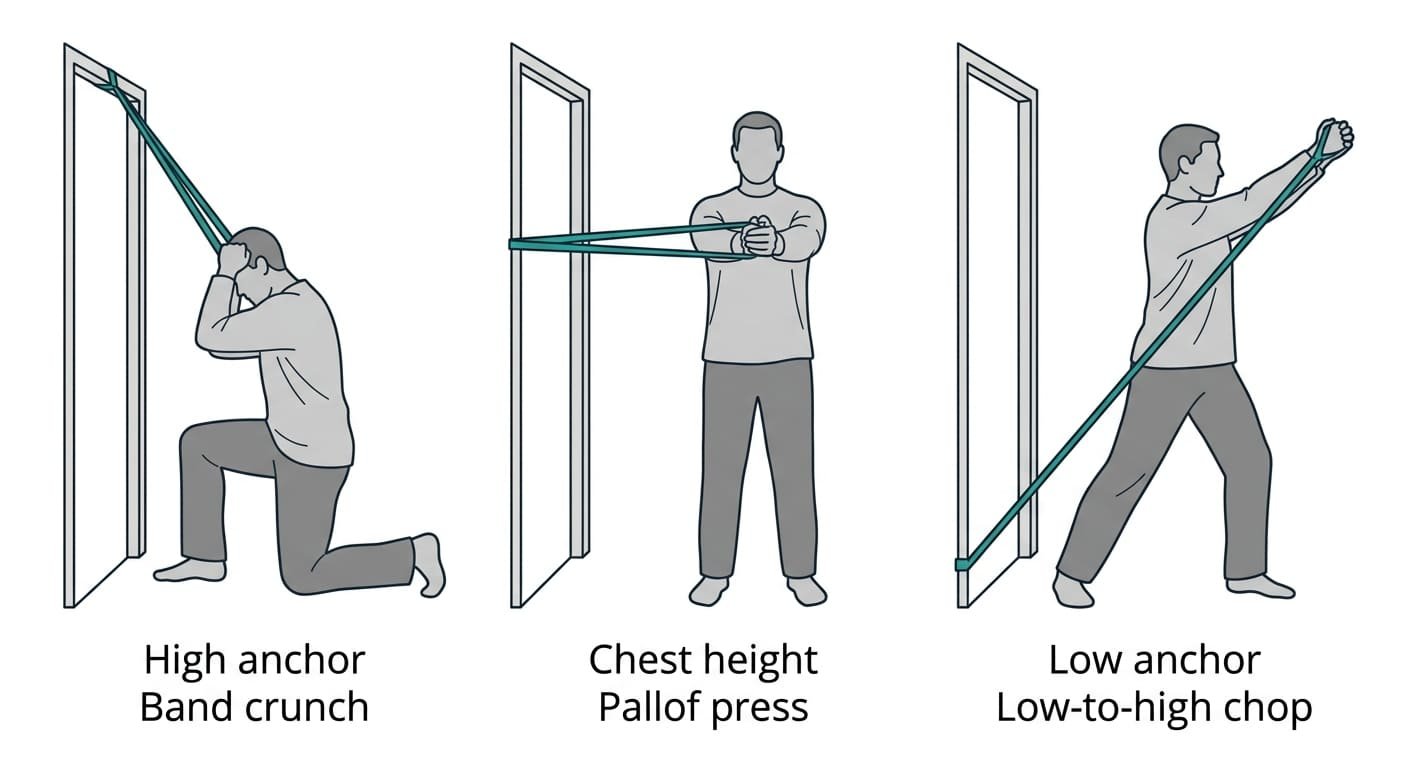
| Anchor height | Where | Exercises it suits |
|---|---|---|
| High | Top of the door, above head height | Kneeling band crunch, high-to-low chop |
| Middle | Chest height | Pallof press, standing rotation |
| Low | Bottom of the door or a bed leg | Low-to-high chop, dead bug, reverse crunch |
Before every session, run the band through your hands and look for nicks, cracks or pale stretched patches. Replace a damaged band rather than risking it. Tug the anchor firmly before your first rep, and never stretch a band toward your face.
The core muscles you are training
Knowing what each muscle does makes it much easier to choose exercises.
| Muscle | Where it is | Main job | Band exercises that train it |
|---|---|---|---|
| Rectus abdominis | The front of your stomach, the six-pack muscle | Curls the ribs toward the pelvis and stops the lower back arching | Band crunch, reverse crunch, dead bug |
| External and internal obliques | The sides of your waist | Twist and side-bend the trunk, and resist being twisted | Pallof press, rotation, chop, side bend |
| Transverse abdominis | The deepest layer, wrapping around like a corset | Braces the trunk and supports the spine | Dead bug, bird dog, Pallof press |
| Hip flexors | The front of the hips | Lift the legs | Leg lower, mountain climber, bicycle crunch |
A complete core routine covers four jobs rather than one:
- Flexion: curling the trunk, as in a crunch
- Anti-extension: stopping the lower back from arching, as in a dead bug or plank
- Anti-rotation: stopping the trunk from being twisted, as in a Pallof press
- Rotation and side bending: turning or bending against resistance, as in a chop
Most home ab routines are almost all flexion. Bands make the other three easy to train. For more on the deep layer, see our guide to transverse abdominis exercises.
The 12 best resistance band ab exercises
Move slowly on every one of these. Two seconds out, a brief pause, two seconds back. Breathe out during the hard part of each rep.
1. Banded dead bug
The best place for a beginner to start. It teaches you to keep your lower back still while your arms and legs move.
- Anchor a long band low behind your head, or loop it around a bed leg
- Lie on your back with your head toward the anchor. Hold the band in both hands with your arms straight up over your chest, so the band is pulling them back toward the anchor
- Lift your knees over your hips, bent to 90 degrees
- Press your lower back gently into the floor
- Slowly straighten one leg until the heel hovers above the floor, keeping your arms still against the pull of the band
- Return and switch legs
Sets and reps: 2 to 3 sets of 6 to 8 per side.
Form cue: if your lower back lifts off the floor, do not lower your leg as far.
2. Pallof press
The classic anti-rotation exercise. It looks like nothing and feels like a lot.
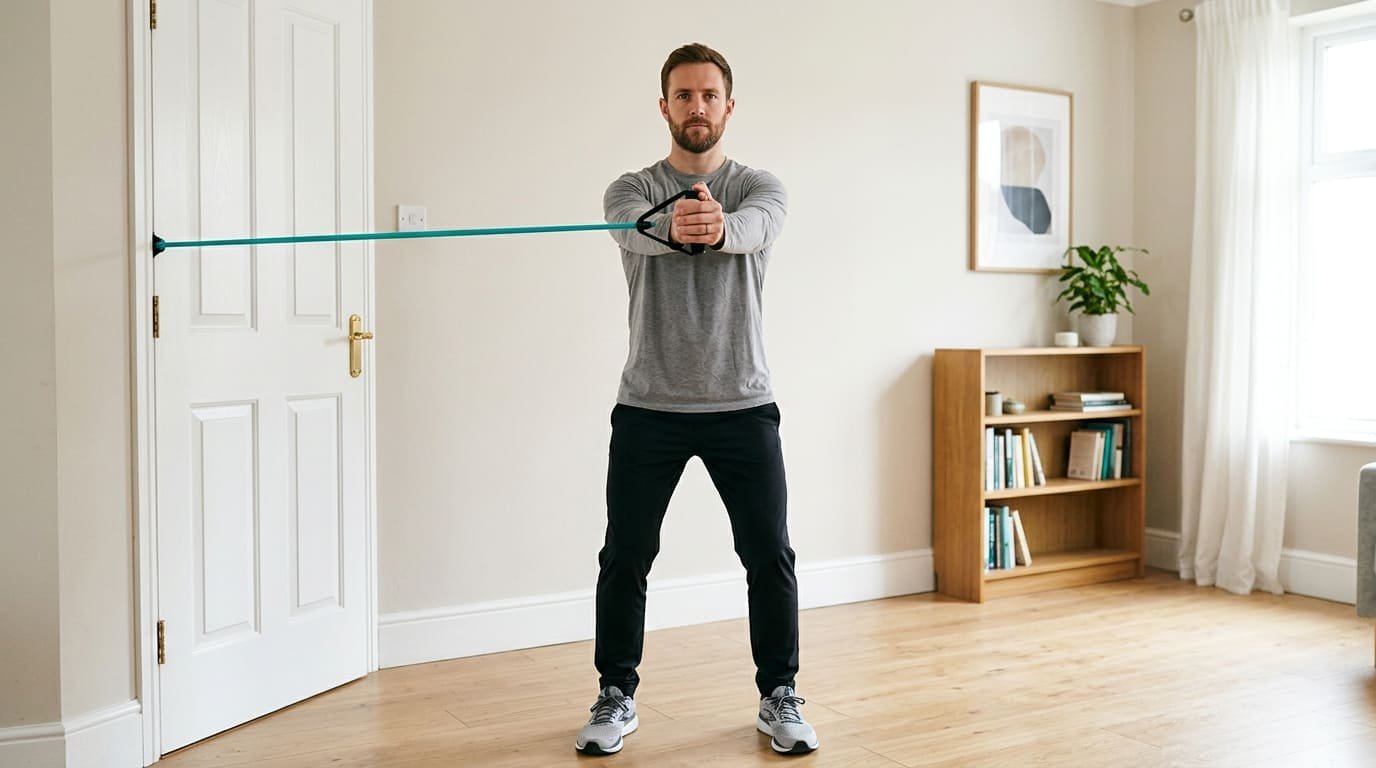
- Anchor the band at chest height
- Stand side-on to the anchor, feet shoulder-width apart, knees soft
- Hold the band in both hands at the centre of your chest and step away until there is tension
- Brace your stomach and press your hands straight out in front of you
- Hold for two seconds. The band will try to turn you toward the anchor. Do not let it
- Bring your hands back to your chest
Sets and reps: 2 to 3 sets of 8 to 10 per side.
Make it easier: stand closer to the anchor. Make it harder: step further away, bring your feet together, or do it half-kneeling.
3. Kneeling band crunch
The home version of the cable crunch, and the simplest way to add real load to your six-pack muscle.
- Anchor the band high, at the top of a door
- Kneel facing the door, about half a metre away, and hold the band with both hands beside your head. You can also kneel facing away from the door, with the band running over your shoulders, as the diagram above shows
- Keep your hips still over your knees
- Curl your ribs down toward your pelvis, rounding your upper back, until your elbows move toward your thighs
- Pause, then uncurl slowly
Sets and reps: 2 to 3 sets of 10 to 15.
Form cue: the movement is a curl of the spine, not a bow from the hips. If your hips drop back toward your heels, your hip flexors are doing the work.
4. Low-to-high band chop
A rotation exercise that works the obliques together with the hips and shoulders.
- Anchor the band low, or stand on one end with the foot nearest the anchor
- Stand side-on, holding the band in both hands by the hip nearest the anchor
- With arms nearly straight, pull the band up and across your body until your hands are above the opposite shoulder
- Let your back foot pivot and your hips turn with you
- Return slowly along the same path
Sets and reps: 2 to 3 sets of 8 to 12 per side.
The high-to-low version, with the band anchored above your head and pulled down to the opposite hip, is equally good. Our medicine ball workouts guide covers the same pattern with a ball.
5. Standing band rotation
- Anchor the band at chest height and stand side-on
- Hold the band in both hands with your arms straight out in front of your chest
- Keeping your arms straight and your hips facing forward, turn your shoulders and chest away from the anchor
- Pause, then return under control
Sets and reps: 2 to 3 sets of 10 per side.
Form cue: the turn comes from your trunk. Your arms stay in front of your chest the whole time, like the hands of a clock that turns with you.
6. Banded reverse crunch
- Anchor the band low. Lie on your back with your feet toward the anchor and loop the band around the tops of both feet
- Slide away from the anchor until the band is taut with your knees bent over your hips
- Rest your arms by your sides
- Pull your knees toward your chest and curl your hips a few centimetres off the floor
- Lower slowly until your thighs are vertical again
Sets and reps: 2 to 3 sets of 8 to 12.
This is one of the best band exercises for the lower part of the abdominals. Our lower ab workout has more options for that area.
7. Mini band bicycle crunch
No anchor needed.
- Place a mini band around the middle of both feet
- Lie on your back with your hands lightly behind your head and your knees over your hips
- Lift your shoulder blades off the floor
- Straighten one leg against the band while you bring the opposite elbow toward the bent knee
- Switch sides in a slow pedalling motion
Sets and reps: 2 to 3 sets of 8 to 12 per side.
Form cue: rotate from your ribs. If only your elbow is moving, slow down.
8. Mini band mountain climber
- Place a mini band around both feet
- Start in a high plank, hands under shoulders, body in a straight line
- Drive one knee toward your chest against the band, keeping your hips level
- Return the foot and switch
- Move at a steady, controlled pace rather than sprinting
Sets and reps: 2 to 3 sets of 8 to 10 per side, or 20 to 30 seconds.
9. Plank band row
An anti-rotation plank. Taking one hand off the floor makes your core fight to keep your hips square.
- Anchor the band low. Set up in a high plank facing the anchor, feet wider than hip-width
- Take the band in one hand with your arm reaching toward the anchor
- Pull your elbow back to your ribs without letting your hips turn or lift
- Straighten the arm slowly
- Finish your reps, then switch hands
Sets and reps: 2 sets of 6 to 8 per side.
Make it easier: do it from your knees.
10. Standing band side bend
- Stand on one end of the band with your right foot and hold the other end in your right hand, arm straight by your side
- Place your left hand on your hip
- Let the band pull you slightly to the right, then bend to the left by squeezing the left side of your waist
- Return slowly
Sets and reps: 2 sets of 10 to 12 per side.
Form cue: bend directly sideways, as if you were standing between two panes of glass. Our oblique exercises guide has more work for the sides of the waist.
11. Banded bird dog
- Kneel on all fours. Loop a long band around one foot and hold the other end in the opposite hand
- Brace your stomach and keep your back flat
- Reach the banded arm forward and the banded leg back at the same time, stretching the band
- Pause for one second, then return without touching down if you can
Sets and reps: 2 sets of 6 to 8 per side.
This one trains the muscles along your spine as well as your abdominals, which makes it a good companion to the crunching exercises.
12. Mini band leg lower
- Place a mini band around both ankles and lie on your back with your legs straight up
- Press your lower back into the floor
- Keep one leg vertical and slowly lower the other toward the floor, stretching the band
- Stop when you feel your lower back about to lift, then return
- Alternate legs
Sets and reps: 2 sets of 6 to 10 per side.
Three resistance band ab workouts
Pick the one that matches your equipment. Each covers more than one of the four core jobs.
Routine 1: beginner, no anchor (8 to 10 minutes)
All you need is a mini band and a long band or tube. Rest 30 to 45 seconds between sets.
| Exercise | Sets | Reps | Core job |
|---|---|---|---|
| Mini band leg lower | 2 | 6 per side | Anti-extension |
| Mini band bicycle crunch | 2 | 8 per side | Flexion and rotation |
| Standing band side bend | 2 | 10 per side | Side bending |
| Banded bird dog | 2 | 6 per side | Anti-rotation |
Routine 2: anchored strength workout (15 minutes)
Use a door anchor or a fixed post. Rest 45 to 60 seconds between sets.
| Exercise | Sets | Reps | Core job |
|---|---|---|---|
| Banded dead bug | 3 | 6 to 8 per side | Anti-extension |
| Pallof press | 3 | 8 to 10 per side | Anti-rotation |
| Kneeling band crunch | 3 | 10 to 15 | Flexion |
| Low-to-high band chop | 2 | 10 per side | Rotation |
Routine 3: band core circuit (20 minutes)
Work for 40 seconds, rest for 20, then move to the next exercise. Rest one minute after each round and complete three rounds.
| Order | Exercise | Notes |
|---|---|---|
| 1 | Kneeling band crunch | Slow, full curl |
| 2 | Pallof press, left side | Hold each press for two seconds |
| 3 | Pallof press, right side | Same |
| 4 | Banded reverse crunch | Do not swing |
| 5 | Mini band mountain climber | Steady pace |
| 6 | Standing band rotation, alternate sides each round | Hips face forward |
For bodyweight routines to alternate with these, try our 15-minute ab workout or the beginner core workout.
Sets, reps and how often to train
| Question | Answer |
|---|---|
| How many exercises per session? | 3 to 5 |
| How many sets? | 2 to 3 per exercise |
| How many reps? | 8 to 15 for moving exercises, 6 to 10 per side for stability exercises |
| How fast? | About two seconds each way, with a short pause |
| How close to failure? | Stop with one or two good reps left |
| How often? | 2 to 3 times a week, with a day between sessions |
| When in the workout? | At the end, or as a short session on its own |
Your abs recover quickly, but they still need recovery. Our guide on whether you can train abs every day explains why two or three focused sessions beat seven rushed ones, and sets and reps explains the numbers above.
How to make band ab exercises harder
Progress in this order, changing one thing at a time.
- Add reps until you reach the top of the range on every set
- Slow down. Take three seconds to return on each rep
- Add a pause of two to three seconds at the hardest point
- Increase the stretch. Step further from the anchor or grip the band shorter
- Use a thicker band and go back to the bottom of the rep range
- Reduce your base of support. Feet together, half-kneeling, or one hand off the floor
| Week | Pallof press, target 3 sets of 8 to 10 per side | Change |
|---|---|---|
| 1 | Light band, 2 steps from anchor: 8, 8, 8 | Start |
| 2 | Same: 9, 9, 8 | Add reps |
| 3 | Same: 10, 10, 10 | Top of range |
| 4 | Light band, 3 steps from anchor: 8, 8, 8 | More stretch |
| 5 | Same, with a 3-second hold: 8, 8, 8 | Add a pause |
| 6 | Medium band, 2 steps from anchor: 8, 8, 8 | Thicker band |
Common mistakes
- Using a band that is too heavy. If your hips twist or your back arches, the band is winning. Go lighter
- Moving fast. A band snaps you back if you let it. The slow return is where much of the work happens
- Bending at the hips instead of the spine in crunches, which shifts the work to the hip flexors
- Letting the lower back arch in dead bugs and leg lowers. Reduce the range until you can keep it flat
- Holding your breath. Breathe out as you work and in as you return
- Only doing crunches. Include at least one anti-rotation exercise and one anti-extension exercise each session
- Skipping the anchor check. It takes five seconds
Will a resistance band ab workout burn belly fat?
No, and it is better to know that now than to be disappointed in six weeks.
Ab exercises make the abdominal muscles stronger and a little thicker. They do not remove the fat that sits over them. In one study, people did abdominal exercises five days a week for six weeks. Their abdominal endurance improved, but their abdominal fat, waist size and body weight did not change compared with a group that did no exercise.
Fat loss comes from eating slightly less than you burn over a period of weeks, helped by walking, cardio and strength training for your whole body. Your body decides where the fat comes off first. Ab training makes sure there is strong, visible muscle underneath when it does. Our guides on how to get a flat stomach and the body fat percentage needed to see abs cover that side of it.
Bands, bodyweight or weights for abs?
| Method | Strengths | Limits | Best for |
|---|---|---|---|
| Bodyweight | Free, no setup, good for learning control | Hard to add resistance, so reps climb quickly | Beginners in the first few months |
| Resistance bands | Adjustable load, resistance from any angle, portable | Needs a safe anchor for some exercises, load is hard to measure exactly | Home training once bodyweight work feels easy |
| Dumbbells and plates | Load is exact and easy to increase | Only resists downward, so anti-rotation work is limited | Weighted crunches, carries and side bends |
| Cable machine | Smooth, measurable resistance from any height | Needs a gym | Gym training |
They work well together. A typical week might include one band session and one bodyweight or dumbbell session. Our ab workout with dumbbells covers the weighted side.
Who should take care
Band core training is low impact and suits most people. A few sensible cautions:
- Lower back pain: start with dead bugs, bird dogs and Pallof presses, which keep the spine still. Leave crunches and chops until those feel comfortable. Our McGill Big 3 guide is a good starting point for a sensitive back
- Pregnancy and the months after birth: get advice from your doctor or a women’s health physiotherapist before doing loaded abdominal work
- A hernia or recent abdominal surgery: get medical clearance first
- Latex allergy: choose latex-free or fabric bands
Stop any exercise that causes sharp pain, pain that travels down a leg, or pain that lingers after the session.
The bottom line
A resistance band turns ab training from a test of how many reps you can tolerate into proper strength work. It lets you load a crunch, and it lets you train the jobs that floor exercises miss: resisting a twist and resisting an arch.
Start with a light band. Learn the banded dead bug and the Pallof press first, add the kneeling crunch and a chop, and you have a complete routine in fifteen minutes. Train two or three times a week, move slowly, and make it harder one small step at a time.
Check your band and your anchor every time. And remember that the band builds the muscle, while your eating and your overall activity decide how much of it you can see.
Frequently asked questions
Can you build abs with resistance bands?
Yes. Bands add resistance to crunches, rotations and anti-rotation exercises, which lets you train your abs in the 8 to 15 rep range that builds strength and muscle. Research comparing elastic resistance with weights and machines has found similar strength gains from both.
What is the best resistance band exercise for abs?
There is no single best one, because the core has several jobs. The kneeling band crunch is the best for loading the six-pack muscle, the Pallof press is the best for the obliques and deep core, and the banded dead bug is the best starting point for beginners.
Which type of resistance band is best for ab workouts?
A long loop band or a tube band with handles and a door anchor covers most exercises. A mini loop band is useful for exercises with the band around your feet, such as bicycle crunches and mountain climbers. Choose light to medium resistance to begin with.
How often should I do a resistance band ab workout?
Two or three times a week, with at least a day between sessions. Each session needs only three to five exercises and takes 10 to 20 minutes. More frequent training does not speed up results and leaves less time to recover.
Can I do a band ab workout without an anchor?
Yes. Mini band bicycle crunches, mountain climbers and leg lowers need no anchor, and you can stand on a long band for side bends and low-to-high chops. A banded bird dog uses your own foot as the anchor.
Do resistance band ab workouts burn belly fat?
No. They strengthen the abdominal muscles but do not remove the fat over them. A study of six weeks of daily abdominal exercise found no change in abdominal fat. Fat loss comes from a modest calorie deficit and overall activity.
Are resistance band ab exercises safe for a bad back?
Many of them are a good choice, because exercises such as the dead bug, bird dog and Pallof press train the core while the spine stays still. Start with those, use a light band, and stop if anything causes sharp or travelling pain. See a doctor or physiotherapist for ongoing back pain.
How long does it take to see results?
Most people feel stronger and steadier within three to four weeks. Visible changes depend mainly on body fat, so they vary widely. Expect noticeable strength gains in six to eight weeks if you train two or three times a week and progress the resistance.
What’s next?
Reading is the easy part. Pick one of these and do it today.