Hotel Room Workout: 4 Routines for Any Trip (No Equipment)
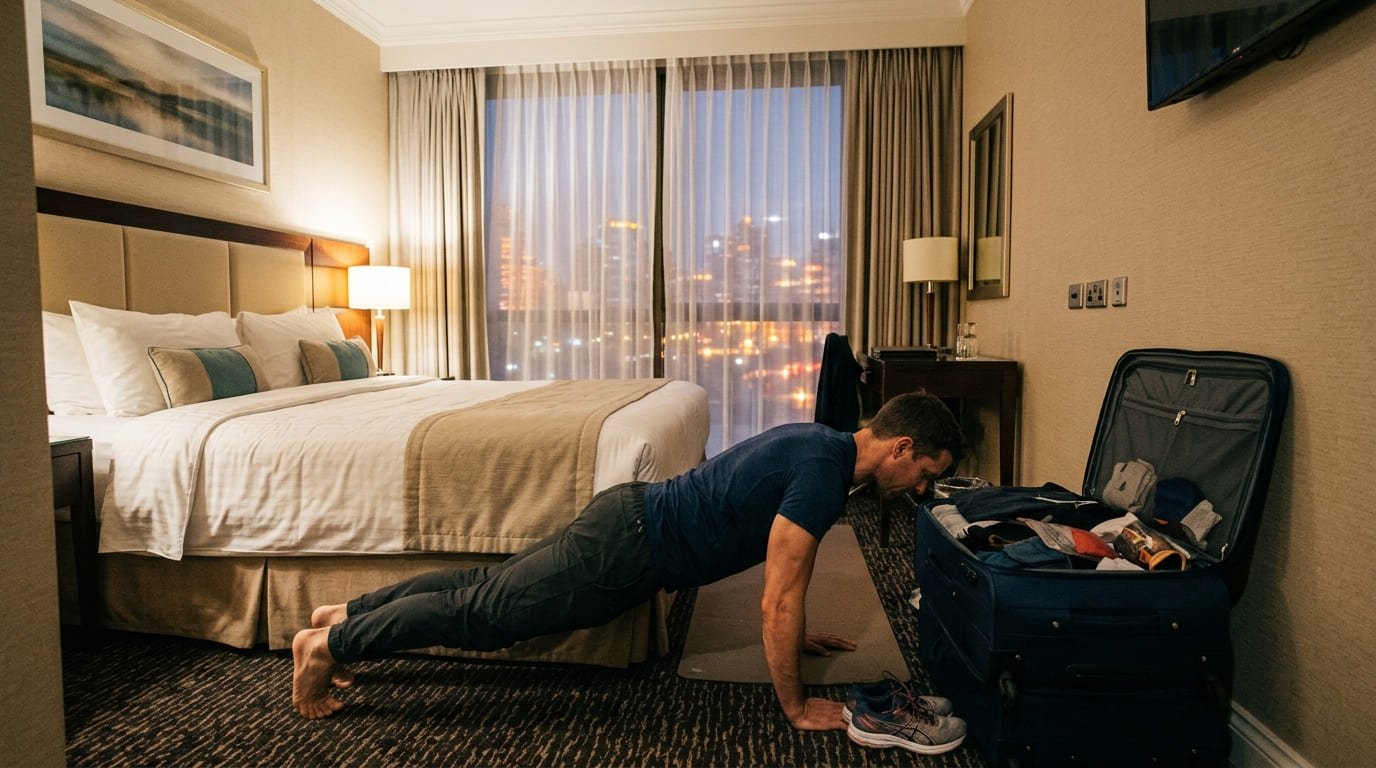
A hotel room is a strange place to train. The floor space is roughly the size of a bath towel, the person below you can hear everything, you have no equipment, and you are usually tired, dehydrated and eating differently than you would at home. None of that means you have to skip training. It just means the workout has to be designed for the room you are actually in.
I have written this around the constraints that genuinely matter on the road: limited floor space, thin floors, no equipment, and a body that has been sitting in a car, plane or conference chair for hours. There are four routines below for different amounts of time, plus the details most travel workout articles leave out, like how to train when you are jet lagged and what to do if the room is too small to lie down in.
At a glance
- All four routines fit in roughly 2 metres by 1 metre of floor space
- None of them require equipment, though a suitcase and a towel are useful
- The quiet routine has no jumping, so it works for late nights and upper floors
- Two sessions a week is enough to maintain strength on a trip of up to two weeks
- The most useful travel habit is not the workout, it is walking and moving every couple of hours
- Sitting for hours before you train means the warm-up is not optional
Working out in a small room: what actually fits
Before the routines, a practical check. Most hotel rooms give you a strip of floor between the bed and the wall, or the space at the foot of the bed. That is usually enough, but the furniture in the room is more useful than it looks.
| Hotel item | Use it for | Why it works |
|---|---|---|
| The bed | Incline push-ups, step-ups, hip thrusts, tricep dips | Stable, roughly the right height, already there |
| A sturdy chair | Dips, split squats, rows over the back, box squats | The most versatile object in most rooms |
| The desk | Incline push-ups, inverted rows underneath if it is solid | Great for scaling push-ups when you are tired |
| Your suitcase | Weighted squats, carries, goblet squats, deadlifts | A packed case is often 10 to 20 kg |
| A bath towel | Sliders on hard floor, hamstring curls, stretching | Turns a smooth floor into a slider system |
| The wall | Wall sits, handstand holds, wall push-ups | Free support that takes any load |
| The door frame | Chest stretches, isometric rows, towel rows | Useful for pulling movements, which are the hardest to replicate |
That last point is worth flagging honestly. Pulling movements are genuinely difficult without equipment. The routines below include towel rows and door frame isometrics, which are not a perfect substitute for a proper row but do keep your back working rather than leaving it out entirely.
A 5-minute warm-up for a stiff travelling body
Nearly every travel workout article I read either skipped the warm-up or gave it a single line. That is a problem specifically for travel, because you have usually been sitting for three, six or twelve hours before you train. Cold hips and a stiff upper back are exactly what causes a tweak.
- March on the spot: 60 seconds, gradually lifting the knees higher
- Hip circles: 8 each direction on each leg, standing and holding the wall
- Cat cow on the floor or standing: 8 slow reps
- World’s greatest stretch: 5 each side, the deep lunge with a rotation
- Arm circles and shoulder rolls: 20 seconds each direction
- Bodyweight squats: 10 slow reps
- Incline push-ups on the desk: 8 reps
Five minutes. On a travel day, treat this as part of the workout rather than an optional extra, and do not be surprised if it feels harder than usual.
Routine 1: the 10-minute wake-up
For mornings when you have a flight, a meeting or both. Two rounds, 40 seconds of work and 20 seconds of rest per exercise.
| Exercise | Work | Rest | Notes |
|---|---|---|---|
| Bodyweight squat | 40 sec | 20 sec | Full depth, slow and controlled |
| Incline push-up on the bed or desk | 40 sec | 20 sec | Higher surface makes it easier |
| Reverse lunge, alternating | 40 sec | 20 sec | Step back, not forward, to save space |
| Glute bridge | 40 sec | 20 sec | Squeeze hard for a second at the top |
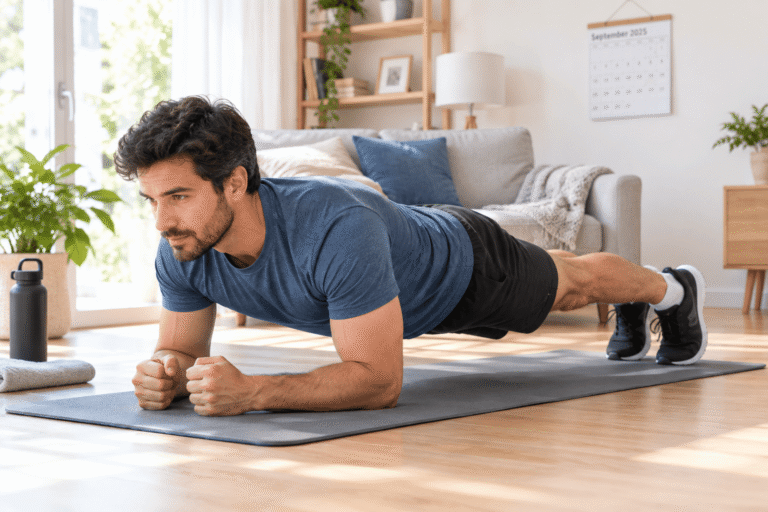
| Plank | 40 sec | 20 sec | Straight line from head to heels |
Two rounds takes just under 10 minutes including the transition. It will not build much, but it wakes up the body, loosens the hips after travelling and keeps your routine intact, which matters more than people admit.
Routine 2: the 30-minute strength session
This is the one to use if you are away for more than a few days and want to maintain the strength you have built. Three rounds, with real rest between sets.
| Exercise | Sets | Reps | Rest |
|---|---|---|---|
| Bulgarian split squat, foot on the bed | 3 | 8 to 12 each leg | 60 sec |
| Push-up, or incline push-up if needed | 3 | 8 to 15 | 60 sec |
| Suitcase Romanian deadlift | 3 | 10 to 12 | 60 sec |
| Chair or bed tricep dip | 3 | 8 to 15 | 45 sec |
| Towel row against a door frame | 3 | 10 to 12 | 60 sec |
| Suitcase goblet squat | 3 | 10 to 15 | 60 sec |
| Side plank | 3 | 20 to 40 sec each side | 45 sec |
How to make each exercise harder without weight:
- Slow down the lowering phase. A 4-second descent on a split squat turns an easy set into a hard one
- Pause at the bottom. Two seconds at the bottom of a push-up removes all momentum
- Reduce the leverage. Decline push-ups with feet on the bed load the chest and shoulders far more
- Go unilateral. Single-leg work doubles the load on each leg without any equipment
- Shorten the rest. Cutting rest from 60 to 30 seconds raises the difficulty considerably
Routine 3: the quiet routine (no jumping, no noise)
Most travel workout guides ignore the single most common real-world constraint: there is someone in the room below you, and it is half past ten at night. Every exercise here is silent.
| Exercise | Sets | Reps or time | Rest |
|---|---|---|---|
| Wall sit | 3 | 30 to 60 sec | 45 sec |
| Slow bodyweight squat, 4 seconds down | 3 | 10 to 12 | 60 sec |
| Incline push-up with a 2-second pause | 3 | 8 to 12 | 60 sec |
| Reverse lunge, stepping softly | 3 | 10 each leg | 60 sec |
| Glute bridge march | 3 | 10 each side | 45 sec |
| Dead bug | 3 | 10 each side | 45 sec |
| Plank shoulder taps | 3 | 16 taps | 45 sec |
| Towel hamstring curl on a smooth floor | 3 | 8 to 12 | 60 sec |
Isometric holds and slow tempo work are your friends here. They produce real training stress with zero impact, which is exactly what a hotel floor needs.
Routine 4: 15 minutes of conditioning
If you want your heart rate up and the room allows a little noise. Four rounds, 30 seconds on and 30 seconds off.
- Squat to stand-up, driving hard out of the bottom
- Mountain climbers, keeping the hips low
- Reverse lunge with a knee drive
- Push-up to shoulder tap
- High knees, or fast marching for the quiet version
- Plank to downward dog
Rest 60 seconds between rounds. If the floor is a concern, swap high knees and mountain climbers for fast marching and slow plank walk-outs. The session stays effective and nobody complains at reception.
Hotel rooms are often warmer and drier than your home, and you may already be mildly dehydrated from flying. Fill a bottle before you start, and expect to sweat more than the same workout would produce at home.
Which routine to use, based on your trip
| Trip length | Sessions per week | Recommended approach |
|---|---|---|
| 1 to 2 nights | 1, or none | Routine 1 on the morning after you arrive, prioritise walking |
| 3 to 5 nights | 2 | Routine 2 twice, ideally day 1 and day 4 |
| 1 to 2 weeks | 3 | Routine 2 twice plus Routine 4 once |
| Longer than 2 weeks | 3 to 4 | Rotate Routine 2, Routine 3 and Routine 4, and look for a local gym |
| Back-to-back work trips | 2 to 3 | Focus on maintenance, accept that this is not a growth phase |
The most useful mindset for travel training is maintenance rather than progress. Two solid sessions a week is enough to hold onto the strength you have built. Trying to run your full home programme in a hotel room usually leads to skipping it entirely.
Training with jet lag and bad sleep
This section is missing from every competing article I read, which is odd given that jet lag is the defining feature of most long trips.
Your strength, coordination and tolerance for hard training all drop when you are short on sleep. That is not a reason to skip training, but it is a reason to change it.
- Train in the local morning or early afternoon. Daylight plus movement is one of the more reliable ways to shift your body clock
- Lower the intensity for the first 24 to 48 hours. Stick to Routine 1 or Routine 3 rather than a hard conditioning session
- Expect to feel weaker. A 20 to 30 percent drop in how the same workout feels is normal after a long flight
- Avoid hard training right before bed if you are trying to fall asleep at a new local time
- Prioritise a walk outside over an indoor workout on your first day if you only have energy for one
If you find you are exhausted after every session on a trip, that is usually accumulated sleep debt rather than a training problem. Our guide on feeling tired after a workout goes into the causes in more detail.
Eating and hydrating on the road
You do not need a travel meal plan. You do need to avoid two specific traps.
- Protein tends to collapse when you travel. Breakfast buffets are heavy on pastry and light on protein. Eggs, yoghurt, milk and a protein shake in your bag fix this cheaply
- Dehydration is common and easy to miss. Cabin air, air conditioning, coffee and alcohol all add up. Carry a bottle and refill it
- Restaurant portions and timings are unpredictable. Eat a proper meal when you can rather than waiting for the perfect one
- Alcohol affects sleep quality more than most people realise, which then affects how your training feels the next day
If you want a practical starting point on what to eat around a session, see our guide to what to eat after a workout. On a trip, the simplest version is a protein source plus a carbohydrate source within a couple of hours, and that is genuinely enough.
What to do when the room is genuinely tiny
Some rooms, particularly in older European hotels and in Japan, do not have space to lie flat. Here is a version that fits in the space beside a single bed.
| Standard exercise | Tiny room swap |
|---|---|
| Plank | Standing plank against the wall, or a desk plank |
| Mountain climbers | Standing knee drives |
| Push-ups | Wall or desk push-ups |
| Lunges | Split squat in place, or a static wall sit |
| Glute bridge | Standing hip hinge or a wall-supported single-leg deadlift |
| Dead bug | Standing march with a slow, braced core |
| Hamstring curls | Standing single-leg deadlift, holding the wall for balance |
Almost every floor exercise has a standing equivalent. You lose a little, but a standing session you actually do beats a floor session you skip because there is nowhere to lie down.
The thing that matters more than the workout
If you take one practical point from this article, take this one. On most trips, the biggest change to your body is not the missed gym session. It is the drop from 9,000 steps a day to 2,500 because you are in cars, planes and meeting rooms.
- Walk to dinner instead of taking a taxi
- Take the stairs in the hotel, particularly if you are on floor 4 or lower
- Get outside for 15 minutes in the morning, which helps both step count and jet lag
- Stand and move for a few minutes every hour of a long working day
- Explore on foot for an hour on any free afternoon
Twenty minutes of extra walking a day across a week outweighs one missed workout by a wide margin, and it is far easier to fit around a schedule you do not control.
A sample 5-day work trip
Here is how the routines fit together on a realistic trip, rather than in theory.
| Day | What is happening | Training |
|---|---|---|
| Day 1 | Arrive late evening after a long flight | Warm-up plus 15 minutes of walking, nothing more |
| Day 2 | First full day, jet lagged | Routine 1 in the morning, walk to dinner |
| Day 3 | Full day of meetings | Routine 2, 30 minutes, before dinner |
| Day 4 | Lighter schedule | Routine 4 if you feel good, or a long walk if you do not |
| Day 5 | Travel home | Routine 3 in the morning, quiet and low impact |
Notice that this is five days with two proper sessions and a lot of walking. That is a successful trip, not a compromised one.
Common hotel workout mistakes
- Trying to replicate your home programme. You have no barbell, no bench and no pull-up bar. Adapt rather than force it
- Skipping the warm-up after a long flight. This is exactly when a cold hip or back gets tweaked
- Only doing push movements. Push-ups and dips are easy without equipment, so most travel routines end up push-heavy. Include towel rows and door frame isometrics
- Going too hard on day one. Fatigue, dehydration and a bad night’s sleep all stack against you
- All-or-nothing thinking. A 10-minute session counts. A 10-minute session you skipped because you could not do 45 minutes does not
- Ignoring the floor below you. Jumping at 11pm is how you get a phone call from reception
- Training in flip flops. Pack one light pair of trainers, they weigh almost nothing and they change what you can do safely
What to pack (and what to leave)
| Item | Weight | Worth packing? |
|---|---|---|
| A pair of light trainers | 400 to 600 g | Yes, they open up every routine here |
| A long resistance band | 80 to 150 g | Yes, the best value item you can pack |
| A loop band | 30 g | Yes if you train legs or glutes |
| A suspension trainer | 400 g | Only for longer trips with a solid door |
| A jump rope | 200 g | Only if you have outdoor space, too loud for most rooms |
| Sliders | 100 g | No, a bath towel does the same job |
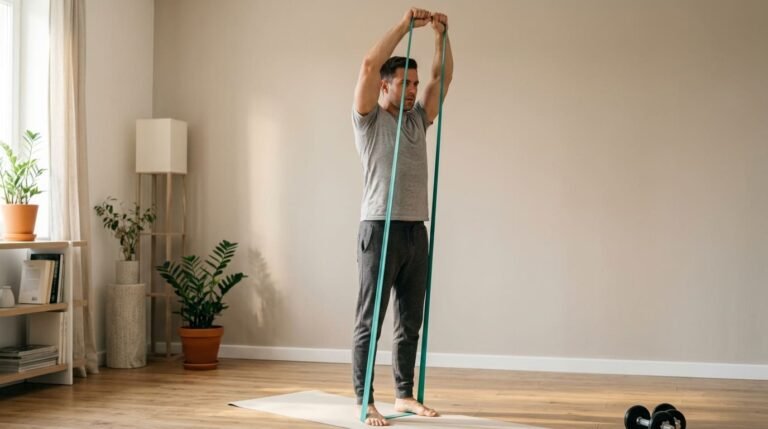
A long resistance band plus a pair of trainers is the highest-value travel kit there is. Between them they cover rows, presses, curls, squats and pulls in under a kilogram of luggage. If you want to see what a band alone can do, our resistance band leg workout works in exactly this kind of space.
The bottom line
A hotel room workout does not need to be clever. It needs to fit the space, be quiet enough for the building, account for a body that has been sitting for hours, and be short enough that you actually do it after a long day.
Use Routine 1 on travel days, Routine 2 when you have half an hour and want to hold onto your strength, Routine 3 when the floor is thin, and Routine 4 when you want to sweat. Walk more than you think you need to. Then pick your normal training back up the day after you get home, without treating the trip as a setback, because it very rarely is one.
Frequently asked questions
Can you build muscle with hotel room workouts?
You can build some muscle as a beginner, because bodyweight movements are challenging enough to create a training stimulus when you are new to them. If you already train with weights, expect to maintain rather than build during a trip. Maintenance takes surprisingly little: two solid sessions a week holds onto strength for several weeks.
How long should a hotel room workout be?
Between 10 and 30 minutes. Ten minutes maintains the habit and loosens a stiff body on travel days, while 30 minutes with real rest between sets is enough to maintain strength. Sessions longer than that rarely survive contact with a real travel schedule.
What can I use as weights in a hotel room?
A packed suitcase is the best option, often weighing 10 to 20 kg, and it works for goblet squats, Romanian deadlifts and carries. A backpack loaded with books, water bottles and shoes works for lighter movements, and full water bottles make usable light dumbbells for lateral raises and curls.
How do I work out in a hotel without disturbing people below?
Remove all jumping and replace it with slow tempo work, isometric holds and unilateral exercises. Wall sits, slow squats, paused push-ups, split squats and planks create real training stress with zero impact. Routine 3 in this article is built entirely from silent exercises.
Should I work out on the day I fly?
A light session or a walk is usually better than a hard workout on a travel day. Long flights leave you dehydrated, stiff and short on sleep, all of which lower your tolerance for intense training. A 10-minute mobility and bodyweight session plus 20 minutes of walking is the better use of that day.
How do I train my back in a hotel room?
Back training is the hardest part without equipment. Towel rows around a solid door frame, inverted rows under a sturdy desk, door frame isometric holds and prone Y and T raises on the floor all work the upper back. A packed resistance band solves this problem almost completely.
Is it better to use the hotel gym or my room?
Use the hotel gym if it has dumbbells and a cable machine, since that gives you loading options your room cannot. Many hotel gyms have only a treadmill and two light dumbbells, in which case a well-structured room workout with tempo and unilateral work will be more productive.
How many times a week should I train while travelling?
Two to three sessions a week is enough for trips up to two weeks. Two sessions maintain strength and muscle in most people, and the third adds conditioning if you have the energy. Prioritise daily walking over adding a fourth session, since step count is what usually drops most on the road.