Trap Workout With Dumbbells: 8 Exercises for Upper, Middle and Lower Traps
A good trap workout with dumbbells trains all three parts of the trapezius: the upper traps with shrugs and carries, the middle traps with rows and reverse flys, and the lower traps with Y raises and overhead work. Most people only ever do shrugs, which build the top of the muscle but miss the parts that do the most for your posture and shoulder health.
For years my entire trap training was a few sets of heavy shrugs at the end of a back workout. My neck got a bit thicker, but my shoulders still rolled forward and my upper back ached after long days at a desk. When a friend who worked as a physiotherapist showed me how much my middle and lower traps were being ignored, I added two simple exercises and noticed a difference in how I sat and stood within a few weeks.
This guide explains what your traps actually do, eight dumbbell exercises that cover every part of the muscle, two complete routines, and the mistakes that turn shrugs into a neck ache.
At a glance
- Three parts: upper, middle and lower traps
- Upper traps: shrugs and farmer’s carries
- Middle traps: rows with a squeeze and reverse flys
- Lower traps: prone Y raises and overhead work
- Equipment: a pair of dumbbells, plus a bench or bed for some moves
- How often: 2 times a week, often as part of back or shoulder days
- Big benefit: better posture and healthier shoulders, not just bigger traps
What your traps actually do
The trapezius is a large, diamond-shaped muscle that runs from the base of your skull, down the back of your neck, across the tops of your shoulders and down the middle of your upper back. It’s usually described in three sections, because each part does a different job.
| Section | Where it is | Main job | Best exercises |
|---|---|---|---|
| Upper traps | Top of shoulders and side of neck | Lift your shoulders up (shrugging) | Shrugs, farmer’s carries |
| Middle traps | Between your shoulder blades | Squeeze your shoulder blades together | Rows, reverse flys, prone T raises |
| Lower traps | Lower middle back, towards your spine | Pull your shoulder blades down and help rotate them when you lift your arms | Prone Y raises, overhead carries |
All three parts work together to control your shoulder blades. That’s important, because your shoulder blades are the base your arms move from. When they’re stable and move well, pressing, pulling and lifting overhead all feel smoother and safer.
Why train your traps?
- Better posture. Strong middle and lower traps help pull your shoulders back and down, countering desk slouch.
- Healthier shoulders. Well-balanced traps help your shoulder blades move properly when you raise your arms.
- Neck support. Strong upper traps help support your head and neck.
- Carrying strength. Carrying shopping, bags and luggage all rely on your traps.
- A stronger-looking upper body. Developed traps give your shoulders and upper back a fuller, more athletic look.
If posture is your main goal, pair trap work with the rows in my back workout with dumbbells, which train the surrounding upper back muscles too.
8 dumbbell trap exercises
1. Dumbbell shrug (upper traps)
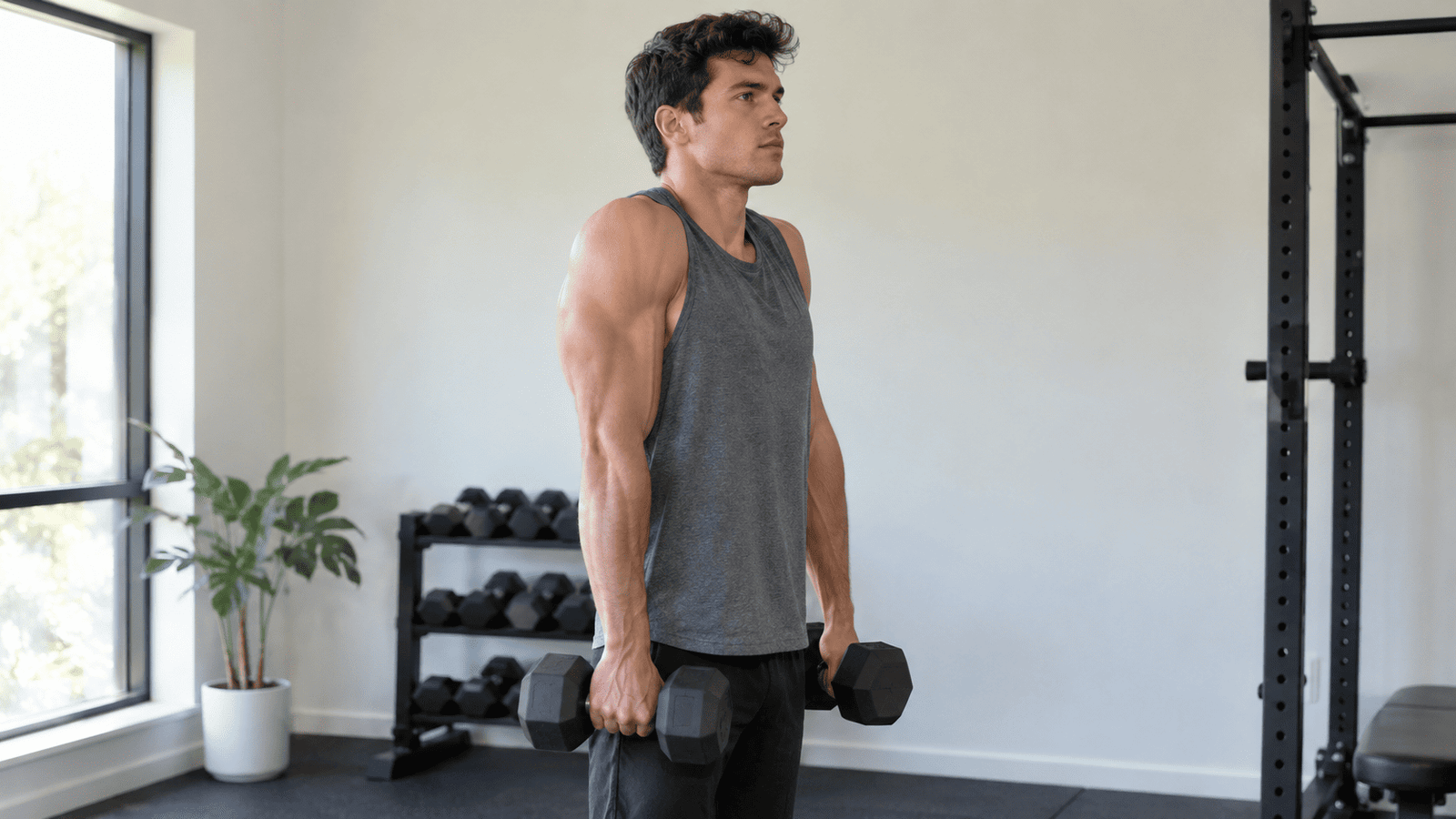
Stand tall with a dumbbell in each hand, arms by your sides and palms facing in. Lift your shoulders straight up towards your ears as high as you can, pause for a second, then lower them slowly.
Keep it simple: straight up and straight down. Don’t roll your shoulders forward or backwards, which adds strain without adding benefit. Keep your neck long and your chin level rather than jutting your head forward.
Because your upper traps are strong, you can usually use fairly heavy dumbbells here. Control matters more than weight, though. A slow lift and a real pause at the top will do more than bouncing a heavy load.
2. Farmer’s carry (upper traps and grip)
Hold a heavy dumbbell in each hand and walk tall for 20 to 40 metres or seconds. Your upper traps work hard to stop your shoulders being pulled down, while your grip, core and legs work too. It’s one of the best trap exercises there is, and it builds real-world carrying strength. My full guide to the farmer’s carry covers technique and variations.
3. Dumbbell row with a squeeze (middle traps)
Place one hand and knee on a bench or sturdy chair, with a dumbbell in the other hand. Row the dumbbell up towards your hip. At the top, squeeze your shoulder blade towards your spine and hold for two seconds before lowering.
That pause and squeeze is what shifts more of the work to your middle traps. Without it, the lats and biceps do most of the job.
4. Bent-over reverse fly (middle traps and rear shoulders)
Hinge forward at your hips with a flat back and a slight bend in your knees, holding light dumbbells beneath your chest. With a slight bend in your elbows, raise the dumbbells out to the sides until your arms are level with your body, squeezing your shoulder blades together. Lower slowly.
Go light. This exercise works small muscles, and heavy weights turn it into a swinging mess. Two to five kilograms is plenty for most beginners.
5. Prone T raise (middle traps)
Lie face down on a bench, or on the floor with your forehead on a small towel. Hold very light dumbbells, or no weight at all, with your arms hanging down or resting beside you. Raise your arms straight out to the sides to form a T, thumbs pointing up, squeezing your shoulder blades together. Lower slowly.
Lying down removes momentum, which makes this a very strict and effective middle trap exercise.
6. Prone Y raise (lower traps)
Lie face down on a bench or the floor. Hold very light dumbbells, or nothing, with your arms reaching forward and slightly out, like the letter Y. Thumbs up. Lift your arms a few centimetres off the floor or bench by drawing your shoulder blades down and back, pause, then lower.
This is one of the best exercises for your lower traps, and one that most people have never done. Expect it to feel surprisingly difficult even with no weight. The movement is small, and that’s exactly right.
7. Overhead dumbbell hold (lower and upper traps)
Press a pair of light dumbbells overhead and hold them there with your arms straight and your ribs down, for 20 to 30 seconds. Actively push the dumbbells up towards the ceiling, as if trying to make your arms longer.
Holding weights overhead trains your traps to rotate and stabilise your shoulder blades. Only do this if you can comfortably raise your arms fully overhead without pain or arching your lower back.
8. Wide-grip upright row to chest height (upper traps and shoulders)
Hold dumbbells in front of your thighs. Lead with your elbows and raise the dumbbells to about chest height, keeping them close to your body and your elbows slightly wider than your hands. Lower slowly.
Two important safety points. Don’t pull higher than chest height, and use light to moderate weights. Pulling the dumbbells up to your chin can pinch the shoulder joint for some people. If this exercise causes any discomfort at the front of your shoulder, skip it. The other seven exercises cover your traps perfectly well.
A 4-minute warm-up for traps and shoulders
Not one of the top-ranking trap guides I read includes a warm-up, which is a strange omission for a muscle group that sits right next to your neck. Four minutes is enough.
- Arm circles: 20 seconds forwards, 20 seconds backwards
- Shoulder rolls: 10 slow rolls backwards, focusing on the squeeze between your shoulder blades
- Neck nods and turns: 5 gentle nods and 5 slow turns each way, no forcing
- Band pull-aparts or no-weight reverse flys: 15 reps
- Scapular shrugs: hold light dumbbells and shrug just 2 or 3 centimetres, 10 slow reps
- One light set of your first exercise, at about half your working weight
The last two matter most. They wake up the exact movement you’re about to load, so your first working set doesn’t come as a shock to a cold neck.
Two dumbbell trap workouts
Routine 1: Complete trap workout (about 25 minutes)
| Exercise | Sets | Reps | Rest |
|---|---|---|---|
| Dumbbell shrug | 3 | 12 to 15 | 60 seconds |
| Dumbbell row with squeeze | 3 | 10 per side | 60 seconds |
| Bent-over reverse fly | 3 | 12 to 15 | 45 seconds |
| Prone Y raise | 3 | 10 to 12 | 45 seconds |
| Farmer’s carry | 3 | 30 metres or 30 seconds | 60 seconds |
This covers all three parts of your traps in one session. Do it twice a week, or split the exercises between your back and shoulder days.
Routine 2: Posture-focused trap routine (about 15 minutes)
| Exercise | Sets | Reps |
|---|---|---|
| Prone T raise | 2 | 12 |
| Prone Y raise | 2 | 12 |
| Bent-over reverse fly | 2 | 15 |
| Overhead dumbbell hold | 2 | 20 to 30 seconds |
This version focuses on the middle and lower traps, which matter most if you sit a lot. It’s light, quick and works well as a warm-up before pressing or as a short session on its own. If you’d rather do it with no equipment, the bodyweight Y and T raises in my bodyweight shoulder workout do a similar job.
Sets, reps and weights
| Exercise type | Reps | Weight |
|---|---|---|
| Shrugs | 10 to 15 | Moderate to heavy |
| Farmer’s carry | 20 to 40 metres or seconds | Heavy |
| Rows | 8 to 12 per side | Moderate |
| Reverse flys and T raises | 12 to 15 | Light |
| Y raises | 10 to 15 | Very light or none |
| Overhead holds | 20 to 30 seconds | Light |
Upper trap exercises can handle heavier loads. Middle and lower trap exercises work best with light weights and strict form. It’s normal to use a heavy dumbbell for shrugs and a tiny one, or none at all, for Y raises.
How to progress over 8 weeks
The guides ranking for this topic list exercises but rarely explain how to get stronger at them. Use double progression: add reps until you reach the top of your range, then add weight and start again at the bottom.
| Weeks | Shrugs | Rows and carries | Y raises and reverse flys |
|---|---|---|---|
| Weeks 1 to 2 | 3 sets of 10, moderate weight | 3 sets of 10, focus on the squeeze | 2 sets of 12, very light |
| Weeks 3 to 4 | 3 sets of 12 to 15 | 3 sets of 12, or longer carries | 3 sets of 12 |
| Weeks 5 to 6 | Add weight, back to 3 sets of 10 to 12 | Add weight or 10 more metres | 3 sets of 15 |
| Weeks 7 to 8 | 4 sets of 10 to 12 with a 1-second pause at the top | 4 sets, heavier carries | 3 sets of 15 with a 2-second hold |
Write down what you lift. Traps respond well to consistency, and the difference between a shrug with a real pause and a bounced one only shows up in your notes.
A simple way to track progress:
- Shrug weight for 3 sets of 12 with a pause
- Carry time or distance with your heaviest pair of dumbbells
- Y raise reps with the hips and back staying still
- A photo from behind every 8 weeks, in the same light
How often to train your traps
Twice a week is plenty for most people. Your traps also work during many other exercises, including rows, deadlifts, carries, overhead presses and lateral raises. If you already do a lot of pulling and carrying, you may need less direct trap work.
A simple way to fit it in:
- Add shrugs and farmer’s carries to the end of a back or leg day
- Add reverse flys and Y raises to a shoulder or upper body day
My guides to the shoulder workout with dumbbells and the upper body dumbbell workout both have natural places to add these exercises.
Why lower traps matter so much
The lower traps are often the weakest part of the muscle, especially in people who sit a lot, look at screens or do a lot of pressing exercises. When they’re weak, the upper traps tend to take over whenever you lift your arms, which can contribute to tight necks, rounded shoulders and discomfort during overhead movements.
Training your lower traps with prone Y raises and overhead holds helps your shoulder blades move and sit more comfortably. It’s rarely the exercise people are excited about, but it’s often the one that makes the biggest difference to how their shoulders feel.
What muscles do shrugs work?
Shrugs mainly work your upper trapezius. They also involve the levator scapulae, a smaller muscle at the side of your neck, and your grip and forearms when you hold heavier dumbbells. They don’t do much for your middle and lower traps, which is why shrugs alone don’t make a complete trap workout.
Dumbbells, barbells, cables and machines compared
Dumbbells are not the only way to train traps, but they suit home training particularly well.
| Equipment | Strengths | Weaknesses | Best exercise |
|---|---|---|---|
| Dumbbells | Natural arm path, works each side independently, easy at home | Grip can fail before the traps do on heavy shrugs | Shrugs, farmer’s carries, prone Y raises |
| Barbell | Allows the heaviest loads | Fixed hand position, bar can drift away from the body | Barbell shrugs, rack pulls |
| Cables | Constant tension, easy to change the angle | Needs a gym | Face pulls, cable shrugs |
| Machines | Simple and stable, good when learning | Fixed path, one angle only | Shrug machine, reverse pec deck |
| Bodyweight | Free, great for the middle and lower traps | Very limited load for the upper traps | Prone Y and T raises, scapular pull-ups |
For most people training at home, dumbbells plus a heavy pair for carries covers almost everything. The only real limit is grip strength on heavy shrugs, which straps solve if you get that far.
Common trap training mistakes
- Only doing shrugs. This misses the middle and lower traps.
- Rolling your shoulders during shrugs. Adds strain and no benefit.
- Jutting your head forward while shrugging or rowing.
- Going too heavy on reverse flys and Y raises. These need light weights and control.
- Pulling upright rows too high. Keep them to chest height or skip them.
- Bouncing heavy shrugs. Use a controlled lift and a pause at the top.
- Ignoring neck discomfort. Reduce the weight or change the exercise if your neck complains.
Tight upper traps, weak lower traps: the desk problem
Here’s something the competing articles skip entirely, even though it affects most people reading them.
If you work at a desk, your upper traps are often overactive and feel tight, while your middle and lower traps are weak and underused. Sitting with your shoulders rounded and your head slightly forward asks the upper traps to hold your head up all day, but never asks the lower traps to do their job of drawing the shoulder blades down and back.
The instinctive response is to stretch the tight upper traps. Stretching can feel good, but it rarely fixes the cause on its own. What usually helps more is strengthening the parts that aren’t pulling their weight:
- Prioritise prone Y raises, prone T raises and reverse flys
- Keep shrugs in your programme, but don’t make them the only trap work you do
- Take a short break from sitting every 45 minutes or so
- Set your screen at eye height so your head isn’t pushed forward
- Add rows and pulling exercises across the week
Give it six to eight weeks. Most people find their neck feels better not because they stretched more, but because their shoulder blades finally have the strength to sit where they should.
If your neck or shoulders hurt
Some tightness in your upper traps after a hard session is normal. Sharp pain, pain that travels down your arm, numbness, tingling or headaches that start with training are not.
If trap exercises bother your neck:
- Lighten the weight on shrugs
- Keep your chin level and your neck long
- Focus more on middle and lower trap exercises, which are usually gentler on the neck
- Warm up with arm circles and light band pull-aparts first
If symptoms persist, or you have a history of neck or shoulder problems, get it assessed before continuing.
If an exercise hurts, swap it
Competing guides rarely offer alternatives, which leaves you stuck if something doesn’t suit your shoulders. Here are direct swaps that train the same part of the trapezius.
| If this bothers you | Try this instead | Why it usually helps |
|---|---|---|
| Upright rows | Wide-grip high pull to chest height, or a lateral raise | Less internal rotation at the shoulder |
| Heavy shrugs | Farmer’s carries | Same upper trap work, no bouncing and less neck strain |
| Overhead holds | Prone Y raises | Trains the lower traps without going overhead |
| Bent-over reverse flys | Chest-supported reverse flys on an incline bench or bed | Removes the load from your lower back |
| Prone work on the floor | The same exercises lying on a bench or firm bed | Gives your arms room to move |
| Anything that pinches at the front of the shoulder | Rows with a squeeze, and lighter Y raises | Keeps the shoulder in a comfortable range |
Sharp pain is always a stop signal. Muscle burn is fine, and mild next-day soreness is normal.
No dumbbells? Bodyweight trap options
You can still train your traps without weights:
- Prone Y, T and W raises on the floor, with no weight
- Scapular push-ups, where you keep your arms straight and move only your shoulder blades
- Table rows with a squeeze at the top
- Carrying heavy bags as a makeshift farmer’s carry
- Dead hangs and scapular pull-ups if you have a pull-up bar
If you want dumbbells that will grow with you, my guide to the best adjustable dumbbells for home explains what to look for.
How long until your traps look different
Trap size responds well to training, but it isn’t instant. Here’s a realistic timeline for a beginner training twice a week and eating enough.
| Timeframe | What usually changes |
|---|---|
| Weeks 1 to 2 | Better control and less neck strain during shrugs and carries |
| Weeks 3 to 6 | Noticeably stronger: heavier shrugs, longer carries, easier Y raises |
| Weeks 6 to 12 | Visible thickness starting to show, especially from behind |
| 3 to 6 months | Clear change in shape across the upper back, particularly with progressive overload |
| Beyond 6 months | Steady growth, dependent on overall training, food and sleep |
Two things speed this up more than any exercise choice: adding weight or reps over time, and eating enough protein. Two things slow it down: only ever doing shrugs, and training so heavy that your form collapses.
The bottom line
A complete trap workout trains all three parts of the muscle. Use shrugs and farmer’s carries for your upper traps, rows with a squeeze and reverse flys for your middle traps, and prone Y raises and overhead holds for your lower traps.
Train them twice a week, use heavier weights for shrugs and carries and light weights for the posture exercises, and keep every rep controlled. You’ll build a stronger, more balanced upper back, better posture and shoulders that feel as good as they look.
Frequently asked questions
What is the best workout for traps?
The best trap workout trains all three parts of the muscle: shrugs and farmer’s carries for the upper traps, rows with a squeeze and reverse flys for the middle traps, and prone Y raises for the lower traps.
Can you build traps with just dumbbells?
Yes. Dumbbells work well for shrugs, farmer’s carries, rows, reverse flys, Y raises and overhead holds, which together train every part of the trapezius.
What muscles do shrugs work?
Shrugs mainly work the upper trapezius, along with the levator scapulae at the side of the neck and your grip muscles. They do little for the middle and lower traps, so they should be combined with other exercises.
How do I train my lower traps?
Prone Y raises are one of the best lower trap exercises. Lie face down, reach your arms forward in a Y shape with thumbs up, and lift them slightly by drawing your shoulder blades down and back. Use very light weights or none at all.
How often should I train traps?
Twice a week is enough for most people. Your traps also work during rows, deadlifts, carries and overhead presses, so you may need less direct work if you already do those exercises.
How heavy should dumbbell shrugs be?
Use a moderate to heavy weight that lets you complete 10 to 15 controlled reps with a pause at the top. Avoid bouncing the weight or rolling your shoulders.
Do upright rows hurt your shoulders?
Upright rows can irritate the shoulder for some people, especially when pulled to chin height with a narrow grip. Use light weights, a wider grip and stop at chest height, or skip the exercise if it causes discomfort.
Will training traps improve my posture?
Strengthening the middle and lower traps, along with the rest of your upper back, can help you hold your shoulders back and down more comfortably. Combine trap work with rows and regular breaks from sitting for the best results.
Source: NHS, Physical activity guidelines for adults aged 19 to 64