Medicine Ball Workouts: 10 Exercises and 3 Routines for Beginners
A medicine ball workout uses a weighted ball, usually 2 to 6 kg for beginners, to add resistance to movements like squats, lunges, twists and presses, and to train power with throws and slams. It’s one of the most versatile pieces of home equipment you can own, because one ball covers strength, core and cardio. The key is choosing the right type and weight, and knowing which exercises need a wall, a sturdy floor or a ball that doesn’t bounce.
I bought my first medicine ball on impulse, used it for Russian twists twice, and then left it in the corner of my room for about four months. It only became genuinely useful when I realised it could replace half the equipment I thought I needed. Squats, presses, core work and a surprisingly brutal conditioning circuit, all with one ball. Now it’s one of the first things I recommend to anyone setting up a small home workout space.
This guide covers the different types of medicine ball, how heavy yours should be, 10 beginner exercises, three complete routines, and the safety details that stop you breaking a floor, a wall or a toe.
At a glance
- Beginner weight: 2 to 4 kg for most exercises, up to 6 kg for squats and slams
- Best for: core, full body strength, power and conditioning
- Session length: 15 to 30 minutes
- How often: 2 to 3 times a week
- Throwing and slamming: use the right type of ball for the job
- Space needed: a clear area about 2 by 2 metres, plus a solid wall for throws
- Biggest mistake: starting too heavy and losing form
Types of medicine ball (and why it matters)
Not all weighted balls are the same, and using the wrong one for an exercise can damage your floor, your walls or you. Here are the main types:
| Type | What it’s like | Best for | Avoid using it for |
|---|---|---|---|
| Traditional medicine ball | Rubber or leather, often bouncy, compact | Squats, presses, twists, sit-ups, chest passes | Hard slams onto hard floors, as it can bounce back at your face |
| Slam ball | Thick rubber shell, filled with sand, designed not to bounce | Ball slams, heavy carries, squats | Wall throws and catches, as it’s awkward to catch |
| Wall ball | Large, soft, slightly squishy | Wall throws and catches, squats with a throw | Heavy slams onto hard floors |
| Soft grip or handle ball | Has handles or a soft outer layer | Twists, presses and beginner-friendly exercises | Throws and slams |
For most beginners at home, a traditional rubber medicine ball of 3 to 4 kg is the most versatile starting point. If you know you’ll want to do slams, a slam ball is safer for that specific job.
What weight should a beginner use?
A medicine ball feels lighter than you’d expect for the first few reps, and much heavier after a few minutes of twisting and throwing. It’s better to start lighter and move faster with good control than to struggle with something too heavy.
| Exercise type | Beginner weight | More experienced |
|---|---|---|
| Core twists and sit-ups | 2 to 3 kg | 4 to 6 kg |
| Presses and chest passes | 2 to 4 kg | 4 to 6 kg |
| Squats and lunges | 4 to 6 kg | 6 to 10 kg |
| Slams | 4 to 6 kg | 6 to 12 kg |
| Wall throws | 3 to 5 kg | 5 to 9 kg |
If you can only buy one ball, a 4 kg ball works well for most beginners across most exercises. My guide to the best home gym equipment for beginners covers where a medicine ball fits alongside other useful kit.
Benefits of medicine ball training
- Full body strength. Adds load to squats, lunges and presses without needing dumbbells.
- Core strength. Twists, woodchops and holding the ball away from your body challenge your core in lots of directions.
- Power. Throws and slams train you to move explosively, which most gym exercises don’t.
- Conditioning. Medicine ball circuits raise your heart rate quickly.
- Coordination. Catching, throwing and passing improve how well your body moves as a unit.
- Fun. Slamming a ball into the floor is one of the most satisfying ways to finish a workout.
Medicine ball safety
A few simple rules make medicine ball training much safer:
- Check your space. Clear furniture, lights and anything breakable within throwing range.
- Only slam a slam ball, or a ball designed to be slammed, and only onto a solid floor that can take it. A thick rubber mat on a ground floor or a garage floor is ideal.
- Never slam a bouncy ball. It can fly back up and hit you in the face.
- Only throw at solid walls, like brick or concrete. Plasterboard walls can dent or crack.
- Watch your feet when dropping or catching a ball.
- Keep your back neutral when picking the ball up off the floor, bending your knees and hips.
- Warm up first. Throwing and twisting on cold muscles is asking for a strain.
If you live in an upstairs flat, skip slams and wall throws entirely. The noise and vibration carry a long way. Stick to squats, presses, lunges and core exercises, which are just as effective and silent.
10 medicine ball exercises for beginners
1. Medicine ball squat
Hold the ball against your chest with both hands. Stand with your feet shoulder width apart, push your hips back and bend your knees to lower until your thighs are roughly parallel to the floor, then stand back up. Keep your chest up and your heels down.
This is the easiest place to start, and holding the ball in front of you actually helps many people squat with better posture. If squats are new to you, my guide on what muscles squats work covers form in detail.
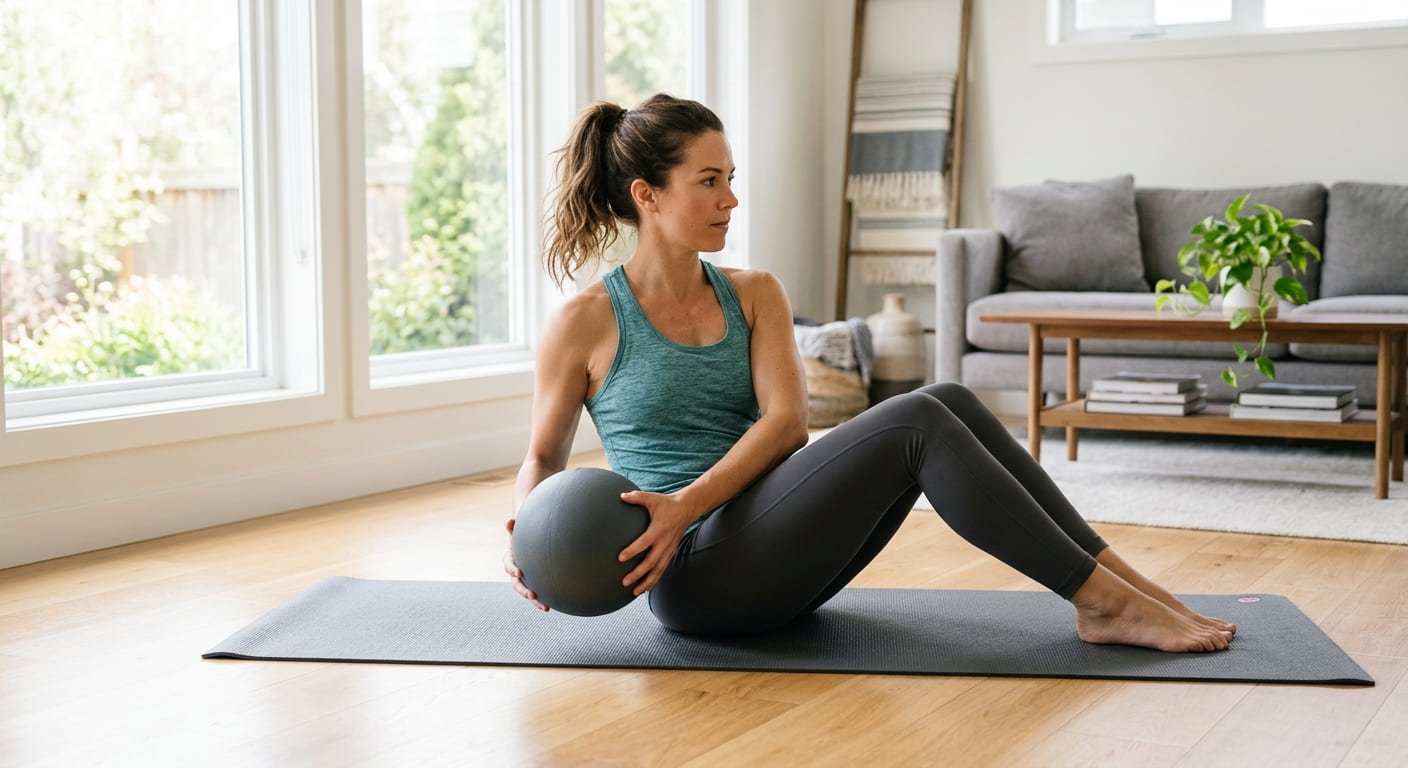
2. Russian twist
Sit on the floor with your knees bent and feet flat. Lean back slightly with a straight back, holding the ball in front of your chest. Rotate your torso to bring the ball to one side of your hips, then the other. Keep your feet on the floor to start. Lift them only once the movement feels controlled.
The mistake here is swinging your arms without turning your torso. Move your ribs, not just the ball. My guide to oblique exercises has more side-ab work if you like this one.
3. Overhead press
Stand tall, holding the ball at chest height with both hands. Press it straight up overhead until your arms are straight, then lower it back to your chest. Brace your core so your lower back doesn’t arch. It’s a great shoulder exercise that also trains your core to keep you steady.
4. Reverse lunge with rotation
Hold the ball at chest height. Step one foot back into a reverse lunge. As you lower, rotate your torso towards your front leg, then return to centre as you step back up. Alternate legs. This combines leg strength, balance and core rotation in one move.
5. Woodchop
Stand with your feet wider than shoulder width. Hold the ball with both hands above one shoulder, then chop it diagonally down across your body towards the opposite knee, bending your knees and rotating your torso. Return to the start with control. Do all reps on one side, then switch.
6. Chest pass (against a wall)
Stand about a metre from a solid wall. Hold the ball at chest height, then push it explosively into the wall, like a basketball chest pass. Catch it as it rebounds and repeat. Start close to the wall and move back as you get comfortable catching. Use a traditional or wall ball, not a slam ball.
7. Sit-up with press
Lie on your back with your knees bent, holding the ball at your chest. Sit up and press the ball overhead at the top, then lower it back to your chest as you roll back down. It turns a basic sit-up into a more complete core and shoulder exercise. Move slowly to protect your neck.
8. Medicine ball slam
Stand with your feet shoulder width apart, holding a slam ball overhead with your arms straight. Engage your core and slam the ball down into the floor just in front of your feet, bending your knees and hips as you do. Squat down to pick it up with a neutral back, then repeat.
This is a power and conditioning exercise, so move with intent, but keep it controlled. Only do this with a proper slam ball on a suitable floor.
9. Plank ball roll
Get into a high plank with the ball placed beside one hand. Keeping your hips as still as possible, roll the ball across to your other hand, then take that hand back to the floor. Continue rolling it side to side. It’s a fantastic anti-rotation core exercise, and it’s harder than it looks.
10. Lying ball pass
Lie on your back holding the ball overhead with your legs straight. Lift your arms and legs at the same time to pass the ball from your hands to your feet, gripping it between your ankles. Lower both arms and legs, then lift again to pass it back. Bend your knees to make it easier. Stop if your lower back arches off the floor.
Three medicine ball workouts
Warm up for 5 to 8 minutes before each routine. My general warm-up routine works well.
Routine 1: Full body beginner workout (20 minutes)
| Exercise | Reps | Notes |
|---|---|---|
| Medicine ball squat | 12 | Ball held at chest |
| Overhead press | 10 | Brace your core |
| Reverse lunge with rotation | 8 per side | Slow and controlled |
| Russian twist | 16 total | Feet on the floor |
| Plank ball roll | 10 total | Hips steady |
Complete 3 rounds, resting 60 to 90 seconds between rounds. This is a great starting point if you’re new, and it fits neatly alongside a routine like my full body workout for beginners.
Routine 2: Core workout (12 minutes)
| Exercise | Reps or time |
|---|---|
| Russian twist | 20 total |
| Woodchop | 10 per side |
| Sit-up with press | 10 |
| Lying ball pass | 8 |
| Plank ball roll | 12 total |
Complete 2 to 3 rounds with 45 seconds of rest between rounds. My guide to the beginner core workout has more stability exercises you can add.
Routine 3: Conditioning circuit (15 minutes)
| Exercise | Work | Rest |
|---|---|---|
| Medicine ball slam | 30 seconds | 30 seconds |
| Medicine ball squat | 30 seconds | 30 seconds |
| Chest pass against a wall | 30 seconds | 30 seconds |
| Woodchop, alternating sides | 30 seconds | 30 seconds |
| Rest | 60 seconds |
Complete 3 rounds. If you can’t do slams or wall throws at home, swap them for fast squats and presses. This style of session works a lot like my HIIT workout for beginners at home, and you can also turn it into a timed AMRAP workout once you’re comfortable.
How often to do medicine ball workouts
For most beginners, two or three medicine ball sessions a week works well, on non-consecutive days. You could use the full body routine twice a week and the conditioning circuit once, or add the core routine to the end of other workouts.
| Day | Session |
|---|---|
| Monday | Full body medicine ball routine |
| Tuesday | Walk or rest |
| Wednesday | Strength workout with dumbbells or bodyweight |
| Thursday | Core routine plus a brisk walk |
| Friday | Conditioning circuit |
| Weekend | Active rest or a longer walk |
How to progress
Once a routine feels easy, progress by changing one thing at a time:
- Add reps, two at a time, up to around 15 for strength moves
- Add a round, up to 4 or 5 rounds
- Slow down the lowering phase of squats and presses
- Use a heavier ball for squats and slams
- Try harder variations, like lifting your feet during Russian twists
- Reduce rest in conditioning circuits
A heavier ball isn’t always the best progression, especially for core exercises. Often, better control and slower reps with the same ball make a bigger difference.
Medicine ball vs dumbbells
| Medicine ball | Dumbbells | |
|---|---|---|
| Best for | Core, power, throws, conditioning | Strength, muscle building, progressive loading |
| Weight range | Usually limited to one or two balls | Wide range, especially adjustable sets |
| Throwing and slamming | Yes, with the right ball | No |
| Grip | Two hands, awkward shape | One hand each, easy to hold |
| Space and noise | Throws need space and make noise | Quiet and compact |
A medicine ball is brilliant for variety, core and conditioning, but dumbbells are better for building strength over the long term, because you can keep adding weight. If you have both, use the medicine ball for core and power work and dumbbells for your main strength training. My guide to the ab workout with dumbbells shows how the two overlap for core training.
Common medicine ball mistakes
- Starting too heavy. Form breaks down quickly, especially in twists and throws.
- Rounding your back when picking the ball up from the floor.
- Swinging your arms in Russian twists without turning your torso.
- Slamming a bouncy ball. It can rebound straight into your face.
- Throwing at weak walls or in rooms with breakable things nearby.
- Holding your breath. Breathe out on the effort, especially during slams and presses.
- Doing only core exercises. A medicine ball can train your whole body.
A 5-minute medicine ball warm-up
Before any of the routines, this short sequence warms up your shoulders, hips and core using a light ball, or no ball at all if yours is heavy.
- Ball halos: circle the ball slowly around your head, 5 each direction
- Squat to overhead reach: squat down, then stand and press the ball overhead, 10 reps
- Standing trunk rotations: hold the ball at chest height and turn gently side to side, 10 each way
- Reverse lunge with reach: step back and reach the ball overhead, 5 per leg
- Light chest passes or presses: 10 easy reps
By the end you should feel warm and loose, particularly through your shoulders and upper back, which do a lot of work in throws and twists.
Who medicine ball training suits
Medicine ball training works well for almost everyone, but it’s especially useful if you:
- Train at home with limited space and equipment, since one ball covers a lot of exercises
- Find standard workouts boring and want more variety
- Play sports that involve throwing, swinging or twisting, like tennis, golf, cricket or basketball
- Want to improve core strength in a more dynamic way than planks alone
- Enjoy circuit-style workouts that raise your heart rate
It’s less ideal as your only form of strength training if your main goal is building a lot of muscle, simply because you’ll outgrow a single ball’s weight. Older adults and anyone with joint problems can still benefit from lighter medicine ball exercises, such as squats, presses and gentle rotations, but should skip slams and fast throws until they’ve built a solid base.
What to look for when buying a medicine ball
- Weight: 3 to 4 kg for most beginners, or 4 to 6 kg if you’re mainly doing squats and slams
- Grip: a textured surface stops it slipping when your hands get sweaty
- Type: traditional for general use, slam ball for slams, wall ball for throws and catches
- Durability: check reviews for splitting seams or leaking sand
- Size: smaller balls are easier to hold for twists and presses
The bottom line
A medicine ball is one of the most useful and affordable pieces of home workout equipment. Start with a 3 to 4 kg ball, learn the basic exercises with good form, and use the three routines above two or three times a week. Use the right type of ball for slams and throws, protect your floors and walls, and progress gradually.
It won’t replace dumbbells for long-term strength building, but for core strength, power, conditioning and simply making workouts more varied and fun, it’s hard to beat. Keep it somewhere you’ll see it, not tucked away in a cupboard. A ball sitting in the corner of the room has a funny way of turning ten spare minutes into a workout.
A medicine ball opens up throws and passes that need a second person. Our partner workouts guide covers those, along with thirteen other two-person exercises.
Frequently asked questions
What weight medicine ball should a beginner use?
Most beginners do well with a 3 to 4 kg medicine ball for general exercises like presses, twists and passes, and 4 to 6 kg for squats and slams. Start lighter if you’re unsure, as form matters more than weight.
Are medicine ball workouts effective?
Yes. Medicine ball workouts build core strength, full body strength, power and conditioning, and they add variety to home training. For long-term strength and muscle building, they work best alongside dumbbells or other progressive resistance.
What is the difference between a medicine ball and a slam ball?
A traditional medicine ball is often bouncy and suits squats, presses, twists and wall passes. A slam ball has a thick rubber shell filled with sand and is designed not to bounce, which makes it safer for slamming onto the floor.
How often should I do medicine ball workouts?
Two to three sessions a week on non-consecutive days works well for most beginners. You can also add a short medicine ball core routine to the end of other workouts.
Can you build muscle with a medicine ball?
A medicine ball can build some strength and muscle, especially for beginners, but most people only own one or two weights, which limits progression. Dumbbells or other adjustable resistance are better for building muscle over time.
Are medicine ball slams good for weight loss?
Slams are a demanding exercise that raises your heart rate and burns energy quickly, so they can be part of a weight loss plan. Weight loss still depends mainly on your overall eating and activity across the week.
Can I do medicine ball exercises in an apartment?
Yes, but avoid slams and wall throws if you live upstairs or share walls, as they’re noisy and can damage floors and walls. Squats, presses, lunges, twists and plank variations work well and make little noise.
What are the best medicine ball exercises for abs?
Good medicine ball core exercises include Russian twists, woodchops, sit-ups with a press, plank ball rolls and lying ball passes. Focus on slow, controlled reps and rotating your torso rather than just swinging the ball.
Source: NHS, Physical activity guidelines for adults aged 19 to 64