
Chest and Tricep Workout: The Push Day Pairing Explained
Chest and triceps belong in the same session because your triceps already work on every chest press, and the order matters more than the exercise list: chest first, triceps second, always. Train the triceps first and you sabotage your pressing, because the small muscle fails before the big one gets worked.
This is the classic push day pairing, and it is the one I would recommend to almost anyone training upper body at home. It is efficient, it needs very little equipment, and the logic behind it is simple enough that you can build your own sessions once you understand it.
At a glance
- Why they pair: the triceps assist on every pressing movement, so they are already warm
- The order: chest first, triceps second, without exception
- Session length: 35 to 45 minutes
- Split: 3 or 4 chest exercises, 2 or 3 tricep exercises
- Frequency: twice a week, with 48 hours between
- Minimum equipment: none, though a pair of dumbbells opens up a lot
Why chest and triceps go together
Every time you press something away from your chest, two things happen at once. Your chest brings your upper arm across and in toward your midline, and your triceps straighten your elbow. Neither can happen without the other in a press. The chest is doing the big job and the triceps are finishing it.
Muscles that assist a movement like this are called synergists, and pairing a muscle with its synergist is the whole idea behind a push day. By the time you finish your chest work, your triceps have already done a considerable amount of work and are thoroughly warm. Training them next costs you very little extra time.
The alternative approach is to pair opposing muscles instead, which is what the chest and back workout does. Both are valid. Chest and triceps is the simpler of the two to program and the easier one to do at home, because almost everything is a variation of pressing.
The order is not negotiable
This is the single most common mistake and it is worth being blunt about.
Your triceps are much smaller than your chest and they fatigue much sooner. If you do tricep extensions first, then move to press-ups, your triceps give out partway through the set while your chest still has plenty left. You end up limited by the small muscle, and your chest never gets properly worked.
Do it the right way round and nothing is lost. Your chest gets fully trained while fresh, and your triceps get finished off afterwards with isolation work that does not need them to be fresh.
Chest first. Triceps second. If you remember one thing from this article, that is it.
The exercise list
Nine movements, grouped by what they need. Pick three or four chest and two or three triceps from these to build a session.
| Exercise | Target | Equipment |
|---|---|---|
| Push-up | Chest | None |
| Incline push-up | Chest, upper | A chair or sofa |
| Floor press | Chest | Dumbbells |
| Dumbbell bench press | Chest | Dumbbells, bench |
| Squeeze press | Chest and triceps | Dumbbells |
| Chair dip | Triceps | A chair |
| Diamond push-up | Triceps | None |
| Overhead extension | Triceps, long head | One dumbbell |
| Lying extension | Triceps, long head | Dumbbells |
The chest movements
Push-up. Hands slightly wider than your shoulders, body in one line from head to heels. Lower until your chest is a fist’s height off the floor, then press up. If you cannot do ten, put your hands on a chair rather than dropping to your knees. Elevating the hands keeps the movement identical and simply reduces the load, which knee push-ups do not.
Incline push-up. Hands on a sofa arm or worktop. Easier than a floor push-up and it shifts the emphasis slightly toward the upper chest. The full range of angles is covered in incline and decline push-ups.
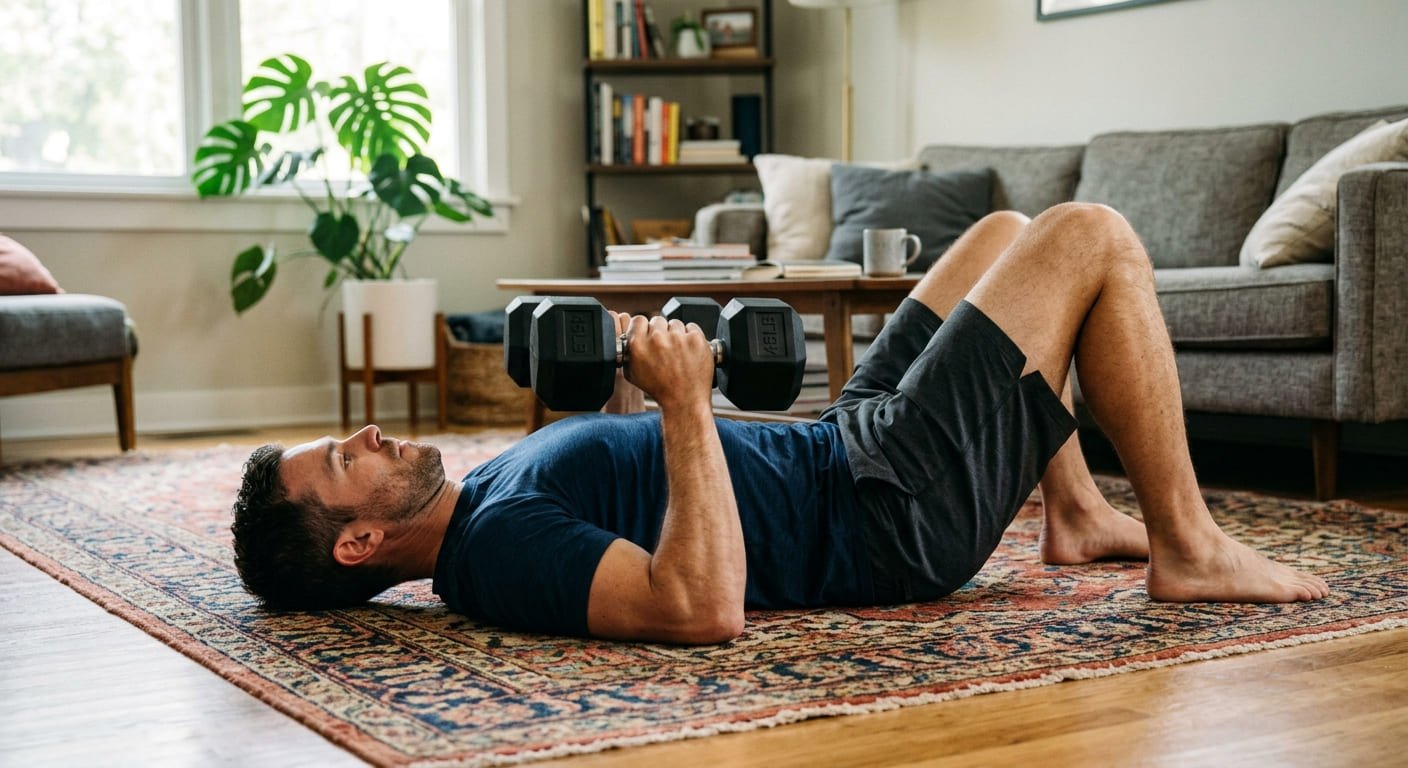
Floor press. Lie on your back on the floor with a dumbbell in each hand, elbows resting on the ground at about 45 degrees from your body. Press straight up, then lower until your upper arms touch the floor. The floor stops your elbows travelling too far back, which makes this the most shoulder-friendly press there is and an excellent option if you have dumbbells but no bench.
Dumbbell bench press. The same movement on a bench, which lets your arms travel further and stretches the chest more at the bottom. If you own a bench, this is your main chest builder. Setup details are in weight bench dumbbell exercises.
Squeeze press. A floor or bench press with the dumbbells pressed hard together throughout, as though trying to crush something between them. Pushing them together forces your chest to work at the top of the movement, where a normal press gets easy. It also loads the triceps heavily, which makes it the one exercise here that genuinely trains both at once.
The tricep movements
Chair dip. Sit on the edge of a chair, hands beside your hips gripping the front edge, slide your backside off. Bend your elbows and lower straight down until your upper arms are roughly parallel to the floor, then press up. Keep your back close to the chair. Drifting forward turns it into an uncomfortable shoulder exercise.
Diamond push-up. A push-up with your hands together under your chest, thumbs and index fingers forming a triangle. Significantly harder than a standard push-up. Elevate your hands on a chair if the floor version is out of reach.
Overhead extension. Hold one dumbbell in both hands above your head, arms straight. Keeping your elbows pointing forward and still, lower the weight behind your head, then press it back up. This is the important one, because the long head of the triceps only lengthens properly when the elbow is overhead, and nothing else on this list does that. The full reasoning is in tricep exercises at home.
Lying extension. On your back, dumbbells pressed up, bend only at the elbows to lower them toward your forehead. Angle your upper arms slightly back toward your head rather than straight up, which keeps tension on the triceps throughout instead of letting them rest at the top.
Three ready-made sessions
Pick the one that matches what you own. All three follow the same structure: chest first, triceps second, finishing with the movement that reaches the long head.
No equipment at all
| Exercise | Sets | Reps |
|---|---|---|
| Push-up | 4 | 8 to 12 |
| Incline push-up | 3 | 12 to 15 |
| Wide push-up | 3 | To 2 reps short of failure |
| Chair dip | 3 | 10 to 15 |
| Diamond push-up | 3 | 6 to 10 |
| Bodyweight skull crusher | 2 | 10 to 12 |
The bodyweight skull crusher is done against a table edge: hands on the edge, body straight, bend only at the elbows so your head travels below your hands. It is the no-equipment way to get the elbow overhead.
Dumbbells, no bench
| Exercise | Sets | Reps |
|---|---|---|
| Dumbbell floor press | 4 | 8 to 10 |
| Squeeze press | 3 | 10 to 12 |
| Push-up | 3 | To 2 short of failure |
| Chair dip | 3 | 10 to 15 |
| Overhead extension | 3 | 10 to 12 |
Dumbbells and a bench
| Exercise | Sets | Reps |
|---|---|---|
| Flat dumbbell press | 4 | 8 to 10 |
| Incline dumbbell press | 3 | 10 to 12 |
| Squeeze press | 3 | 12 |
| Bench dip or chair dip | 3 | 10 to 15 |
| Lying extension | 3 | 10 to 12 |
| Overhead extension | 2 | 12 to 15 |
Rest 90 seconds between chest sets and 60 between tricep sets. Any of these takes 35 to 45 minutes including a warm-up.
How to make it harder over time
Doing the same session indefinitely stops producing change after a few weeks. You need one of these to move.
- Add reps. If the plan says 8 to 12, work up to 12 on every set before anything else changes.
- Add weight. Once you hit the top of the rep range on all sets, go up. With dumbbells that is usually a 2 kg jump, and your reps will drop back to the bottom of the range, which is expected.
- Change the leverage. With bodyweight, elevate your feet to make push-ups harder, or elevate your hands to make them easier. This is the bodyweight equivalent of changing the weight.
- Slow the lowering. Three seconds down on every rep makes the same session considerably harder without changing anything else. Useful when you have run out of ways to add load.
Pick one and stick with it for a few weeks. Changing several at once means you cannot tell what worked.
How often
Twice a week, with at least 48 hours between sessions. Chest and triceps are not large enough muscle groups to need more than that, and the triceps in particular get worked by any overhead pressing you do on other days.
If you are training upper body twice a week and lower body twice a week, this session slots straight into the upper days. The muscle groups to work out together guide covers how the rest of the week fits around it.
Four things that go wrong
Triceps before chest. Covered above, and worth repeating because it is the one that quietly wastes whole sessions.
Too much tricep volume. The triceps have already worked hard through all your pressing. Adding five isolation exercises on top is more than they need and it eats into your recovery. Two or three is plenty.
Flaring the elbows out wide. On any press, elbows at roughly 45 degrees from your body is the sweet spot. Straight out to the sides at 90 degrees is hard on the shoulder joint and no better for the chest.
Skipping the overhead movement. If every tricep exercise you do has your elbow below your shoulder, you are training two of the three tricep heads. One overhead movement per session fixes it and takes four minutes.
Frequently asked questions
Should you train chest and triceps together?
Yes. The triceps assist on every chest press, so they are already warm and partly worked by the time your chest session ends. Training them next is efficient and it is the standard push day pairing.
Should I do chest or triceps first?
Chest first, always. Your triceps are smaller and fatigue sooner. Tiring them first means they fail partway through your pressing and your chest never gets properly trained.
How many exercises for chest and triceps?
Three or four chest exercises and two or three tricep exercises. That is five to seven movements, which lands at 35 to 45 minutes. More tricep work than that is usually counterproductive given how much they already do during pressing.
Can I do a chest and tricep workout at home without equipment?
Yes. Push-ups, incline push-ups and wide push-ups cover the chest, and chair dips, diamond push-ups and bodyweight skull crushers off a table cover the triceps. That is a complete session with nothing but a chair and a table.
How often should I train chest and triceps?
Twice a week with at least 48 hours between sessions. Remember that any overhead pressing on other days also works the triceps, so those sets count toward your weekly total.
What is a squeeze press?
A dumbbell press with the weights pressed hard together throughout the movement. Pushing them into each other keeps the chest working at the top, where a normal press gets easy, and it loads the triceps heavily at the same time. It is the one movement that genuinely trains both.
Do I need a bench for chest exercises?
No. The dumbbell floor press is an excellent substitute and is actually gentler on the shoulder, because the floor stops your elbows travelling too far back. A bench gives you more range and more angles, but it is an upgrade rather than a requirement.
Why are my shoulders sore after chest day?
Usually elbows flaring too wide on the press, which shifts load onto the front of the shoulder. Bring them to roughly 45 degrees from your body. Going too deep on chair dips is the other common cause.
Where to go next
Pick the session that matches your equipment and run it twice a week for a month, adding reps before you add anything else. That is enough to see real change.
For the pulling half of your week, the back and biceps workout is the natural counterpart, and beginner upper body workout shows how to balance the two.


