Glute Strengthening Exercises: 14 Best Moves for Stronger Glutes (Home and Gym)
Glute strengthening exercises do far more than shape your backside. Your glutes are the largest muscle group in your body, and they power almost everything you do on your feet: standing up from a chair, climbing stairs, walking, running, jumping and lifting things from the floor. Weak glutes are linked with knee pain, lower back pain and poor balance, while strong glutes make everyday life and every other workout easier.
The good news is that you do not need fancy equipment. Some of the best glute exercises can be done at home with nothing but a mat, and the rest need only a dumbbell, a band or a bench. What matters most is choosing the right exercises, doing them with good form, and making them gradually harder.
This guide explains the three glute muscles, what research says about which exercises activate them most, 14 glute strengthening exercises for home and gym, sample routines, a 10-week plan, and the mistakes that hold most people back.
At a glance
- The glutes are three muscles: gluteus maximus, medius and minimus
- Research shows step-ups, hip thrusts, deadlift variations, lunges and squats activate the gluteus maximus strongly
- Side-lying hip abduction and single leg exercises target the gluteus medius well
- The best plan combines a hip thrust or bridge, a squat or lunge, a hinge and a side-of-hip exercise
- You can build strong glutes at home with bodyweight, bands and dumbbells
- Train your glutes 2 to 3 times a week and increase the challenge gradually
- Strong glutes can help knees, hips and lower back as well as appearance
The three glute muscles
| Muscle | Where it is | Main jobs |
|---|---|---|
| Gluteus maximus | The large, rounded muscle of the buttocks | Extends the hip (standing up, climbing, sprinting), rotates the thigh outward |
| Gluteus medius | Upper, outer side of the hip | Moves the leg out to the side, keeps the pelvis level when standing on one leg |
| Gluteus minimus | Beneath the medius | Helps the medius stabilise the hip |
When people search for exercises for bum, they usually mean the gluteus maximus. But the medius is just as important for healthy knees and hips, so a good plan trains both.
Why glute strengthening matters
| Benefit | How strong glutes help |
|---|---|
| Easier daily movement | Standing, climbing stairs and lifting |
| Knee support | The gluteus medius helps keep knees from collapsing inward |
| Lower back support | Strong hips reduce how much the back has to work when bending |
| Better balance | Steadier on one leg, which matters more with age |
| Sports performance | More power for running, jumping and changing direction |
| Shape and posture | Fuller, rounder glutes and a more upright stance |
What the research says about the best glute exercises
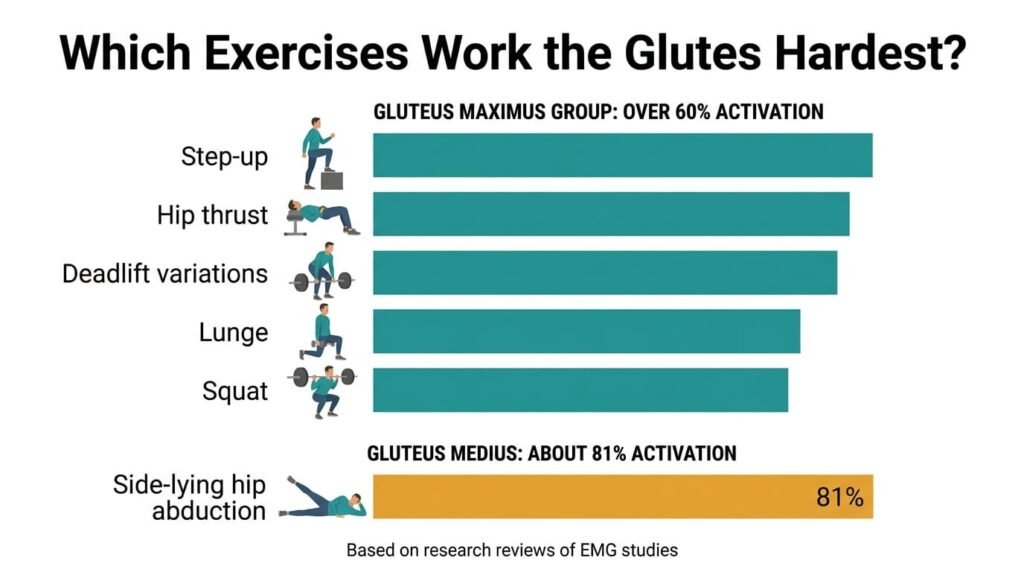
A systematic review of 16 studies measured gluteus maximus activation during common strength exercises. The highest activation, above 60 percent of maximum, was seen in step-up variations, several hip thrust variations, deadlift variations, lunges and squat-type exercises. The authors noted that load, speed, fatigue and exercise complexity all affect how hard the glutes work.
Another study compared common rehab exercises. Side-lying hip abduction produced the highest gluteus medius activity (about 81 percent of maximum), while the single leg squat and single leg deadlift activated both the gluteus medius and maximus well, at around 59 to 64 percent.
The takeaway: there is no single magic glute exercise. A mix of hip thrusts or bridges, step-ups or lunges, a hinge like a deadlift, and a side-of-hip move covers all three muscles well.
Glute strengthening exercises at home (best exercises for bum with no gym)
1. Glute bridge
Lie on your back with knees bent and feet flat. Push through your heels to lift your hips until your body forms a straight line from shoulders to knees. Squeeze your glutes at the top, then lower slowly. Do 3 sets of 12 to 15. Our guide to glute bridges has many variations.
2. Single leg glute bridge
Same as the bridge, but with one foot lifted. It doubles the load on the working side and challenges hip stability. Do 3 sets of 8 to 12 per side.
3. Frog pump
Lie on your back with the soles of your feet together and knees falling out. Drive your hips up, squeezing your glutes. Short, quick reps. Do 2 sets of 20. A simple, effective finisher.
4. Side-lying hip abduction
Lie on your side with your legs straight. Lift your top leg up, keeping it slightly behind your body and your toes pointing forward. Lower slowly. Research shows this is one of the best gluteus medius exercises. Do 3 sets of 12 to 15 per side.
5. Clamshell
Lie on your side with knees bent and feet together. Lift your top knee while keeping your feet touching, then lower. Add a band around your knees to make it harder. Do 3 sets of 15 per side.
6. Banded side walk (monster walk)
Place a band around your knees or ankles. In a slight squat, step sideways, keeping tension on the band. Do 2 to 3 sets of 10 to 15 steps each way. Our guide to monster walks shows variations.
7. Step-up
Place one foot on a sturdy step or bench. Push through your heel to stand up tall, then lower slowly. Step-ups were among the highest glute activating exercises in research. Do 3 sets of 8 to 12 per leg. Holding dumbbells makes it harder.
8. Bulgarian split squat
Rest the top of your back foot on a bench or sofa. Lower your back knee toward the floor, leaning your torso slightly forward to bias the glutes. Push back up. Do 3 sets of 8 to 10 per leg.
9. Reverse lunge
Step one foot back and lower until both knees are bent, then push through your front heel to return. Reverse lunges are often kinder to the knees than forward lunges. Do 3 sets of 10 per leg. Our lunge alternatives guide has more options.
Glute strengthening exercises for the gym
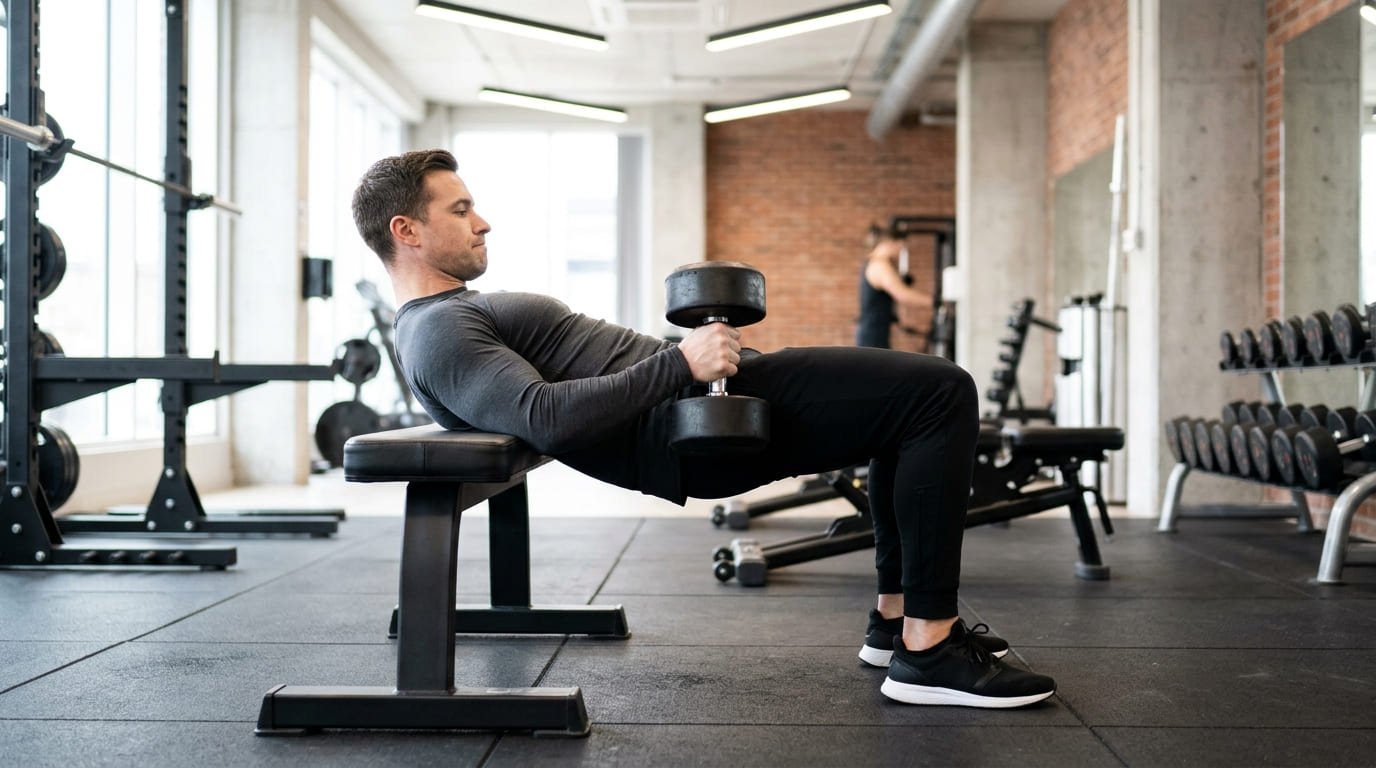
10. Barbell or dumbbell hip thrust
Sit with your upper back against a bench, a padded barbell or dumbbell across your hips. Drive your hips up until your body is in a straight line from shoulders to knees, squeeze, then lower. One of the most popular glute exercises for good reason. Do 3 sets of 8 to 12. Our guides to hip thrusts at home and glute bridge vs hip thrust explain the difference.
11. Romanian deadlift
Hold dumbbells or a barbell in front of your thighs. With a slight knee bend, push your hips back and lower the weight down your legs, keeping your back flat, until you feel a strong stretch in your hamstrings. Drive your hips forward to stand. Do 3 sets of 8 to 10.
12. Goblet squat or back squat
Hold a dumbbell at your chest, or a barbell on your upper back. Sit down between your heels as deep as you can with good form, then stand up. Deeper squats tend to involve the glutes more. Do 3 sets of 8 to 12. Our guide to what muscles squats work explains why depth matters.
13. Cable kickback and pull-through
Kickbacks with an ankle strap and pull-throughs with a rope are excellent glute isolation exercises on the cable machine. Do 2 to 3 sets of 12 to 15. Our cable leg exercises guide shows both.
14. Kettlebell swing
Hinge at the hips and swing a kettlebell to chest height by snapping your hips forward. A powerful, fast glute exercise. Learn the technique first with a light kettlebell. Our kettlebell swing guide covers form step by step.
| Exercise | Main glute focus | Equipment | Level |
|---|---|---|---|
| Glute bridge | Maximus | None | Beginner |
| Single leg glute bridge | Maximus, medius | None | Beginner to intermediate |
| Frog pump | Maximus | None | Beginner |
| Side-lying hip abduction | Medius | None | Beginner |
| Clamshell | Medius | Optional band | Beginner |
| Banded side walk | Medius | Band | Beginner |
| Step-up | Maximus, medius | Step, optional dumbbells | Beginner |
| Bulgarian split squat | Maximus | Bench, optional dumbbells | Intermediate |
| Reverse lunge | Maximus | Optional dumbbells | Beginner |
| Hip thrust | Maximus | Bench, barbell or dumbbell | Beginner to intermediate |
| Romanian deadlift | Maximus, hamstrings | Dumbbells or barbell | Intermediate |
| Squat | Maximus, quads | Dumbbell or barbell | Beginner to intermediate |
| Cable kickback and pull-through | Maximus | Cable machine | Beginner |
| Kettlebell swing | Maximus, power | Kettlebell | Intermediate |
Sample routines using the best glute exercises
Home glute routine (20 minutes)
| Exercise | Sets x reps |
|---|---|
| Glute bridge | 3 x 15 |
| Step-up (sofa-height step) | 3 x 10 per leg |
| Reverse lunge | 2 x 10 per leg |
| Side-lying hip abduction | 3 x 15 per side |
| Clamshell with band | 2 x 15 per side |
| Frog pump finisher | 1 x 25 |
Gym glute routine (35 minutes)
| Exercise | Sets x reps |
|---|---|
| Hip thrust | 4 x 8 to 10 |
| Romanian deadlift | 3 x 8 to 10 |
| Bulgarian split squat | 3 x 8 per leg |
| Cable kickback | 2 x 12 per side |
| Banded side walk | 2 x 15 steps each way |
A 10-week plan of glute strengthening exercises
| Weeks | Sessions per week | Focus |
|---|---|---|
| 1 and 2 | 2 | Learn the movements with bodyweight, 2 sets each |
| 3 and 4 | 2 to 3 | Add a third set, add a band to bridges and clamshells |
| 5 and 6 | 3 | Add dumbbells to step-ups, lunges and bridges |
| 7 and 8 | 3 | Move to hip thrusts and Romanian deadlifts with weight |
| 9 and 10 | 3 | Increase weight gradually, keep form strict |
Progress by adding reps, then load. When you can do the top of the rep range for every set with good form, increase the weight slightly next session.
How to feel your glutes working
Many people say they feel these exercises in their thighs or back instead of their glutes. A few cues help:
- Push through your heels in bridges, hip thrusts and step-ups
- Squeeze at the top for a second on every rep
- Tuck your ribs down so your lower back does not arch at the top of bridges and thrusts
- Lean slightly forward in split squats and step-ups to bias the glutes
- Warm up with a few bridges and clamshells before your main exercises
- Slow down, especially on the lowering phase
Upper glute and side glute focus
If you want to target the upper and outer part of the glutes, focus on abduction moves like side-lying leg raises, banded side walks and cable abductions, alongside hip thrusts. Our guides to upper glute exercises and hip abductor exercises go into more detail.
Common mistakes
| Mistake | What happens | Fix |
|---|---|---|
| Only doing bridges | Glutes plateau quickly | Add step-ups, lunges, hinges and abduction |
| Arching the lower back at the top | Back takes the strain | Ribs down, squeeze the glutes |
| Never adding resistance | Little strength gain | Add bands, dumbbells or a barbell over time |
| Rushing reps | Less glute work | Control the lowering, squeeze at the top |
| Skipping the gluteus medius | Weaker hip stability | Include side-lying abduction or band walks |
| Training glutes every day | Poor recovery | 2 to 3 times a week |
Glute exercises and pain
Strong glutes can help with some knee, hip and lower back pain, but exercises should not cause sharp pain. If you have hip pain on the outside of the hip, our hip bursitis exercises guide explains which moves to modify. If your knees hurt, start with bridges, side-lying abduction and shallow step-ups. Get persistent pain assessed by a professional.
This article is general information, not medical advice. See our medical disclaimer.
Glute strengthening exercises for older adults
Strong glutes are especially important as we age, because they help with standing up from a chair, climbing stairs and keeping your balance. Gentle options include:
| Exercise | Dose |
|---|---|
| Sit-to-stand from a chair | 2 x 8 to 10 |
| Glute bridge on the bed or floor | 2 x 10 |
| Standing hip abduction holding a counter | 2 x 10 per side |
| Step-up onto the bottom stair, holding the rail | 2 x 8 per leg |
| Standing kickback holding a counter | 2 x 10 per side |
Our leg exercises for seniors guide has a full routine with seated and standing options.
Glute exercises for runners
Runners rely on their glutes to absorb impact and drive each stride. Weak glutes are often linked to knee and hip niggles. Two short sessions a week of single leg bridges, step-ups, side-lying abduction and banded side walks can make a real difference. Do them after easy runs or on separate days, not before hard sessions.
Glute exercises for desk workers
Sitting for long periods can leave the glutes underused and the hip flexors tight. Every hour or two, stand up and do 10 bodyweight squats or 10 standing glute squeezes, and stretch your hip flexors for 30 seconds each side. At home, a few sets of bridges in the evening help wake the glutes up again.
How to keep progressing
| Progression | Example |
|---|---|
| Add reps | 10 reps becomes 15 |
| Add sets | 2 sets becomes 3 |
| Add a band | Banded bridges and clamshells |
| Single leg versions | Single leg bridge instead of bridge |
| Add weight | Dumbbell step-ups and hip thrusts |
| Slow the lowering | 3 seconds down on every rep |
| Pause at the top | Hold the squeeze for 2 seconds |
Choose one progression at a time. The glutes are strong muscles, so they need a steadily increasing challenge to keep getting stronger.
Food and recovery
Muscles grow and strengthen with enough protein, sleep and recovery. Aim for protein at every meal, sleep 7 to 9 hours, and leave a rest day between hard glute sessions. Our protein intake calculator gives a simple daily target.
Quick form checklist for glute strengthening exercises
| Exercise | Key form point |
|---|---|
| Bridges and hip thrusts | Chin tucked, ribs down, squeeze at the top |
| Step-ups | Whole foot on the step, push through the heel, do not push off the back foot |
| Split squats and lunges | Front knee tracks over the toes, slight forward lean |
| Romanian deadlifts | Flat back, hips back, weight close to the legs |
| Side-lying abduction | Leg slightly behind the body, toes forward, no rolling back |
| Banded walks | Stay low, keep tension on the band, small steps |
Good form matters more than heavy weight. These glute strengthening exercises work best when every rep looks the same as the first.
How long does a glute workout take?
A focused glute session takes 20 to 35 minutes. Two or three of these a week, combined with walking and general activity, is plenty for most people. If you already train your whole body, you can add three or four glute exercises to your existing leg days instead of doing separate sessions.
Simple kit that helps
A set of mini loop bands, a pair of dumbbells and a sturdy bench or step will cover almost every exercise in this guide. Our best resistance bands for beginners guide explains which bands to choose for exercises for bum and hips at home.
Consistency is the real secret
Every one of these glute strengthening exercises works, but only if you do them regularly. Pick a routine you enjoy, put two or three sessions in your calendar, and stick with it for at least ten weeks before judging results. The people with the strongest glutes are rarely the ones with the cleverest plan. They are the ones who kept doing their glute strengthening exercises week after week.
A 3-minute glute warm-up
Before any glute session, do 10 bodyweight bridges, 10 clamshells per side and 10 bodyweight squats. It wakes up the glutes, helps you feel them working in your main exercises, and prepares your hips and knees for heavier work.
The bottom line
The best glute exercises, and the most effective glute strengthening exercises, combine a bridge or hip thrust, a step-up, lunge or squat, a hinge like the Romanian deadlift, and a side-of-hip move such as side-lying abduction or band walks. Research shows these cover all three glute muscles, with step-ups, hip thrusts, deadlifts, lunges and squats activating the gluteus maximus most.
Train your glutes two or three times a week, start with bodyweight, then add bands and weights gradually. Squeeze at the top, control every rep, and give it at least 10 weeks. You will feel the difference climbing stairs, standing up and lifting long before you see it in the mirror.
Frequently asked questions
What are the best glute strengthening exercises?
Hip thrusts, glute bridges, step-ups, Bulgarian split squats, Romanian deadlifts, squats and side-lying hip abduction are among the best. Combining several covers all three glute muscles.
What exercises are best for the bum at home?
Glute bridges, single leg bridges, step-ups, reverse lunges, Bulgarian split squats, side-lying hip abduction and banded side walks all work well at home with little equipment.
How often should I train glutes?
Two or three times a week is enough for most people, with at least a day of rest between sessions.
How long does it take to strengthen glutes?
Most people feel stronger within 4 to 6 weeks. Visible changes usually take 8 to 12 weeks or more of consistent training with gradually increasing resistance.
Why do I feel glute exercises in my legs instead of my glutes?
Try pushing through your heels, squeezing at the top, slowing down and leaning slightly forward on step-ups and split squats. A few warm-up bridges also help.
Are squats good for glutes?
Yes, especially deeper squats. But for the best glute development, add hip thrusts, step-ups and hinges as well.
Do I need weights to build glutes?
Not at first. Bodyweight and bands work well for beginners. Over time, adding dumbbells or a barbell helps you keep progressing.
Can glute exercises help back pain?
Stronger glutes can take some load off the lower back during bending and lifting. Start gently and get persistent back pain assessed.
What is the difference between glute bridges and hip thrusts?
Both drive the hips up. Bridges start with your shoulders on the floor, while hip thrusts use a bench under your upper back, allowing a bigger range and heavier loads.
What’s next?
Reading is the easy part. Pick one of these and do it today.