Cable Back Exercises: 10 Beginner-Friendly Moves and a First-Time Gym Plan
Cable back exercises are a brilliant place to start if you are new to the gym. The cable machine can look intimidating the first time you see it, with its pulleys, pins and assorted handles. But once you know how it works, it is one of the most beginner-friendly pieces of equipment in the building. The weight moves smoothly, you can start very light, and you can change the angle of almost any back exercise just by sliding the pulley up or down.
This guide is written for someone walking into a gym for the first or second time. It explains how a cable machine works, which handles to use, 10 cable back exercises with clear steps, lower back exercises on the cable machine that are safe for beginners, how to choose a weight, a simple 8-week plan and the common mistakes to avoid.
If you train at home, our guides to the dumbbell back workout at home and kettlebell back exercises cover similar muscles without a cable machine.
At a glance
- Cables give smooth, constant tension, which makes them easy to control and good for learning
- The main cable back exercises are pulldowns, rows, face pulls, straight arm pulldowns and pull-throughs
- Start light, focus on pulling with your back rather than your arms, and move slowly
- Lower back work on cables should be gentle: pull-throughs and anti-rotation holds, not heavy bending
- Two back sessions a week, with 10 or more sets in total, is a good target over time
- Research suggests training each muscle twice a week builds more muscle than once a week
- Ask gym staff to show you the machine if you are unsure. They are usually happy to help
Why use the cable machine for your back?
| Advantage | What it means for you |
|---|---|
| Constant tension | Muscles work through the whole movement, not just part of it |
| Smooth and controlled | Easier to learn good form than with free weights |
| Small weight steps | You can increase the load gradually |
| Adjustable height | One machine covers pulldowns, rows and face pulls |
| Safer for beginners | If you cannot finish a rep, you simply let the weight return |
| Joint friendly | You can adjust the angle to suit your shoulders |
Free weights and bodyweight exercises are excellent too. Cables are simply an easy, safe way to learn how back exercises should feel.
If your main goal is a wider back, our guide to latissimus dorsi exercises focuses on the lats with gym and home options.
How a cable machine works (for first-timers)
The parts
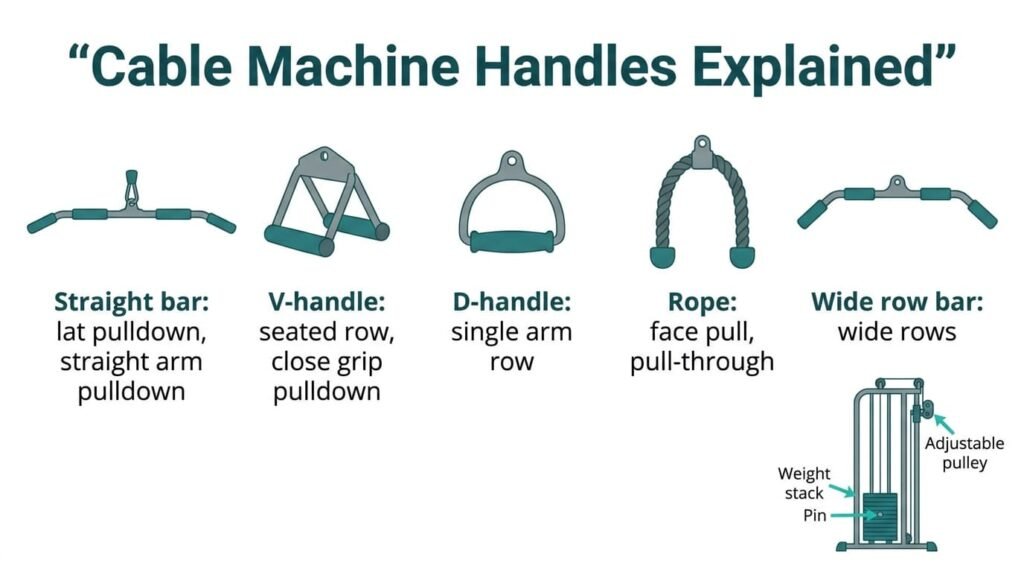
- The weight stack: a column of plates with a pin you slide in to choose the weight
- The pulley: the wheel the cable runs through. On most machines you can slide it up and down
- The handle attachment: clips onto the end of the cable with a carabiner
- Single or dual stacks: some machines have one pulley, others (often called cable crossovers or functional trainers) have two
Which handle to use
| Handle | Looks like | Best for |
|---|---|---|
| Long straight bar | A metal bar about a metre long | Lat pulldowns, straight arm pulldowns |
| Close grip V-handle | A small triangle shape | Seated rows, close grip pulldowns |
| Single D-handle | A stirrup-shaped handle | Single arm rows, single arm pulldowns |
| Rope | A thick rope with two ends | Face pulls, pull-throughs |
| Wide row bar | A bar with angled ends | Wide grip rows |
If you cannot find a handle, look on the racks or hooks near the machine. Always clip it firmly onto the carabiner before you start.
Gym etiquette tips
- Wipe down the handles and seat after use
- Put the handles back where you found them
- If someone is between sets, ask if you can work in
- Do not leave the pin at a very heavy setting without telling anyone
10 cable back exercises for beginners
Each exercise lists the main muscles, the handle and simple steps. Start with 2 sets of 10 to 12 reps at a light weight. Move slowly: about 1 to 2 seconds to pull and 2 to 3 seconds to return.
1. Lat pulldown
Muscles: lats, biceps, middle back. Handle: long straight bar on a lat pulldown station.
- Sit facing the machine with your thighs snug under the pads
- Grip the bar a little wider than shoulder width, palms facing away
- Lean back very slightly, chest up
- Pull the bar down to your upper chest, leading with your elbows
- Squeeze your shoulder blades down and back
- Let the bar rise slowly until your arms are straight
The lat pulldown is one of the classic back exercises cable machine users start with, and a great step toward your first pull-up. Avoid pulling the bar behind your neck.
2. Close grip pulldown
Muscles: lats, lower lats, biceps. Handle: V-handle.
Same as the lat pulldown, but with a close grip and palms facing each other. Pull the handle to your upper chest, keeping your elbows close to your sides. Many beginners find this grip easier and stronger.
3. Seated cable row
Muscles: middle back, rhomboids, lats, rear shoulders. Handle: V-handle or wide row bar.
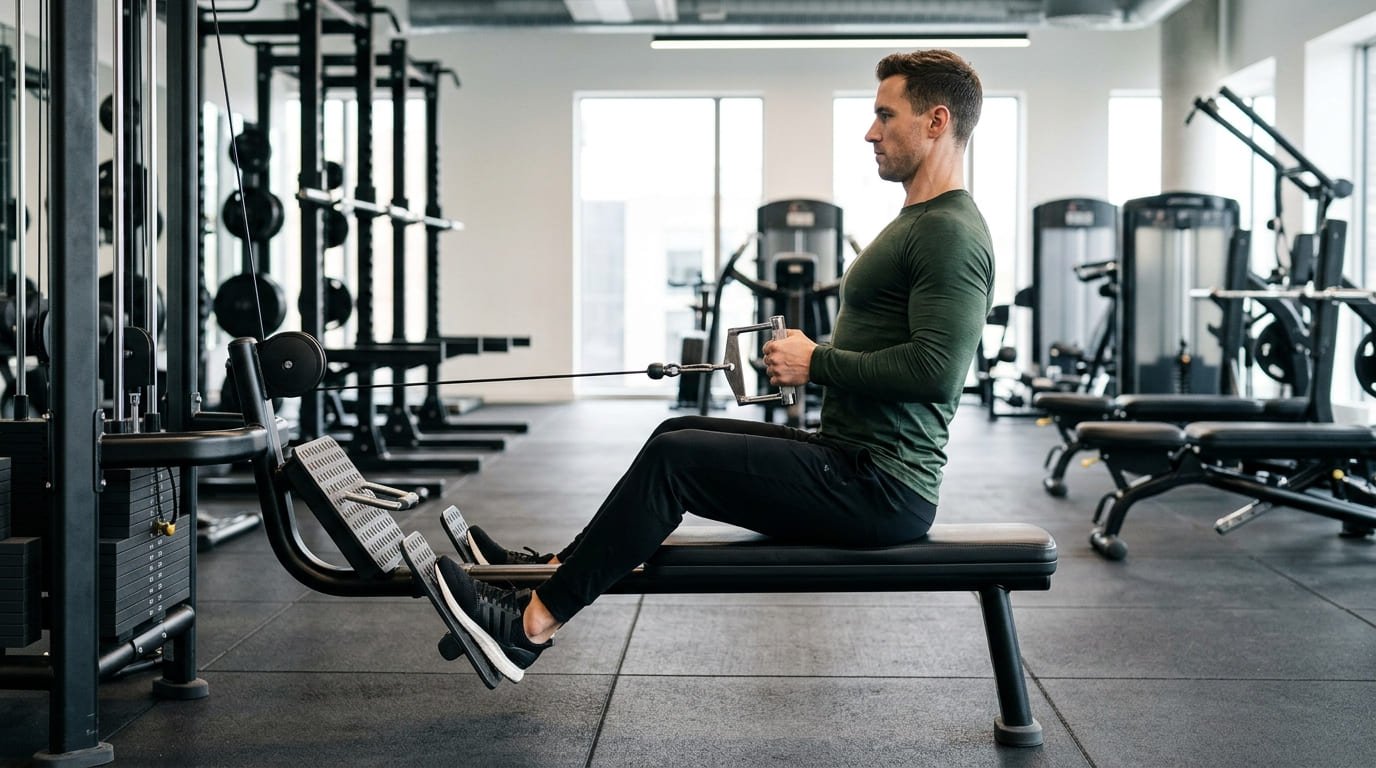
- Sit on the bench with your feet on the platform and knees slightly bent
- Grab the handle and sit tall, chest up, arms straight
- Pull the handle to your lower ribs, squeezing your shoulder blades together
- Pause for a second, then let the handle move forward slowly
- Keep your torso still. Do not rock back and forth
If you only do one back exercise cable movement, make it this one.
4. Single arm cable row
Muscles: lats, middle back, core. Handle: D-handle, pulley at chest height.
Stand side-on or facing the machine in a staggered stance. Pull the handle toward your hip, keeping your shoulders square and your core tight. Working one side at a time helps you notice and fix differences between sides.
5. Face pull
Muscles: rear shoulders, upper back, rotator cuff. Handle: rope, pulley at face height or a little higher.
- Hold the rope ends with your palms facing each other
- Step back so the cable is taut, arms straight
- Pull the rope toward your face, splitting the ends apart
- Finish with your hands beside your ears and your elbows high
- Return slowly
Face pulls are excellent for posture and shoulder health. Our cable shoulder exercises guide covers more moves for this area.
6. Straight arm pulldown
Muscles: lats. Handle: straight bar or rope, pulley high.
Stand facing the machine, hinge forward slightly and hold the bar with straight arms at shoulder height. Keeping your arms almost straight, sweep the bar down to your thighs. Return slowly. This isolates the lats without much bicep help, so it teaches you what “pulling with your back” feels like.
7. Half kneeling high row
Muscles: lats, middle back, core. Handle: D-handle, pulley high.
Kneel on one knee facing the machine. Pull the handle down and back toward your ribs with the opposite arm. The kneeling position helps you keep your torso steady.
8. Cable reverse fly
Muscles: rear shoulders, rhomboids, middle traps. Handle: no handle (hold the cable ends) or D-handles, both pulleys at shoulder height.
Stand between two pulleys and grab the opposite cables, so your arms cross in front of you. With a slight bend in your elbows, open your arms out to the sides until they are in line with your shoulders. Use a very light weight. Our mid back exercises guide has more moves for this area.
9. Cable shrug
Muscles: upper traps. Handle: straight bar, pulley low.
Stand tall holding the bar in front of your thighs. Lift your shoulders straight up toward your ears, pause, then lower slowly. Do not roll your shoulders.
10. Cable pull-through
Muscles: glutes, hamstrings, lower back (as stabilisers). Handle: rope, pulley low.
- Stand facing away from the machine with the rope between your legs
- Walk forward until the cable is taut, feet shoulder width apart
- Push your hips back, keeping your back flat and knees slightly bent
- Drive your hips forward to stand tall, squeezing your glutes
- Do not lean back at the top
This is one of the safest lower back exercises cable machines allow, because the load stays light and the movement is driven by your hips, not by bending your spine.
Lower back exercises on the cable machine
Many people search for lower back exercises cable machines can offer. The lower back muscles mostly work to keep your spine steady, so the best cable options train that job rather than repeatedly bending and straightening the back under load.
| Exercise | What it trains | Why it is beginner friendly |
|---|---|---|
| Cable pull-through | Hip hinge with a neutral spine | Load is light and driven by the hips |
| Pallof press | Resisting twisting | No spinal movement at all |
| Half kneeling cable chop | Controlled rotation through the hips and upper back | Light load, slow movement |
| Single arm cable row | Resisting rotation while pulling | Core and back work together |
| Cable deadlift with a low rope | Basic hip hinge pattern | A smooth, gentle introduction to lifting from the floor |
If you have back pain, start with the gentlest options and our guide to core exercises for back pain. Avoid heavy, fast or jerky movements until your back feels strong and settled.
What the research says about training your back
Two well-known meta-analyses by Schoenfeld and colleagues give useful guidance for beginners. The first found a clear dose-response relationship between weekly training volume and muscle growth: more weekly sets per muscle led to greater gains, with each additional set adding a small amount.
The second found that when weekly volume was equal, training a muscle twice a week produced better muscle growth than training it once a week.
In plain terms: train your back at least twice a week, and gradually build up to 10 or more hard sets a week. You do not need to start there. Beginners make great progress with less.
How to choose the right weight
- Start with a weight you could lift about 15 times with good form
- Do 10 to 12 reps. The last 2 or 3 should feel challenging but clean
- If you could easily do 5 more reps, go up one plate next set
- If your form breaks down, go down a plate
- When you can do 12 good reps for every set, increase the weight next session
Cable weight stacks are not all the same. A pulley system can make the same pin setting feel lighter or heavier on different machines, so do not compare numbers between gyms. Our next-step resistance calculator can help you judge how big a jump the next weight up is.
Form cues that make cable back exercises work
| Cue | Why it helps |
|---|---|
| Lead with your elbows | Shifts the work from your arms to your back |
| Shoulders down, away from your ears | Engages the lats and protects the neck |
| Chest up | Keeps your spine in a strong position |
| Pause and squeeze | Builds the mind-muscle connection |
| Slow return | The lowering phase builds strength too |
| Stay still | Rocking means the weight is too heavy |
An 8-week cable back exercises plan for first-timers
Do this as part of two upper body or full body sessions a week, at least two days apart.
| Weeks | Session A | Session B |
|---|---|---|
| 1 and 2 | Lat pulldown 2 x 12, seated cable row 2 x 12 | Close grip pulldown 2 x 12, face pull 2 x 15 |
| 3 and 4 | Lat pulldown 3 x 10, seated cable row 3 x 10, face pull 2 x 15 | Single arm cable row 3 x 10 each side, straight arm pulldown 2 x 12, pull-through 2 x 12 |
| 5 and 6 | Lat pulldown 3 x 10, seated row 3 x 10, reverse fly 2 x 15 | Close grip pulldown 3 x 10, half kneeling high row 3 x 10 each side, face pull 3 x 15 |
| 7 and 8 | Lat pulldown 4 x 8 to 10, seated row 3 x 10, straight arm pulldown 3 x 12 | Single arm row 3 x 10 each side, face pull 3 x 15, cable shrug 2 x 12, pull-through 3 x 12 |
Add biceps or chest work on the same days if you like. Our back and biceps workout shows a simple way to pair them.
Warm-up before cable back work
- Five minutes on a bike, rower or cross trainer
- Arm circles and shoulder rolls, 30 seconds each
- One light set of face pulls, 15 reps
- One light set of your first exercise, 12 reps
Our guide to the warm-up before a workout has more detail.
Common mistakes
| Mistake | What happens | Fix |
|---|---|---|
| Going too heavy | Rocking, jerking, arms doing the work | Drop the weight, slow down |
| Pulling with the arms only | Biceps tire before the back | Think “elbows to pockets” |
| Shrugging during rows and pulldowns | Neck tension, less lat work | Shoulders down and back |
| Pulling the bar behind the neck | Strain on the shoulders and neck | Pull to the upper chest |
| Rushing the return | Less muscle work, less control | 2 to 3 seconds on the way back |
| Rounding the back on pull-throughs | Strain on the lower back | Hinge at the hips, back flat |
If your grip gives out first
If your hands tire before your back, use a slightly lighter weight, try lifting straps once your technique is solid, and train your grip separately. Our hand grip exercises guide has simple drills.
Feeling nervous in the gym?
Almost everyone feels a little self-conscious the first time they use a cable machine. A few things help:
- Go at quieter times, often mid-morning or early afternoon
- Write your plan down or keep it on your phone
- Watch someone else set up the machine first
- Ask a member of staff for a quick demonstration
- Remember that most people are focused on their own workout
Safety tips
- Check the handle is firmly clipped on and the pin is fully inserted
- Control the weight on the way back. Do not let the stack slam
- Stop if you feel sharp pain in your shoulders, elbows or back
- If you have a back, neck or shoulder condition, ask a physiotherapist which exercises suit you
This article is general information, not medical advice. See our medical disclaimer.
Cable back exercises at home
Many home gyms now include a small cable tower or a pulley attached to a rack. If you have one, every exercise in this guide works at home. If you do not, resistance bands anchored to a door or a sturdy post can mimic many cable back exercises: band pulldowns, band rows, face pulls and straight arm pulldowns all translate well. Our guide to the best resistance bands for beginners explains which bands to choose.
How cable back exercises fit into a weekly routine
| Weekly split | Where to put back work |
|---|---|
| Full body 3 times a week | One or two cable back exercises in each session |
| Upper and lower 4 times a week | Pulldowns and rows on both upper days |
| Push, pull, legs | All your back work on pull day, twice a week if possible |
Our guides to the 3-day workout split and 5-day workout split show complete weekly plans.
Keep a simple training log
Write down the exercise, weight, sets and reps for every session. Before your next workout, look at what you did last time and aim to beat it slightly: one more rep, or the next plate up. A log turns cable back exercises into steady, visible progress instead of guesswork.
The bottom line
Cable back exercises are one of the easiest ways to start training your back in the gym. The machine gives smooth, steady resistance, lets you start very light and adapts to almost every pulling angle. Lat pulldowns, seated rows, face pulls, straight arm pulldowns and pull-throughs give you a complete back workout.
Start light, pull with your elbows, keep your shoulders down and control every rep. Train your back twice a week and add sets gradually over the 8-week plan. Within a couple of months, the cable machine will feel familiar, and your back, posture and pulling strength will all be noticeably better.
Frequently asked questions
What are the best cable back exercises for beginners?
The lat pulldown, seated cable row, face pull and straight arm pulldown are the best starting points. They are easy to learn and cover the main back muscles.
Can you build a strong back with only cable exercises?
Yes, especially as a beginner. Cables provide smooth, adjustable resistance. Over time, adding free weights and pull-ups can give extra variety and challenge.
What are good lower back exercises on the cable machine?
Cable pull-throughs, Pallof presses and single arm cable rows train the lower back to keep the spine steady without heavy bending. Start light and move slowly.
How many sets of cable back exercises should I do?
Beginners can start with 4 to 6 hard sets for the back, twice a week, and build toward 10 or more sets a week over a couple of months.
How heavy should I go on cable rows?
Choose a weight you can lift for 10 to 12 controlled reps with the last few feeling challenging. If you rock or jerk, the weight is too heavy.
Are lat pulldowns as good as pull-ups?
Both train the lats well. Pulldowns are easier to adjust for beginners and help build the strength needed for pull-ups. Use both once you can.
Why do I feel cable rows in my arms more than my back?
You may be pulling with your hands instead of your elbows, or using too much weight. Lighten the load, lead with your elbows and squeeze your shoulder blades.
How often should I do back exercises on the cable machine?
Twice a week is a good target. Research suggests training each muscle at least twice a week supports better muscle growth than once a week.
Are cable back exercises safe for people with back pain?
Many are, if you choose gentle options and light weights. Pallof presses, pull-throughs and seated rows with good posture are common choices. Ask a physiotherapist if you are unsure.
What’s next?
Reading is the easy part. Pick one of these and do it today.