
Skipping Rope Cardio Workout: 6 Jump Rope HIIT Sessions for Beginners
A skipping rope cardio workout is one of the most efficient ways I know to get your heart pumping. In 10 minutes you can be breathing as hard as after a long run, with nothing more than a cheap rope and a small patch of floor. That is exactly why boxers, CrossFit athletes and busy people with no time for the gym all love it.
The secret is how you structure the time. Skipping continuously for 20 minutes is hard for most beginners and tough on the calves. Breaking it into short bursts with rests in between, which is what HIIT (high-intensity interval training) means, lets you work harder, keep your form tidy and recover enough to do it again.
This guide gives you 6 jump rope HIIT sessions, from an 8-minute starter to a 25-minute challenge, plus how hard each interval should feel, a 6-week plan, a warm-up and cool-down, and what the research actually says about jump rope cardio. If you cannot skip continuously yet, start with our step-by-step guide on how to jump rope and come back in a couple of weeks.
At a glance
- A skipping rope cardio workout can be done as steady skipping or as intervals (HIIT)
- HIIT means short bursts of hard work followed by rest, repeated several times
- Beginners should start with work periods of 20 to 30 seconds and equal or longer rest
- A randomised trial found interval and steady rope skipping both improved cardio fitness in 8 weeks
- Interval sessions gave similar fitness gains with less total exercise time
- Keep the impact under control: small jumps, soft landings, a forgiving surface
- Two or three HIIT sessions a week is plenty, with easier days in between
Why jump rope cardio works so well
| Benefit | Why it matters |
|---|---|
| Raises heart rate quickly | You reach a hard effort within a minute or two |
| Uses lots of muscle at once | Calves, thighs, core, shoulders and forearms all work |
| Needs almost no equipment | A rope and a small space |
| Easy to adjust | Change speed, steps or interval length |
| Short sessions work | 10 to 20 minutes is enough |
| Builds coordination | Timing, rhythm and footwork improve as you go |
Jump rope cardio also has a built-in form check. If you get sloppy, the rope catches your feet. That makes it harder to “coast” than on many gym machines.
What is HIIT, and how does it apply to skipping?
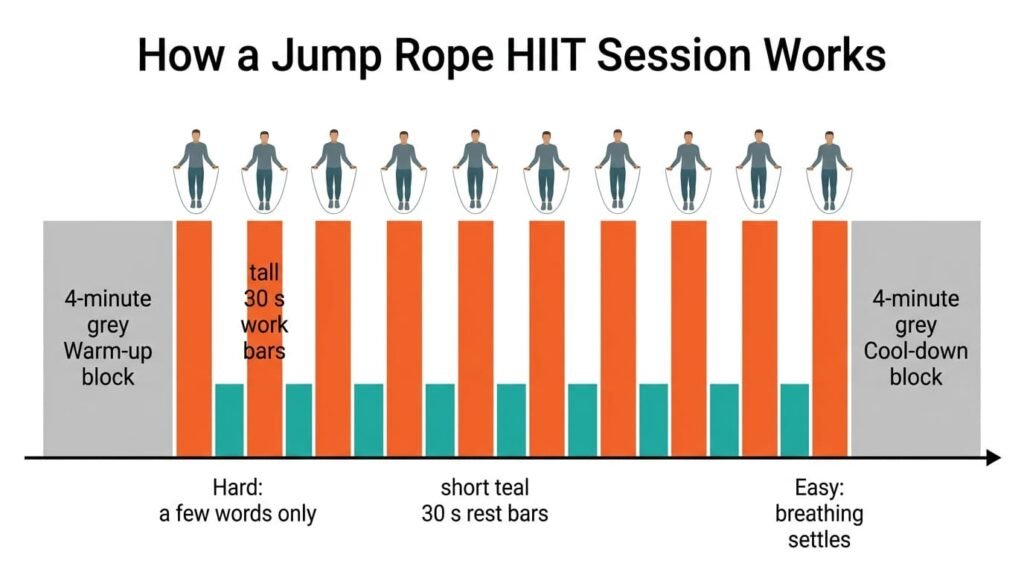
HIIT training jump rope style simply means alternating short periods of hard skipping with rest or easy movement. A typical structure looks like this:
| Part | What you do | How it feels |
|---|---|---|
| Work interval | Skip fast or with harder footwork | Hard: you can only say a few words |
| Rest interval | Stand, walk on the spot or skip very slowly | Easy: breathing settles |
| Rounds | Repeat work and rest | Each round a little harder than the last |
| Total time | 8 to 25 minutes including rests | Short but tiring |
The rest is not cheating. It is what lets you work at a higher intensity during the work intervals. Many beginners make the mistake of going too hard in the first round and fading badly. Aim for a pace you can repeat for every round.
What the research says about jump rope HIIT
A randomised trial in 59 healthy young adults compared three groups for 8 weeks. One group did high-intensity interval rope skipping: nine 2-minute bouts at about 80 percent of maximum heart rate with 1-minute active recovery, three times a week. Another did moderate continuous rope skipping for 30 minutes at about 70 percent of maximum heart rate, five times a week. The third group did no exercise. Both skipping groups improved their cardiorespiratory fitness significantly compared with the control group. The interval group got similar gains with much less weekly training time. Body composition did not change in any group over 8 weeks, and enjoyment was similar for both types of skipping.
More broadly, a meta-analysis of 13 trials in overweight and obese adults found that HIIT and moderate continuous training produced similar modest reductions in fat mass and waist circumference, but HIIT took about 40 percent less training time.
In plain terms: a jump rope HIIT workout is a time-efficient way to build fitness. It is not magic for fat loss on its own, but it fits easily into a busy week.
How hard should each interval feel?
| Effort level | Talk test | Heart rate (rough guide) | Use it for |
|---|---|---|---|
| Easy | You could chat comfortably | Below about 65 percent of maximum | Warm-up, cool-down, rest intervals |
| Moderate | Short sentences | About 65 to 75 percent | Steady skipping, longer intervals |
| Hard | A few words at a time | About 75 to 85 percent | Most HIIT work intervals |
| Very hard | Cannot talk | Above about 85 percent | Short sprints of 10 to 20 seconds |
If you have a heart rate monitor, our target heart rate calculator estimates your zones. If not, the talk test works well. Most of your work intervals should feel hard, not all-out.
Warm-up (4 minutes)
- March on the spot, 45 seconds
- Ankle circles and slow calf raises, 45 seconds
- Arm circles and wrist rolls, 30 seconds
- Easy skipping, basic bounce, 60 seconds
- Easy boxer step, 60 seconds
Never jump straight into fast intervals on cold calves. A few minutes of easy skipping makes the hard rounds safer and more comfortable.
6 skipping rope cardio workout sessions
Each skipping rope cardio workout below lists the total time including rests but not the warm-up and cool-down. Start with Workout 1 and move on only when it feels manageable.
Workout 1: The starter (8 minutes)
| Round | Work | Rest |
|---|---|---|
| 1 to 8 | 20 seconds basic bounce, steady pace | 40 seconds rest |
Total skipping time is under 3 minutes, but it is a proper workout if you are new. Focus on a smooth rhythm and soft landings.
Workout 2: 30-30 intervals (10 minutes)
| Round | Work | Rest |
|---|---|---|
| 1 to 10 | 30 seconds skipping, alternating basic bounce and boxer step each round | 30 seconds rest |
This is the classic jump rope cardio workout for beginners. By the end of the 10 rounds, your heart rate will be high and your calves will know about it.
Workout 3: Tabata style (12 minutes)
| Block | Work | Rest |
|---|---|---|
| Block 1: 8 rounds | 20 seconds fast skipping | 10 seconds rest |
| Rest | 2 minutes easy walking | |
| Block 2: 8 rounds | 20 seconds boxer step at a quick pace | 10 seconds rest |
Short rests make this one of the toughest sessions here. Keep the work intervals fast but controlled. If the 10-second rests are too short, start with 20 seconds of rest.
Workout 4: Footwork pyramid (15 minutes)
| Round | Work | Rest |
|---|---|---|
| 1 | 20 seconds basic bounce | 20 seconds |
| 2 | 30 seconds boxer step | 30 seconds |
| 3 | 40 seconds side to side | 40 seconds |
| 4 | 50 seconds alternate foot run | 50 seconds |
| 5 | 40 seconds side straddle | 40 seconds |
| 6 | 30 seconds high knees | 30 seconds |
| 7 | 20 seconds fast basic bounce | 20 seconds |
The pyramid builds up and then comes back down, so the hardest effort is in the middle. Our high knees exercise guide explains the high knees step if it is new to you.
Workout 5: Skip and strength circuit (20 minutes)
Do 4 rounds of the following, with 60 seconds of rest between rounds:
- 60 seconds skipping
- 12 bodyweight squats
- 30 seconds skipping
- 8 push-ups (on your knees if needed)
- 30 seconds skipping
- 20-second plank
This mixes jump rope cardio with simple strength moves, which gives your calves a short break and works your whole body.
Workout 6: The 25-minute challenge
| Block | Work | Rest |
|---|---|---|
| Block 1: 6 rounds | 60 seconds steady skipping | 30 seconds |
| Rest | 2 minutes easy walking | |
| Block 2: 8 rounds | 30 seconds fast skipping | 30 seconds |
| Rest | 2 minutes easy walking | |
| Block 3: 6 rounds | 15 seconds sprint skipping | 45 seconds |
Only try this once Workouts 2 to 4 feel comfortable. It combines endurance, intervals and short sprints. If you use a speed rope, the sprint block is where it shines.
Cool-down (4 minutes)
- Walk slowly, 1 minute
- Calf stretch, straight knee, 30 seconds each side
- Calf stretch, bent knee, 30 seconds each side
- Standing quad stretch, 20 seconds each side
- Slow shoulder rolls and deep breaths, 30 seconds
Our guide to calf stretches has more options if your lower legs feel tight.
A 6-week skipping rope cardio workout plan
| Week | Session 1 | Session 2 | Session 3 (optional) |
|---|---|---|---|
| 1 | Workout 1 | Workout 1 | Easy walk |
| 2 | Workout 2 | Workout 1 | Easy walk or bike |
| 3 | Workout 2 | Workout 4 | Workout 1 |
| 4 | Workout 3 | Workout 2 | Workout 5 |
| 5 | Workout 4 | Workout 5 | Workout 3 |
| 6 | Workout 6 | Workout 4 | Workout 5 |
Leave at least one day between HIIT sessions. On the days in between, walk, cycle, stretch or do strength training. If a week feels too hard, repeat it. There is no prize for rushing.
HIIT or steady skipping?
Both are useful. Steady skipping at a moderate pace builds an aerobic base and teaches rhythm. HIIT builds fitness quickly in less time and adds variety. The research above suggests both improve fitness. A sensible mix for most people is two HIIT sessions and one steady session a week, or one of each plus some walking. Our guide to steady state cardio explains why easy sessions still matter.
| Type | Best for | Example |
|---|---|---|
| Steady skipping | Building endurance and rhythm | 10 to 20 minutes at a talkable pace with short breaks |
| HIIT skipping | Time-efficient fitness gains | 30 seconds hard, 30 seconds easy, 10 rounds |
| Mixed | Variety and all-round fitness | Steady first half, intervals second half |
Steps to use in your skipping rope cardio workout and jump rope HIIT workout
| Step | Difficulty | Best used for |
|---|---|---|
| Basic bounce | Easy | Warm-ups, steady rounds, beginners |
| Boxer step | Easy to moderate | Longer work intervals |
| Side to side | Moderate | Footwork and ankle control |
| Side straddle | Moderate | Coordination and hip work |
| Alternate foot run | Moderate | Fast intervals and sprints |
| High knees | Hard | Short, very hard bursts |
| Double unders | Very hard | Advanced intervals only |
If you want to learn doubles later, our guide to the double under jump rope breaks them into simple drills.
How many calories does a jump rope HIIT workout burn?
It depends on your body weight, how fast you skip and how much of the session is actual skipping. A 20-minute session with lots of rest may only include 10 minutes of skipping. As a rough guide, continuous skipping burns roughly 9 to 22 calories per minute depending on your body weight and speed, with heavier people and faster skipping burning more. Our guide on how many calories jumping rope burns has detailed charts by body weight and speed.
No rope? No space?
If your ceiling is too low or you do not have a rope, a ropeless jump rope or simple shadow skipping gives you almost the same cardio workout. Every session in this guide works with ropeless handles too.
Safety tips
- Build up gradually. Skipping is high impact, especially on the calves and Achilles tendons
- Skip on a forgiving surface such as a mat, wooden floor or rubber gym floor. See our guide to the jump rope mat and shoes
- Wear supportive trainers
- Keep jumps small and landings soft
- Stop if you feel chest pain, dizziness, unusual shortness of breath, or sharp pain in your legs or feet
- Check with a doctor before starting high-intensity exercise if you have heart disease, high blood pressure, are pregnant, or have been inactive for a long time
This article is general information, not medical advice. See our medical disclaimer.
Common mistakes
| Mistake | What happens | Fix |
|---|---|---|
| Going all-out in round one | You fade badly and form collapses | Pick a pace you can repeat every round |
| Skipping rest periods | Work intervals get slower | Rest fully, it is part of the plan |
| HIIT every day | Sore calves, fatigue, injury risk | 2 or 3 sessions a week maximum |
| Jumping too high | Wasted energy, heavy landings | Stay 2 to 3 cm off the floor |
| Ignoring the warm-up | Tight calves, clumsy first rounds | 4 minutes of easy skipping first |
| Only doing HIIT | Missing aerobic base and recovery | Mix in steady skipping or walking |
Fitting jump rope cardio into your week
If you already do other training, jump rope HIIT slots in easily:
| Your routine | Where to add skipping |
|---|---|
| Strength training 3 times a week | 10-minute jump rope HIIT at the end of 2 sessions |
| Running | Replace one easy run with Workout 2 or 4 |
| Walking for weight loss | Add Workout 1 or 2 on two walking days |
| Home workouts | Use Workout 5 as a full session |
| Very busy weeks | Workout 1 or 2 on 2 or 3 days, 10 minutes each |
If you prefer a broader set of routines, our jump rope workout guide and our HIIT workout for beginners at home both pair well with this plan.
How to progress your skipping rope cardio workout
Once a session feels comfortable, change one thing at a time:
| Lever | How to progress | Example |
|---|---|---|
| Work time | Add 5 to 10 seconds per interval | 30 seconds becomes 40 seconds |
| Rest time | Shorten rests slightly | 30 seconds becomes 20 seconds |
| Rounds | Add 1 or 2 rounds | 10 rounds becomes 12 |
| Speed | Skip a little faster in the work intervals | More turns per minute |
| Footwork | Use harder steps | Basic bounce becomes high knees |
| Rope | Try a faster or weighted rope | Speed rope for sprints, weighted rope for upper body |
Change only one lever per week. If you add work time, rest time and rounds all at once, the jump is too big, and your calves will complain.
Using heart rate during HIIT training jump rope sessions
If you wear a heart rate monitor, watch how quickly your heart rate drops in the rest intervals. As your fitness improves, it should come down faster between rounds. That is one of the clearest signs that your HIIT training jump rope sessions are working. During work intervals, aim for about 75 to 85 percent of your maximum heart rate. Short sprints may push you higher.
A sample week for a busy beginner
| Day | Session |
|---|---|
| Monday | Workout 2 (10 minutes) plus 10 minutes of strength exercises |
| Tuesday | 30-minute walk |
| Wednesday | Rest or gentle stretching |
| Thursday | Workout 4 (15 minutes) |
| Friday | 30-minute walk or easy bike ride |
| Saturday | Workout 5 (20 minutes) |
| Sunday | Rest |
That adds up to under an hour of skipping a week, yet it builds real cardio fitness when you keep it up for a couple of months.
Keeping it fun
The trial on rope skipping found that people enjoyed interval and steady skipping about equally. In practice, enjoyment is what keeps you coming back. Try skipping to music with a strong beat, setting a timer app with a countdown, or challenging yourself to beat your best number of skips in 30 seconds. Small goals keep a jump rope cardio routine fresh for months.
Before every skipping rope cardio workout
- Rope sized correctly, handles reaching about your armpits
- Supportive trainers laced firmly
- A clear space with enough room overhead
- A timer or interval app ready
- Water nearby
- Four minutes of warm-up done
This quick checklist takes less than a minute and makes every skipping rope cardio workout safer and smoother. If any session feels unusually hard, stop early and try again another day. Consistency over weeks matters far more than any single tough skipping rope cardio workout.
The bottom line
A skipping rope cardio workout is fast, cheap and effective, and it suits almost any schedule. Breaking it into intervals, HIIT style, lets you work harder with good form and gets real results in just 10 to 20 minutes. Research shows both interval and steady rope skipping improve cardio fitness, with intervals needing less time.
Start with the 8-minute starter, keep your jumps small and your landings soft, and follow the 6-week plan at two or three sessions a week. Mix in some steady skipping or walking on the other days. Within a few weeks, the sessions that once left you gasping will feel like a good, honest challenge.
Frequently asked questions
Is a skipping rope cardio workout good for beginners?
Yes, as long as you start with short intervals and plenty of rest. Twenty seconds of skipping with 40 seconds of rest, repeated 8 times, is a great first session.
How long should a jump rope HIIT workout be?
For most people, 10 to 20 minutes including rests is enough, plus a warm-up and cool-down. Beginners can start with 8 to 10 minutes.
How many times a week should I do jump rope HIIT?
Two or three times a week, with at least one easier day in between. Skipping is high impact, so your calves and tendons need recovery time.
Is jump rope cardio better than running?
Both are excellent. Skipping fits into less space and time and works coordination, while running is easier to keep up for long sessions. Many people enjoy doing both.
Does HIIT training with a jump rope burn fat?
It burns calories and can support fat loss alongside a healthy diet. Research suggests HIIT and steady cardio give similar fat loss, with HIIT taking less time.
What is a good jump rope HIIT workout for beginners?
Try 30 seconds of skipping followed by 30 seconds of rest, for 10 rounds. Alternate the basic bounce and boxer step to share the work between your legs.
Can I do a skipping rope cardio workout every day?
Short, easy skipping on most days is fine for some people, but hard HIIT sessions every day increase injury risk. Keep high-intensity sessions to two or three a week.
What if I keep tripping during intervals?
Slow down and use the basic bounce. Tripping usually means you are going faster than your timing allows. Speed comes with practice.
Do I need a special rope for jump rope HIIT?
No. Any rope that suits your skill works. A light speed rope helps with fast sprints, while a beaded or PVC rope is easier while you learn.
What’s next?
Reading is the easy part. Pick one of these and do it today.