
Speed Rope Guide: What It Is, Who It Suits and 8 Speed Rope Exercises
A speed rope is the rope you see in boxing gyms, CrossFit boxes and jump rope competitions: a thin cable, slim handles and a rope that spins so fast it almost disappears. If you have only ever used a chunky plastic rope from a sports shop, picking up a speed jump rope for the first time feels like switching from a bicycle to a racing bike.
That speed is the whole point. A speed rope turns quickly with very little effort, which makes fast footwork, sprints and double unders far easier. But it also makes timing harder at first, and a fast cable stings when it catches your shins. So it is not automatically the best rope for every beginner.
This guide explains what a speed rope is, how it compares with other ropes, who should use one, how to size it, 8 speed rope exercises and a 4-week plan to get faster.
At a glance
- A speed rope has a thin cable and smooth bearings, so it turns very quickly with little effort
- It is ideal for fast skipping, footwork drills and double unders
- Beginners can use one, but many find a slightly heavier or beaded rope easier to learn timing with
- Size it a little long at first, then shorten it as your skipping gets smoother
- Speed rope exercises include fast singles, high knees, the boxer step, side straddles and double unders
- Fast skipping loads the ankles and calves heavily, so build up gradually
- There are no affiliate links here. This is general advice, not a product review
What is a speed rope?
A speed jump rope is built to spin fast. The main features are:
- A thin cable, usually coated steel or a thin PVC line, which cuts through the air with little drag
- Ball bearings in the handles, so the cable spins freely without twisting
- Light, slim handles, which let your wrists do the work
- An adjustable length, usually set with a screw or clamp in the handle
| Feature | Speed rope | Standard PVC rope | Beaded rope | Weighted rope |
|---|---|---|---|---|
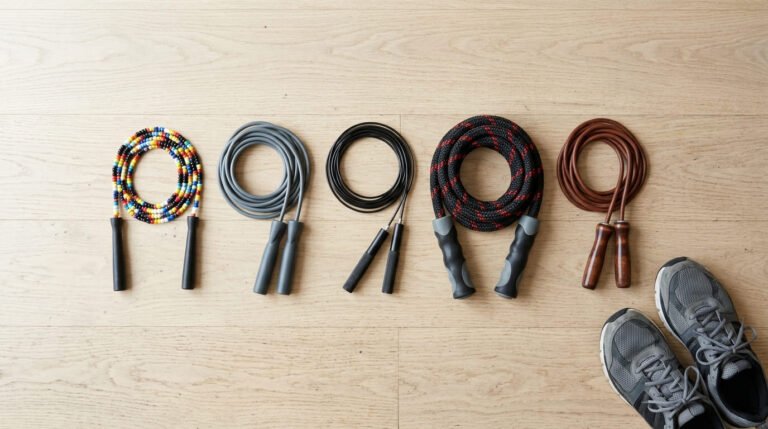
| Speed | Very fast | Medium | Slow to medium | Slow |
| Feel and feedback | Low | Medium | High | High |
| Best for | Footwork, sprints, double unders | General fitness | Learning, tricks | Upper body effort, timing |
| Stings when it hits you | Yes, the most | A little | A little | A little |
| Noise | Quiet whirr | Medium | Loud clicks | Quiet thud |
If you are still deciding which rope suits you, our guides to the beaded jump rope and the weighted jump rope explain those options.
Who should use a speed rope?
| You are | Speed rope? | Why |
|---|---|---|
| A complete beginner who keeps tripping | Maybe later | A heavier rope is easier to feel at first |
| Comfortable skipping for 1 to 2 minutes | Yes | You are ready for more speed |
| Learning double unders | Yes | The fast spin makes doubles easier |
| Boxing or martial arts training | Yes | Matches the quick, light footwork |
| CrossFit or HIIT workouts | Yes | Fast and durable on gym floors |
| Skipping mainly for relaxed cardio | Optional | Any comfortable rope works |
So is a speed rope for beginners a good idea? It can be, if you are patient. Some beginners like the light feel straight away. Many others learn faster with a slightly heavier rope, then switch to a speed rope once their timing is reliable. Neither path is wrong.
How to size a speed rope
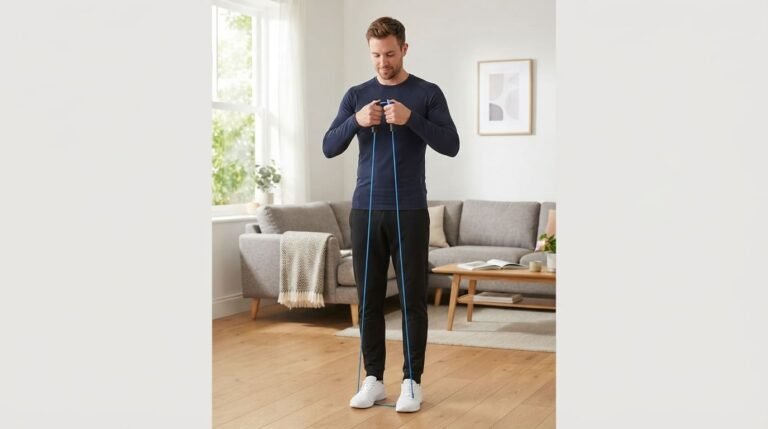
Stand on the middle of the cable with one foot and pull the handles straight up. For learning, the cable should meet the handles around your armpits. As you get faster, many people shorten it toward the lower chest.
| Your level | Handles reach about | Notes |
|---|---|---|
| New to speed ropes | Armpits | More forgiving |
| Comfortable and fast | Lower chest | Quicker turns |
| Double unders and sprints | Bottom of the ribs | Fast, little room for error |
Shorten a speed rope in small steps of 2 to 3 cm. Leave the spare cable in the handle for at least a week before you cut anything, because a cut cable cannot be made longer. Our full guide on how long a jump rope should be has a size chart by height.
Speed rope technique
- Stand tall with your weight on the balls of your feet
- Keep your elbows close to your ribs and your hands just in front of your hips
- Turn the rope with small circles of your wrists, not your arms
- Jump only 1 to 3 cm off the floor
- Keep your knees soft and your landings quiet
- Look straight ahead and keep your shoulders relaxed
A speed rope punishes big arm movements. If your arms are doing the work, the rope slows down and the timing gets messy. Think “small and quick”.
Where to use a speed rope
Speed cables wear out quickly on rough concrete. Use a rubber gym floor, a wooden floor or a jump rope mat. Make sure you have clear space overhead and around you, because a fast cable can mark walls and furniture.
Our guide to choosing a jump rope mat and shoes covers the best surfaces and how to protect your cable on concrete.
8 speed rope exercises
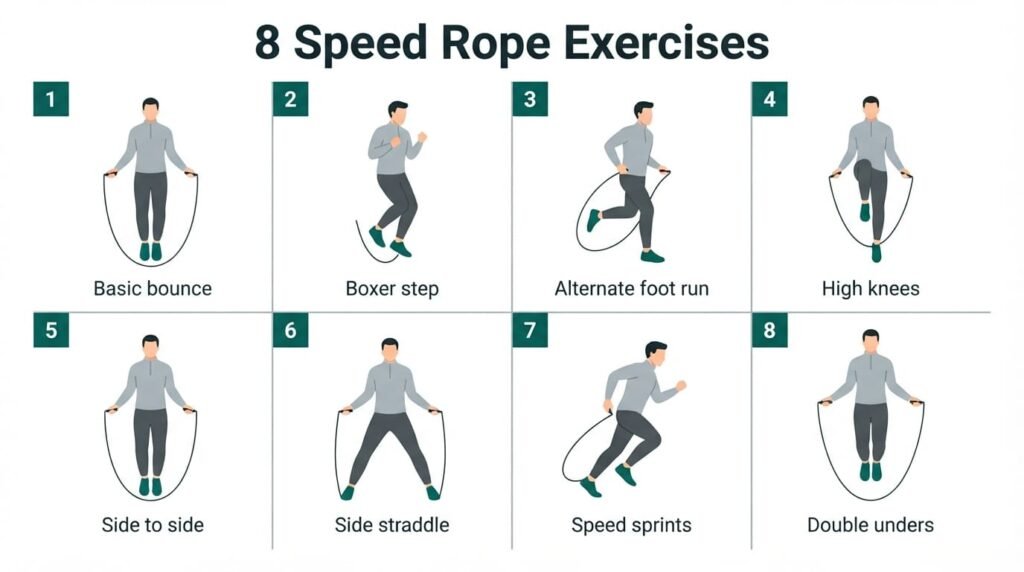
Do each for 20 to 30 seconds at first, with plenty of rest. These speed rope exercises go from easiest to hardest.
1. Fast basic bounce
Both feet together, small jumps, wrists turning quickly. Focus on rhythm first, then speed. This is the foundation of all other speed rope exercises.
2. Boxer step
Shift your weight from one foot to the other with each turn, like a light jog on the spot. It lets you skip for longer and is the classic boxing footwork. Our guide to the boxing jump rope explains it step by step.
3. Alternate foot run
Run on the spot, one foot at a time, as the rope passes under each foot. This is how speed skippers count their fastest efforts.
4. High knees
Like the alternate foot run, but lift your knees toward hip height. It raises your heart rate fast. Our high knees exercise guide has more on form.
5. Side-to-side bounce
Jump a few centimetres left, then right, keeping your feet together. It trains quick lateral movement and ankle control.
6. Side straddle
Jump your feet apart, then together, like a small jumping jack, in time with the rope. It adds coordination to your speed work.
7. Speed sprints
Skip at an easy pace for 20 seconds, then as fast as you can with good form for 10 seconds. Rest for 30 seconds. These short bursts are where a speed rope really shines.
8. Double unders
Jump a little higher and flick your wrists twice as fast so the rope passes under twice. Our guide to the double under jump rope breaks this down into drills.
What the research says about fast skipping
A study of 16 adolescent competitive jump rope athletes compared fast single skipping, known as the speed step, with double unders and running. Peak ground forces were similar across the three, but fast single skipping relied more on the hips, and peak ankle moments were 9 to 20 percent higher in the speed step than in double unders and running. Both skipping skills produced much higher braking forces at the ankle than running.
In plain terms: fast skipping is a real workout for your calves, ankles and Achilles tendons. That is great for building springy, resilient lower legs, but it also means you should build up gradually.
Jump rope training in general has good evidence for fitness. A review of 21 studies found small to moderate improvements in cardiorespiratory endurance, strength, jumping and sprinting, mostly in young people.
A 4-week speed rope plan
Do this 3 times a week, on non-consecutive days, after a 3-minute warm-up.
| Week | Workout | Total skipping time |
|---|---|---|
| 1 | 8 rounds: 20 seconds fast basic bounce, 40 seconds rest | About 3 minutes |
| 2 | 8 rounds: 30 seconds boxer step, 30 seconds rest | 4 minutes |
| 3 | 10 rounds: 20 seconds easy, 10 seconds fast sprint, 30 seconds rest | 5 minutes |
| 4 | 10 rounds: 30 seconds mixed (basic, side to side, high knees), 30 seconds rest | 5 minutes |
Count your best number of skips in 30 seconds at the end of week 1 and again at the end of week 4. Most people see a clear improvement. Our jump rope workout guide has more routines once you finish this plan.
3 speed rope workouts
Speed rope intervals (8 minutes)
Do 20 seconds of fast skipping, then 10 seconds of rest, for 8 rounds. Repeat once after a 2-minute break. Keep the form clean even when you are tired.
Footwork ladder (10 minutes)
Do 30 seconds each of basic bounce, boxer step, side to side, side straddle and high knees, with 30 seconds of rest between each. Repeat the circuit twice.
Skip and strength (15 minutes)
Do 4 rounds: 45 seconds of speed rope, 10 squats, 8 push-ups, a 20-second plank, then rest for 60 seconds.
What to look for in a speed rope
| Feature | Why it matters |
|---|---|
| Adjustable length | You will want to shorten it as you improve |
| Smooth bearings | The cable should spin freely without catching |
| Coated cable | Lasts longer and is gentler on floors |
| Spare or replacement cables | Cables wear out, especially on rough surfaces |
| Comfortable handles | Grippy and not too thin for your hands |
| Cable thickness | Slightly thicker cables are easier to feel while learning |
You do not need an expensive rope to start. A simple adjustable speed rope with smooth bearings works well. Many of the most searched brands are good ropes, but I have not tested them, so I am not going to rank them here.
Common mistakes
| Mistake | What happens | Fix |
|---|---|---|
| Turning from the shoulders | The rope slows and timing slips | Small wrist circles, elbows in |
| Jumping too high | Tiring and slow | Stay 1 to 3 cm off the floor |
| Rope set too short too soon | Constant tripping | Start at armpit length |
| Skipping on rough concrete | The cable wears out fast | Use a mat or a smooth floor |
| Going flat out every session | Sore calves and shins | Mix easy and fast work |
| Bare legs while learning | Stinging welts | Wear full-length joggers or leggings |
Protecting your calves and Achilles
Fast skipping loads the lower legs heavily, so build up slowly. Stop and rest if you feel pain along your shin, in your Achilles tendon or in the arch of your foot. Stretch your calves after each session, and include strength work such as calf raises and our tibialis anterior exercises. If you have had lower leg injuries or have been told to avoid high-impact exercise, check with a doctor or physiotherapist first. Our guides to calf stretches and shin splints stretches are useful too.
This article is general information, not medical advice. See our medical disclaimer.
Does a speed rope burn more calories?
Faster skipping burns slightly more calories per minute than slow skipping. But the rope itself makes little difference. What matters is how fast and how long you skip. Our guide on how many calories jumping rope burns has charts by body weight and speed.
A 3-minute warm-up before speed rope work
Fast skipping on cold calves is asking for trouble. Before any session with your speed jump rope, try this short routine:
- March on the spot for 30 seconds, swinging your arms
- Ankle circles, 10 each way on each foot
- Slow calf raises, 15 reps
- Easy basic bounce with the rope, 30 seconds, at a relaxed pace
- Boxer step, 30 seconds, still relaxed
- Three short bursts of 5 seconds at a faster pace, with 15 seconds of easy skipping between them
By the end, your calves should feel warm and your timing should feel smooth. Only then is it time for faster speed rope exercises.
Speed rope for beginners: how to make the switch
If you are moving to a speed rope from a heavier PVC or beaded rope, the first few sessions can feel strange. The rope is lighter in your hands, so it is harder to feel where it is. A few simple steps make the switch much easier.
| Step | What to do | Why it helps |
|---|---|---|
| 1 | Set the rope a little longer than your old one | Gives you extra room while your timing adjusts |
| 2 | Start with the basic bounce only | Keeps everything simple while you learn the new feel |
| 3 | Listen for the whirr of the cable | Sound replaces the feel of a heavier rope |
| 4 | Skip slower than you think you need to | Smooth rhythm first, speed later |
| 5 | Keep sessions short for the first week | Your calves adapt to the faster pace gradually |
| 6 | Wear full-length joggers or leggings | Takes the sting out of missed jumps |
Most people find that by the third or fourth session the speed rope starts to feel natural, and their old rope suddenly feels slow and heavy. That is a good sign. If you are still finding it frustrating after two weeks, there is no shame in going back to a heavier rope for a while and trying again later. Speed rope for beginners works best when it is a step forward, not a struggle.
How to measure your skipping speed
Speed skippers usually count how many times the right foot touches the floor in a set time, often 30 seconds or 60 seconds, while doing the alternate foot run. For beginners, it is simpler to count every jump in 30 seconds of basic bounce.
| Level | Skips in 30 seconds (basic bounce) | What it feels like |
|---|---|---|
| Beginner | 40 to 60 | Steady but deliberate |
| Improving | 60 to 80 | Smooth and rhythmic |
| Confident | 80 to 100 | Fast and light |
| Advanced | Over 100 | Very fast, with small, quick jumps |
These numbers are rough guides from common practice, not research norms. Use them only to track your own progress. Filming yourself on your phone for 30 seconds and counting the jumps later is the easiest way to do it accurately.
Looking after your speed jump rope
A speed jump rope is simple, but a few habits make it last much longer.
- Hang it up or coil it loosely. Tight wrapping can kink the cable, and a kinked cable never spins quite as smoothly again
- Keep it off rough surfaces. Asphalt and rough concrete wear through the coating quickly
- Check the cable before each session. If the coating is split or the wire is fraying, replace the cable. A frayed cable can scratch your skin
- Check the screws and clamps that hold the cable in the handles. They can loosen over time
- Keep it dry. If you skip outdoors and the rope gets wet, wipe it down and let it dry before you store it
A replacement cable usually costs far less than a new rope, so if your handles are still in good shape, it is worth keeping a spare.
Speed rope vs regular jump rope: which should you buy first?
If you can only buy one rope and you are brand new to skipping, a light adjustable PVC or beaded rope is usually the easier first choice. If you already skip, box, or do CrossFit style workouts, a speed rope is likely to be the rope you use most. Many people end up owning both: a heavier rope for learning new tricks and steady cardio, and a speed rope for sprints, footwork and double unders.
Can you use a speed rope outdoors?
Yes, with a little care. A smooth sports court, a running track or a flat patch of tarmac is fine for occasional sessions, but rough surfaces wear the cable quickly. If you skip outside often, bring a portable jump rope mat, check the cable more often, and avoid wet or gritty ground, which can make the rope drag and damage the coating.
The bottom line
A speed rope is a thin, fast rope with smooth bearings, built for quick footwork, sprints and double unders. It is a great upgrade once you can skip steadily for a minute or two, and some beginners enjoy it from day one. If you keep losing your timing, a heavier or beaded rope may help first.
Size it at armpit height, keep your wrists doing the work and your jumps small, and build up gradually with the speed rope exercises and 4-week plan above. Your calves and Achilles will thank you for the patience, and your skipping will get faster than you might expect.
Frequently asked questions
What is a speed rope?
A speed rope is a jump rope with a thin cable and smooth bearings in the handles, designed to spin very quickly with little effort. It is popular for boxing, CrossFit, sprints and double unders.
Is a speed rope good for beginners?
It can be, but many beginners learn timing more easily with a slightly heavier or beaded rope. Once you can skip steadily for a minute or two, a speed rope is a great next step.
What are the best speed rope exercises?
The fast basic bounce, boxer step, alternate foot run, high knees, side-to-side bounce, side straddle, speed sprints and double unders. Start with the basic bounce and add the others as your timing improves.
How long should a speed rope be?
When you stand on the middle of the cable, the handles should reach about your armpits while you learn. Experienced skippers often shorten it to the lower chest or bottom of the ribs.
Is a speed rope better than a regular rope?
It is better for speed, footwork and double unders, but not for everything. A regular or heavier rope may be easier for learning and for relaxed cardio.
Why does a speed rope hurt when it hits me?
The thin cable moves very fast, so it stings more than a thick plastic rope. Hits become rare as your timing improves. Wear full-length joggers or leggings while you learn.
Can I use a speed rope on concrete?
You can, but concrete wears the cable quickly and is hard on your shins. A rubber mat or a wooden floor is much better for your rope and your legs.
Does a speed rope burn more calories?
Only a little, because faster skipping burns slightly more per minute. How long and how often you skip matters far more than the type of rope.
How do I make my speed rope last longer?
Skip on smooth surfaces, store it hanging or loosely coiled, avoid kinks, and replace the cable when the coating starts to wear. Keep a spare cable if your rope allows it.
What’s next?
Reading is the easy part. Pick one of these and do it today.