Fascia Release Exercises: 12 Foam Roller and Ball Moves for Beginners
Fascia release exercises have become one of the most popular recovery trends, and for good reason. Rolling your thighs on a foam roller or pressing a ball into a tight spot in your back simply feels good, and it can make stiff muscles feel looser within a few minutes.
I want to be honest from the start, though, because the marketing around fascia gets carried away. A foam roller does not “break up” or permanently reshape your fascia. What the research does show is useful enough on its own: rolling gives a short-term boost in range of motion and can ease post-workout soreness a little. That makes it a handy tool, not a miracle.
This guide explains what fascia is, what myofascial release can and cannot do, and 12 fascia release exercises using a foam roller, a massage ball and simple stretches. You will also get a 10-minute routine, the mistakes to avoid and the people who should be careful.
At a glance
- Fascia is a web of connective tissue that wraps and connects your muscles, bones and organs
- Fascia release exercises usually mean slow foam rolling, ball pressure and stretches that move a whole muscle chain
- A meta-analysis found foam rolling improves range of motion in the short term about as much as stretching
- Rolling after exercise slightly reduced muscle soreness and helped strength recover
- Roll slowly, about one inch per second, at a pressure of 5 to 7 out of 10, for 30 to 90 seconds per area
- Avoid rolling directly over bones, joints, the front of the neck, varicose veins or injured areas
- Combine myofascial exercises with movement and strength work for lasting change
What is fascia?
Fascia is connective tissue made mostly of collagen. It forms thin sheets around every muscle, groups muscles together and links them into long chains that run through the body. One well-known example is the thick band down the outside of the thigh, often called the IT band. Another is the plantar fascia on the sole of your foot.
Fascia is not just packaging. It contains nerve endings that sense pressure and movement, which is one reason rolling and massage can change how a muscle feels so quickly. It also helps transfer force between muscles, so a stiff calf can feel connected to a stiff hamstring.
What myofascial release really means
“Myofascial release” comes from manual therapy, where a therapist applies sustained pressure to muscles and fascia. Self-myofascial release is the do-it-yourself version, usually with a foam roller, a ball or a massage stick.
The idea that rolling physically “releases adhesions” or lengthens fascia is not well supported. Fascia is very strong, and the pressure from a foam roller is far too small to deform it permanently. The more likely explanation for the effects you feel is the nervous system. Pressure and movement change how sensitive the area is and how much stretch your body will tolerate, so the muscle feels looser and moves further for a while.
That is still a useful result. It just means fascia release exercises work best as part of a warm-up or cool-down, not as a stand-alone fix.
What the research says
| Question | What studies found | What it means for you |
|---|---|---|
| Does foam rolling improve flexibility? | A large meta-analysis of 26 trials found a clear short-term increase in range of motion compared with doing nothing | Roll before stretching or training to move more freely |
| Is it better than stretching? | Not in that analysis. The two gave similar gains | Choose whichever you enjoy, or combine them |
| Does rolling before exercise affect performance? | Small improvement in sprint performance and flexibility, negligible effect on jumping and strength | Rolling will not ruin your workout, but it will not supercharge it either |
| Does rolling after exercise help recovery? | It slightly reduced muscle pain and helped sprint and strength performance recover | A few minutes after hard sessions can make the next day feel better |
The same recovery meta-analysis found a tendency for foam rollers to help strength recovery more than handheld roller sticks, although the difference was small.
What you need
| Tool | Best for | Beginner tip |
|---|---|---|
| Soft or medium foam roller | Thighs, calves, upper back, glutes | Start with a smooth, medium-density roller |
| Massage ball or tennis ball | Glutes, shoulders, feet, small tight spots | A tennis ball is softer than a lacrosse ball |
| Massage stick | Calves and thighs when getting on the floor is hard | Good for older adults |
| Yoga strap or towel | Stretches for whole muscle chains | Any long towel works |
| Exercise mat | Comfort on the floor | Useful for all floor work |
You do not need anything expensive. A medium foam roller and a tennis ball cover almost every one of the fascia release exercises below.
How to do fascia release exercises safely
- Go slowly. Roll about one inch per second. Fast rolling feels busy but does less
- Moderate pressure. Aim for 5 to 7 out of 10. You should be able to breathe calmly
- 30 to 90 seconds per area. Longer is not better
- Pause on tender spots. When you find one, hold gentle pressure for 20 to 30 seconds and breathe until it eases a little
- Avoid bones and joints. Roll the muscle, not the kneecap, hip bone or spine
- Keep moving afterwards. Follow rolling with stretches or easy movement to make the most of the extra range
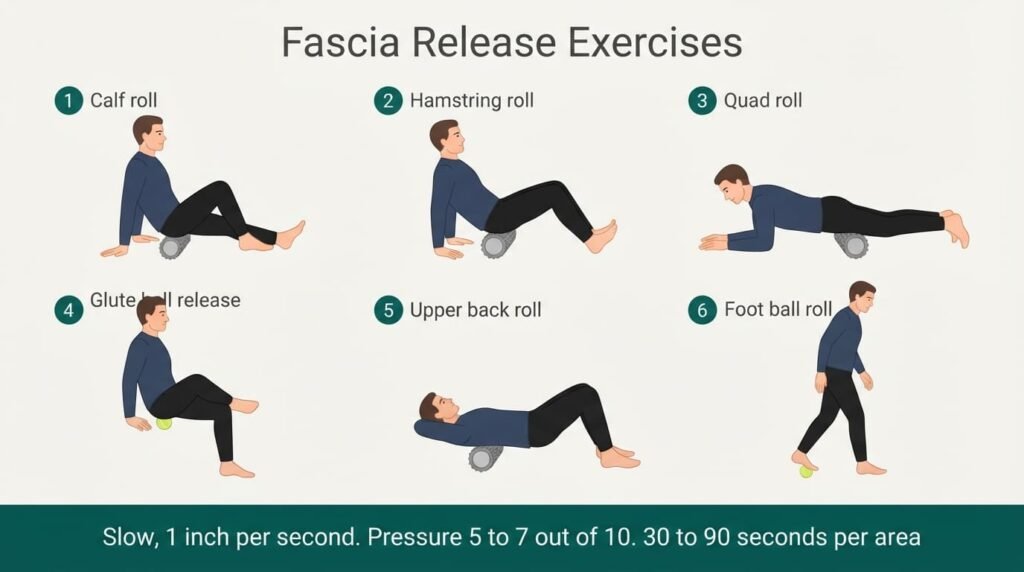
12 fascia release exercises
1. Calf roll
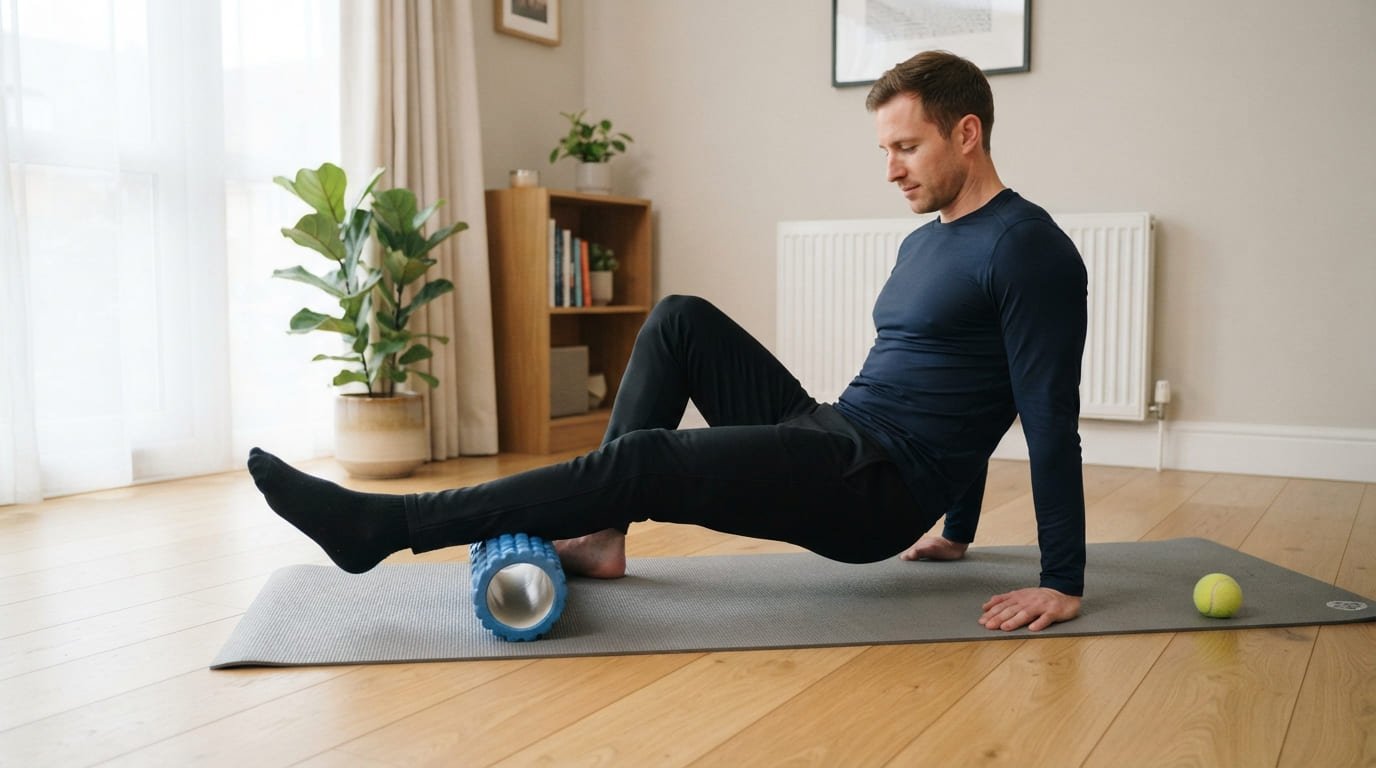
Sit with the roller under one calf, hands on the floor behind you. Lift your hips slightly and roll slowly from just above the ankle to just below the knee. Turn the leg in and out to reach the sides. Cross the other leg on top for more pressure. 45 to 60 seconds per leg.
2. Hamstring roll
Sit with the roller under the backs of your thighs. Lift your hips and roll from just above the knees to just below the buttocks. Work one leg at a time for more pressure. 45 to 60 seconds per leg.
3. Quad roll
Lie face down with the roller under the fronts of your thighs, resting on your forearms like a plank. Roll from just above the knees to the top of the thighs. Bend one knee to stretch the front of the thigh while you roll. 45 to 60 seconds. Pair this with our quad stretches.
4. Outer thigh roll (IT band area)
Lie on your side with the roller under your outer thigh and your top foot planted in front for support. Roll slowly between the hip and the knee. This area is often tender, so keep the pressure lighter and let your supporting foot take some weight. 30 to 45 seconds per side. The IT band itself is very tough, so the goal is to ease the muscles around it, not to flatten the band.
5. Glute ball release
Sit on the floor and place a tennis ball under one buttock. Cross that ankle over the opposite knee to open the hip. Shift your weight slowly to find tender spots and pause on each for 20 to 30 seconds. 60 seconds per side. Tight glutes often feel connected to the lower back, so this one is popular with desk workers.
6. Hip front ball release (tensor fasciae latae)
The tensor fasciae latae is a small muscle at the front and outside of the hip, just below the hip bone. Lie face down at a slight angle with a ball under that spot. Hold gentle pressure and slowly bend and straighten the knee. 30 to 45 seconds per side. Avoid pressing directly on the bony point of the hip.
7. Upper back roll
Lie on your back with the roller across your upper back, just below the shoulder blades. Support your head with your hands, lift your hips and roll slowly between the bottom of the shoulder blades and the top of the shoulders. Do not roll your lower back this way. 45 to 60 seconds. Our guide to thoracic mobility exercises uses the roller for extension drills too.
8. Lat roll
Lie on your side with your bottom arm stretched overhead and the roller under the side of your chest, just below the armpit. Roll a few centimetres up and down along the side of your back. 30 to 45 seconds per side. Helpful if overhead movements feel tight.
9. Chest ball release
Stand facing a wall corner or door frame and place a ball between the wall and the front of your shoulder, just below the collarbone. Lean gently into the ball and move slowly. Avoid the armpit and the front of the neck. 30 to 45 seconds per side.
10. Foot ball roll
Stand or sit and roll a ball slowly under the sole of your foot, from heel to toes. Press a little harder through the arch. 60 seconds per foot. It is a lovely way to start the day and a gentle option for tired feet after walking.
11. Back line stretch (fascia stretch)
This is one of the simplest fascia stretching exercises because it moves a whole chain of tissue from the feet to the neck.
- Stand with feet hip-width apart and soft knees
- Slowly roll down, one vertebra at a time, letting your arms and head hang
- Gently straighten your knees a little until you feel the stretch along your calves, hamstrings and back
- Breathe slowly for 30 seconds, then roll up just as slowly
Do 2 or 3 rounds. Bend your knees more if your lower back complains.
12. Side line stretch
Stand and cross your right foot behind your left. Reach your right arm up and over to the left, feeling the stretch from the outside of the hip all the way up the side of the body. Hold for 30 seconds and switch. This links the outer hip, ribs and shoulder in one stretch, which is why it often appears in myofascial exercises.
Fascia release exercises for common problem areas
Different people tend to feel tight in different places. Use this table to choose the fascia release exercises that suit your day, rather than rolling everything every time.
| You are | Usually tight in | Best moves from this guide |
|---|---|---|
| A desk worker | Upper back, chest, hips, glutes | Upper back roll, chest ball release, glute ball release, side line stretch |
| A walker or runner | Calves, feet, hamstrings, outer thighs | Foot ball roll, calf roll, hamstring roll, outer thigh roll |
| A gym beginner | Quads, glutes, lats | Quad roll, glute ball release, lat roll |
| Standing all day | Feet, calves, lower back | Foot ball roll, calf roll, back line stretch |
| Often stiff in the morning | Whole back line | Back line stretch, upper back roll, gentle walking |
Pick three or four myofascial release exercises from your row and spend about a minute on each. That focused approach takes less time and usually feels better than rushing through every area.
Rolling or stretching: which should you choose?
The range of motion research suggests rolling and stretching give similar short-term results. So the best choice is the one you will actually do. Rolling suits people who find stretching boring or uncomfortable, and it is easy to do in front of the TV. Stretching suits people who prefer no equipment. Many people like to roll first for a minute and then stretch the same area, which combines both.
A 10-minute fascia release routine
| Order | Exercise | Time |
|---|---|---|
| 1 | Foot ball roll | 30 seconds per foot |
| 2 | Calf roll | 45 seconds per leg |
| 3 | Hamstring roll | 45 seconds |
| 4 | Quad roll | 45 seconds |
| 5 | Glute ball release | 45 seconds per side |
| 6 | Upper back roll | 60 seconds |
| 7 | Back line stretch | 2 rounds of 30 seconds |
| 8 | Side line stretch | 30 seconds per side |
Use it after a workout, a long walk or a day of sitting. Before a workout, use a shorter version of 3 to 5 minutes followed by a proper warm-up. Our guide to warming up before a workout shows how to fit them together.
When to do myofascial release exercises
| Timing | How to use it |
|---|---|
| Before training | 2 to 5 minutes on tight areas, then dynamic warm-up moves |
| After training | 5 to 10 minutes of slow rolling and stretching |
| Rest days | A full 10-minute routine with relaxed breathing |
| Desk days | Ball releases for glutes and upper back during breaks |
| Before bed | Gentle foot roll, upper back roll and breathing |
Using fascia release exercises for sore muscles
After a hard or unfamiliar workout, muscles can feel sore for a day or two. Gentle rolling is one of the few recovery tools with some evidence behind it, though the effect is modest. Keep the pressure lighter than usual on very sore muscles, and combine it with walking, sleep and good food. Our guide to how to reduce muscle soreness covers the rest.
Common mistakes
| Mistake | Why it matters | Fix |
|---|---|---|
| Rolling too fast | Little time for the tissue and nervous system to respond | One inch per second |
| Pressing as hard as possible | Can cause bruising and tensing up | 5 to 7 out of 10 pressure |
| Rolling the lower back with a roller | Puts awkward pressure on the spine | Use a ball beside the spine instead, or stretch |
| Spending ages on one spot | Can irritate the tissue | 20 to 30 seconds per tender spot |
| Rolling over the IT band hard | Very painful and little extra benefit | Ease the muscles around it with lighter pressure |
| Only rolling, never moving | Effects fade quickly | Follow with stretches and strength work |
Who should be careful
Fascia release exercises are safe for most people, but check with a doctor or physiotherapist first if you:
- Have osteoporosis or a history of fractures
- Take blood-thinning medication or bruise easily
- Have varicose veins, a history of blood clots or swelling in the legs
- Are pregnant
- Have diabetes with reduced feeling in your feet
- Have a recent injury, wound or inflammation in the area
Never roll over the front of the neck, a swollen joint or a painful lump.
This article is general information, not medical advice. See our medical disclaimer.
How to make the benefits last
The extra range you get from rolling usually lasts minutes to an hour. To make changes stick:
- Use the range. Stretch or move through the new range straight after rolling
- Strengthen the area. Strength training through a full range of motion improves flexibility over time. Our guide to how to improve flexibility explains why
- Move more often. Long periods of stillness are what make tissues feel stiff
- Be consistent. A few minutes most days beats one long session a week
Our stretching routine for beginners and back stretching exercises pair well with the routine above.
The bottom line
Fascia release exercises, such as foam rolling, ball pressure and whole-body stretches, are a simple way to feel looser and move more comfortably. They will not permanently reshape your fascia, but research shows they improve range of motion in the short term and can slightly reduce soreness after exercise.
Roll slowly, use moderate pressure, avoid bones and joints, and follow your rolling with movement. Ten minutes a few times a week, alongside strength training and regular activity, is all most beginners need.
If you are completely new to this, start with just three moves: the foot ball roll, the calf roll and the upper back roll. They are the easiest to control, they feel good straight away, and they teach you how much pressure is right for you before you move on to the more tender areas such as the outer thighs and glutes.
Frequently asked questions
What are fascia release exercises?
They are exercises that apply pressure to or stretch the muscles and surrounding connective tissue, usually with a foam roller, a massage ball or stretches that move a whole chain of muscles. They aim to make the area feel looser and move more freely.
Do myofascial release exercises actually work?
They work for short-term gains in range of motion and can slightly reduce muscle soreness after exercise. There is little evidence that they permanently change fascia, so they work best combined with stretching and strength training.
How long should I foam roll each muscle?
30 to 90 seconds per area is enough. If you find a tender spot, hold gentle pressure for 20 to 30 seconds rather than rolling over it repeatedly.
Should I foam roll before or after a workout?
Both can help. Before, keep it short, 2 to 5 minutes, then warm up properly. After, a longer 5 to 10 minute session may help with soreness and recovery.
Is it normal for foam rolling to hurt?
Mild discomfort is normal, especially on tight areas. Sharp pain, numbness or pain that lasts after rolling is not. Lighten the pressure, and stop if it hurts.
Can I foam roll every day?
Yes, gentle rolling can be done daily. Keep the pressure moderate and avoid working the same tender spot hard every day.
What are the best fascia stretching exercises?
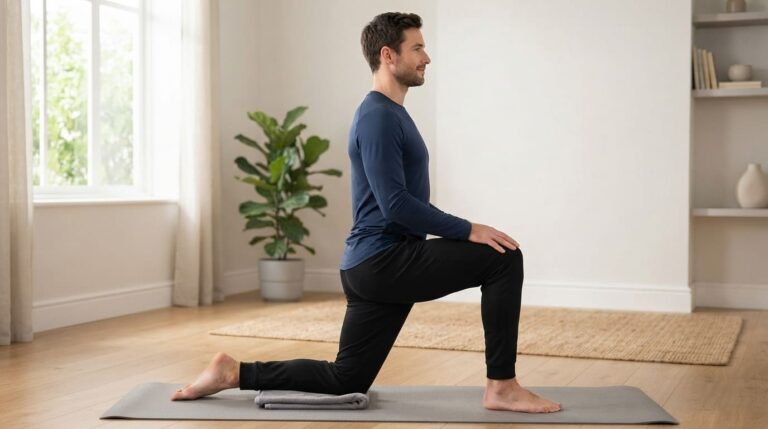
Stretches that move a long chain of muscles work well, such as the back line roll-down, the side line stretch, the couch stretch and downward dog. Hold them for about 30 seconds and breathe slowly.
Can I foam roll my lower back?
It is better not to roll a foam roller directly along the lower back, because there are no ribs to spread the pressure. Use a ball on the muscles beside the spine, roll your glutes and upper back, and add gentle back stretches instead.
Do I need an expensive foam roller?
No. A smooth, medium-density foam roller and a tennis ball are enough for nearly every exercise. Vibrating rollers have not been shown to be clearly better than standard ones.
Do fascia release exercises help with cellulite or fat loss?
No. Rolling does not break down fat or permanently change the appearance of cellulite. Fat loss comes from overall calorie balance, and strength training helps the look of the area by building muscle underneath.
How soon will I feel a difference from myofascial release exercises?
Usually straight away. Most people feel looser and move a little further within minutes. That effect fades within an hour or so, which is why it works best before stretching, training or a walk.
What’s next?
Reading is the easy part. Pick one of these and do it today.