Tibialis Anterior Exercises: 10 Moves for Stronger Shins and Ankles
Tibialis anterior exercises are the most overlooked part of lower body training. Most of us train our calves without thinking twice, but the muscle on the front of the shin barely gets a mention. That is a shame, because it does a lot of quiet work every time you walk, run, climb stairs or catch yourself from a trip.
I like these exercises because they are small, cheap and easy to fit in. Most need nothing but a wall, and you can do several of them while brushing your teeth or waiting for the kettle. They are also a gentle way to build ankle strength if you are new to exercise.
This guide explains what the tibialis anterior does, who benefits most from training it, and 10 tibialis anterior exercises from easiest to hardest. You will also find a 6-week plan, the mistakes to avoid, and an honest look at what the research does and does not say about shin pain.
At a glance
- The tibialis anterior runs down the front of your shin and lifts your foot and toes toward you
- It helps you clear the ground when you walk, control your foot as it lands and keep your balance
- Tibialis anterior exercises are simple: most lift the toes against gravity, a band or a light weight
- Start with seated toe lifts and wall tib raises, then progress to single-leg and loaded versions
- Two or three short sessions a week are enough. Go for 15 to 25 slow reps per set
- Weak ankle dorsiflexors have been linked with falls in older adults
- Research on strengthening for shin splints is limited, so treat these as one helpful piece, not a cure
What the tibialis anterior does
The tibialis anterior is the long muscle you can feel on the outside edge of your shin bone. Pull your toes up toward your nose and you will feel it tighten. It starts near the top of the shin and its tendon runs across the front of the ankle into the inside of the foot.
Its main jobs are:
- Dorsiflexion. Lifting the foot and toes toward the shin, so your toes clear the ground as you swing your leg forward
- Controlling the landing. When your heel hits the ground, the tibialis anterior lowers the front of your foot smoothly instead of letting it slap down
- Supporting the arch. It helps turn the foot slightly inward and supports the inner arch
- Balance. It makes tiny corrections at the ankle every time you shift your weight
If you have ever heard your foot slap the floor when you are tired, or caught a toe on a step, that is the tibialis anterior not quite keeping up.
Why tibialis exercises are worth your time
| Who | Why it helps |
|---|---|
| Walkers and older adults | Strong dorsiflexors help lift the toes clear of the ground and recover from a stumble |
| Runners | The muscle controls the foot on every landing, thousands of times per run |
| Beginners starting to jog | Shins often complain early. Gradual strength work is a sensible part of the plan |
| People who sit a lot | Ankles stiffen and weaken when they barely move all day |
| Lifters and jumpers | Balanced strength around the ankle supports squats, lunges and landings |
The falls link is the one I find most convincing. A classic study of nursing home residents found that people with a history of falls had weaker knees and ankles than people of the same age who had not fallen. The ankles showed the biggest gap, and ankle dorsiflexion power was the most affected, about 7.5 times lower than in the comparison group at faster speeds.
A later study in people with diabetes found that dorsiflexion strength, walking speed and a nerve symptom score together predicted 75 percent of the people who had fallen in the previous year.
These studies show an association, not proof that tib work prevents falls on its own. Still, strong ankles are clearly part of steady walking, and tibialis anterior exercises are one of the simplest ways to build them.
A quick self-test before you start
Try these two checks to see where you are starting from.
- Heel walk test. Lift your toes and walk on your heels for 10 steps. If your toes drop or you cannot hold the position, start at level 1 in the list below
- Wall tib raise test. Stand with your back against a wall, heels about a foot away. Lift your toes as high as you can, then lower them. Count how many slow reps you can do before the burn makes you stop. Under 15 is a good reason to start gently. Over 25 means you can move quickly to harder versions
Write your numbers down. Retesting every two weeks is the easiest way to see progress.
How to do tibialis anterior exercises well
- Go slowly. Two seconds up, a short pause, two seconds down
- Use the full range. Lift your toes as high as they go, then lower them all the way
- Expect a burn, not pain. The front of the shin fatigues fast. A burning feeling is normal. Sharp pain is not
- Keep your knees still. Let the ankle do the work
- Do higher reps. This is an endurance muscle. Sets of 15 to 25 suit it well
- Wear shoes or go barefoot consistently. Switching makes it harder to track progress
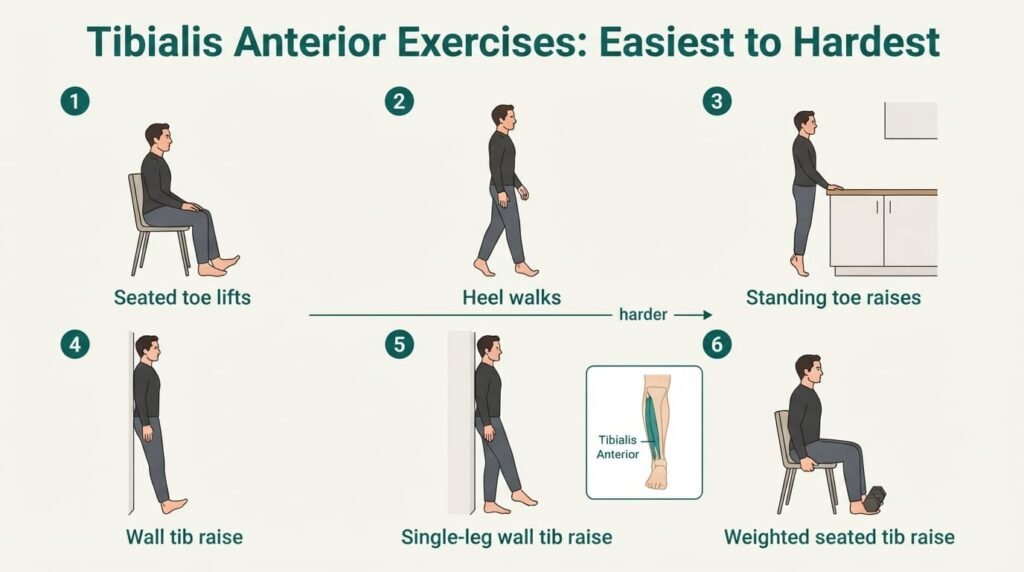
10 tibialis anterior exercises, easiest to hardest
| Level | Exercise | Equipment |
|---|---|---|
| 1 | Seated toe lifts | Chair |
| 2 | Ankle alphabet | Chair |
| 3 | Seated band dorsiflexion | Loop band |
| 4 | Heel walks | None |
| 5 | Standing toe raises | Wall or counter |
| 6 | Wall tib raises | Wall |
| 7 | Single-leg wall tib raise | Wall |
| 8 | Banded tib raise | Band and a sturdy anchor |
| 9 | Weighted seated tib raise | Backpack or dumbbell |
| 10 | Slant board tib raise | Slant board or a sturdy wedge |
1. Seated toe lifts
- Sit on a chair with your feet flat and knees bent at about 90 degrees
- Keep your heels on the floor and lift both sets of toes and the front of your feet as high as you can
- Pause for one second, then lower slowly
Dose: 2 sets of 20. This is the gentlest of all tibialis exercises and good for complete beginners or anyone with sore shins.
2. Ankle alphabet
Sit with one leg straight out and trace the letters of the alphabet in the air with your big toe. Move only from the ankle. Do the whole alphabet with each foot. It builds control and warms the ankle up for harder work.
3. Seated band dorsiflexion
- Sit on the floor with one leg straight
- Loop a resistance band around the top of your foot and anchor the other end to a table leg or have someone hold it, so the band pulls your toes away from you
- Pull your toes back toward your shin against the band, then return slowly
Dose: 2 to 3 sets of 15 per foot. Our guide to resistance bands for beginners explains which bands work best.
4. Heel walks
Lift your toes and walk on your heels across the room and back. Keep your steps short and your posture tall. Start with 20 to 30 seconds and build up to 60 seconds. Heel walks train the muscle in a standing, walking position, which carries over well to daily life.
5. Standing toe raises
- Stand facing a counter, holding it lightly for balance
- Keep your knees soft and lift your toes off the floor, rocking back onto your heels
- Lower with control
Dose: 2 to 3 sets of 15 to 20. Our guide to shin splint stretches and exercises uses this move too.
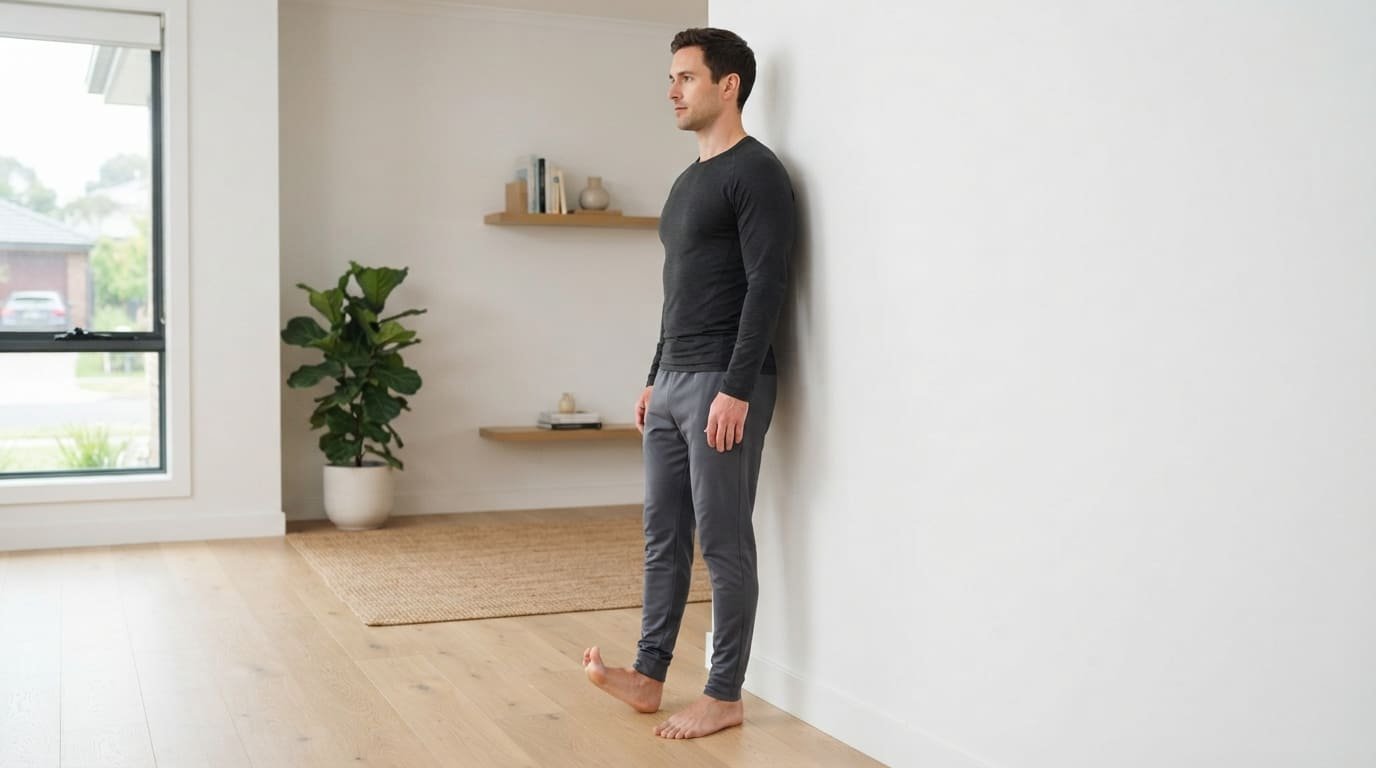
6. Wall tib raises
This is the classic tibialis anterior exercise, and the one I would choose if I could only pick one.
- Stand with your back and buttocks against a wall
- Walk your feet out about 30 to 45 cm, keeping your legs straight
- Lift your toes as high as you can, keeping your heels on the floor
- Lower slowly until your toes almost touch the floor, then lift again
Dose: 2 to 3 sets of 15 to 25. The further your feet are from the wall, the harder tib raises become.
7. Single-leg wall tib raise
Set up as for the wall version, then lift one foot slightly off the floor. Do all your reps on one leg, then switch. This doubles the load and quickly shows if one side is weaker.
8. Banded tib raise
Anchor a band low to a sturdy table or bed leg and loop the other end over the top of your foot. Stand or sit and lift your toes against the band. It adds resistance at the top of the movement, where the muscle is strongest.
9. Weighted seated tib raise
- Sit on a bench or chair with your heels on the floor and a light dumbbell or a small backpack resting across the tops of your feet, held in place gently with your hands or a strap
- Lift your toes against the weight, keeping your heels down
- Lower slowly
Start light, 1 to 3 kg, and add weight in small steps. The muscle is small, so heavy loads are not needed.
10. Slant board tib raise
Stand with your back against a wall and your heels on a slant board or sturdy wedge, toes pointing down the slope. Lift your toes as above. The slope increases the range of motion so the muscle works through a bigger stretch. Our guide to balance board exercises covers other ways to use ankle equipment safely.
A 6-week plan for tibialis anterior exercises
Do this two or three times a week, after a walk or at the end of a leg workout. It takes 5 to 8 minutes.
| Week | Exercises | Sets and reps |
|---|---|---|
| 1 | Seated toe lifts, ankle alphabet | 2 x 20 lifts, 1 alphabet per foot |
| 2 | Seated toe lifts, heel walks | 2 x 25 lifts, 2 x 30 seconds walking |
| 3 | Standing toe raises, heel walks | 3 x 15 raises, 2 x 45 seconds walking |
| 4 | Wall tib raises, heel walks | 3 x 15 raises, 2 x 60 seconds walking |
| 5 | Wall tib raises, banded dorsiflexion | 3 x 20 raises, 2 x 15 per foot |
| 6 | Single-leg wall tib raise, weighted seated tib raise | 2 x 12 per leg, 2 x 15 |
Retest your wall tib raise count at the end of week 3 and week 6. Most beginners see the number climb steadily. You can track the change with our bodyweight exercise progress calculator.
Pair your tib work with calf work
The calves on the back of the leg do the opposite job, pointing the foot down. Training both keeps the ankle balanced. After each set of tibialis anterior exercises, do a set of calf raises, then finish with a stretch. Our guide to calf stretches has a short routine, and the ankle dorsiflexion exercises guide helps if your ankle feels stiff when you squat or lunge.
Do you need a tib bar or slant board?
You will see tib bars, slant boards and special ankle machines sold for this muscle. They are nice to have, not essential. For most beginners, a wall and a chair cover every one of the exercises for tibialis anterior in this guide.
| Equipment | What it adds | Worth buying? |
|---|---|---|
| Tib bar | Lets you load the muscle with small weight plates | Only if you have used up the bodyweight and band options |
| Slant board | Increases the range of motion for tib raises and calf stretches | Useful if you also want it for calf and knee work |
| Resistance band | Adds resistance at the top of the movement | Yes, cheap and versatile |
| Ankle weights | Light load for seated toe lifts | Optional |
| Light dumbbell | Load for seated tib raises | Yes, if you already own one |
If you want one purchase, choose a set of resistance bands. They work for banded dorsiflexion and tib raises, and for dozens of other exercises for tibialis and the rest of the body. A slant board is a sensible second step if you enjoy the training and want more range.
Tibialis exercises and shin splints
Shin pain is the main reason many people go looking for exercises for tibialis anterior. Here is the honest picture.
Shin splints, or medial tibial stress syndrome, usually show up along the inside edge of the shin bone in people who have increased their running or jumping quickly. A systematic review of treatments found that none of the studies were free enough from bias to recommend any one treatment, and stretching and strengthening exercises were among the options that did not show a clear benefit in the trials available.
So, what does that mean for you? Tib raises are unlikely to fix shin splints on their own. The most important steps are reducing the running or jumping that triggers the pain, building back up gradually, and getting persistent pain checked. Strength work for the shin and calf makes sense as part of the build-back, especially once the pain has settled. Our guide to shin splints stretches covers the full approach, and running for beginners explains how to increase your running safely.
This article is general information, not medical advice. See a doctor or physiotherapist if shin pain is sharp, focused on one small spot, present at rest or at night, or not improving after two to three weeks of reduced activity, because these can be signs of a stress fracture. See our medical disclaimer.
Tibialis anterior exercises for different people
| Person | Best starting exercises | Tips |
|---|---|---|
| Complete beginners | Seated toe lifts, heel walks | Short sets, done daily if you like |
| Older adults | Seated toe lifts, standing toe raises at a counter | Always hold on for balance. Pair with our leg exercises for seniors |
| New runners | Wall tib raises, heel walks | Do them after easy runs, not before hard ones |
| Experienced runners | Single-leg and weighted tib raises | Add them to your strength day twice a week |
| People with stiff ankles | Ankle alphabet, banded dorsiflexion | Combine with calf stretches |
| Desk workers | Seated toe lifts under the desk | A set every hour or two keeps the ankles moving |
Common mistakes
| Mistake | Why it matters | Fix |
|---|---|---|
| Rushing the reps | Momentum does the work, not the muscle | Count two seconds up and two down |
| Half reps | You miss the hardest part of the range | Lift as high as you can and lower fully |
| Feet too far from the wall too soon | Your heels slide and your back arches | Start close and walk out gradually |
| Pushing through sharp pain | Can aggravate an irritated shin | Stop, rest and go back a level |
| Only training the front of the shin | Ankle strength becomes unbalanced | Pair with calf raises |
| Going heavy | The muscle is small and fatigues fast | Add reps and range before load |
Fitting tib work into a busy day
You do not need a separate workout for tibialis exercises. A few easy ways to fit them in:
- Do seated toe lifts under your desk during calls
- Do a set of wall tib raises while the kettle boils
- Walk on your heels from the bedroom to the bathroom in the morning
- Add two sets to the end of any home leg workout, such as our beginner leg workout at home
Three or four tiny sets spread across the day add up to the same work as one longer session.
The bottom line
Tibialis anterior exercises train the small muscle on the front of your shin that lifts your toes, controls each landing and helps you stay steady on your feet. Start with seated toe lifts and heel walks, move on to wall tib raises, then progress to single-leg, banded and weighted versions.
Keep the reps slow and fairly high, pair them with calf raises, and give them two or three short sessions a week. They will not cure shin splints on their own, but stronger shins and ankles are a sensible part of walking, running and moving well at any age.
Frequently asked questions
What are the best tibialis anterior exercises?
Wall tib raises are the most popular and effective choice for most people. Seated toe lifts and heel walks are great for beginners, while single-leg, banded and weighted tib raises suit people who need more challenge.
How many tib raises should I do?
Start with 2 to 3 sets of 15 to 25 slow reps, two or three times a week. When you can do 3 sets of 25 easily, move to a harder version rather than adding endless reps.
Do tibialis exercises help shin splints?
They may help as part of a gradual return to running, but research has not shown strengthening alone to be an effective treatment for shin splints. Reducing the activity that causes pain and building back slowly matter most.
Can I train my tibialis anterior every day?
Gentle versions such as seated toe lifts and heel walks can be done daily. Harder versions, such as weighted or single-leg tib raises, are better two or three times a week so the muscle can recover.
Do I need equipment for tibialis anterior exercises?
No. A wall, a chair and the floor are enough for most of them. A resistance band, a light dumbbell or a slant board can be added later for more challenge.
Why does the front of my shin burn during tib raises?
The tibialis anterior is a small muscle that tires quickly, so a burning feeling during a set is normal and fades within a minute of resting. Sharp or lasting pain is different and is a reason to stop.
Are tibialis exercises good for older adults?
Yes, when done safely. Weak ankle dorsiflexors have been linked with falls, and seated toe lifts or counter-supported toe raises are a gentle way to build strength. Always hold on to something stable.
What is the difference between tibialis anterior and tibialis posterior exercises?
The tibialis anterior is on the front of the shin and lifts the foot up. The tibialis posterior sits deep behind the shin and supports the arch. Posterior work uses moves such as calf raises with a ball between the heels and banded inversion, and painful tendons should be assessed first.
How long until I notice results?
Most beginners notice better endurance in the shin within 2 to 3 weeks of steady practice. Clear strength gains, such as doing single-leg tib raises with control, usually take around 6 weeks.
What’s next?
Reading is the easy part. Pick one of these and do it today.