Do Waist Trainers Work? What They Do, What They Do Not, and the Risks
Waist trainers are sold with before-and-after pictures, celebrity endorsements and a simple promise: wear this, and your waist will get smaller. Millions of people search for them every year, for women and increasingly for men.
I understand the appeal. When I first wanted to lose weight around my middle, I would have bought almost anything that promised to speed it up. A garment you simply put on is a much easier idea than months of eating a bit less and training regularly.
So this article gives a straight answer. It explains what a waist trainer is, what it genuinely does, what it cannot do, the risks of wearing one, especially during exercise, and what actually changes the size of your waist.
At a glance
- A waist trainer makes your waist look smaller while you are wearing it. The effect ends when you take it off
- It does not burn fat, and it cannot remove fat from your stomach
- Any weight lost from sweating in one is water, and it returns when you drink
- Wearing one during exercise restricts breathing and movement and is not recommended
- Possible problems include shortness of breath, acid reflux, skin irritation and overheating
- There are no good controlled studies showing lasting waist reduction from waist trainers
- A smaller waist comes from losing body fat overall, through eating, activity and time
What a waist trainer is
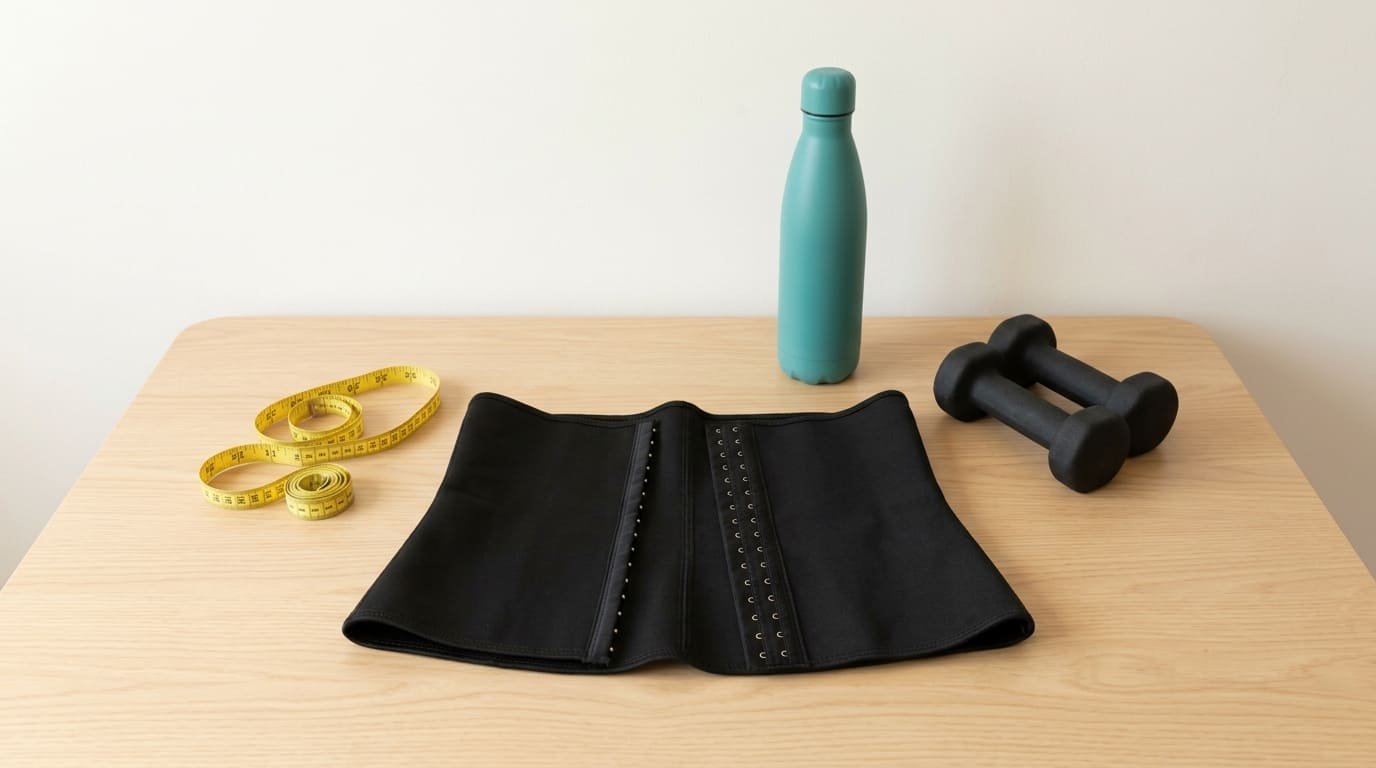
A waist trainer is a tight garment worn around the midsection. It is a modern descendant of the corset.
| Type | What it is | How it fastens | Typical use |
|---|---|---|---|
| Latex or neoprene cincher | A stretchy, thick band | Hooks, a zip or Velcro | Under clothes, or marketed for workouts |
| Steel-boned corset | A rigid garment with metal strips | Laces at the back | Tight lacing for shape |
| Sweat belt or waist trimmer | A neoprene wrap | Velcro | Marketed for sweating during exercise |
| Shapewear | Light compression underwear | Pull-on | Smoothing under clothing |
| Postpartum or medical binder | A supportive wrap | Velcro | Support after birth or surgery, under medical advice |
The first three are what people usually mean by a waist trainer. The claim behind them is waist training: that wearing the garment for hours a day, over weeks or months, will permanently reduce your waist.
Shapewear and medical binders are different things with different purposes, and this article is not about them.
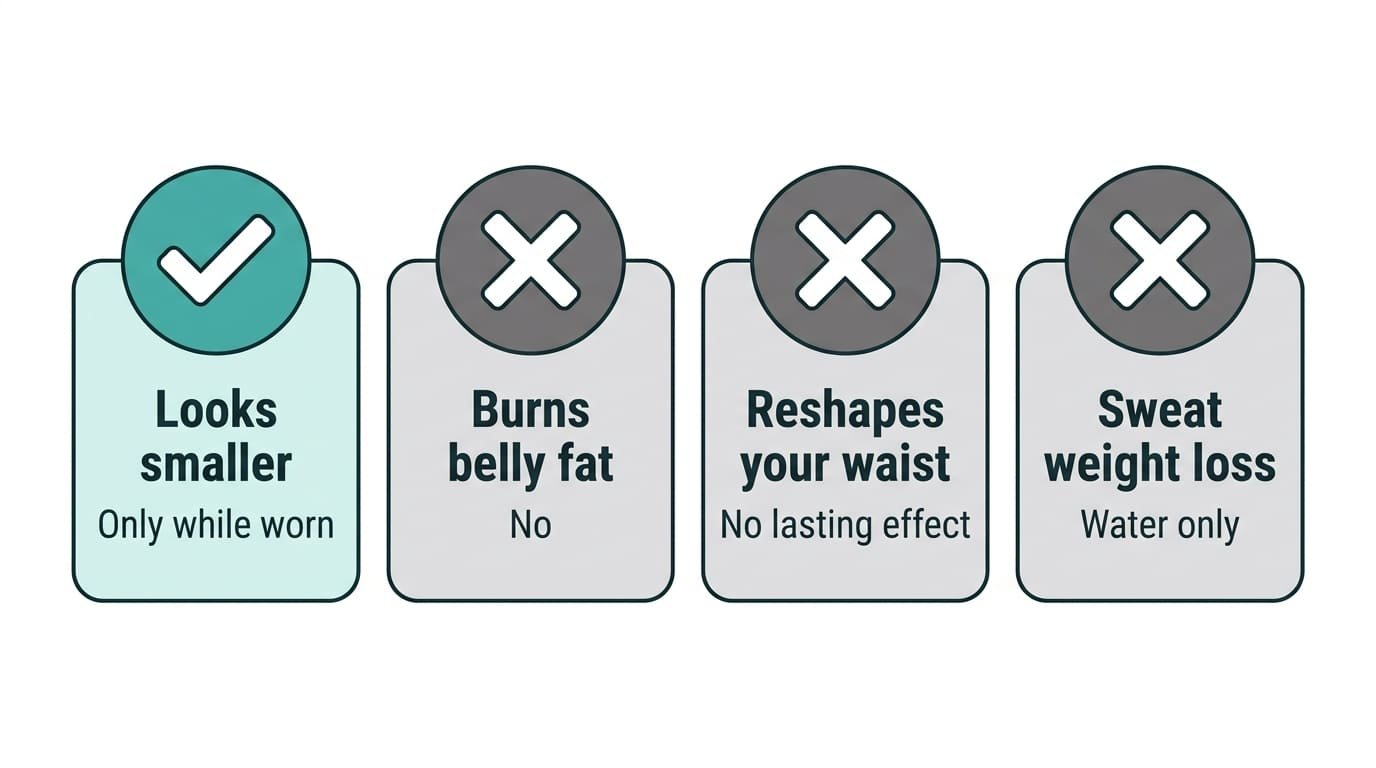
What waist trainers are claimed to do
| Claim | Is it true? | What actually happens |
|---|---|---|
| Makes your waist look smaller immediately | Yes, while it is on | It compresses soft tissue and shifts it up and down |
| Burns belly fat | No | Compression and heat do not burn fat |
| Permanently reshapes your waist | No good evidence | Soft tissue returns to its shape when the garment comes off |
| Makes you lose weight | Only water, temporarily | Sweat is replaced as soon as you drink |
| Reduces appetite | Sometimes, for a bad reason | A compressed stomach feels full sooner. This is not a healthy way to eat less |
| Improves posture | While it is on, somewhat | It holds you upright. It does not strengthen the muscles that do that job |
| Strengthens the core | No | If anything it does the core’s job for it |
| Boosts workout results | No | It restricts breathing and movement |
Why a waist trainer cannot burn fat
Body fat is stored energy. The only way to reduce it is to use more energy than you take in, over time. Your body then draws on fat from all over, in an order set mostly by your genetics and hormones.
Squeezing an area does not change that. Neither does heating it, sweating from it or exercising it.
The idea that you can lose fat from one chosen place is called spot reduction, and it has been tested directly. In one study, people did abdominal exercises five days a week for six weeks. Their abdominal fat and waist size did not change compared with a group that did nothing. In another, twelve weeks of training a single leg reduced fat in the upper body and trunk, not in the trained leg.
If hard exercise of a muscle cannot remove the fat on top of it, a tight band certainly cannot.
What about all the sweat?
Neoprene belts and latex cinchers trap heat, so you sweat heavily underneath them. Step on the scale straight afterward and you may be lighter. That loss is water. A litre of sweat weighs a kilogram, and you replace it with your next few drinks.
Sweating is how your body cools itself. It is not a sign that fat is being burned, and blocking it by wrapping yourself in rubber makes it harder for your body to control its temperature.
What the research says
Very little, and that is the most important point.
I looked for controlled studies of modern waist trainers showing lasting reductions in waist size or body fat and could not find any of good quality. The claims on product pages rest on testimonials and photographs, which can be affected by posture, lighting, bloating, time of day, and by the diet and exercise changes people often make at the same time.
That last point matters. Many people who buy a waist trainer also start eating better and exercising. When their waist shrinks, the garment gets the credit that belongs to the other changes.
Medical and health organisations that have commented on waist trainers consistently say the same thing: they do not produce lasting fat loss, and any visible effect is temporary.
Should you wear a waist trainer while working out?
No. This is the use that concerns health professionals most.
- It restricts your breathing. Exercise raises your need for air. A band tight around your ribs and abdomen limits how far your diaphragm can move down and how far your ribs can expand, at exactly the moment you need them to
- It limits movement. You cannot hinge, squat deeply, twist or brace properly in a rigid garment
- It interferes with bracing. Lifting safely depends on tightening your own trunk muscles around a breath. A waist trainer gets in the way of that and gives a false sense of support
- It increases overheating. Trapped heat and heavy sweating raise the risk of dehydration and heat illness, especially in warm conditions
- It does not increase fat burning. You will not burn more fat for wearing it, and you will probably train less well
| What people hope for | What actually happens |
|---|---|
| More fat burned from the stomach | No change in where fat is lost |
| A harder, more effective workout | Shallower breathing and a lower-quality session |
| Core support | Less work for the core muscles |
| Extra weight loss | Extra water loss, regained within hours |
A weightlifting belt is not a waist trainer. A lifting belt is a stiff belt worn briefly for very heavy squats and deadlifts. It gives your abdominal muscles something to push out against, which helps you brace. It is tightened for a set and loosened afterward, and it is not intended to squeeze the waist smaller. Beginners do not need one.
Risks and side effects
Most people who try a waist trainer for an hour or two will experience nothing worse than discomfort. Problems become more likely with tight lacing, long hours and exercise.
| Area | Possible problem |
|---|---|
| Breathing | Shallow breathing, shortness of breath, light-headedness |
| Digestion | Acid reflux and heartburn, as the stomach is pushed upward. Bloating and constipation |
| Skin | Chafing, rashes, irritation and infections from trapped sweat |
| Temperature | Overheating and dehydration |
| Muscles | The trunk muscles may do less work while the garment supports you |
| Nerves | Numbness or tingling on the outer thigh, from pressure on a nerve near the hip |
| Circulation | Pressure marks, and in very tight garments, restricted blood flow |
| Ribs and organs | With extreme, prolonged tight lacing, pressure on the lower ribs and abdominal organs |
| Eating | Feeling full very quickly, which can lead to under-eating |
Take it off straight away if you feel short of breath, dizzy, faint, numb or in pain.
Who should not use one
- Anyone who is pregnant
- People with acid reflux, a hernia or digestive conditions
- People with asthma or other breathing problems
- People with heart conditions or high blood pressure
- Anyone with a history of disordered eating
- Children and teenagers
- Anyone recovering from surgery, unless their surgeon has prescribed a specific garment
After childbirth or abdominal surgery, a doctor or physiotherapist may recommend a specific support garment for a limited time. That is medical care. It is not the same as buying a waist trainer to change your shape, and it should follow their instructions, not a product label.
Do waist trainers work for men?
The answer is the same. Products for men are marketed more often as sweat belts or waist trimmers for the gym, and with promises about belly fat and abdominal definition. The physiology is identical: the garment compresses, it makes you sweat, and it does not remove fat.
Men tend to store more fat around and inside the abdomen. That deeper fat responds well to overall fat loss through diet and activity, and not at all to compression. Our guide on how to lose love handles covers the approach that works.
If you still want to use one
Some people like the look or the feel of a waist trainer under an outfit, and that is a personal choice. If you do wear one:
- Treat it as clothing, not as a fat-loss tool
- Choose a size by your actual waist measurement. Do not size down
- You should be able to breathe deeply, sit comfortably and slide a couple of fingers under the edge
- Keep it to short periods, and never sleep in it
- Do not exercise in it
- Wear a thin layer underneath and wash it regularly
- Stop if you get pain, reflux, numbness or breathing difficulty
Lightweight shapewear gives a smoothing effect with far less compression and is the more comfortable option for most people.
Where waist training came from
Tight lacing is centuries old. Corsets were worn in Europe from the sixteenth century, and by the nineteenth century physicians were already writing about the effects of extreme lacing on breathing, digestion and the lower ribs. The fashion faded in the early twentieth century.
The modern waist trainer returned through social media in the 2010s, promoted by celebrities and influencers, often in paid posts. The garment changed from laced fabric and steel to latex and neoprene, and the promise changed from a fashionable silhouette to fat loss. The first of those a corset can deliver while it is worn. The second it never could.
Why before-and-after photos mislead
The pictures used to sell waist trainers can be honest and still tell you nothing.
- Posture. Standing tall with shoulders back narrows the waist by itself
- Time of day. A waist is smallest first thing in the morning and larger after meals
- Breathing in. A held breath pulls the abdomen flat
- Lighting and angle. Side lighting and a slight turn of the hips change the outline considerably
- Other changes. Most people who start waist training also start dieting and exercising
- Time. A photo taken twelve weeks apart shows twelve weeks of everything that person did
- Wearing it in the picture. Some after photos are simply taken with the garment on, or just after it is removed, while the skin is still compressed
A fair test would compare two similar groups eating and exercising the same way, one with a waist trainer and one without. I could not find such a study for modern waist trainers.
What a waist trainer costs, and what else that buys
| Spend | What you get |
|---|---|
| A waist trainer, 20 to 100 dollars | A temporary change in outline while it is worn |
| A tape measure and a food scale, about 15 dollars | The tools to track the two things that change a waist |
| A pair of adjustable dumbbells, 50 to 150 dollars | Years of strength training at home |
| Resistance bands, 15 to 40 dollars | A full-body workout kit |
| Comfortable walking shoes | The most reliable fat-loss habit there is |
What actually makes a waist smaller
Three things change your waist measurement. A waist trainer does none of them.
| What changes your waist | How to do it | How long it takes |
|---|---|---|
| Less body fat | A modest calorie deficit, kept up consistently | Weeks to months |
| Less bloating | Regular meals, enough fibre and water, noticing which foods trigger it | Days |
| Better posture and stronger trunk muscles | Core and upper-back training | Weeks |
1. Lose body fat, slowly
- Eat about 300 to 500 calories below what you burn each day. Our TDEE calculator estimates your starting point
- Keep protein high, around 1.6 to 2.2 grams per kilogram of body weight
- Walk daily. Aim for 7,000 to 10,000 steps
- Sleep 7 to 9 hours. Short sleep increases hunger
You cannot choose where fat comes off first. For many people the waist is one of the last places to change, which is frustrating and normal.
2. Strength train
Lifting weights two to four times a week keeps your muscle while you lose fat, which means more of the weight you lose is fat. It also changes proportions. Broader shoulders, a stronger back and fuller glutes all make a waist look smaller by comparison, with no change in the tape measure at all.
Our 3-day workout split is a good place to start, and our shoulder to waist ratio calculator puts a number on that proportion.
3. Train your core properly
Core exercises do not burn belly fat. They do strengthen the muscles that hold your trunk upright and your abdomen in, including the deep transverse abdominis, which wraps around your middle like a natural corset.
| Exercise | What it trains | Sets and reps |
|---|---|---|
| Dead bug | Deep core control | 3 sets of 8 per side |
| Plank | The whole trunk | 3 holds of 30 to 45 seconds |
| Side plank | Obliques | 3 holds of 20 to 30 seconds per side |
| Bird dog | Back and deep core | 3 sets of 8 per side |
| Suitcase carry | Obliques and posture | 3 carries of 30 seconds per side |
Our transverse abdominis exercises and beginner core workout guides have full routines.
4. Stand taller
Slouching pushes the abdomen forward and can add several centimetres to how wide your waist looks. Strengthening your upper back and practising an upright posture has an immediate visible effect. Our posture exercises guide shows how.
5. Deal with bloating
A waist can vary by a few centimetres across a single day from food, fluid and gas. Eating regularly, drinking enough water, increasing fibre gradually and noticing your own trigger foods all help. Our guide on how to get a flat stomach covers this.
A realistic timeline
| Timeframe | With a waist trainer only | With a modest deficit, strength training and walking |
|---|---|---|
| Day 1 | Waist looks smaller while worn | No visible change |
| Week 2 | Same as day 1 | Less bloating, slightly looser waistband |
| Week 6 | Same as day 1 | Waist typically down 2 to 4 cm |
| Week 12 | Same as day 1 | Waist typically down 4 to 8 cm, and stronger |
| After you stop | Back to the start within minutes | The change stays, as long as the habits do |
Individual results vary widely. Measure your waist at the navel, at the same time of day, every two weeks. Our guide on how to measure your waist and hips shows the correct tape position.
The bottom line
A waist trainer works in one narrow sense: it makes your waist look smaller for as long as you have it on. It does not burn fat, it does not permanently reshape you, and the weight lost by sweating in one is water that returns within hours.
Wearing one during exercise makes breathing and moving harder for no benefit, and long hours in a tight one can cause reflux, skin problems and overheating. There are no good studies showing a lasting effect.
A smaller waist comes from losing body fat gradually, building muscle around it, training your core and standing taller. None of that is as quick as putting on a garment. All of it lasts.
Frequently asked questions
Do waist trainers actually work?
Only while you are wearing them. They compress your midsection so your waist looks smaller, and the effect disappears when you take the garment off. They do not burn fat or permanently change your shape, and there are no good studies showing lasting results.
Do waist trainers help you lose belly fat?
No. Fat is lost when you use more energy than you eat, and your body decides where it comes from. Compression, heat and sweating do not burn fat in the area underneath. Any weight lost while wearing one is water.
Is it safe to wear a waist trainer while working out?
It is not recommended. A tight garment restricts your breathing and movement at the moment you need both, interferes with bracing your core, and increases the risk of overheating. It does not make the workout burn more fat.
How long does it take for a waist trainer to work?
The visual effect is immediate and lasts only while it is on. No amount of time produces a permanent change, because soft tissue returns to its normal position once the compression is removed. Lasting change requires losing body fat.
Do waist trainers work for men?
No differently than for women. Men’s products are often sold as sweat belts for the gym. They make you sweat and compress the stomach, but they do not remove belly fat. Fat loss through diet and activity is what reduces a man’s waist.
What are the side effects of waist trainers?
Possible side effects include shortness of breath, acid reflux, bloating, skin irritation, overheating, numbness on the outer thigh and reduced use of your own core muscles. Risks increase with tight lacing, long wear and exercise.
Can you sleep in a waist trainer?
You should not. Sleeping in one prolongs the pressure on your stomach and ribs, can worsen acid reflux, restricts breathing and disturbs sleep. Since the garment has no lasting effect on fat, there is no benefit to set against those drawbacks.
What works better than a waist trainer for a smaller waist?
A modest calorie deficit, high protein, daily walking and strength training two to four times a week. Add core and posture work to improve how your midsection is held. Expect a visible change over six to twelve weeks.
What’s next?
Reading is the easy part. Pick one of these and do it today.