Cindy Workout: Rules, Good Scores, Scaling and a 6-Week Plan
Cindy is three exercises, twenty minutes and no weights. It looks so simple on paper that most people badly underestimate it the first time.
I certainly did. I had done plenty of push-ups and squats, so I set off at a pace I thought was sensible. By minute six my push-ups had gone from sets of ten to sets of three, and I spent the rest of the workout staring at the floor between singles. I finished with nine rounds and a new respect for pacing.
Cindy is one of the best-known benchmark workouts in CrossFit, and it is also one of the most accessible, because every movement can be made easier. This guide covers the rules, the movement standards, what a good score looks like, how to scale it to your level, how to pace it, and a six-week plan to improve.
At a glance
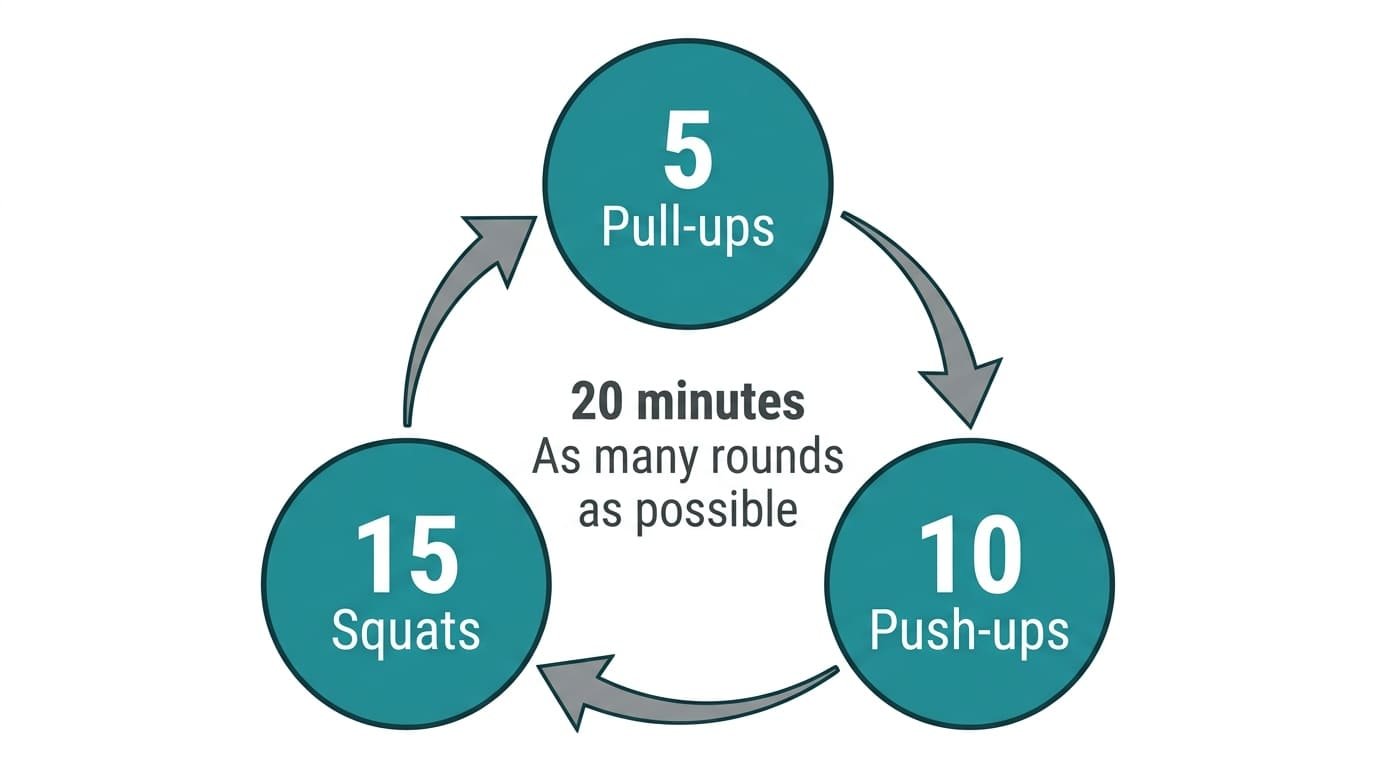
- Cindy is as many rounds as possible in 20 minutes of 5 pull-ups, 10 push-ups and 15 squats
- Your score is the number of full rounds, plus any extra reps
- Each round is 30 reps. Twenty rounds is 100 pull-ups, 200 push-ups and 300 squats
- Beginners typically score 5 to 10 rounds, and 15 or more is a strong result
- Every movement can be scaled: ring rows for pull-ups, incline or knee push-ups, and squats to a chair
- Start slower than feels necessary. Push-ups are what stop most people
- You need a pull-up bar, or something to row from, and a timer
What the Cindy workout is
| Element | Detail |
|---|---|
| Format | AMRAP, meaning as many rounds as possible |
| Time | 20 minutes |
| One round | 5 pull-ups, then 10 push-ups, then 15 air squats |
| Equipment | A pull-up bar and a timer |
| Score | Rounds completed, plus extra reps |
Set a clock for twenty minutes. Do five pull-ups, ten push-ups and fifteen squats, in that order, and go straight back to the pull-ups. Keep cycling until the clock runs out. You may rest whenever you need to, but the clock does not stop.
Cindy is one of a group of CrossFit benchmark workouts given women’s names and often called the Girls. They are repeated every few months so that people can measure their progress against their own earlier scores. Cindy is among the most popular because it needs almost no equipment and takes exactly twenty minutes.
It belongs to a style of exercise that researchers call high-intensity functional training: varied, multi-joint movements performed at high effort, usually combining strength and conditioning in the same session.
The rules
- Start the clock, and it runs for 20 minutes without stopping
- Complete the movements in order: 5 pull-ups, 10 push-ups, 15 squats
- Finish all the reps of one movement before starting the next
- You may break any movement into smaller sets and rest as needed
- When time runs out, count your full rounds and any reps in the unfinished round
How to write your score. If you complete 11 full rounds and then 5 pull-ups and 6 push-ups before the clock stops, your score is 11 rounds plus 11 reps, written as 11+11.
Rx and scaled. In CrossFit, doing a workout exactly as written is called Rx, short for as prescribed. Changing any movement to an easier version is called scaling. Record which version you did, so you compare like with like next time.
Movement standards
Pull-up
- Start hanging from the bar with your arms fully straight
- Pull until your chin is clearly above the bar
- Lower until your arms are straight again
- Any grip is allowed. Strict pull-ups and kipping pull-ups, which use a swing of the body, both count in CrossFit
For beginners, strict or scaled is the sensible choice. Kipping is a skill that puts considerable stress on the shoulders, and it is best learned with a coach after you have built the strength for several strict pull-ups.
Push-up
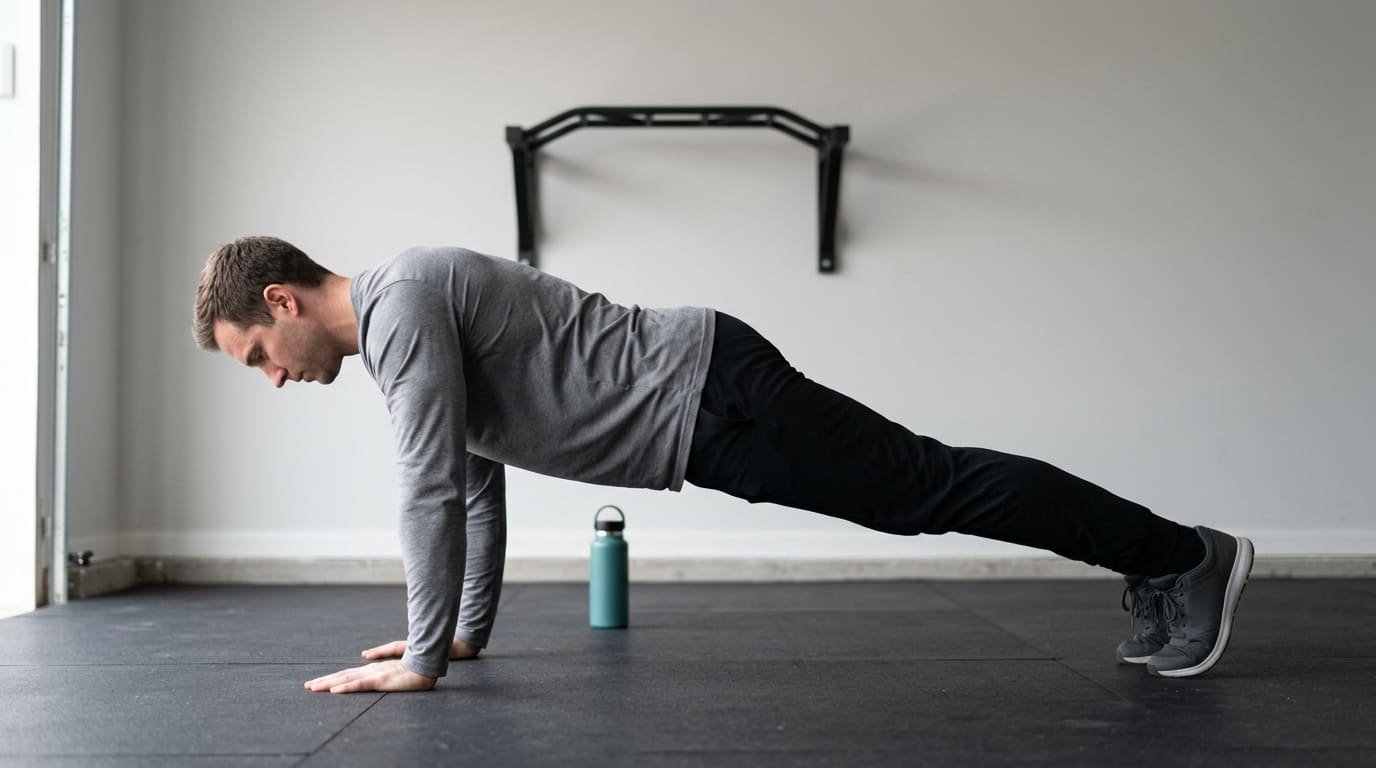
- Hands on the floor, about shoulder-width apart, body in a straight line from head to heels
- Lower until your chest touches the floor
- Press up until your arms are fully straight
- Your hips must not sag and your thighs should not rest on the floor between reps
Air squat
- Feet about shoulder-width apart, toes turned out slightly
- Lower until the crease of your hip is below the top of your knee
- Stand up until your hips and knees are fully straight
- Heels stay on the floor and knees track over the toes
What is a good Cindy score?
These ranges are rough community benchmarks, not official standards. Scores vary with body weight, age and whether the pull-ups are strict or kipping.
| Level | Rounds in 20 minutes | What it usually means |
|---|---|---|
| First attempt, scaled | 5 to 8 | New to this kind of training |
| Beginner | 8 to 11 | Some training background, movements scaled or done strictly |
| Intermediate | 12 to 16 | Comfortable with all three movements as written |
| Advanced | 17 to 21 | Strong, efficient and well paced |
| Elite | 22 and above | Competitive level, more than one round a minute throughout |
| Rounds | Pull-ups | Push-ups | Squats | Total reps |
|---|---|---|---|---|
| 5 | 25 | 50 | 75 | 150 |
| 10 | 50 | 100 | 150 | 300 |
| 15 | 75 | 150 | 225 | 450 |
| 20 | 100 | 200 | 300 | 600 |
| 25 | 125 | 250 | 375 | 750 |
Look at the row for twenty rounds. One hundred pull-ups, two hundred push-ups and three hundred squats is exactly the bodyweight work in the Murph workout, without the two runs. Many people split Murph into twenty rounds of Cindy for that reason. Our Murph workout guide explains how.
The only score that matters is your last one. A good result is more rounds, or the same rounds with a harder version of a movement, than you managed before.
How to scale Cindy
The aim of scaling is to keep you moving. If you are standing still for most of the twenty minutes, the version you chose is too hard.
A good rule: choose versions that let you complete your first three rounds without stopping within a set.
Scaling the pull-up
| Level | Option | How |
|---|---|---|
| 1 | Standing band row or towel row | Hold a band or towel fixed at chest height, lean back and pull your chest to your hands |
| 2 | Ring row or table row | Lie under rings or a sturdy table, body straight, and pull your chest up. The more horizontal you are, the harder it is |
| 3 | Jumping pull-up | Use a box so the bar is at wrist height with your arms raised. Jump to bring your chin over the bar and lower under control |
| 4 | Band-assisted pull-up | Loop a long band over the bar and place a foot or knee in it |
| 5 | Strict pull-up | As written |
Our pull-up alternatives guide explains each of these and how to progress from one to the next.
Scaling the push-up
| Level | Option | How |
|---|---|---|
| 1 | Wall push-up | Hands on a wall, body straight |
| 2 | Incline push-up, hands on a kitchen counter | Same form, less load |
| 3 | Incline push-up, hands on a sturdy chair or low box | Closer to the floor |
| 4 | Knee push-up | Knees on the floor, body straight from knees to head |
| 5 | Full push-up | As written |
Incline push-ups are generally the better choice, because they keep the whole body in the same straight line as the full version. See our guide to incline and decline push-ups.
Scaling the squat
| Level | Option | How |
|---|---|---|
| 1 | Sit to stand from a chair | Sit down under control and stand up without using your hands |
| 2 | Squat to a box or chair, touch and go | Lightly touch the seat, then stand |
| 3 | Air squat to a comfortable depth | As deep as you can with heels down |
| 4 | Full air squat | Hip crease below the knee |
Scaling the numbers or the time
You can also keep the movements and change the amounts.
| Version | Round | Time |
|---|---|---|
| Half Cindy | 5 pull-ups, 10 push-ups, 15 squats | 10 minutes |
| Three-quarter Cindy | 5, 10, 15 | 15 minutes |
| Reduced reps | 3 pull-ups, 6 push-ups, 9 squats | 20 minutes |
| Beginner Cindy | 5 ring rows, 5 incline push-ups, 10 squats | 10 to 15 minutes |
For a first attempt, Half Cindy with scaled movements is an excellent starting point.
How to pace Cindy
Cindy is won and lost on pacing. Almost everyone starts too fast.
Work out your target before you begin.
| Target score | Time per round | What that feels like |
|---|---|---|
| 5 rounds | 4 minutes | A round, then a long rest |
| 8 rounds | 2 minutes 30 seconds | A round, then about a minute of rest |
| 10 rounds | 2 minutes | Steady, with a short pause between movements |
| 12 rounds | 1 minute 40 seconds | Continuous but controlled |
| 15 rounds | 1 minute 20 seconds | Very little standing still |
| 20 rounds | 1 minute | A round every minute, for twenty minutes |
Five pacing rules:
- Start at the pace you can hold in minute fifteen. The first three rounds should feel almost too easy
- Break up the push-ups from the very first round. Do them as 5 and 5, or 4, 3 and 3, with a few seconds between, long before you need to. Push-ups are the limiting factor for most people, and once they fail they do not come back
- Never go to failure. Stop each set with two reps in hand
- Use the squats to recover your upper body. Keep them smooth and continuous, and breathe
- Take short, planned rests of three to five breaths, not long, unplanned ones
Watch the clock at halfway. If you have done more than half your target rounds by the ten-minute mark, you are on pace. Most people complete noticeably fewer rounds in the second half, so aim to be slightly ahead.
Technique tips for each movement
- Pull-ups: use a grip just outside shoulder width. Drop from the bar between sets if needed, shake out your arms and regrip. Chalk helps if your hands sweat
- Push-ups: keep your elbows at about 45 degrees from your body, squeeze your glutes to stop your hips sagging, and rest at the top with straight arms, not on the floor
- Squats: let your arms swing forward as you go down for balance, breathe in on the way down and out on the way up, and find a rhythm
- Transitions: set up so the bar and your floor space are a step apart. Seconds lost walking around add up over ten or fifteen rounds
Warm-up
- Three minutes of easy cardio: jogging on the spot, skipping or rowing
- 10 arm circles in each direction
- 20-second hang from the bar, or 10 band pull-aparts
- 10 bodyweight squats
- 5 incline push-ups
- Two practice rounds at an easy pace using half the reps: 2 pull-ups, 5 push-ups, 7 squats
Rest two minutes, then start the clock. Our workout warm-up guide has more.
A 6-week plan to improve your Cindy score
Test Cindy in week one, train for five weeks, and retest in week six. Do two sessions a week from this plan alongside your normal training, on non-consecutive days.
| Week | Session 1 | Session 2 |
|---|---|---|
| 1 | Test: Cindy, or Half Cindy, with your chosen scaling. Record your score | Every minute for 10 minutes: 1 round at half reps, which is 2 pull-ups, 5 push-ups, 7 squats |
| 2 | Push-up practice: 6 sets of half your maximum, resting 60 seconds | Every minute for 12 minutes: 3 pull-ups, 5 push-ups, 8 squats |
| 3 | Pull-up practice: 6 sets of half your maximum, resting 90 seconds. Then 3 sets of 20 squats | Three-quarter Cindy: 15 minutes at your target pace |
| 4 | Push-up practice: 8 sets of half your maximum, resting 45 seconds | Every 90 seconds for 15 minutes: 1 full round of 5, 10, 15 |
| 5 | Pull-up practice: 8 sets of half your maximum. Then 4 sets of 20 squats | Two blocks of 8 minutes of Cindy, resting 4 minutes between |
| 6 | Easy session: 10 minutes of light movement and stretching | Retest: full Cindy. Aim to beat week one |
Every minute on the minute means you start a new set at the top of each minute and rest for whatever time is left. It teaches you to hold a steady pace, which is exactly the skill Cindy rewards.
To build the underlying strength, add push-up and pulling work to your regular week. Our calisthenics workout plan for beginners is a good companion.
Related workouts and variations
| Workout | What it is | How it compares |
|---|---|---|
| Half Cindy | The same round for 10 minutes | A beginner version and a good first test |
| Chelsea | One round of 5, 10, 15 every minute on the minute for 30 minutes | A fixed pace. Fall behind and the workout is over |
| Mary | 20 minutes of 5 handstand push-ups, 10 single-leg squats, 15 pull-ups | A much harder cousin |
| Angie | 100 pull-ups, 100 push-ups, 100 sit-ups, 100 squats, for time | Each movement finished before the next |
| Barbara | 5 rounds of 20 pull-ups, 30 push-ups, 40 sit-ups, 50 squats, resting 3 minutes between | Larger sets with built-in rest |
| Murph | 1 mile run, 100 pull-ups, 200 push-ups, 300 squats, 1 mile run | Twenty rounds of Cindy between two runs |
| Weighted Cindy | Cindy wearing a weighted vest | For advanced trainees only |
Our AMRAP workout guide explains the format and has more routines of this type, and weighted vest training covers the vest.
Doing Cindy at home
You need three things.
- Something to pull on. A doorway pull-up bar is the simplest. Rings or a suspension trainer on a door anchor work for ring rows. A sturdy table works for table rows
- Two square metres of floor
- A timer. A phone will do
Our guide to bodyweight exercise equipment explains which bar to buy and how to check it is safe.
How often should you do Cindy?
As a test, every six to eight weeks is enough. Doing it weekly leaves little time for the training that actually improves it.
As a regular workout, a scaled or shortened version once a week is fine. Twenty minutes of high-rep push-ups and pull-ups is a lot of work for the shoulders and elbows, so give yourself at least two days before training the same muscles hard again.
Safety
A systematic review of CrossFit research concluded that the quality of evidence was still limited, while noting consistently high reported levels of motivation and community among participants. In practical terms, the risks of a workout like Cindy come mostly from doing too much, too soon.
- Scale honestly. There is no value in grinding out ugly reps
- Build up the volume. If you have never done fifty push-ups in a session, do not attempt two hundred. Start with Half Cindy
- Look after your hands. High-rep pull-ups can tear the skin of the palms. Stop if you feel a hot spot forming
- Do not kip until you can do strict pull-ups
- Stop for sharp pain in the shoulders, elbows or wrists
- Be aware of rhabdomyolysis. Very high volumes of unaccustomed exercise can, rarely, cause serious muscle breakdown. Warning signs are extreme muscle pain and swelling and dark, cola-coloured urine in the day or two afterward. That needs urgent medical attention. Sensible scaling makes it very unlikely
- Get medical advice first if you have a heart condition, high blood pressure or a current injury
Common mistakes
- Sprinting the first three rounds
- Doing push-ups in unbroken sets of ten until they collapse
- Choosing a version that is too hard and standing still for half the time
- Shortening the range of motion as fatigue builds: half squats, chin not reaching the bar, chest not reaching the floor
- Letting the hips sag in push-ups
- Losing count. Use a tally on paper or move a coin from one pile to another each round
- Skipping the warm-up
- Retesting every week instead of training
The bottom line
Cindy is five pull-ups, ten push-ups and fifteen squats, repeated for twenty minutes. It needs a bar and a timer, it scales to any level, and it gives you a single number to beat next time.
Choose versions of each movement that keep you moving. Start slower than you want to, split your push-ups from the first round, and never go to failure. Test it, train the movements for a few weeks, and test it again.
If you can add even one round, you are fitter than you were.
Frequently asked questions
What is the Cindy workout?
Cindy is a CrossFit benchmark workout. You complete as many rounds as possible in 20 minutes of 5 pull-ups, 10 push-ups and 15 air squats, in that order. Your score is the number of full rounds plus any extra reps when the clock stops.
What is a good score for Cindy?
As a rough guide, 8 to 11 rounds is a solid beginner score, 12 to 16 is intermediate, 17 to 21 is advanced and 22 or more is elite. Scores depend on body weight, age and how the movements are performed, so your own previous score is the best comparison.
How many reps is 20 rounds of Cindy?
Twenty rounds is 600 reps in total: 100 pull-ups, 200 push-ups and 300 squats. That is the same bodyweight work as the Murph workout, without the two one-mile runs, and it means completing one round every minute for twenty minutes.
Can beginners do the Cindy workout?
Yes, with scaling. Replace pull-ups with ring rows or jumping pull-ups, use incline or knee push-ups, and squat to a chair if needed. Starting with Half Cindy, which is 10 minutes, is a sensible first attempt.
How do I scale Cindy without a pull-up bar?
Use ring rows or a suspension trainer on a door anchor, rows underneath a sturdy table, or standing rows with a resistance band fixed at chest height. All of these train the same pulling muscles and let you keep the same round structure.
How should I pace the Cindy workout?
Start at a pace you could hold for the whole twenty minutes, and split the push-ups into two or three small sets from the first round. Stop every set before failure and take short planned rests. Most people lose rounds by starting too fast.
How often should I do Cindy?
Test the full workout every six to eight weeks to measure progress. In between, train push-ups, pull-ups and squats in your normal sessions, and use shorter or scaled versions no more than once a week to practise pacing.
How many calories does Cindy burn?
It varies widely with body weight and effort, but roughly 150 to 300 calories for the twenty minutes is a reasonable estimate for most adults. The main benefits are muscular endurance and conditioning, not calorie burn.
What’s next?
Reading is the easy part. Pick one of these and do it today.