3-Day Workout Split: The Best Options and 3 Full Routines
Three days a week is enough to build real strength and muscle. It is also the schedule most people can actually keep, which matters more than any detail of the programme. A plan you follow for a year beats a better plan you abandon in a month.
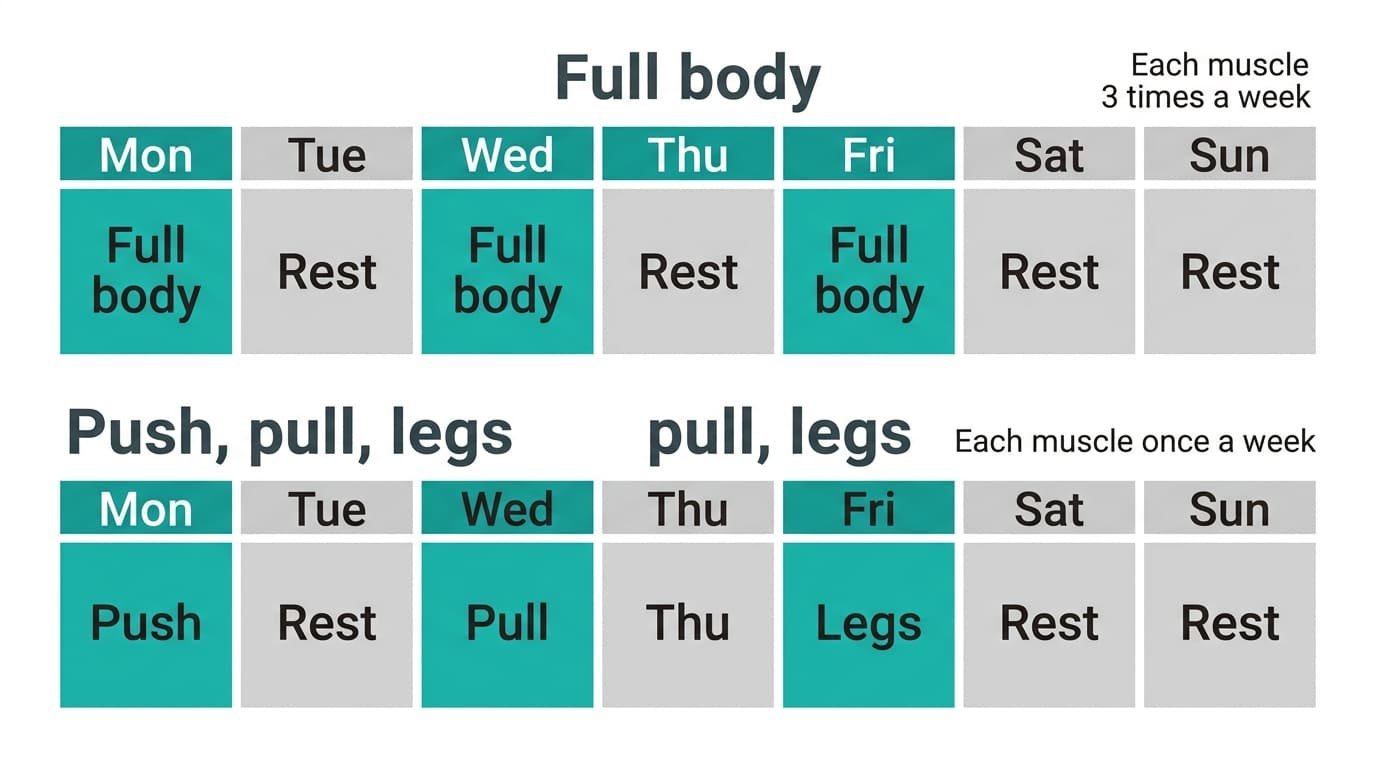
The question is how to arrange those three days. You can train your whole body each time, split it into push, pull and legs, or mix upper and lower sessions. Each option trains every muscle, but they differ in one important way: how often each muscle gets worked. That single difference decides which split suits a beginner and which suits someone with a few years of training behind them.
This guide compares the main three-day splits, tells you plainly which one to choose, and gives you three complete routines: a full-body plan for the gym, a full-body plan for home with dumbbells, and a push, pull, legs plan for when you are ready to move on.
At a glance
- Three sessions a week is enough to build strength and muscle
- For beginners, full body three times a week is the best choice
- Full body trains each muscle three times a week. Push, pull, legs trains each only once
- Train on non-consecutive days, such as Monday, Wednesday and Friday
- Each session needs 5 to 7 exercises and takes 45 to 60 minutes
- Add weight or reps over time. The split matters less than getting stronger
What a workout split is
A split is simply how you divide your training across the week. Every sensible split covers the same muscles. What changes is how they are grouped and how often each one is trained.
| 3-day split | Day 1 | Day 2 | Day 3 | Times each muscle is trained per week |
|---|---|---|---|---|
| Full body | Full body | Full body | Full body | 3 |
| Upper, lower, full | Upper body | Lower body | Full body | 2 |
| Push, pull, legs | Push | Pull | Legs | 1 |
| Body part split | Chest and back | Legs | Shoulders and arms | 1 |
That last column is the one to look at.
Why training frequency matters
Research on how often to train a muscle points in a consistent direction: training each muscle group at least twice a week produces more muscle growth than training it once, when the total amount of work is the same.
There are practical reasons too, especially for beginners:
- You get more practice. Squatting three times a week teaches the movement far faster than squatting once
- Each session is less punishing. Three or four sets per muscle is more manageable than ten in one go, and the quality of each set is higher
- A missed session costs less. Miss leg day on a push, pull, legs plan and your legs go two weeks without training. Miss one full-body session and every muscle is still trained twice that week
- Recovery is built in. A day off between sessions is enough when the work per muscle is moderate
With only three days available, a push, pull, legs split trains each muscle once a week. That is why it is a better fit for a six-day schedule, where the cycle runs twice.
Which 3-day split should you choose?
| Your situation | Best split | Why |
|---|---|---|
| New to strength training | Full body | Most practice, highest frequency, forgiving if you miss a day |
| Training for under a year | Full body | Still progressing quickly on the basics |
| Training for a year or more, want variety | Upper, lower, full | Twice-weekly frequency with more exercises per area |
| Enjoy focused sessions and long workouts | Push, pull, legs | Fine for maintenance, but lower frequency |
| Can only train two days some weeks | Full body | Each session still covers everything |
| Main goal is fat loss | Full body | Works the most muscle each session |
The short answer: if you are reading a beginner site, choose full body. Move to an upper, lower, full arrangement when your full-body sessions start to run long because you need more sets per muscle.
How to schedule the three days
Put at least one rest day between sessions.
| Option | Training days | Rest days |
|---|---|---|
| Classic | Monday, Wednesday, Friday | Tuesday, Thursday, weekend |
| Alternative | Tuesday, Thursday, Saturday | Monday, Wednesday, Friday, Sunday |
| Weekend-friendly | Sunday, Tuesday, Thursday | Monday, Wednesday, Friday, Saturday |
Rest days do not mean doing nothing. Walking, light cycling or stretching all help. Our rest day activities guide has ideas.
If you miss a day, simply do that session on your next available day and carry on. Do not try to squeeze two sessions into one.
How each session is built
A balanced full-body session covers five movement patterns. This is more useful than thinking in terms of individual muscles.
| Pattern | What it trains | Examples |
|---|---|---|
| Squat | Quads, glutes | Goblet squat, back squat, split squat |
| Hinge | Hamstrings, glutes, lower back | Romanian deadlift, hip thrust, deadlift |
| Push | Chest, shoulders, triceps | Push-up, bench press, overhead press |
| Pull | Back, biceps | Row, pull-up, lat pulldown |
| Core and carry | Trunk | Plank, dead bug, farmer’s carry |
Pick one exercise for each pattern, add one or two extras for areas you want to improve, and you have a session. Our guide on how many exercises per workout explains why five to seven is the right number.
Routine 1: full body, three days a week (gym)
Three different sessions, A, B and C, so each pattern is trained with a slightly different exercise through the week. Rest 90 seconds to 2 minutes on the first two exercises and 60 to 90 seconds on the rest.
Day A
| Exercise | Sets | Reps |
|---|---|---|
| Back squat or goblet squat | 3 | 8 to 10 |
| Bench press or dumbbell press | 3 | 8 to 10 |
| Seated cable row | 3 | 10 to 12 |
| Romanian deadlift | 2 | 10 |
| Dumbbell lateral raise | 2 | 12 to 15 |
| Plank | 3 | 30 to 45 seconds |
Day B
| Exercise | Sets | Reps |
|---|---|---|
| Deadlift or trap bar deadlift | 3 | 5 to 8 |
| Overhead press | 3 | 8 to 10 |
| Lat pulldown or assisted pull-up | 3 | 8 to 12 |
| Split squat | 2 | 10 per leg |
| Dumbbell curl | 2 | 10 to 12 |
| Dead bug | 3 | 8 per side |
Day C
| Exercise | Sets | Reps |
|---|---|---|
| Leg press or front squat | 3 | 10 to 12 |
| Incline dumbbell press | 3 | 10 to 12 |
| One-arm dumbbell row | 3 | 10 per side |
| Hip thrust | 3 | 10 to 12 |
| Triceps pushdown or overhead extension | 2 | 12 |
| Farmer’s carry | 3 | 30 seconds |
Routine 2: full body, three days a week (home, dumbbells)
All you need is a pair of dumbbells and a chair or sofa. Rest 60 to 90 seconds between sets.
Day A
| Exercise | Sets | Reps |
|---|---|---|
| Goblet squat | 3 | 10 to 12 |
| Push-up, or incline push-up | 3 | 8 to 12 |
| One-arm dumbbell row | 3 | 10 per side |
| Dumbbell Romanian deadlift | 3 | 10 |
| Dumbbell lateral raise | 2 | 12 to 15 |
| Plank | 3 | 30 seconds |
Day B
| Exercise | Sets | Reps |
|---|---|---|
| Reverse lunge | 3 | 8 per leg |
| Dumbbell overhead press | 3 | 8 to 10 |
| Dumbbell pullover | 3 | 10 to 12 |
| Glute bridge, weighted | 3 | 12 to 15 |
| Dumbbell curl | 2 | 10 to 12 |
| Dead bug | 3 | 8 per side |
Day C
| Exercise | Sets | Reps |
|---|---|---|
| Bulgarian split squat, foot on a chair | 3 | 8 per leg |
| Floor press | 3 | 10 to 12 |
| Bent-over two-dumbbell row | 3 | 10 |
| Single-leg Romanian deadlift, with support | 2 | 8 per leg |
| Overhead triceps extension | 2 | 12 |
| Suitcase carry | 3 | 30 seconds per side |
If you do not own dumbbells yet, our full-body workout for beginners uses bodyweight only, and the dumbbell workout plan for beginners has more home options.
Routine 3: push, pull, legs (three days)
Use this once you have at least a year of consistent training and you prefer longer, more focused sessions. Because each muscle is trained once a week, each session has more sets.
Push day: chest, shoulders, triceps
| Exercise | Sets | Reps |
|---|---|---|
| Bench press or dumbbell press | 4 | 6 to 10 |
| Overhead press | 3 | 8 to 10 |
| Incline dumbbell press | 3 | 10 to 12 |
| Lateral raise | 3 | 12 to 15 |
| Triceps extension | 3 | 10 to 12 |
Pull day: back, biceps, rear shoulders
| Exercise | Sets | Reps |
|---|---|---|
| Pull-up or lat pulldown | 4 | 6 to 10 |
| Barbell or dumbbell row | 3 | 8 to 10 |
| Seated row or chest-supported row | 3 | 10 to 12 |
| Reverse fly or face pull | 3 | 12 to 15 |
| Dumbbell curl | 3 | 10 to 12 |
Leg day: quads, hamstrings, glutes, calves
| Exercise | Sets | Reps |
|---|---|---|
| Squat | 4 | 6 to 10 |
| Romanian deadlift | 3 | 8 to 10 |
| Split squat or lunge | 3 | 10 per leg |
| Hip thrust | 3 | 10 to 12 |
| Calf raise | 3 | 12 to 15 |
Our push day workout and pull day workout guides cover those two sessions in detail, including home versions.
A 5-minute warm-up for any session
- Three minutes of easy movement: brisk walking, cycling or marching on the spot
- Ten bodyweight squats
- Ten hip hinges, hands sliding down the thighs
- Ten arm circles each direction
- Ten incline push-ups or band pull-aparts
- One or two lighter sets of your first exercise before your working sets
The lighter sets matter most. They rehearse the exact movement you are about to load and do not count toward your working sets.
Exercise swaps
You do not need the exact exercises listed. Swap within the same movement pattern and the routine still works.
| If you cannot do | Use instead | Pattern |
|---|---|---|
| Back squat | Goblet squat, leg press, split squat | Squat |
| Deadlift | Romanian deadlift, hip thrust, kettlebell deadlift | Hinge |
| Bench press | Push-up, dumbbell floor press, machine press | Push |
| Overhead press | Seated dumbbell press, pike push-up | Push |
| Pull-up | Lat pulldown, band-assisted pull-up, inverted row | Pull |
| Barbell row | One-arm dumbbell row, seated cable row | Pull |
| Plank | Dead bug, side plank, carry | Core |
Swap for comfort, not novelty. If an exercise hurts a joint, change it. If it is simply hard, keep it. Staying with the same exercises for at least eight weeks is what lets you measure progress.
Three days versus four or five
More days are not automatically better. They give you room for more total sets, which matters more as you become experienced.
| Days per week | Typical split | Best for | Trade-off |
|---|---|---|---|
| 2 | Full body twice | Very busy weeks, older beginners | Less total work, slower progress |
| 3 | Full body, or upper, lower, full | Beginners and most intermediates | Sessions get long as you advance |
| 4 | Upper, lower, upper, lower | Intermediates wanting more volume | Needs four reliable days |
| 5 to 6 | Push, pull, legs twice, or body part splits | Experienced lifters | High time demand, recovery must be good |
For the first year, three days is not a compromise. Most beginners gain as much from three good sessions as from five, because recovery, not training time, is the limit. Our guide on how many days a week you should work out covers this in more detail.
How to progress
The split is only a container. What produces results is doing a little more over time.
Use double progression:
- Start at the bottom of the rep range with a weight you can lift with good form, stopping one or two reps before failure
- Each session, try to add a rep to one or more sets
- When you reach the top of the range on every set, add the smallest weight available and go back to the bottom of the range
- Write down what you did, every session
| Week | Goblet squat, target 3 sets of 10 to 12 | Action |
|---|---|---|
| Week 1 | 12 kg: 10, 10, 10 | Start |
| Week 2 | 12 kg: 11, 11, 10 | Add reps |
| Week 3 | 12 kg: 12, 12, 11 | Add reps |
| Week 4 | 12 kg: 12, 12, 12 | Top of range reached |
| Week 5 | 14 kg: 10, 10, 10 | Add weight, start again |
Our sets and reps guide explains the numbers behind this in more detail.
Take an easier week every 6 to 8 weeks. Use about two thirds of your normal sets for one week. It helps joints and motivation recover, and most people come back stronger.
What to expect
| Timeframe | What usually happens |
|---|---|
| Weeks 1 to 2 | Learning the movements, some soreness after sessions |
| Weeks 3 to 6 | Rapid strength gains as your nervous system adapts |
| Weeks 6 to 12 | First visible changes in muscle, clothes fit differently |
| Months 3 to 6 | Steady strength gains, clearer changes in shape |
| Beyond 6 months | Progress slows, and you may need more sets per muscle |
That last row is the signal to consider moving from full body to an upper, lower, full arrangement or a fourth training day.
The upper, lower, full option
A good middle step. Each muscle is trained twice a week, and the split sessions leave room for more exercises per area.
| Day | Session | Example exercises |
|---|---|---|
| Day 1 | Upper body | Bench press, row, overhead press, pulldown, curl, triceps extension |
| Day 2 | Lower body | Squat, Romanian deadlift, split squat, hip thrust, calf raise, plank |
| Day 3 | Full body | Deadlift, incline press, pull-up, lunge, lateral raise, carry |
Recovery between sessions
Three sessions only work if you recover from them. The training is the signal, and the growth happens on the days in between.
- Sleep 7 to 9 hours where you can. It is the single biggest factor in recovery
- Eat enough protein. Around 1.6 to 2.2 grams per kilogram of body weight per day is a well-supported target for building muscle. Our protein intake calculator works out your number
- Eat enough overall. Building muscle in a large calorie deficit is slow. If fat loss is the goal, keep the deficit modest
- Expect some soreness in the first two weeks. It fades as your body adapts, and mild soreness is not a reason to skip a session
- Watch for signs you need an easier week: weights that normally move well feel heavy, sleep gets worse, or your motivation drops for several sessions in a row
Seven common mistakes
- Picking a once-a-week split as a beginner, and missing out on practice and frequency
- Training on consecutive days and arriving at the second session still tired
- Doing too many exercises. Five to seven is enough
- Changing the programme every two weeks. Give a plan at least eight weeks
- Not tracking weights and reps, so there is no way to know if you are progressing
- Skipping legs or pulling work, which a full-body plan makes harder to do
- Training every set to failure, which builds fatigue faster than it builds muscle
Where cardio and other training fit
Three strength days leave four other days in the week.
- Walk daily if you can. It supports recovery and general health
- Add one or two cardio sessions on rest days if fat loss or fitness is a goal. Twenty to thirty minutes is enough
- Keep at least one day genuinely easy each week
- If you do cardio on a strength day, do it after the weights or several hours apart
Our beginner workout schedule shows how to fit strength, cardio and rest into a week.
The bottom line
A three-day split is enough to get strong and build muscle, and it is one of the easiest schedules to keep going.
If you are a beginner, train your whole body on three non-consecutive days. It gives you the most practice at each movement, works each muscle three times a week, and still covers everything when life makes you miss a session. Move to an upper, lower, full split, or push, pull, legs, once you have a year of steady training behind you and want more work per muscle.
Whichever split you choose, pick five to seven exercises per session, write your numbers down, and add a rep or a little weight whenever you can. That steady progression is what does the work.
If you train with a barbell, our guide to barbell exercises for beginners has form steps for every main lift.
Ready for more training days? Our push pull legs workout guide covers five and six day schedules, and the upper lower split is the best option for four days.
Much later, if you want to train more often still, our 5-day workout split covers the options.
If three full sessions feel like too much to organise, the 2-2-2 workout method is a simpler structure to start with.
Frequently asked questions
What is the best 3-day workout split?
For beginners, a full-body routine done three times a week on non-consecutive days. It trains each muscle three times a week, gives the most practice at the main movements, and still covers everything if you miss a session. Upper, lower, full is a good next step for more experienced lifters.
Is a 3-day split enough to build muscle?
Yes. Three well-planned sessions a week provide enough work to build muscle and strength, particularly for beginners and intermediates. What matters most is training each muscle at least twice a week, taking sets close to failure, and adding weight or reps over time.
Is full body or push pull legs better for 3 days a week?
Full body is better for most people training three days. It works each muscle three times a week, while a three-day push, pull, legs split works each muscle only once. Push, pull, legs suits a six-day schedule, where the cycle is repeated twice.
What days should I work out on a 3-day split?
Any three non-consecutive days. Monday, Wednesday and Friday is the classic choice, and Tuesday, Thursday and Saturday works just as well. The key is having at least one rest day between sessions so you recover.
How long should each workout be?
About 45 to 60 minutes, including a short warm-up. That allows five to seven exercises with two to four sets each and proper rest between sets. If your sessions regularly run past 75 minutes, you are probably doing too many exercises.
Can I do a 3-day split at home?
Yes. A pair of dumbbells and a chair are enough for a full-body routine built on goblet squats, push-ups, rows, Romanian deadlifts and overhead presses. With no equipment at all, bodyweight versions of the same movement patterns work well for beginners.
Should I do cardio on rest days?
You can. Walking daily is helpful, and one or two cardio sessions of 20 to 30 minutes on rest days suit fat loss or fitness goals. Keep at least one day a week easy so you recover properly.
When should I change my workout split?
Stay with a plan for at least eight weeks. Consider changing when you have trained consistently for about a year, your full-body sessions are running long, or progress has stalled despite good effort, sleep and eating. Until then, keep adding reps and weight.
What’s next?
Reading is the easy part. Pick one of these and do it today.