
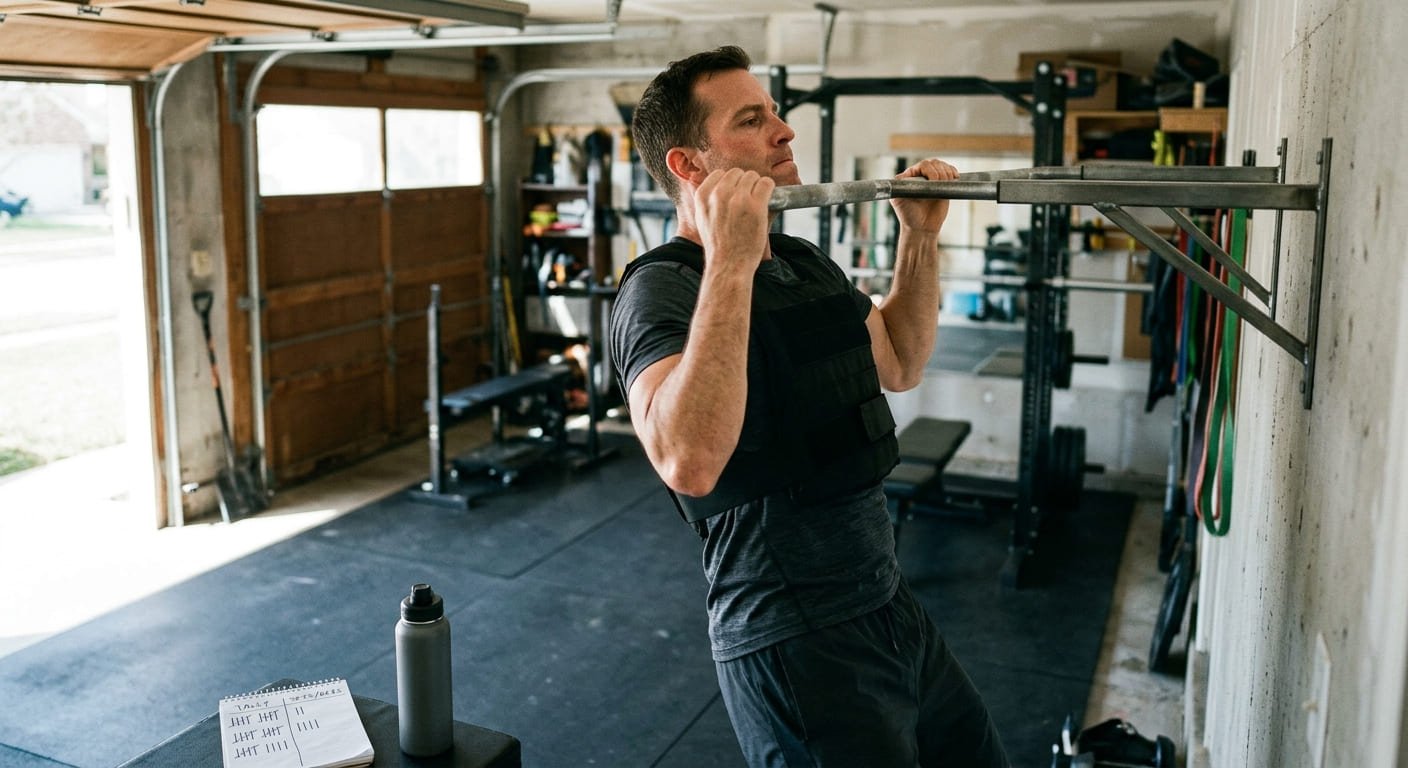
The Murph Workout: What It Is and How Beginners Can Scale It
The Murph is a famous bodyweight workout: a 1-mile run, 100 pull-ups, 200 push-ups, 300 air squats, then another 1-mile run, traditionally done wearing a 20 lb weighted vest. It’s named in honour of US Navy SEAL Lieutenant Michael Murphy, and every year thousands of people complete it around Memorial Day. For most beginners, the full version is far too much at first, but scaled versions like the half Murph and quarter Murph are genuinely achievable goals.
I first heard about the Murph when a friend described spending over an hour and a half grinding through it, then being unable to lift his arms properly for three days. My immediate thought was that it sounded awful. My second thought, a week later, was that I wanted to be able to do it. It took me months of building up, starting with a quarter Murph, and finishing my first full Murph remains one of the proudest training days I’ve had.
This guide explains what the Murph is, the story behind it, typical times, how to scale it, and how to build up to it safely without hurting yourself.
At a glance
- Full Murph: 1-mile run, 100 pull-ups, 200 push-ups, 300 squats, 1-mile run
- Standard version: done with a 20 lb vest (14 lb in many women’s standards)
- Beginner starting point: a quarter Murph with scaled exercises, no vest
- Typical time: 45 to 90 minutes for most people who can finish it
- Most common strategy: split the reps into smaller rounds
- Traditionally done: on or around Memorial Day in the US
- Biggest risk: doing far too much volume without building up
What is the Murph workout?
The Murph is a benchmark workout, which means it’s a fixed session people repeat over time to measure their fitness. It became widely known through CrossFit, where it’s one of the “Hero” workouts named in honour of fallen military and first responder personnel.
| Part | Standard Murph | Half Murph | Quarter Murph |
|---|---|---|---|
| Run | 1 mile (1.6 km) | Half a mile (800 m) | A quarter mile (400 m) |
| Pull-ups | 100 | 50 | 25 |
| Push-ups | 200 | 100 | 50 |
| Air squats | 300 | 150 | 75 |
| Run | 1 mile (1.6 km) | Half a mile (800 m) | A quarter mile (400 m) |
| Weighted vest | 20 lb (14 lb in many women’s standards) | Optional | No |
The pull-ups, push-ups and squats can be done in any order and split up however you like, as long as you complete the first run before starting them and the second run after finishing them.
The story behind the Murph
Lieutenant Michael P. Murphy was a US Navy SEAL killed in Afghanistan in June 2005 during Operation Red Wings. He was posthumously awarded the Medal of Honor for his actions.
The workout was one of his favourites. He reportedly called it “Body Armor”, because he often did it wearing a weighted vest or body armour. After his death, it was renamed in his honour and became one of the most widely recognised workouts in the world.
Every year, many gyms, clubs and individuals complete the Murph around Memorial Day in the United States, often as part of events that raise money for charities connected to his memory. For a lot of people, doing the Murph is as much about remembrance as it is about fitness, which is part of why it carries such weight in the training community.
What’s a good Murph time?
Murph times vary enormously depending on fitness, whether you wear a vest and how you scale the movements. These rough ranges give a sense of what to expect for the full, unscaled workout:
| Level | Approximate time (full Murph) |
|---|---|
| Elite, with vest | Under 40 minutes |
| Very fit, with vest | 40 to 50 minutes |
| Fit, without vest | 45 to 65 minutes |
| Regular trainee, scaled or partitioned | 60 to 90 minutes |
| First attempt for most people | 75 minutes or more |
Your first goal should simply be finishing safely, with good form. Time comes later. Comparing your first Murph to elite times is a quick route to discouragement or injury.
How to split up the reps
Very few people do all 100 pull-ups, then all 200 push-ups, then all 300 squats. Most split the work into rounds, which spreads the fatigue across your muscles and keeps form much better.
| Strategy | Each round | Rounds | Good for |
|---|---|---|---|
| 20 rounds | 5 pull-ups, 10 push-ups, 15 squats | 20 | Most people, balances fatigue well |
| 10 rounds | 10 pull-ups, 20 push-ups, 30 squats | 10 | Stronger athletes |
| Mini chunks | 5 pull-ups, 5 push-ups, 15 squats, 5 push-ups | 20 | People whose push-ups fail first |
| Straight through | All pull-ups, then push-ups, then squats | 1 | Very advanced only |
The 20-round version, 5 pull-ups, 10 push-ups and 15 squats, is by far the most popular, and it’s what I’d recommend for your first attempt at any version. For a half Murph, that’s 10 rounds. For a quarter Murph, 5 rounds.
How to scale the Murph for beginners
Scaling means adjusting the workout so it matches your current fitness. Good scaling keeps the spirit of the workout while protecting you from doing too much.
Scale the volume
The simplest way to scale is to do a smaller version: quarter Murph, then half Murph, then three-quarter Murph, then the full workout. That’s how I built up, and it’s the approach I’d recommend for almost everyone.
Scale the pull-ups
Pull-ups are the limiting factor for most beginners. Good substitutes include:
- Ring rows or table rows: pull your chest towards a bar or sturdy table edge
- Band-assisted pull-ups: a resistance band reduces the load
- Jumping pull-ups: use a small jump to help you up, then lower slowly
- Negatives: jump to the top and lower yourself slowly
If you don’t have a bar, my guide to pull-up alternatives covers options you can do at home.
Scale the push-ups
Push-ups tend to fail before anything else in the Murph, because 200 reps is a huge amount. Use incline push-ups on a sturdy bench or step, or knee push-ups, and keep every rep clean. My guide to incline and decline push-ups shows how to choose the right height.
Scale the squats
If 300 squats is too much, reduce the depth slightly, squat to a box or chair, or reduce the reps. My guide to what muscles squats work covers good squat form.
Scale the runs
You can replace the runs with a brisk walk, a row, a bike ride of similar effort, or simply shorter distances. The goal is to start and finish with a steady cardio effort, not a sprint.
Skip the vest
The weighted vest makes the workout significantly harder and puts more load on your joints. Leave it out until you can comfortably complete the full Murph without one.
An 8-week plan to build up to your first Murph
This plan works towards a scaled half Murph by week 8. Do the Murph-style sessions once a week, with two other strength or cardio sessions and plenty of rest.
| Week | Murph session | Other training |
|---|---|---|
| Week 1 | Quarter Murph, scaled exercises, 5 rounds of 5-10-15 | 2 easy runs or walks, 1 full body session |
| Week 2 | Quarter Murph, scaled | Same as week 1 |
| Week 3 | 3 rounds of half Murph reps, then stop | Add one extra push-up and pull-up practice session |
| Week 4 | Recovery week: quarter Murph only | Easy cardio and mobility |
| Week 5 | Half Murph without runs | 2 runs, 1 strength session |
| Week 6 | Half Murph with shorter runs | Same as week 5 |
| Week 7 | Half Murph, standard runs, scaled exercises | Lighter training otherwise |
| Week 8 | Half Murph, try to reduce scaling slightly | Easy week before and after |
Spread your pull-up and push-up practice through the week in small doses. A few sets of 3 to 5 good reps on several days builds strength far better than one exhausting session.
A serious safety note: too much too soon
The Murph involves a very large number of reps. For people who aren’t used to high-volume training, doing too much at once can cause more than ordinary soreness. In rare cases, extreme muscle breakdown, called rhabdomyolysis, can occur. It can be serious and needs urgent medical care.
The risk is highest when someone who is untrained or returning from a long break attempts a huge workout like the full Murph, especially in hot weather or while dehydrated.
Get urgent medical help if, after a hard workout, you have severe muscle pain that seems far beyond normal soreness, significant swelling, extreme weakness, or dark brown or cola-coloured urine. Don’t try to push through or wait it out.
The best prevention is simple: build up gradually, scale the workout, stay hydrated, and don’t attempt the full Murph as your first big training session.
Tips for the day itself
- Warm up properly. Five minutes of easy cardio, arm circles, some light squats, push-ups and pull-up or row practice.
- Pace the first run. Going out too fast leaves you exhausted before the reps even start.
- Use rounds. The 5-10-15 split keeps things manageable.
- Keep rests short but real. Planned short breaks beat long collapses.
- Break push-ups early. Don’t wait until they fail. Split them into smaller sets from the start.
- Keep water nearby, especially if it’s warm.
- Walk if you need to on the final run. Finishing matters more than looking fast.
- Record your time and scaling. Next year, you’ll have something to beat.
Recovery after the Murph
Expect significant soreness, especially in your chest, arms, shoulders and legs, for two or three days. Gentle walking, light stretching, good sleep, plenty of fluids and proper meals with protein all help. My guide on how to reduce muscle soreness has more detail.
Don’t do another hard upper body session for several days afterwards. The Murph asks a lot of your body, and it deserves a proper recovery.
Training that prepares you well
Several training styles build the fitness you need for the Murph:
- Push-up and pull-up practice in small, frequent sets across the week
- Squat endurance work, such as sets of 20 to 30 bodyweight squats
- Steady running a couple of times a week, like the sessions in my cardio exercises for beginners guide
- Bodyweight circuits, especially time-based ones like the AMRAP workout
- Military-style calisthenics, which use very similar exercises. My military calisthenics workout plan is a good foundation
Warming up for the Murph
Because the Murph asks so much of your shoulders, a thorough warm-up is essential. Spend 8 to 10 minutes on easy jogging, jumping jacks, arm circles, band pull-aparts if you have a band, a few scap pull-ups or table rows, some incline push-ups and bodyweight squats. My general warm-up routine is a good base.
Doing the Murph at home without a pull-up bar
Plenty of people do the Murph at home, and you don’t need a gym to take part. The main challenge is the pull-ups, and there are good solutions.
| If you have | Use this instead of pull-ups | Notes |
|---|---|---|
| A doorway pull-up bar | Band-assisted pull-ups or negatives | Closest to the real movement |
| A sturdy table | Table rows, lying underneath and pulling your chest up | Check the table can take your weight |
| Two sturdy chairs and a broom handle | Inverted rows | Only if everything is completely stable |
| Nothing suitable | Towel rows around a closed door, or extra push-ups and squats | Least similar, but keeps the spirit |
For the runs, a route of roughly the right distance outdoors is ideal. If that isn’t possible, use a treadmill, an exercise bike, or even marching and jogging on the spot for a similar length of time. The goal is a steady cardio effort at the start and end, not a precise mile.
Space-wise, you need enough floor for push-ups and squats, and somewhere to keep count. A notepad with tally marks for each round is surprisingly helpful when you’re tired.
Doing the Murph with a partner or team
The Murph is often done in teams, especially at Memorial Day events, and it’s a great way to make the workout more achievable and more social.
- Partner Murph: both people run together, then split the 100 pull-ups, 200 push-ups and 300 squats between them however they like, before running together again.
- Team Murph: larger groups share the reps, with each person taking a turn while others rest.
- Relay runs: team members take turns running shorter distances to make up the miles.
Partner and team versions are a brilliant way for beginners to join in without taking on the full volume alone. They also keep the sense of occasion, which is a big part of why people love this workout.
Eating and drinking around the Murph
Because the Murph is long and demanding, what you eat and drink around it matters more than for a typical workout.
- Eat a normal meal two to three hours before. Something with carbohydrate and a little protein, like porridge with banana or eggs on toast.
- Drink water in the hours beforehand, especially if it’s warm.
- Keep water nearby during the workout and sip between rounds.
- Eat properly afterwards, with protein and carbohydrate, to support recovery.
- Avoid alcohol the night before and immediately after, since it worsens dehydration.
My guides on what to eat before a workout and what to eat after a workout go into both in more detail.
After your first Murph: what next?
Once you’ve completed a scaled version, the natural next steps are to reduce the scaling gradually: fewer assisted pull-ups, lower push-up inclines, longer runs, then eventually a bigger fraction of the workout.
Many people make the Murph an annual tradition, recording their time and scaling each year. It becomes a really satisfying measure of how much fitter you’ve become. Some people then add the vest, but there’s absolutely no requirement to. An unweighted full Murph, done with good form, is a genuinely impressive achievement.
Common Murph mistakes
- Attempting the full Murph with no preparation. The most common and most risky mistake.
- Wearing a vest too early. Leave it until the unweighted version feels manageable.
- Sprinting the first mile. Pace yourself.
- Doing all the pull-ups first. It wrecks your grip and shoulders early.
- Poor push-up form. Sagging hips and half reps add up over 200 reps.
- Not scaling. Scaling isn’t cheating. It’s how you build up to the real thing.
- Ignoring warning signs. Sharp pain or unusual symptoms are reasons to stop.
Doing it with the right intent
It’s worth remembering why this workout exists. For many people, especially in military and first responder communities, the Murph is a genuine act of remembrance rather than just a hard session. You don’t need to be connected to the military to take part, and people everywhere do it in that spirit.
If you do the Murph around Memorial Day, many gyms and clubs link it to fundraising for charities that support service members, veterans and their families. Taking a moment before you start to read about Lieutenant Murphy, or joining an organised event, adds real meaning to the workout. Scaled or full, fast or slow, it’s the effort and the intent that matter.
The bottom line
The Murph is a tough, meaningful workout: a 1-mile run, 100 pull-ups, 200 push-ups, 300 squats and another 1-mile run, traditionally done in memory of Lieutenant Michael Murphy. For beginners, the full version is a long-term goal, not a first-week challenge.
Start with a scaled quarter Murph, split the reps into rounds, build up over weeks, and only add the vest when you’re ready. Finish safely, record your time and scaling, and enjoy the satisfaction of improving each year.
Frequently asked questions
What is the Murph workout?
The Murph is a benchmark workout consisting of a 1-mile run, 100 pull-ups, 200 push-ups, 300 air squats and another 1-mile run, traditionally done wearing a 20 lb weighted vest. It’s named after US Navy SEAL Lieutenant Michael Murphy.
Why is it called the Murph?
It’s named in honour of Lieutenant Michael P. Murphy, a US Navy SEAL killed in Afghanistan in 2005 and posthumously awarded the Medal of Honor. The workout was one of his favourites, and he reportedly called it Body Armor.
How long does the Murph take?
Most people who can complete the full Murph take between 45 and 90 minutes. Very fit athletes finish in under 40 minutes with a vest, while first attempts often take 75 minutes or more.
What is a half Murph?
A half Murph halves every part of the workout: a half-mile run, 50 pull-ups, 100 push-ups, 150 air squats and another half-mile run. It’s a great goal for people building up to the full workout.
Can beginners do the Murph?
Beginners should start with a scaled version, such as a quarter Murph with ring rows, incline push-ups and no vest. Attempting the full Murph without preparation risks extreme soreness and, in rare cases, serious muscle breakdown.
How should I split up the Murph reps?
The most popular method is 20 rounds of 5 pull-ups, 10 push-ups and 15 squats between the two runs. For a half Murph that’s 10 rounds, and for a quarter Murph it’s 5 rounds.
Do you have to wear a vest for the Murph?
The standard version uses a 20 lb vest, often 14 lb for women, but it’s optional for most people. Beginners should complete the workout without a vest first, and only add weight once the unweighted version feels manageable.
When do people do the Murph?
Many people do the Murph on or around Memorial Day in the United States, the last Monday in May, as a tribute to Lieutenant Murphy and other fallen service members. It can be done at any time of year as a fitness benchmark.
Source: NHS, Physical activity guidelines for adults aged 19 to 64