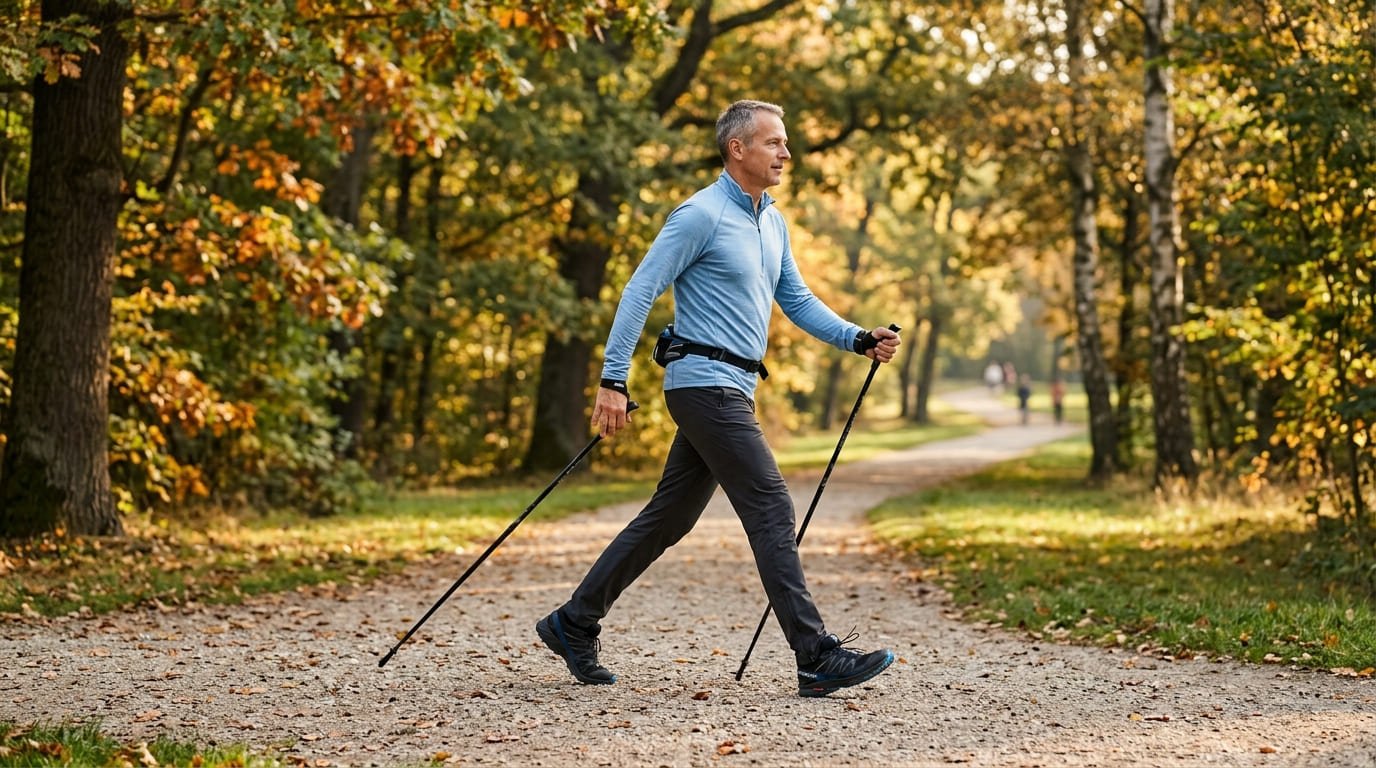
Nordic Walking for Beginners: Technique, Poles, Benefits and a 6-Week Plan
Nordic walking is ordinary walking with a clever twist: you carry two specially designed poles and use them to push yourself along. It started as summer training for cross-country skiers in Finland, and it has become one of the most popular forms of exercise for adults of all ages across Europe. Walk past a park on a weekday morning in Germany or Scandinavia and you will often see a group clicking along with their poles.
What makes Nordic walking interesting is that it turns walking into a whole-body exercise. Your arms, shoulders, back and core join in, so you burn more energy at the same speed, often without feeling that you are working any harder. The poles can also make walking feel more stable for people who are less steady on their feet.
This guide covers what Nordic walking is, the real benefits backed by research, how to choose and size Nordic walking poles, step-by-step Nordic walking technique, common mistakes, a 6-week beginner plan and safety tips.
At a glance
- Nordic walking means walking with two purpose-made poles that you push behind you
- It works the upper body as well as the legs, turning walking into a whole-body exercise
- A field study found it raised calorie burn by roughly 17 to 21 percent at the same distance, without feeling harder
- A systematic review found benefits for heart rate, blood pressure, fitness and quality of life
- Proper Nordic walking poles have hand straps and are lighter than hiking poles
- Pole length is roughly your height in centimetres multiplied by 0.68
- Good technique matters: arms swing naturally, poles angle backward, push behind you
What is Nordic walking?
Nordic walking uses poles in a specific way. Rather than placing the poles in front of you for support, as with hiking poles, you plant them at an angle behind you and push off. Each push helps propel you forward and brings your arms, shoulders and back into the movement.
| Feature | Nordic walking | Regular walking | Hiking with poles |
|---|---|---|---|
| Poles | Two, with special gloves or straps | None | Two, usually with simple loops |
| Pole angle | Backward, pushing behind you | Not applicable | Forward or upright, for support |
| Upper body work | High | Low | Moderate |
| Main purpose | Fitness and whole-body exercise | Getting around, light fitness | Support and balance on rough ground |
| Terrain | Parks, paths, tracks, trails | Anywhere | Hills and mountains |
Nordic walking benefits
1. More calories burned at the same speed
A field study had 22 adults walk 1,600 metres on a track with and without poles. With Nordic walking, women burned about 5.4 calories a minute compared with 4.6 without poles, and men burned about 6.9 compared with 5.7. Oxygen use and heart rate also rose. Importantly, the walkers did not feel they were working significantly harder.
That works out to roughly 17 to 21 percent more energy used. Not every study finds such a big difference, and it depends a lot on how actively you push with the poles. But for many people, it means more exercise for the same effort.
2. Broad health benefits
A systematic review of 16 randomised trials with 1,062 participants and 11 observational studies with 831 participants found that Nordic walking had beneficial effects on resting heart rate, blood pressure, exercise capacity, maximal oxygen uptake and quality of life. In several measures it outperformed brisk walking without poles, and in some measures it even compared well with jogging.
3. Good for older adults
A meta-analysis of 15 studies in older adults found that Nordic walking improved dynamic balance, functional mobility and aerobic capacity, and the authors described it as a safe and accessible form of aerobic exercise for older people.
4. Other Nordic walking benefits
| Benefit | Why it happens |
|---|---|
| Upper body workout | Arms, shoulders, chest and back push the poles with every step |
| Better posture | The arm swing encourages an upright, open chest |
| More stability | Four points of contact instead of two |
| Sociable | Popular in groups and clubs |
| Easy to learn | Most people pick up the basics in one or two sessions |
| Low impact | Gentler on the joints than running |
Choosing Nordic walking poles
What to look for
| Feature | Why it matters |
|---|---|
| Proper Nordic straps or gloves | Let you push the pole and release it without gripping tightly |
| Light shaft (aluminium or carbon) | Less tiring for your arms |
| Removable rubber paws | Quiet and grippy on pavements and tarmac |
| Hardened tips | Grip on grass, gravel and trails when the paws are removed |
| Fixed or adjustable length | Fixed poles are lighter and sturdier, adjustable poles are easier to share and travel with |
| Comfortable grip | Cork or rubber feels good for long walks |
Hiking or trekking poles can be used for Nordic walking at a pinch, but they usually lack the proper strap system and are often designed to be planted in front of you, not pushed behind. If you enjoy it, a pair of real Nordic walking poles is a worthwhile upgrade. There are no affiliate links on this page, and I am not recommending specific brands.
How long should Nordic walking poles be?
A common guide is to multiply your height in centimetres by 0.68 and round to the nearest 5 cm. When you hold the pole with the tip on the ground beside your foot, your elbow should be bent at about 90 degrees.
| Your height | Suggested pole length |
|---|---|
| 150 cm (4 ft 11 in) | About 100 to 105 cm |
| 160 cm (5 ft 3 in) | About 105 to 110 cm |
| 170 cm (5 ft 7 in) | About 115 cm |
| 180 cm (5 ft 11 in) | About 120 to 125 cm |
| 190 cm (6 ft 3 in) | About 130 cm |
Beginners often prefer poles a little on the shorter side, because they are easier to control. If you are between sizes, choose the shorter one.
Nordic walking technique step by step
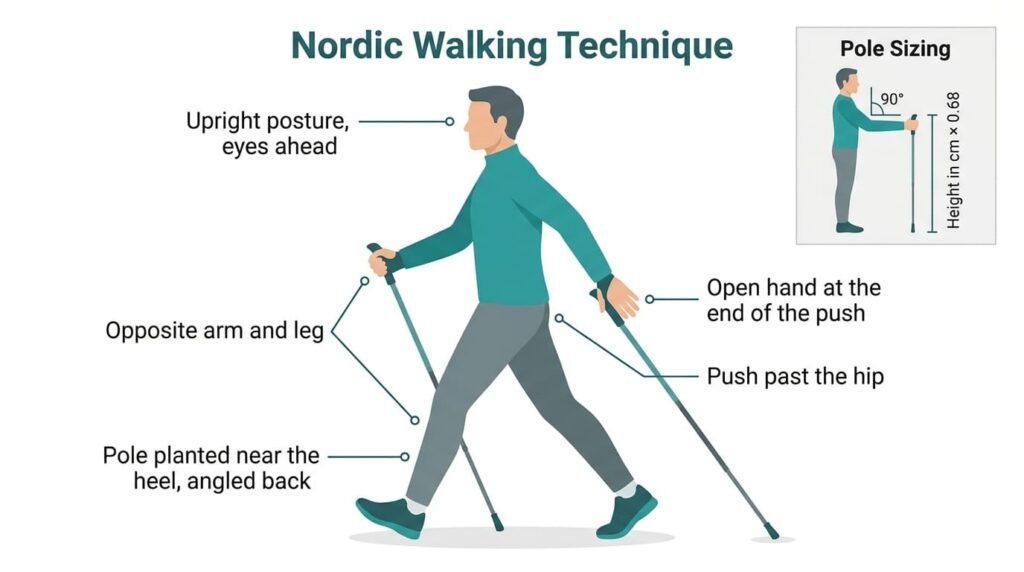
Step 1: Walk without poles first
Walk normally and notice your arms. They swing opposite to your legs: right arm forward with the left leg. Nordic walking technique uses exactly this natural rhythm.
Step 2: Drag the poles
Put the straps on and let the poles hang loosely from your wrists, trailing behind you. Walk for a minute or two, swinging your arms naturally while the poles drag along the ground. This teaches the opposite arm and leg pattern without thinking about planting.
Step 3: Start to plant
As your arm swings forward, let the pole tip touch the ground roughly level with your heel, angled backward. Do not plant it out in front of you.
Step 4: Push
Push down and back through the strap as your body moves past the pole. Your arm finishes behind your hip, almost straight.
Step 5: Open your hand
At the end of the push, open your hand slightly and let the strap carry the pole. Close your hand again as your arm swings forward. This relaxed grip prevents tension in your forearms.
Step 6: Lengthen your stride
As you get comfortable, take slightly longer steps and push a little harder. You should feel your upper back, shoulders and arms working.
| Body part | What to do |
|---|---|
| Head and eyes | Look ahead, not at your feet |
| Shoulders | Relaxed and down |
| Arms | Swing naturally from the shoulder, almost straight |
| Hands | Grip as the pole lands, open as it pushes past |
| Poles | Angled backward, tips planted around heel level |
| Feet | Heel strike, roll through to push off from the toes |
| Trunk | Upright with a slight forward lean, gentle rotation |
Common Nordic walking mistakes
| Mistake | What happens | Fix |
|---|---|---|
| Planting poles in front of you | Poles act as brakes | Plant at heel level, angled back |
| Same arm and leg moving together | Awkward, unnatural rhythm | Start again with the dragging drill |
| Gripping the poles tightly | Tense forearms and shoulders | Relax your hands, let the straps work |
| Short, choppy arm swing | Little upper body work | Swing from the shoulder, push past the hip |
| Poles too long | Shoulders hunch up | Use the height times 0.68 guide |
| Looking down | Rounded posture | Eyes forward, chest open |
A 6-week Nordic walking plan for beginners
Walk 3 times a week, ideally on flat, smooth paths at first.
| Week | Session length | Focus |
|---|---|---|
| 1 | 20 minutes | Dragging drill, then light planting. Easy pace |
| 2 | 25 minutes | Planting and pushing. Relaxed hands |
| 3 | 30 minutes | Longer stride and stronger push in short bursts |
| 4 | 30 to 35 minutes | Include a gentle hill or two |
| 5 | 35 to 40 minutes | Two 5-minute faster sections in each walk |
| 6 | 40 to 45 minutes | Mix of steady walking and three faster sections |
Warm up with 5 minutes of easy walking without pushing hard, and finish with a few minutes of easy walking and stretches for your calves, chest and shoulders. Our guide on how long it takes to walk a mile helps you track your pace, and our walking calorie calculator gives a rough idea of your calorie burn.
Nordic walking for weight loss
Because you burn more energy at the same speed, Nordic walking can help a weight loss plan, especially if regular walking feels too easy and running feels too hard. As with any exercise, results depend on consistency and eating habits. Our walking for weight loss guide has a full plan you can follow with poles.
Who is Nordic walking good for?
- Beginners who want more than a gentle walk but are not ready to run
- Older adults who want more stability and whole-body exercise. Our leg exercises for seniors are a good addition
- People with sore knees or hips who need low-impact exercise. See our exercises for knee pain
- Hikers who want to build fitness for trails. See our strength training for hiking guide
- Anyone who enjoys walking and wants a little more from it
Where to Nordic walk
| Surface | Pole tip | Notes |
|---|---|---|
| Pavement and tarmac | Rubber paws on | Quiet and grippy |
| Park paths and gravel | Paws off | Tips grip better |
| Grass | Paws off | Great for learning, soft underfoot |
| Trails and hills | Paws off | Push harder uphill, shorter poles downhill |
| Snow | Paws off, snow baskets if available | Popular in Nordic countries |
Nordic walking vs regular walking
| Factor | Nordic walking | Regular walking |
|---|---|---|
| Muscles used | Legs, arms, shoulders, back, core | Mostly legs |
| Calories at the same speed | Often higher | Baseline |
| Feels harder? | Often not much harder | Baseline |
| Stability | Higher, with four points of contact | Normal |
| Equipment | Poles | None |
| Learning curve | A little practice needed | None |
Safety tips
- Start on flat, even ground while you learn
- Wear supportive walking shoes
- Use the rubber paws on hard surfaces to avoid slipping
- Take care around other people, dogs and bikes. Keep your poles close in crowds
- If you have shoulder, elbow or wrist problems, start with a gentle push and check with a physiotherapist
- Check with a doctor first if you have heart disease or other medical conditions
This article is general information, not medical advice. See our medical disclaimer.
A short history of Nordic walking
Cross-country skiers in Finland have used poles for summer training for decades, walking and bounding up hills to keep their upper bodies and legs in shape when there was no snow. In the late 1990s, purpose-made walking poles and a simple teaching method turned this into a fitness activity for everyone. Since then, Nordic walking has spread across Europe and beyond, with clubs, instructors and walking groups in many countries.
Your first Nordic walking session
Your first session will feel a little strange. That is normal. Here is a simple 20-minute plan:
| Minutes | What to do |
|---|---|
| 0 to 5 | Walk normally without poles, notice your arm swing |
| 5 to 10 | Wear the straps and drag the poles behind you |
| 10 to 15 | Start letting the poles touch down at heel level |
| 15 to 18 | Add a gentle push as each pole passes your hip |
| 18 to 20 | Easy walk and stretch |
Do not worry if the rhythm comes and goes. Most people find it clicks somewhere between the second and fourth session. If you lose the rhythm, go back to dragging the poles for a minute and start again.
Joining a Nordic walking group
Many parks, leisure centres and walking clubs run Nordic walking groups, often with a qualified instructor. A group is a great way to learn good Nordic walking technique quickly, borrow poles before buying your own, and stay motivated. Groups are also sociable, which is one reason Nordic walking is so popular with older adults.
Nordic walking on hills
| Direction | Technique tip |
|---|---|
| Uphill | Lean slightly forward, shorten your stride, push harder through the poles |
| Downhill | Bend your knees slightly, shorten your stride, plant the poles a little further forward for control |
| Steep ground | Consider shortening adjustable poles for descents and lengthening them for climbs |
Hills are where the poles really show their value. Uphill, your arms take some of the work from your legs. Downhill, the poles add balance and control.
Simple strength exercises for Nordic walkers
Nordic walking uses your upper body, so a little strength work makes it easier and more comfortable. Twice a week, try:
- Wall push-ups or knee push-ups, 2 sets of 10
- Band rows or bent-over dumbbell rows, 2 sets of 12
- Bodyweight squats, 2 sets of 12
- Calf raises, 2 sets of 15
- Side plank from the knees, 2 holds of 20 seconds per side
Our strength training for hiking guide has a fuller routine that suits Nordic walkers well.
Tracking steps and calories
Nordic walking counts toward your daily steps just like ordinary walking, and it often burns a little more energy per step. If you track steps, our steps to calories calculator gives a rough estimate of calories burned. Remember that the extra effort from the poles is not counted by most step trackers.
Looking after your poles
- Wipe poles clean after muddy walks
- Check that the rubber paws are not worn through
- Replace worn tips so they keep gripping on trails
- For adjustable poles, check the locks are tight before every walk
- Store poles somewhere dry
What to wear
Wear comfortable walking shoes with good grip, ideally lightweight trail shoes if you walk on paths or grass. Choose layers you can remove as you warm up, because Nordic walking raises your heart rate more than ordinary walking. Thin gloves help in cold weather and stop the straps rubbing. In the evening, wear something bright or reflective.
Staying motivated
Set a simple goal, such as three walks a week for six weeks, and tick each one off. Try new routes, invite a friend, or join a local group. Many people find that once Nordic walking technique becomes automatic, the walks feel more enjoyable and less like exercise, which is the best way to make the habit stick.
Nordic walking in all weathers
One of the nice things about Nordic walking is that it works in most weather. In rain, the poles add stability on slippery paths. In winter, remove the rubber paws so the metal tips grip on snow and frozen ground. In hot weather, walk early or late, carry water, and slow your pace. Whatever the season, short and regular walks beat long walks you only manage now and then. Keep a light jacket and your poles by the door so it is easy to head out whenever you have half an hour free.
The bottom line
Nordic walking turns an everyday walk into a whole-body workout, and it is one of the most beginner-friendly ways to get fitter. With proper Nordic walking poles, a natural arm swing and a backward push, you use your arms, shoulders, back and core as well as your legs. Research shows Nordic walking benefits include higher calorie burn at the same speed, better fitness, lower resting heart rate and blood pressure, and improved balance in older adults.
Choose poles that fit your height, learn the technique with the dragging drill, and follow the 6-week plan three times a week. It takes a few sessions to feel natural, but once it clicks, you may find it hard to go back to walking without them.
Frequently asked questions
What is Nordic walking?
Nordic walking is walking with two specially designed poles that you push behind you with each step. It works the upper body as well as the legs, turning walking into a whole-body exercise.
What are the main Nordic walking benefits?
Research shows benefits for resting heart rate, blood pressure, aerobic fitness and quality of life. It also burns more calories than walking at the same speed and can improve balance in older adults.
How do I choose Nordic walking poles?
Look for proper Nordic straps, a light shaft, removable rubber paws and the right length. A common guide is your height in centimetres multiplied by 0.68.
Does Nordic walking burn more calories?
Usually yes. One study found about 17 to 21 percent more calories burned at the same distance, without people feeling they worked harder. The difference depends on how actively you push.
Can I use hiking poles for Nordic walking?
You can try it, but hiking poles usually lack proper Nordic straps and are designed to be planted in front of you. Real Nordic walking poles make the technique easier.
What is the correct Nordic walking technique?
Swing your arms naturally opposite to your legs, plant the pole tips around heel level angled backward, push down and back past your hip, and open your hand slightly at the end of the push.
Is Nordic walking good for weight loss?
It can help, because it burns more energy than regular walking at the same speed. Combine it with sensible eating and regular sessions for the best results.
Is Nordic walking good for seniors?
Yes. Research suggests it improves balance, mobility and aerobic fitness in older adults, and the poles add stability. Start on flat paths and build up gradually.
How often should I go Nordic walking?
Three times a week for 30 to 45 minutes is a great target. Beginners can start with 20 minutes and add a few minutes each week.
What’s next?
Reading is the easy part. Pick one of these and do it today.