Deep Breathing Exercises for Anger: 8 Techniques That Calm You Down
Deep breathing exercises for anger are one of the simplest tools you can use when your temper starts to rise. They take less than a minute, need no equipment and work anywhere: in traffic, in a meeting, in the middle of an argument or lying awake replaying something that annoyed you.
Anger itself is a normal emotion. It tells you something feels unfair or threatening. The problem is what happens in the body when it spikes: your heart races, your breathing gets fast and shallow, your muscles tense, and it becomes much harder to think clearly before you speak or act. Slow breathing is one of the few ways to directly turn that reaction down.
This guide explains why breathing helps with anger, 8 deep breathing exercises for anger with clear steps, how to use them in the moment and as a daily habit, and when anger is a sign you need more support.
At a glance
- Anger triggers a stress response: faster breathing, a racing heart and tense muscles
- Slow breathing with long exhales activates the body’s calming system
- A systematic review linked slow breathing to more relaxation and less anxiety and anger
- In a Stanford study, 5 minutes a day of cyclic sighing improved mood more than mindfulness meditation
- An anger treatment review found relaxation techniques were especially helpful for in-the-moment anger
- The physiological sigh and extended exhale breathing are the fastest options in a heated moment
- Practise daily when calm, so the skill is ready when you need it
Why breathing helps when you are angry
When you get angry, your body switches into fight-or-flight mode. Stress hormones rise, your heart beats faster and your breathing becomes quick and high in the chest. That state is useful if you need to run from danger. It is not so useful when you are trying to reply calmly to a difficult email.
Your breathing is one of the few parts of this response you can control directly. Slow breaths, and especially long exhales, activate the parasympathetic nervous system, the “rest and digest” side of your nervous system. Heart rate starts to slow, muscles soften and the thinking part of the brain gets a chance to catch up.
A systematic review of slow breathing studies found it increased heart rate variability, a marker of calm and flexible nervous system activity, and was linked with more comfort, relaxation and alertness, and less anxiety, depression, anger and confusion in healthy people.
What research says about breathing and anger
| Study | What it found | What it means for you |
|---|---|---|
| Systematic review of slow breathing (2018) | Slow breathing increased calming nervous system activity and was linked with less anxiety and anger | Slowing your breath is a sensible first response to anger |
| Stanford breathwork trial (2023) | Five minutes a day of breathwork improved mood and lowered breathing rate, and exhale-focused cyclic sighing worked best, beating mindfulness meditation | Practise a few minutes daily, focusing on long exhales |
| Meta-analysis of anger treatments (2004) | Anger treatments had medium to large effects. Relaxation was recommended for in-the-moment (state) anger, while thinking-based therapies suited long-standing anger | Breathing helps in the moment. Lasting change may also need other strategies |
The honest summary: breathing exercises for anger are a well-supported way to calm your body in the moment. They are one tool, not the whole toolbox. If anger is frequent or damaging, they work best alongside other strategies or professional support.
How to do deep breathing exercises for anger
- Breathe low. Let your belly and lower ribs expand, rather than lifting your shoulders
- Make the exhale longer. The out-breath is where the calming effect is strongest
- Breathe through your nose when you can. It naturally slows the breath
- Do not force it. Big, strained breaths can make you feel light-headed
- Give it time. One breath helps a little. One to five minutes helps much more
- Stop if you feel dizzy. Return to normal breathing and try a gentler pattern
8 deep breathing exercises for anger
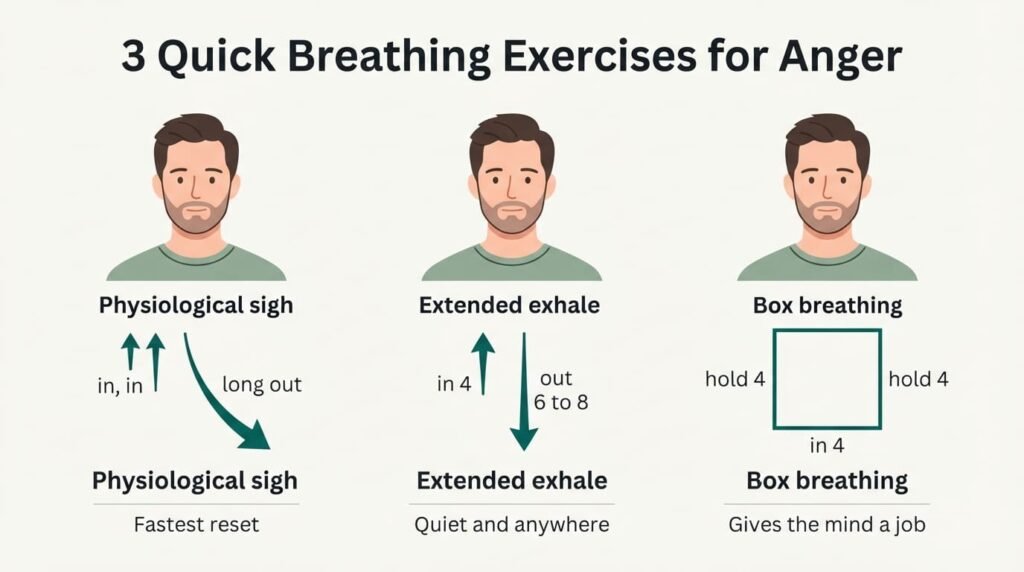
1. The physiological sigh (cyclic sighing)
This is the fastest of all calming breathing exercises, and it was the most effective pattern in the Stanford study.
- Breathe in through your nose
- At the top, take a second short sip of air through your nose to fill your lungs fully
- Breathe out slowly and completely through your mouth, as long as is comfortable
- Repeat
In the moment: 2 to 3 sighs. Daily practice: 5 minutes. The long exhale is what does the work.
2. Extended exhale breathing (4-6 or 4-8)
- Breathe in through your nose for a count of 4
- Breathe out slowly through your mouth or nose for a count of 6 to 8
- Repeat for 1 to 5 minutes
This is easy to do quietly in public. Nobody will notice you are using one of your deep breathing exercises for anger management in the middle of a conversation.
3. Box breathing
- Breathe in for 4 counts
- Hold for 4 counts
- Breathe out for 4 counts
- Hold for 4 counts
Repeat for 1 to 5 minutes. The counting gives your mind a job, which helps break the loop of angry thoughts. If holding feels uncomfortable, shorten the holds to 2 counts.
4. Diaphragmatic (belly) breathing
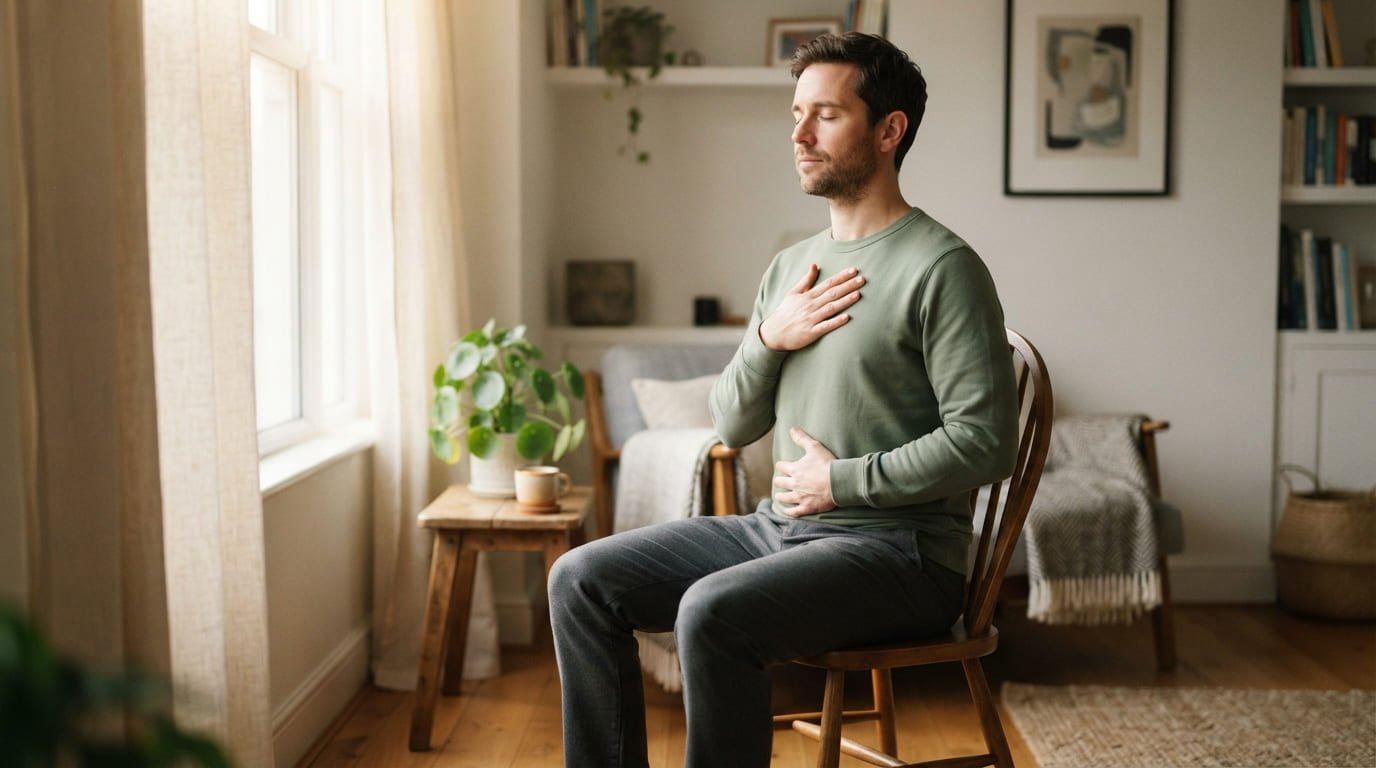
- Sit or lie down with one hand on your chest and one on your belly
- Breathe in slowly through your nose so the belly hand rises and the chest hand stays mostly still
- Breathe out slowly through pursed lips, feeling the belly fall
Practise for 5 minutes when calm. This builds the habit of breathing low, which makes every other technique easier. Our guide to breathing while running uses the same belly breathing.
5. Slow-paced breathing (about 6 breaths a minute)
Breathe in for about 5 seconds and out for about 5 seconds, so you take roughly 6 breaths per minute. Many people find this rhythm feels especially calming. Use a timer or a breathing app if counting is hard. Practise for 5 to 10 minutes a day.
6. Counting breaths backward
Breathe slowly, counting each exhale backward from 10 to 1. If you lose count or your mind returns to the argument, simply start again at 10. This combines slow breathing with a simple distraction, which is helpful when angry thoughts keep replaying.
7. Humming exhale
Breathe in through your nose, then breathe out slowly while humming gently with your mouth closed. Do 5 to 10 rounds. Humming naturally lengthens the exhale, and many people find the vibration soothing. Best used somewhere you can make a little noise.
8. Breathing with muscle release
- Breathe in slowly and tense your shoulders, fists and jaw for a few seconds
- Breathe out slowly and let them go completely
- Repeat 3 to 5 times, then breathe normally
Anger often shows up as clenched fists, a tight jaw and raised shoulders. Pairing the exhale with letting go of that tension helps your body get the message that the threat has passed.
What to do in a heated moment
When you notice anger rising, try this simple sequence:
- Notice it. Name it to yourself: “I am getting angry”
- Pause. If you can, say “Give me a minute” and step away
- Breathe. Do 2 or 3 physiological sighs, then a minute of extended exhale breathing
- Relax your body. Drop your shoulders, unclench your hands and soften your jaw
- Decide. Only then decide what to say or do
The pause is often the hardest part. Breathing gives you something concrete to do during it, which makes it easier to avoid saying something you regret.
| Situation | Best technique | Time |
|---|---|---|
| Mid-argument | Physiological sigh, extended exhale | 30 seconds to 1 minute |
| Road rage | Extended exhale breathing, counting backward | 1 to 2 minutes, eyes on the road |
| Before replying to a message | Box breathing | 1 minute |
| Lying awake angry | Slow-paced breathing, breathing with muscle release | 5 to 10 minutes |
| After a stressful day | Belly breathing, humming exhale | 5 minutes |
Building a daily breathing habit
Deep breathing exercises for anger work best when you practise them while you are calm. Just like any skill, they become automatic with repetition, so they are ready when you need them most.
| Week | Daily practice | Time |
|---|---|---|
| 1 | Belly breathing | 3 minutes |
| 2 | Belly breathing plus extended exhale | 5 minutes |
| 3 | Cyclic sighing | 5 minutes |
| 4 | Slow-paced breathing or box breathing, your choice | 5 to 10 minutes |
Link it to something you already do, such as after brushing your teeth or before lunch. A short session before you check messages in the morning is another good slot, because it sets a calmer tone for the day. Our guide to building an exercise habit uses the same habit-stacking idea.
Recognising the early signs of anger
Breathing works best when you catch anger early, before it boils over. Most people have physical warning signs a few seconds or minutes before they lose their temper. Learning yours makes it much easier to use deep breathing exercises for anger at the right moment.
| Body signs | Thought signs | Behaviour signs |
|---|---|---|
| Racing heart, feeling hot, clenched jaw or fists | “This is so unfair”, “They always do this” | Raised voice, pacing, interrupting |
| Tight shoulders, fast shallow breathing | Replaying the situation over and over | Slamming doors, typing angrily |
| Tension in the stomach or chest | Wanting to win the argument | Swearing, sarcasm, walking away abruptly |
Pick your two most common early signs. When you notice them, treat them as a cue to start an extended exhale or a physiological sigh straight away.
Using an anger scale with your breathing
Some people find it helpful to rate their anger from 0 to 10. It makes it easier to choose the right response.
| Anger level | What it feels like | What to do |
|---|---|---|
| 1 to 3 | Mild irritation | A few slow breaths and carry on |
| 4 to 6 | Clearly annoyed, body tensing | Two or three physiological sighs, then a minute of extended exhale breathing |
| 7 to 8 | Very angry, hard to think clearly | Take a break, step away and breathe for 3 to 5 minutes |
| 9 to 10 | Close to losing control | Leave the situation safely and use breathing plus movement, such as a walk, before returning |
The higher the number, the more important it is to pause before acting. Deep breathing exercises for anger management are most useful between 4 and 8, when you still have enough control to use them.
Breathing exercises for anger in children and teens
Children and teenagers can learn breathing techniques too, and simple, playful versions work best:
- Balloon breathing: breathe in slowly as if filling a balloon in the belly, then let the air out slowly
- Smell the flower, blow out the candle: breathe in through the nose, then out slowly through the mouth
- Five-finger breathing: trace up and down the fingers of one hand, breathing in on the way up and out on the way down
Practise together when everyone is calm. Children copy adults, so seeing you use breathing exercises for anger is one of the best ways for them to learn.
Anger, sleep and stress
Poor sleep, hunger and long-term stress all make anger easier to trigger. If you find yourself snapping more than usual, look at the basics: regular sleep, regular meals, time outdoors and regular exercise. Five minutes of slow breathing before bed can help you wind down after a frustrating day.
Our guides to staying consistent with exercise and mental health exercises cover the habits that keep stress lower over time.
Exercise and anger
Physical activity is another powerful way to manage anger and stress. A brisk walk, a run or a workout uses up the energy of the stress response and improves mood afterwards. Many people find a walk is the best thing to do after a heated moment, once they have calmed their breathing.
Our guide to mental health exercises explains how movement supports mood, and our walking guide has a simple plan to get moving every day.
Common mistakes
| Mistake | Why it matters | Fix |
|---|---|---|
| Breathing fast and deep | Can make you dizzy and more tense | Slow down and lengthen the exhale |
| Only trying it once you are furious | Hard to remember a new skill under pressure | Practise daily when calm |
| Holding your breath for too long | Can increase discomfort | Keep holds short or skip them |
| Expecting it to solve every problem | Breathing calms the body, not the situation | Use it to pause, then deal with the issue calmly |
| Lifting the shoulders | Keeps the breath high and tense | Breathe into the belly and lower ribs |
When anger needs more support
Breathing exercises are a useful self-help tool, but please seek support if:
- Your anger feels out of control or happens very often
- You have hurt, or feel like hurting, yourself or someone else
- People around you are afraid of your anger
- Anger is damaging your relationships, work or health
- Anger comes with low mood, anxiety, heavy drinking or drug use
A doctor, counsellor or psychologist can help. Anger management programmes and talking therapies such as cognitive behavioural therapy have good evidence behind them.
This article is general information, not medical or psychological advice. If you or someone else is in immediate danger, call your local emergency number. If you are having thoughts of harming yourself, contact a crisis line or emergency services straight away. See our medical disclaimer.
Safety notes
Breathing exercises are safe for most people. Take extra care, and keep the breathing gentle with no long holds, if you have a lung or heart condition, panic attacks, are pregnant, or feel dizzy easily. If any technique makes you feel worse, stop and breathe normally.
The bottom line
Deep breathing exercises for anger give you a fast, practical way to calm your body when your temper rises. Long exhales activate your calming nervous system, and research links slow breathing with less anxiety and anger. The physiological sigh and extended exhale breathing work best in the moment, while belly breathing, box breathing and slow-paced breathing make great daily practice.
Practise for a few minutes a day while calm, use a short breathing pause when anger hits, and combine it with exercise and good sleep. And if anger is affecting your life or the people around you, reach out for support. That takes strength, not weakness.
Start small. Choose one technique from this guide, the physiological sigh or extended exhale breathing, and practise it for three minutes a day this week. Next time you feel your jaw tighten or your heart start to race, you will already know exactly what to do. Over time, that short pause between feeling angry and acting on it becomes a habit, and that is where the real change happens. Many people find it helps to write down one moment each week when breathing helped, which reinforces the habit and shows progress that is easy to miss.
Frequently asked questions
What is the best breathing exercise for anger?
The physiological sigh, two quick inhales through the nose followed by a long, slow exhale, is one of the fastest. In a Stanford study, daily cyclic sighing improved mood more than mindfulness meditation. Extended exhale breathing is a good quiet alternative.
How quickly do deep breathing exercises for anger work?
Many people feel calmer within 30 seconds to a minute. A few minutes of slow breathing usually has a stronger effect, especially on heart rate and muscle tension.
Do breathing exercises really help with anger management?
Research supports slow breathing for calming the body and reducing anxiety and anger. An anger treatment review found relaxation particularly helpful for in-the-moment anger. For long-standing anger problems, therapy approaches may also be needed.
How does 4-7-8 breathing compare?
4-7-8 breathing, breathing in for 4, holding for 7 and out for 8, is another long-exhale technique. Some people find the long hold uncomfortable, so the 4-6 or 4-8 pattern without a hold is often easier to start with.
Can I do breathing exercises for anger in public?
Yes. Extended exhale breathing and box breathing are quiet and look like normal breathing. You can do them in a meeting, in a queue or while driving, keeping your eyes open and your attention on the road.
How often should I practise calming breathing exercises?
Five minutes a day is a good target. Daily practice when calm makes it much easier to use the techniques when you are angry.
Why do I feel dizzy when I do deep breathing?
Usually because you are breathing too fast or too deeply. Slow down, make the breaths smaller and focus on a gentle, long exhale. Stop and breathe normally if dizziness continues.
Can exercise help with anger too?
Yes. Walking, running and other exercise help burn off the energy of the stress response and improve mood. Many people find a short walk after calming their breathing works well.
Can breathing exercises help with anger and anxiety at the same time?
Yes. Anger and anxiety both involve the body’s stress response, and slow breathing with long exhales calms both. Research on slow breathing found links with less anxiety as well as less anger.
What should I do after I have calmed down?
Once your breathing has settled, think about what triggered the anger and what you actually want to happen. Then respond calmly, or wait until later if you need more time. A short walk can help you clear your head before the conversation.
Is it better to breathe through the nose or mouth when angry?
Breathing in through the nose tends to slow the breath naturally. Breathing out through the mouth, slowly, as in the physiological sigh, helps lengthen the exhale. Use whichever feels most comfortable, as long as the exhale is slow.
Are there apps that help with breathing exercises for anger?
Many free breathing apps and smartwatch features guide slow breathing with visual or vibrating cues. They can help you learn the rhythm, but you do not need one. Counting in your head works just as well.
What’s next?
Reading is the easy part. Pick one of these and do it today.


